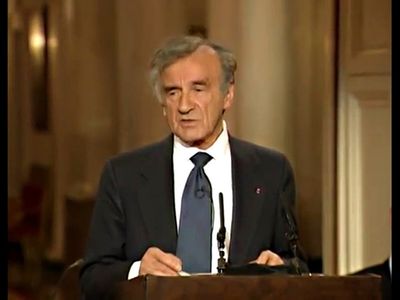
Mr. President, Mrs. Clinton, members of Congress, Ambassador Holbrooke, Excellencies, friends:
Fifty-four years ago to the day, a young Jewish boy from a small town in the Carpathian Mountains woke up, not far from Goethe's beloved Weimar, in a place of eternal infamy called Buchenwald. He was finally free, but there was no joy in his heart. He thought there never would be again.
Liberated a day earlier by American soldiers, he remembers their rage at what they saw. And even if he lives to be a very old man, he will always be grateful to them for that rage, and also for their compassion. Though he did not understand their language, their eyes told him what he needed to know -- that they, too, would remember, and bear witness.
And now, I stand before you, Mr. President -- Commander-in-Chief of the army that freed me, and tens of thousands of others -- and I am filled with a profound and abiding gratitude to the American people. "Gratitude" is a word that I cherish. Gratitude is what defines the humanity of the human being. And I am grateful to you, Hillary, or Mrs. Clinton, for what you said, and for what you are doing for children in the world, for the homeless, for the victims of injustice, the victims of destiny and society. And I thank all of you for being here.
We are on the threshold of a new century, a new millennium. What will the legacy of this vanishing century be? How will it be remembered in the new millennium? Surely it will be judged, and judged severely, in both moral and metaphysical terms. These failures have cast a dark shadow over humanity: two World Wars, countless civil wars, the senseless chain of assassinations (Gandhi, the Kennedys, Martin Luther King, Sadat, Rabin), bloodbaths in Cambodia and Algeria, India and Pakistan, Ireland and Rwanda, Eritrea and Ethiopia, Sarajevo and Kosovo.
The inhumanity in the gulag and the tragedy of Hiroshima. And, on a different level, of course, Auschwitz and Treblinka. So much violence; so much indifference.
What is indifference? Etymologically, the word means "no difference." A strange and unnatural state in which the lines blur between light and darkness, dusk and dawn, crime and punishment, cruelty and compassion, good and evil. What are its courses and inescapable consequences? Is it a philosophy? Is there a philosophy of indifference conceivable?
Can one possibly view indifference as a virtue? Is it necessary at times to practice it simply to keep one's sanity, live normally, enjoy a fine meal and a glass of wine, as the world around us experiences harrowing upheavals?
Of course, indifference can be tempting -- more than that, seductive. It is so much easier to look away from victims. It is so much easier to avoid such rude interruptions to our work, our dreams, our hopes. It is, after all, awkward, troublesome, to be involved in another person's pain and despair. Yet, for the person who is indifferent, his or her neighbor are of no consequence. And, therefore, their lives are meaningless. Their hidden or even visible anguish is of no interest. Indifference reduces the Other to an abstraction.
Over there, behind the black gates of Auschwitz, the most tragic of all prisoners were the "Muselmanner," as they were called. Wrapped in their torn blankets, they would sit or lie on the ground, staring vacantly into space, unaware of who or where they were -- strangers to their surroundings. They no longer felt pain, hunger, thirst. They feared nothing. They felt nothing. They were dead and did not know it.
Rooted in our tradition, some of us felt that to be abandoned by humanity then was not the ultimate. We felt that to be abandoned by God was worse than to be punished by Him. Better an unjust God than an indifferent one. For us to be ignored by God was a harsher punishment than to be a victim of His anger. Man can live far from God -- not outside God. God is wherever we are. Even in suffering? Even in suffering.
In a way, to be indifferent to that suffering is what makes the human being inhuman. Indifference, after all, is more dangerous than anger and hatred. Anger can at times be creative. One writes a great poem, a great symphony. One does something special for the sake of humanity because one is angry at the injustice that one witnesses. But indifference is never creative. Even hatred at times may elicit a response. You fight it. You denounce it. You disarm it.
Indifference elicits no response. Indifference is not a response. Indifference is not a beginning; it is an end. And, therefore, indifference is always the friend of the enemy, for it benefits the aggressor -- never his victim, whose pain is magnified when he or she feels forgotten. The political prisoner in his cell, the hungry children, the homeless refugees -- not to respond to their plight, not to relieve their solitude by offering them a spark of hope is to exile them from human memory. And in denying their humanity, we betray our own.
Indifference, then, is not only a sin, it is a punishment.
And this is one of the most important lessons of this outgoing century's wide-ranging experiments in good and evil.
In the place that I come from, society was composed of three simple categories: the killers, the victims, and the bystanders. During the darkest of times, inside the ghettos and death camps -- and I'm glad that Mrs. Clinton mentioned that we are now commemorating that event, that period, that we are now in the Days of Remembrance -- but then, we felt abandoned, forgotten. All of us did.
And our only miserable consolation was that we believed that Auschwitz and Treblinka were closely guarded secrets; that the leaders of the free world did not know what was going on behind those black gates and barbed wire; that they had no knowledge of the war against the Jews that Hitler's armies and their accomplices waged as part of the war against the Allies.
If they knew, we thought, surely those leaders would have moved heaven and earth to intervene. They would have spoken out with great outrage and conviction. They would have bombed the railways leading to Birkenau, just the railways, just once.
And now we knew, we learned, we discovered that the Pentagon knew, the State Department knew. And the illustrious occupant of the White House then, who was a great leader -- and I say it with some anguish and pain, because, today is exactly 54 years marking his death -- Franklin Delano Roosevelt died on April the 12th, 1945.
So he is very much present to me and to us. No doubt, he was a great leader. He mobilized the American people and the world, going into battle, bringing hundreds and thousands of valiant and brave soldiers in America to fight fascism, to fight dictatorship, to fight Hitler. And so many of the young people fell in battle.
And, nevertheless, his image in Jewish history -- I must say it -- his image in Jewish history is flawed. The depressing tale of the St. Louis is a case in point. Sixty years ago, its human cargo -- nearly 1,000 Jews -- was turned back to Nazi Germany.
And that happened after the Kristallnacht, after the first state-sponsored pogrom, with hundreds of Jewish shops destroyed, synagogues burned, thousands of people put in concentration camps. And that ship, which was already in the shores of the United States, was sent back. I don't understand. Roosevelt was a good man, with a heart. He understood those who needed help.
Why didn't he allow these refugees to disembark? A thousand people -- in America, the great country, the greatest democracy, the most generous of all new nations in modern history. What happened? I don't understand. Why the indifference, on the highest level, to the suffering of the victims?
But then, there were human beings who were sensitive to our tragedy. Those non-Jews, those Christians, that we call the "Righteous Gentiles," whose selfless acts of heroism saved the honor of their faith. Why were they so few?
Why was there a greater effort to save SS murderers after the war than to save their victims during the war? Why did some of America's largest corporations continue to do business with Hitler's Germany until 1942? It has been suggested, and it was documented, that the Wehrmacht could not have conducted its invasion of France without oil obtained from American sources. How is one to explain their indifference?
And yet, my friends, good things have also happened in this traumatic century: the defeat of Nazism, the collapse of communism, the rebirth of Israel on its ancestral soil, the demise of apartheid, Israel's peace treaty with Egypt, the peace accord in Ireland. And let us remember the meeting, filled with drama and emotion, between Rabin and Arafat that you, Mr. President, convened in this very place. I was here and I will never forget it.
And then, of course, the joint decision of the United States and NATO to intervene in Kosovo and save those victims, those refugees, those who were uprooted by a man, whom I believe that because of his crimes, should be charged with crimes against humanity.
But this time, the world was not silent. This time, we do respond. This time, we intervene.
Does it mean that we have learned from the past? Does it mean that society has changed? Has the human being become less indifferent and more human? Have we really learned from our experiences? Are we less insensitive to the plight of victims of ethnic cleansing and other forms of injustices in places near and far? Is today's justified intervention in Kosovo, led by you, Mr. President, a lasting warning that never again will the deportation, the terrorization of children and their parents, be allowed anywhere in the world? Will it discourage other dictators in other lands to do the same?
What about the children? Oh, we see them on television, we read about them in the papers, and we do so with a broken heart. Their fate is always the most tragic, inevitably. When adults wage war, children perish. We see their faces, their eyes. Do we hear their pleas? Do we feel their pain, their agony? Every minute one of them dies of disease, violence, famine.
Some of them -- so many of them -- could be saved.
And so, once again, I think of the young Jewish boy from the Carpathian Mountains. He has accompanied the old man I have become throughout these years of quest and struggle. And together we walk towards the new millennium, carried by profound fear and extraordinary hope.