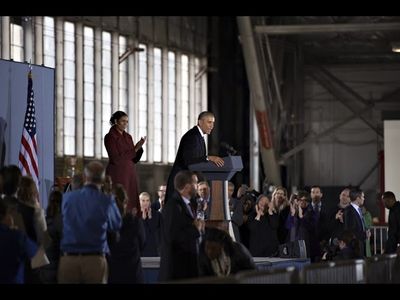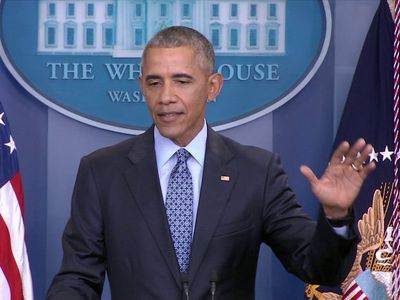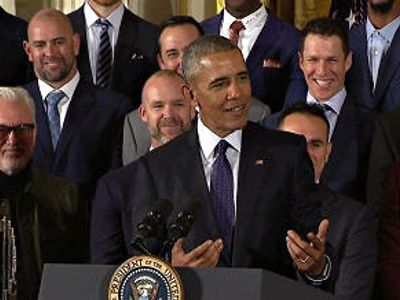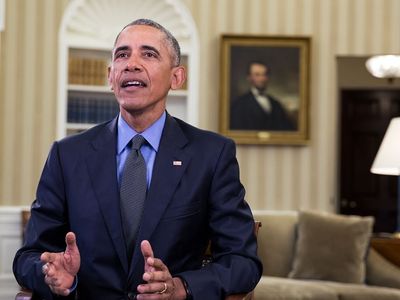
Thank you so much. To the co-chairs, Jeff and Ann; to all the members of Congress who are here, the distinguished guests who've traveled so far to be here this morning; to Randall for your wonderful stories and powerful prayer; to all who are here providing testimony, thank you so much for having me and Michelle here. We are blessed to be here.
I want to begin by just saying a word to Mark Kelly, who's here. We have been praying for Mark's wife, Gabby Giffords, for many days now. But I want Gabby and Mark and their entire family to know that we are with them for the long haul, and God is with them for the long haul.
And even as we pray for Gabby in the aftermath of a tragedy here at home, we're also mindful of the violence that we're now seeing in the Middle East, and we pray that the violence in Egypt will end and that the rights and aspirations of the Egyptian people will be realized and that a better day will dawn over Egypt and throughout the world.
For almost 60 years, going back to President Eisenhower, this gathering has been attended by our President. It's a tradition that I'm proud to uphold not only as a fellow believer but as an elected leader whose entry into public service was actually through the church. This may come as a surprise, for as some of you know, I did not come from a particularly religious family. My father, who I barely knew -- I only met once for a month in my entire life -- was said to be a non-believer throughout his life.
My mother, whose parents were Baptist and Methodist, grew up with a certain skepticism about organized religion, and she usually only took me to church on Easter and Christmas -- sometimes. And yet my mother was also one of the most spiritual people that I ever knew. She was somebody who was instinctively guided by the Golden Rule and who nagged me constantly about the homespun values of her Kansas upbringing, values like honesty and hard work and kindness and fair play.
And it's because of her that I came to understand the equal worth of all men and all women, and the imperatives of an ethical life and the necessity to act on your beliefs. And it's because of her example and guidance that despite the absence of a formal religious upbringing my earliest inspirations for a life of service ended up being the faith leaders of the Civil Rights Movement.
There was, of course, Martin Luther King and the Baptist leaders, the ways in which they helped those who had been subjugated to make a way out of no way, and transform a nation through the force of love. But there were also Catholic leaders like Father Theodore Heshburg, and Jewish leaders like Rabbi Abraham Joshua Heschel, Muslim leaders and Hindu leaders.
Their call to fix what was broken in our world, a call rooted in faith, is what led me just a few years out of college to sign up as a community organizer for a group of churches on the Southside of Chicago.
And it was through that experience working with pastors and laypeople trying to heal the wounds of hurting neighborhoods that I came to know Jesus Christ for myself and embrace Him as my lord and savior.
Now, that was over 20 years ago. And like all of us, my faith journey has had its twists and turns. It hasn't always been a straight line. I have thanked God for the joys of parenthood and Michelle's willingness to put up with me. In the wake of failures and disappointments I've questioned what God had in store for me and been reminded that God's plans for us may not always match our own short-sighted desires.
And let me tell you, these past two years, they have deepened my faith. The presidency has a funny way of making a person feel the need to pray. Abe Lincoln said, as many of you know, "I have been driven to my knees many times by the overwhelming conviction that I had no place else to go."
Fortunately, I'm not alone in my prayers. Pastor friends like Joel Hunter and T.D. Jakes come over to the Oval Office every once in a while to pray with me and pray for the nation. The chapel at Camp David has provided consistent respite and fellowship. The director of our Faith-based and Neighborhood Partnership's office, Joshua DuBois -- young minister himself -- he starts my morning off with meditations from Scripture.
Most of all, I've got friends around the country -- some who I know, some who I don't know, but I know their friends who are out there praying for me. One of them is an old friend named Kaye Wilson. In our family we call her Momma Kaye. And she happens to be Malia and Sasha's godmother. And she has organized prayer circles for me all around the country.
She started small with her own Bible study group, but once I started running for President and she heard what they were saying about me on cable, she felt the need to pray harder. By the time I was elected President, she says, "I just couldn't keep up on my own." "I was having to pray eight, nine times a day just for you." So she enlisted help from around the country.
It's also comforting to know that people are praying for you who don't always agree with you. Tom Coburn, for example, is here. He is not only a dear friend but also a brother in Christ. We came into the Senate at the same time. Even though we are on opposite sides of a whole bunch of issues, part of what has bound us together is a shared faith, a recognition that we pray to and serve the same God. And I keep praying that God will show him the light and he will vote with me once in a while. It's going to happen, Tom. A ray of light is going to beam down.
My Christian faith then has been a sustaining force for me over these last few years. All the more so, when Michelle and I hear our faith questioned from time to time, we are reminded that ultimately what matters is not what other people say about us but whether we're being true to our conscience and true to our God. "Seek first His kingdom and His righteousness and all these things will be given to you as well."
As I travel across the country folks often ask me what is it that I pray for. And like most of you, my prayers sometimes are general: Lord, give me the strength to meet the challenges of my office. Sometimes they're specific: Lord, give me patience as I watch Malia go to her first dance -- where there will be boys. Lord, have that skirt get longer as she travels to that dance.
But while I petition God for a whole range of things, there are a few common themes that do recur. The first category of prayer comes out of the urgency of the Old Testament prophets and the Gospel itself. I pray for my ability to help those who are struggling. Christian tradition teaches that one day the world will be turned right side up and everything will return as it should be. But until that day, we're called to work on behalf of a God that chose justice and mercy and compassion to the most vulnerable.
We've seen a lot of hardship these past two years. Not a day passes when I don't get a letter from somebody or meet someone who's out of work or lost their home or without health care. The story Randall told about his father -- that's a story that a whole lot of Americans have gone through over these past couple of years.
Sometimes I can't help right away. Sometimes what I can do to try to improve the economy or to curb foreclosures or to help deal with the health care system -- sometimes it seems so distant and so remote, so profoundly inadequate to the enormity of the need. And it is my faith, then, that biblical injunction to serve the least of these, that keeps me going and that keeps me from being overwhelmed.
It's faith that reminds me that despite being just one very imperfect man, I can still help whoever I can, however I can, wherever I can, for as long as I can, and that somehow God will buttress these efforts.
It also helps to know that none of us are alone in answering this call. It's being taken up each and every day by so many of you -- back home, your churches, your temples and synagogues, your fellow congregants -- so many faith groups across this great country of ours.
I came upon a group recently called "charity: water," a group that supports clean water projects overseas. This is a project that was started by a former nightclub promoter named Scott Harrison who grew weary of living only for himself and feeling like he wasn't following Christ as well as he should. And because of Scott's good work, "charity: water" has helped 1.7 million people get access to clean water. And in the next 10 years, he plans to make clean water accessible to a hundred million more.
That's the kind of promoting we need more of, and that's the kind of faith that moves mountains. And there's stories like that scattered across this room of people who've taken it upon themselves to make a difference.
Now, sometimes faith groups can do the work of caring for the least of these on their own; sometimes they need a partner, whether it's in business or government. And that's why my administration has taken a fresh look at the way we organize with faith groups, the way we work with faith groups through our Office of Faith-based and Neighborhood Partnerships.
And through that office, we're expanding the way faith groups can partner with our government. We're helping them feed more kids who otherwise would go hungry. We're helping fatherhood groups get dads the support they need to be there for their children. We're working with non-profits to improve the lives of people around the world. And we're doing it in ways that are aligned with our constitutional principles.
And in this work, we intend to expand it in the days ahead, rooted in the notions of partnership and justice and the imperatives to help the poor.
Of course there are some needs that require more resources than faith groups have at their disposal. There's only so much a church can do to help all the families in need -- all those who need help making a mortgage payment, or avoiding foreclosure, or making sure their child can go to college. There's only so much that a nonprofit can do to help a community rebuild in the wake of disaster. There's only so much the private sector will do to help folks who are desperately sick get the care that they need.
And that's why I continue to believe that in a caring and in a just society, government must have a role to play; that our values, our love and our charity must find expression not just in our families, not just in our places of work and our places of worship, but also in our government and in our politics.
Over the past two years, the nature of these obligations, the proper role of government has obviously been the subject of enormous controversy. And the debates have been fierce as one side's version of compassion and community may be interpreted by the other side as an oppressive and irresponsible expansion of the state or an unacceptable restriction on individual freedom.
That's why a second recurring theme in my prayers is a prayer for humility. Now, God answered this prayer for me early on by having me marry Michelle. Because whether it's reminding me of a chore undone, or questioning the wisdom of watching my third football game in a row on Sunday, she keeps me humble.
But in this life of politics when debates have become so bitterly polarized, and changes in the media lead so many of us just to listen to those who reinforce our existing biases, it's useful to go back to Scripture to remind ourselves that none of has all the answers -- none of us, no matter what our political party or our station in life.
The full breadth of human knowledge is like a grain of sand in God's hands. And there are some mysteries in this world we cannot fully comprehend. As it's written in Job, "God's voice thunders in marvelous ways. He does great things beyond our understandings."
The challenge I find then is to balance this uncertainty, this humility, with the need to fight for deeply held convictions, to be open to other points of view but firm in our core principles. And I pray for this wisdom every day.
I pray that God will show me and all of us the limits of our understanding, and open our ears and our hearts to our brothers and sisters with different points of view; that such reminders of our shared hopes and our shared dreams and our shared limitations as children of God will reveal the way forward that we can travel together.
And the last recurring theme, one that binds all prayers together, is that I might walk closer with God and make that walk my first and most important task.
In our own lives it's easy to be consumed by our daily worries and our daily concerns. And it is even easier at a time when everybody is busy, everybody is stressed, and everybody -- our culture is obsessed with wealth and power and celebrity. And often it takes a brush with hardship or tragedy to shake us out of that, to remind us of what matters most.
We see an aging parent wither under a long illness, or we lose a daughter or a husband in Afghanistan, we watch a gunman open fire in a supermarket -- and we remember how fleeting life can be. And we ask ourselves how have we treated others, whether we've told our family and friends how much we love them. And it's in these moments, when we feel most intensely our mortality and our own flaws and the sins of the world, that we most desperately seek to touch the face of God.
So my prayer this morning is that we might seek His face not only in those moments, but each and every day; that every day as we go through the hustle and bustle of our lives, whether it's in Washington or Hollywood or anywhere in between, that we might every so often rise above the here and now, and kneel before the Eternal; that we might remember, Kaye, the fact that those who wait on the Lord will soar on wings like eagles, and they will run and not be weary, and they will walk and not faint.
When I wake in the morning, I wait on the Lord, and I ask Him to give me the strength to do right by our country and its people. And when I go to bed at night I wait on the Lord, and I ask Him to forgive me my sins, and look after my family and the American people, and make me an instrument of His will.
I say these prayers hoping they will be answered, and I say these prayers knowing that I must work and must sacrifice and must serve to see them answered. But I also say these prayers knowing that the act of prayer itself is a source of strength. It's a reminder that our time on Earth is not just about us; that when we open ourselves to the possibility that God might have a larger purpose for our lives, there's a chance that somehow, in ways that we may never fully know, God will use us well.
May the Lord bless you and keep you, and may He bless this country that we love.