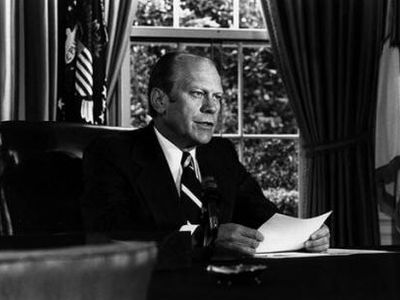
Ladies and gentlemen: I have come to a decision which I felt I should tell you and all of my fellow American citizens, as soon as I was certain in my own mind and in my own conscience that it is the right thing to do.
I have learned already in this office that the difficult decisions always come to this desk. I must admit that many of them do not look at all the same as the hypothetical questions that I have answered freely and perhaps too fast on previous occasions.
My customary policy is to try and get all the facts and to consider the opinions of my countrymen and to take counsel with my most valued friends. But these seldom agree, and in the end, the decision is mine. To procrastinate, to agonize, and to wait for a more favorable turn of events that may never come or more compelling external pressures that may as well be wrong as right, is itself a decision of sorts and a weak and potentially dangerous course for a President to follow.
I have promised to uphold the Constitution, to do what is right as God gives me to see the right, and to do the very best that I can for America. I have asked your help and your prayers, not only when I became President but many times since.
The Constitution is the supreme law of our land, and it governs our actions as citizens. Only the laws of God, which govern our consciences, are superior to it.
As we are a nation under God, so I am sworn to uphold our laws with the help of God. And I have sought such guidance and searched my own conscience with special diligence to determine the right thing for me to do with respect to my predecessor in this place, Richard Nixon, and his loyal wife and family. Theirs is an American tragedy in which we all -- all have played a part. It could go on and on and on, or someone must write the end to it. I have concluded that only I can do that, and if I can, I must.
There are no historic or legal precedents to which I can turn in this matter, none that precisely fit the circumstances of a private citizen who has resigned the Presidency of the United States. But it is common knowledge that serious allegations and accusations hang like a sword over our former President's head, threatening his health as he tries to reshape his life, a great part of which was spent in the service of this country and by the mandate of its people.
After years of bitter controversy and divisive national debate, I have been advised, and I am compelled to conclude that many months and perhaps more years will have to pass before Richard Nixon could obtain a fair trial by jury in any jurisdiction of the United States under governing decisions of the Supreme Court. I deeply believe in equal justice for all Americans, whatever their station or former station. The law, whether human or divine, is no respecter of persons; but the law is a respecter of reality.
The facts, as I see them, are that a former President of the United States, instead of enjoying equal treatment with any other citizen accused of violating the law, would be cruelly and excessively penalized either in preserving the presumption of his innocence or in obtaining a speedy determination of his guilt in order to repay a legal debt to society.
During this long period of delay and potential litigation, ugly passions would again be aroused. And our people would again be polarized in their opinions. And the credibility of our free institutions of government would again be challenged at home and abroad.
In the end, the courts might well hold that Richard Nixon had been denied due process, and the verdict of history would even more be inconclusive with respect to those charges arising out of the period of his Presidency, of which I am presently aware.
But it is not the ultimate fate of Richard Nixon that most concerns me, though surely it deeply troubles every decent and every compassionate person. My concern is the immediate future of this great country. In this, I dare not depend upon my personal sympathy as a long-time friend of the former President, nor my professional judgment as a lawyer, and I do not.
As President, my primary concern must always be the greatest good of all the people of the United States whose servant I am. As a man, my first consideration is to be true to my own convictions and my own conscience. My conscience tells me clearly and certainly that I cannot prolong the bad dreams that continue to reopen a chapter that is closed. My conscience tells me that only I, as President, have the constitutional power to firmly shut and seal this book. My conscience tells me it is my duty, not merely to proclaim domestic tranquility but to use every means that I have to insure it.
I do believe that the buck stops here, that I cannot rely upon public opinion polls to tell me what is right.
I do believe that right makes might and that if I am wrong, 10 angels swearing I was right would make no difference.
I do believe, with all my heart and mind and spirit, that I, not as President but as a humble servant of God, will receive justice without mercy if I fail to show mercy.
Finally, I feel that Richard Nixon and his loved ones have suffered enough and will continue to suffer, no matter what I do, no matter what we, as a great and good nation, can do together to make his goal of peace come true.
Now, therefore, I, Gerald R. Ford, President of the United States, pursuant to the pardon power conferred upon me by Article II, Section 2, of the Constitution, have granted and by these presents do grant a full, free, and absolute pardon unto Richard Nixon for all offenses against the United States which he, Richard Nixon, has committed or may have committed or taken part in during the period from July 20, 1969 through August 9, 1974.
In witness whereof, I have hereunto set my hand this eighth day of September, in the year of our Lord nineteen hundred and seventy-four, and of the Independence of the United States of America the one hundred and ninety-ninth.