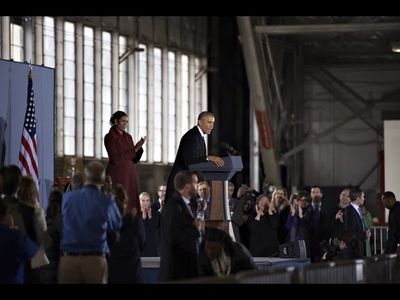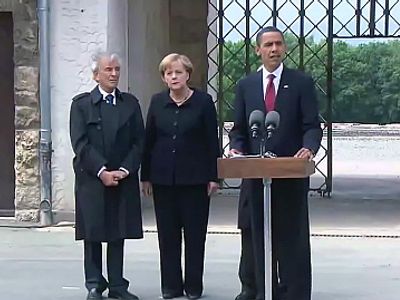
Chancellor Merkel and I have just finished our tour here at Buchenwald. I want to thank Dr. Volkhard Knigge, who gave an outstanding account of what we were witnessing. I am particularly grateful to be accompanied by my friend Elie Wiesel, as well as Mr. Bertrand Herz, both of whom are survivors of this place. 默克尔总理和我刚刚结束了在布痕瓦尔德的参观。我要感谢沃尔克哈德·尼格博士,他对我们所见之物的讲解非常出色。我特别感激我的朋友埃利·维塞尔以及贝特朗·赫尔茨先生陪同我前来,他们都是这个地方的幸存者。
We saw the area known as Little Camp where Elie and Bertrand were sent as boys. In fact, at the place that commemorates this camp, there is a photograph in which we can see a 16-year-old Elie in one of the bunks along with the others. We saw the ovens of the crematorium, the guard towers, the barbed wire fences, the foundations of barracks that once held people in the most unimaginable conditions. 我们看到了被称为"小营地"的区域,那是埃利和贝特朗年少时被送往的地方。事实上,在纪念这个营地的场所,有一张照片,我们可以看到16岁的埃利和其他人一起在其中一个铺位上。我们看到了焚尸炉、岗楼、带刺铁丝网围栏,以及曾经关押着处于最难以想象条件下的人们的营房地基。
We saw the memorial to all the survivors -- a steel plate, as Chancellor Merkel said, that is heated to 37 degrees Celsius, the temperature of the human body; a reminder -- where people were deemed inhuman because of their differences -- of the mark that we all share. 我们看到了纪念所有幸存者的纪念碑——正如默克尔总理所说,这是一块加热到37摄氏度(人体温度)的钢板;这是一个提醒——在那些因差异而被视为非人的人们身上——我们都共有这一印记。
Now these sights have not lost their horror with the passage of time. As we were walking up, Elie said, "if these trees could talk." And there's a certain irony about the beauty of the landscape and the horror that took place here. 如今,这些景象并没有随着时间的流逝而失去其恐怖感。当我们走上时,埃利说:"如果这些树能说话。"这片风景的美丽与这里发生的恐怖之间存在某种讽刺。
More than half a century later, our grief and our outrage over what happened have not diminished. I will not forget what I've seen here today. 半个多世纪后,我们对所发生之事的悲痛和愤怒并没有减弱。我不会忘记今天在这里看到的一切。
I've known about this place since I was a boy, hearing stories about my great uncle, who was a very young man serving in World War II. He was part of the 89th Infantry Division, the first Americans to reach a concentration camp. They liberated Ohrdruf, one of Buchenwald's sub-camps. 我从小就听说过这个地方,听到关于我叔祖父的故事,他在二战期间服役时还很年轻。他是第89步兵师的一员,这是第一批到达集中营的美军部队。他们解放了奥赫德鲁夫,布痕瓦尔德的一个分营。
And I told this story, he returned from his service in a state of shock saying little and isolating himself for months on end from family and friends, alone with the painful memories that would not leave his head. And as we see -- as we saw some of the images here, it's understandable that someone who witnessed what had taken place here would be in a state of shock. 我讲过这个故事,他从服役归来时处于震惊状态,很少说话,几个月来一直与家人和朋友隔绝,独自面对那些不愿离开脑海的痛苦记忆。正如我们看到的——当我们看到这里的一些影像时,可以理解的是,目睹了这里发生之事的人会处于震惊状态。
My great uncle's commander, General Eisenhower, understood this impulse to silence. He had seen the piles of bodies and starving survivors and deplorable conditions that the American soldiers found when they arrived, and he knew that those who witnessed these things might be too stunned to speak about them or be able -- be unable to find the words to describe them; that they might be rendered mute in the way my great uncle had. 我叔祖父的指挥官艾森豪威尔将军理解这种沉默的冲动。他看到了美军到达时发现的成堆尸体、饥饿的幸存者以及令人震惊的状况,他知道那些目睹这些景象的人可能太震惊而无法谈论它们,或者无法——无法找到言语来描述它们;他们可能会像我叔祖父那样变得哑口无言。
And he knew that what had happened here was so unthinkable that after the bodies had been taken away, that perhaps no one would believe it. That's why he ordered American troops and Germans from the nearby town to tour the camp. He invited congressmen and journalists to bear witness and ordered photographs and films to be made. 他知道这里发生的事情是如此难以置信,以至于尸体被运走后,或许没人会相信。这就是为什么他命令美军和附近城镇的德国人参观营地。他邀请国会议员和记者来见证,并下令拍摄照片和电影。
And he insisted on viewing every corner of these camps so that -- and I quote -- he could "be in a position to give first-hand evidence of these things if ever in the future there develops a tendency to charge these allegations merely to propaganda." 他坚持视察这些营地的每个角落,这样——我引用他的话——他能够"处于能够提供这些事情的第一手证据的位置,如果未来出现将这些指控仅仅归因于宣传的倾向。"
We are here today because we know this work is not yet finished. To this day, there are those who insist that the Holocaust never happened -- a denial of fact and truth that is baseless and ignorant and hateful. This place is the ultimate rebuke to such thoughts; a reminder of our duty to confront those who would tell lies about our history. 我们今天在这里,因为我们知道这项工作尚未完成。直到今天,仍有人坚持认为大屠杀从未发生过——这是一种毫无根据、无知和充满仇恨的对事实和真理的否认。这个地方是对这种想法的最终驳斥;提醒我们有责任对抗那些编造历史谎言的人。
Also to this day, there are those who perpetuate every form of intolerance -- racism, anti-Semitism, homophobia, xenophobia, sexism, and more -- hatred that degrades its victims and diminishes us all. In this century, we've seen genocide. We've seen mass graves and the ashes of villages burned to the ground; children used as soldiers and rape used as a weapon of war. 直到今天,仍有人在延续各种形式的不宽容——种族主义、反犹太主义、恐同、仇外心理、性别歧视等等——这些仇恨贬低了受害者,也贬低了我们要所有人。在这个世纪,我们目睹了种族灭绝。我们看到了乱葬岗和被烧毁村庄的灰烬;儿童被用作士兵,强奸被用作战争武器。
This places teaches us that we must be ever vigilant about the spread of evil in our own time, that we must reject the false comfort that others' suffering is not our problem and commit ourselves to resisting those who would subjugate others to serve their own interests. 这个地方教导我们,我们必须时刻警惕我们自己时代邪恶的蔓延,我们必须拒绝那种认为他人痛苦与我们无关的错误安慰,并致力于抵制那些试图奴役他人以服务于自身利益的人。
But as we reflect today on the human capacity for evil and our shared obligation to defy it, we're also reminded of the human capacity for good. For amidst the countless acts of cruelty that took place here, we know that there were many acts of courage and kindness, as well. 但是,当我们今天反思人类作恶的能力以及我们共同抵制它的义务时,我们也被提醒人类行善的能力。因为在这里发生的无数残酷行为中,我们知道也有许多勇气和善意的举动。
The Jews who insisted on fasting on Yom Kippur. The camp cook who hid potatoes in the lining of his prison uniform and distributed them to his fellow inmates, risking his own life to help save theirs. The prisoners who organized a special effort to protect the children here, sheltering them from work and giving them extra food. 那些坚持在赎罪日禁食的犹太人。那个营地厨师,将土豆藏在他的囚服衬里中,分发给他的狱友,冒着生命危险帮助拯救他们。那些组织特别努力保护这里儿童的囚犯,让他们免于劳动并给他们额外的食物。
They set up secret classrooms, some of the inmates, and taught history and math and urged the children to think about their future professions. And we were just hearing about the resistance that formed and the irony that the base for the resistance was in the latrine areas because the guards found it so offensive that they wouldn't go there. 他们建立了秘密教室,一些囚犯在那里教授历史和数学,鼓励孩子们思考他们未来的职业。我们刚刚听到形成的抵抗运动,以及抵抗运动基地位于厕所区域的讽刺,因为卫兵觉得那里太令人厌恶而不愿去那里。
And so out of the filth, that became a space in which small freedoms could thrive. When the American GIs arrived they were astonished to find more than 900 children still alive, and the youngest was just three years old. And I'm told that a couple of the prisoners even wrote a Buchenwald song that many here sang. 因此,从污秽中,这成为了一个可以让小自由繁荣的空间。当美军到达时,他们惊讶地发现仍有900多名儿童活着,最小的只有三岁。我被告知,一些囚犯甚至创作了一首布痕瓦尔德歌曲,许多人在这里唱过。
Among the lyrics were these: "...whatever our fate, we will say yes to life, for the day will come when we are free...in our blood we carry the will to live and in our hearts, in our hearts -- faith." 歌词中有这样一些:"……无论我们的命运如何,我们都要对生命说是,因为自由的一天终将来临……在我们的血液中,我们承载着生存的意志,在我们的心中,在我们的心中——信念。"
These individuals never could have known the world would one day speak of this place. They could not have known that some of them would live to have children and grandchildren who would grow up hearing their stories and would return here so many years later to find a museum and memorials and the clock tower set permanently to 3:15, the moment of liberation. 这些人永远不可能知道世界有一天会谈论这个地方。他们不可能知道他们中的一些人会活着拥有孩子和孙辈,这些孩子会听着他们的故事长大,并在多年后回到这里,找到一个博物馆和纪念馆,以及永久设定在3:15——解放时刻的钟楼。
They could not have known how the nation of Israel would rise out of the destruction of the Holocaust and the strong, enduring bonds between that great nation and my own. And they could not have known that one day an American President would visit this place and speak of them and that he would do so standing side by side with the German Chancellor in a Germany that is now a vibrant democracy and a valued American ally. 他们不可能知道以色列国会如何从大屠杀的毁灭中崛起,以及那个伟大国家与我国之间牢固而持久的纽带。他们不可能知道有一天一位美国总统会访问这个地方并谈论他们,并且会与德国总理并肩站立在一个如今是充满活力的民主国家和美国宝贵盟友的德国。
They could not have known these things. But still surrounded by death they willed themselves to hold fast to life. In their hearts they still had faith that evil would not triumph in the end, that while history is unknowable it arches towards progress, and that the world would one day remember them. 他们不可能知道这些事情。但是,尽管被死亡包围,他们仍意志坚定地把握生命。在他们心中,他们仍然相信邪恶最终不会胜利,虽然历史不可知,但它趋向进步,世界有一天会记住他们。
And it is now up to us, the living, in our work, wherever we are, to resist injustice and intolerance and indifference in whatever forms they may take, and ensure that those who were lost here did not go in vain. It is up to us to redeem that faith. It is up to us to bear witness; to ensure that the world continues to note what happened here; to remember all those who survived and all those who perished, and to remember them not just as victims, but also as individuals who hoped and loved and dreamed just like us. 现在轮到我们要——活着的人,在我们的工作中,无论我们在哪里,抵制不公正、不宽容和冷漠,无论它们以何种形式出现,并确保那些在这里失去生命的人没有白白牺牲。轮到我们来兑现那份信念。轮到我们要作见证;确保世界继续关注这里发生的事情;记住所有幸存者和所有遇难者,不仅要记住他们是受害者,还要记住他们是像我们一样怀揣希望、热爱生活、梦想未来的个体。
And just as we identify with the victims, it's also important for us I think to remember that the perpetrators of such evil were human, as well, and that we have to guard against cruelty in ourselves. And I want to express particular thanks to Chancellor Merkel and the German people, because it's not easy to look into the past in this way and acknowledge it and make something of it, make a determination that they will stand guard against acts like this happening again. 正如我们要认同受害者一样,我认为同样重要的是要记住,这种邪恶的施暴者也是人,我们必须警惕自己内心的残忍。我要特别感谢默克尔总理和德国人民,因为以这种方式正视过去并承认它、从中吸取教训并非易事,他们决心防范此类行为再次发生。
Rather than have me end with my remarks I thought it was appropriate to have Elie Wiesel provide some reflection and some thought as he returns here so many years later to the place where his father died. 与其让我以我的讲话结束,我认为让埃利·维塞尔提供一些反思和想法是合适的,因为他多年后回到这里,回到他父亲去世的地方。