Please be seated. Let me begin by saying a word to Dr. Dorothy Height’s sister, Ms. Aldridge. To some, she was a mentor. To all, she was a friend. But to you, she was family, and my family offers yours our sympathy for your loss.
We are gathered here today to celebrate the life, and mourn the passing, of Dr. Dorothy Height. It is fitting that we do so here, in our National Cathedral of Saint Peter and Saint Paul. Here, in a place of great honor. Here, in the House of God. Surrounded by the love of family and of friends. The love in this sanctuary is a testament to a life lived righteously; a life that lifted other lives; a life that changed this country for the better over the course of nearly one century here on Earth.
Michelle and I didn’t know Dr. Height as well, or as long, as many of you. We were reminded during a previous moment in the service, when you have a nephew who’s 88 -- you’ve lived a full life.
But we did come to know her in the early days of my campaign. And we came to love her, as so many loved her. We came to love her stories. And we loved her smile. And we loved those hats -- that she wore like a crown -- regal. In the White House, she was a regular. She came by not once, not twice -- 21 times she stopped by the White House. Took part in our discussions around health care reform in her final months.
Last February, I was scheduled to see her and other civil rights leaders to discuss the pressing problems of unemployment -- Reverend Sharpton, Ben Jealous of the NAACP, Marc Morial of the National Urban League. Then we discovered that Washington was about to be blanketed by the worst blizzard in record -- two feet of snow.
So I suggested to one of my aides, we should call Dr. Height and say we're happy to reschedule the meeting. Certainly if the others come, she should not feel obliged. True to form, Dr. Height insisted on coming, despite the blizzard, never mind that she was in a wheelchair. She was not about to let just a bunch of men -- in this meeting. It was only when the car literally could not get to her driveway that she reluctantly decided to stay home. But she still sent a message -- about what needed to be done.
And I tell that story partly because it brings a smile to my face, but also because it captures the quiet, dogged, dignified persistence that all of us who loved Dr. Height came to know so well -- an attribute that we understand she learned early on.
Born in the capital of the old Confederacy, brought north by her parents as part of that great migration, Dr. Height was raised in another age, in a different America, beyond the experience of many. It’s hard to imagine, I think, life in the first decades of that last century when the elderly woman that we knew was only a girl.
Jim Crow ruled the South. The Klan was on the rise -- a powerful political force. Lynching was all too often the penalty for the offense of black skin. Slaves had been freed within living memory, but too often, their children, their grandchildren remained captive, because they were denied justice and denied equality, denied opportunity, denied a chance to pursue their dreams.
The progress that followed -- progress that so many of you helped to achieve, progress that ultimately made it possible for Michelle and me to be here as President and First Lady -- that progress came slowly.
Progress came from the collective effort of multiple generations of Americans. From preachers and lawyers, and thinkers and doers, men and women like Dr. Height, who took it upon themselves -- often at great risk -- to change this country for the better.
From men like W.E.B Du Bois and A. Philip Randolph; women like Mary McLeod Bethune and Betty Friedan -- they’re Americans whose names we know. They are leaders whose legacies we teach. They are giants who fill our history books. Well, Dr. Dorothy Height deserves a place in this pantheon. She, too, deserves a place in our history books. She, too, deserves a place of honor in America’s memory.
Look at her body of work. Desegregating the YWCA. Laying the groundwork for integration on Wednesdays in Mississippi. Lending pigs to poor farmers as a sustainable source of income. Strategizing with civil rights leaders, holding her own, the only woman in the room, Queen Esther to this Moses Generation -- even as she led the National Council of Negro Women with vision and energy -- with vision and energy, vision and class.
But we remember her not solely for all she did during the civil rights movement. We remember her for all she did over a lifetime, behind the scenes, to broaden the movement’s reach. To shine a light on stable families and tight-knit communities. To make us see the drive for civil rights and women’s rights not as a separate struggle, but as part of a larger movement to secure the rights of all humanity, regardless of gender, regardless of race, regardless of ethnicity.
It’s an unambiguous record of righteous work, worthy of remembrance, worthy of recognition. And yet, one of the ironies is, is that year after year, decade in, decade out, Dr. Height went about her work quietly, without fanfare, without self-promotion. She never cared about who got the credit. She didn’t need to see her picture in the papers.
She understood that the movement gathered strength from the bottom up, those unheralded men and women who don't always make it into the history books but who steadily insisted on their dignity, on their manhood and womanhood. She wasn’t interested in credit. What she cared about was the cause. The cause of justice. The cause of equality. The cause of opportunity. Freedom’s cause.
And that willingness to subsume herself, that humility and that grace, is why we honor Dr. Dorothy Height. As it is written in the Gospel of Matthew: “For whoever exalts himself will be humbled, and whoever humbles himself will be exalted.” I don’t think the author of the Gospel would mind me rephrasing: “whoever humbles herself will be exalted.”
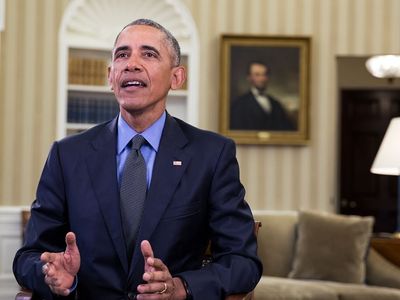
One of my favorite moments with Dr. Height -- this was just a few months ago -- we had decided to put up the Emancipation Proclamation in the Oval Office, and we invited some elders to share reflections of the movement. And she came and it was a inter-generational event, so we had young children there, as well as elders, and the elders were asked to share stories.
And she talked about attending a dinner in the 1940s at the home of Dr. Benjamin Mays, then president of Morehouse College. And seated at the table that evening was a 15-year-old student, “a gifted child,” as she described him, filled with a sense of purpose, who was trying to decide whether to enter medicine, or law, or the ministry.
And many years later, after that gifted child had become a gifted preacher -- I’m sure he had been told to be on his best behavior -- after he led a bus boycott in Montgomery, and inspired a nation with his dreams, he delivered a sermon on what he called “the drum major instinct” -- a sermon that said we all have the desire to be first, we all want to be at the front of the line.
The great test of a life, Dr. Martin Luther King Jr. said, is to harness that instinct; to redirect it towards advancing the greater good; toward changing a community and a country for the better; toward doing the Lord’s work.
I sometimes think Dr. King must have had Dorothy Height in mind when he gave that speech. For Dorothy Height met the test. Dorothy Height embodied that instinct. Dorothy Height was a drum major for justice. A drum major for equality. A drum major for freedom. A drum major for service.
And the lesson she would want us to leave with today -- a lesson she lived out each and every day -- is that we can all be first in service. We can all be drum majors for a righteous cause.
So let us live out that lesson. Let us honor her life by changing this country for the better as long as we are blessed to live.
May God bless Dr. Dorothy Height and the union that she made more perfect.