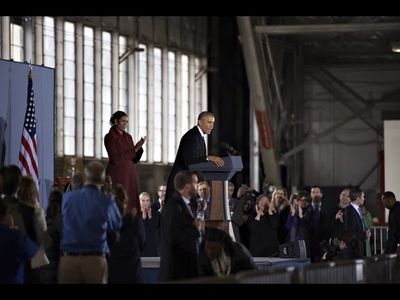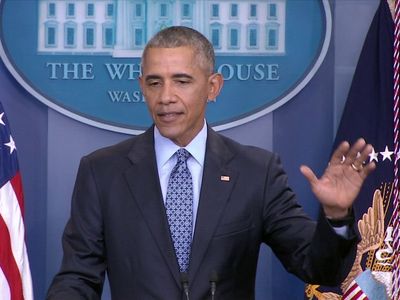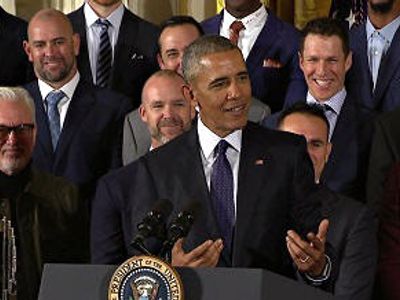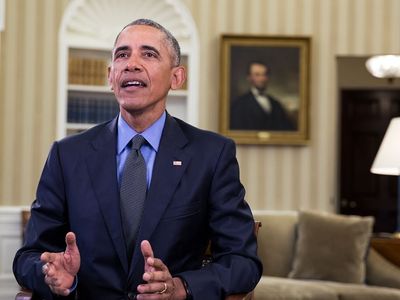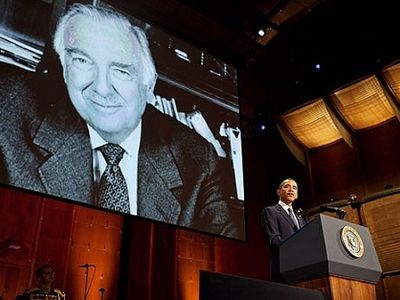
To Chip, Kathy, and Nancy, who graciously shared your father with a nation that loved him; to Walter's friends, colleagues, protégés, and all who considered him a hero; to the men of the Intrepid; to all of you who are gathered here today; I am honored to be here to pay tribute to the life and times of the man who chronicled our time.
I did not know Mr. Cronkite personally. And my regret is made more acute by the stories that have been shared here today. Nor, for that matter, did I know him any better than the tens of millions who turned to him each night in search of the answer to a simple question: "What happened today?" But like them and like all of you, I have benefited as a citizen from his dogged pursuit of the truth, his passionate defense of objective reporting, and his view that journalism is more than just a profession; it is a public good vital to our democracy.
Even in his early career, Walter Cronkite resisted the temptation to get the story first in favor of getting it right. He wanted to get it first, but he understood the importance of getting it right. During one of his first jobs in Kansas City, Walter's program manager urged him to go on the air reporting a massive blaze -- and we just heard how much he loved fires -- a massive blaze at city hall that had already claimed lives.
When Walter reached for the telephone, his boss asked, "What are you doing; get on the air!" Walter replied that he was calling the fire department to confirm the story. "You don't need to confirm it," the manager shouted, "my wife is watching the whole thing!"
Needless to say, Walter made the call, and even as the program manager took to the air himself to broadcast the unfolding tragedy, Walter discovered that it had been nothing more than a small fire that hadn't resulted in any injuries. He lost his job -- but he got the story right.
Walter wasn't afraid to rattle the high and the mighty, either; but he never dared to compromise his integrity. He got along with elected officials, even if they were wary of one another's motives. One politician once remarked, "Walter, my friend, you've got to believe me, fully 85 percent of everything I told you today is the absolute truth."
He shared a complicated relationship with Presidents of both parties, who wanted him on their side even as they were convinced that he wasn't. President Johnson called Walter after the evening news from time to time to voice his displeasure over a certain story. But Walter knew that if he was receiving vociferous complaints from both sides, he must be doing his job.
His endless inquisitiveness about our world, I can imagine, came from a mother who sold encyclopedias for a living. As a boy, Walter spent countless hours getting lost within their pages, endlessly sidetracked by new and interesting entries that branched off from one another, fascinated by the world around us and how it worked.
And that's the way he lived his life -- with curiosity, exploring our planet, seeking to make sense of it and explaining it to others. He went everywhere and he did everything. He raced cars and boats; he traveled everywhere from the Amazon to the Arctic; he plunged 8,000 feet below the sea, trekked 18,000 feet up into the Himalayas, and experienced weightlessness in the upper reaches of our atmosphere -- all with one mission: to make it come alive for the rest of us.
And as our world began to change, he helped us understand those changes. He was forever there, reporting through world war and cold war; marches and milestones; scandal and success; calmly and authoritatively telling us what we needed to know. He was a voice of certainty in a world that was growing more and more uncertain. And through it all, he never lost the integrity or the plainspoken speaking style that he gained growing up in the heartland. He was a familiar and welcome voice that spoke to each and every one of us personally.
So it may have seemed inevitable that he was named the most trusted man in America. But here's the thing: That title wasn't bestowed on him by a network. We weren't told to believe it by some advertising campaign. It was earned. It was earned by year after year and decade after decade of painstaking effort; a commitment to fundamental values; his belief that the American people were hungry for the truth, unvarnished and unaccompanied by theatre or spectacle. He didn't believe in dumbing down. He trusted us.
When he was told of this extraordinary honor that he was the most trusted man in America, he naturally downplayed it by saying the people had not polled his wife. When people of both political parties actually tried to recruit him to run for office, without even asking for his stances on the issues, he said no -- to the relief of all potential opponents. And when, even a decade and a half after his retirement, he still ranked first in seven of eight categories for television journalists, he was disbelieving that he hadn't won the eighth category, "attractiveness."
Through all the events that came to define the 20th century, through all our moments of deepest hurt and brightest hope, Walter Cronkite was there, telling the story of the American age.
And this is how we remember him today. But we also remember and celebrate the journalism that Walter practiced -- a standard of honesty and integrity and responsibility to which so many of you have committed your careers. It's a standard that's a little bit harder to find today. We know that this is a difficult time for journalism. Even as appetites for news and information grow, newsrooms are closing. Despite the big stories of our era, serious journalists find themselves all too often without a beat. Just as the news cycle has shrunk, so has the bottom line.
And too often, we fill that void with instant commentary and celebrity gossip and the softer stories that Walter disdained, rather than the hard news and investigative journalism he championed. "What happened today?" is replaced with "Who won today?" The public debate cheapens. The public trust falters.
We fail to understand our world or one another as well as we should -- and that has real consequences in our own lives and in the life of our nation. We seem stuck with a choice between what cuts to our bottom line and what harms us as a society. Which price is higher to pay? Which cost is harder to bear?
"This democracy," Walter said, "cannot function without a reasonably well-informed electorate." That's why the honest, objective, meticulous reporting that so many of you pursue with the same zeal that Walter did is so vital to our democracy and our society: Our future depends on it.
Walter was no naive idealist. He understood the challenges and the pressures and the temptations facing journalism in this new era. He believed that a media company has an obligation to pursue a profit, but also an obligation to invest a good chunk of that profit back into news and public affairs. He was excited about all the stories that a high-tech world of journalism would be able to tell, and all the newly-emerging means with which to tell it.
Naturally, we find ourselves wondering how he would have covered the monumental stories of our time. In an era where the news that city hall is on fire can sweep around the world at the speed of the Internet, would he still have called to double-check? Would he have been able to cut through the murky noise of the blogs and the tweets and the sound bites to shine the bright light on substance? Would he still offer the perspective that we value? Would he have been able to remain a singular figure in an age of dwindling attention spans and omnipresent media?
And somehow, we know that the answer is yes. The simple values Walter Cronkite set out in pursuit of -- to seek the truth, to keep us honest, to explore our world the best he could -- they are as vital today as they ever were.
Our American story continues. It needs to be told. And if we choose to live up to Walter's example, if we realize that the kind of journalism he embodied will not simply rekindle itself as part of a natural cycle, but will come alive only if we stand up and demand it and resolve to value it once again, then I'm convinced that the choice between profit and progress is a false one -- and that the golden days of journalism still lie ahead.
Walter Cronkite invited a nation to believe in him -- and he never betrayed that trust. That's why so many of you entered the profession in the first place. That's why the standards he set for journalists still stand. And that's why he loved and valued all of you, but we loved and valued Walter not only as the rarest of men, but as an indispensable pillar of our society.
He's reunited with his beloved Betsy now, watching the stories of this century unfold with boundless optimism -- every so often punctuating the air with a gleeful "oh, boy!" We are grateful to him for altering and illuminating our time, and for the opportunity he gave to us to say that, yes, we, too, were there.
Thank you very much.