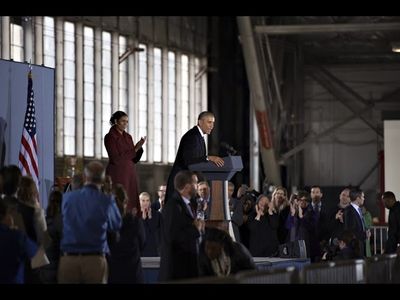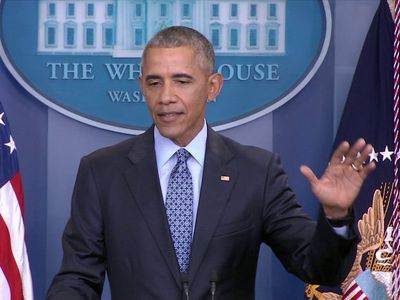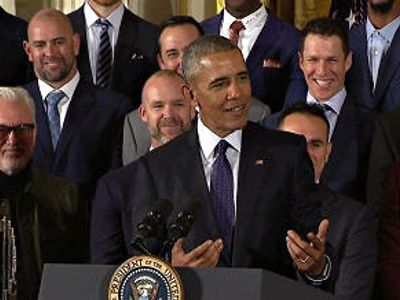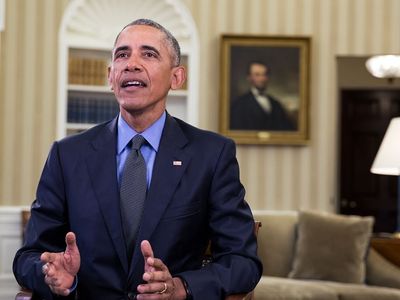
Well, to Secretary Burwell, to Francis Collins, Tony Fauci, your teams, to all of you, thanks so much for welcoming me here today. It is wonderful to be back to America’s laboratory, even if I don’t always understand what you’re doing. 伯韦尔部长、弗朗西斯·柯林斯、托尼·福奇、各位团队成员,感谢大家今天欢迎我。很高兴回到美国的实验室,尽管我并不总能听懂大家在做什么。
Last year, I welcomed Francis and some of you to the White House to launch our BRAIN Initiative to unlock the mysteries of the mind and to pursue new cures for disease. And Francis promoted me at the time to "scientist in chief." Which made me very proud, although I sort of felt guilty that I hadn’t studied more chemistry. 去年,我欢迎弗朗西斯和一些同事到白宫,启动“脑计划”,探索大脑奥秘并寻找新的疾病疗法。当时弗朗西斯还把我提升为“首席科学家”,这让我非常自豪,虽然也有些惭愧,因为我没有多学一点化学。
But the work you do here is remarkable, and I just got a fascinating tour of your vaccine research center. I have to say, I was very impressed with how you can clone a virus gene into a vaccine vector, then subject it to gel electrophoresis. And then pipet the samples into a 96-well microplate. Run it through the world’s most advanced multiparameter flow cytometer. I mean, it was impressive. I’ve been tinkering around the White House, setting up a similar system. We use it for brewing beer. But it works well for your work also. 你们在这里开展的工作非常了不起。我刚刚参观了疫苗研究中心,看到你们如何把病毒基因克隆进疫苗载体,再进行凝胶电泳,把样本移入96孔微孔板,最后用世界最先进的多参数流式细胞仪检测。这令人印象深刻。我也一直在白宫摆弄类似系统,用它来酿啤酒,不过它同样适合你们的研究。
Now, the last time I was here at NIH, early in my presidency, I came to announce a historic boost in funding for biomedical research. Because part of American leadership in the world -- one of the things that has always marked us as exceptional -- is our leadership in science and our leadership in research. And here at NIH, you have always been at the forefront of groundbreaking innovations. You’ve helped pioneer new treatments for everything from cancer to heart disease to HIV/AIDS. 我担任总统早期上次来到国立卫生研究院时,宣布大幅增加生物医学研究经费。美国在世界上的领导力、科学和研究领域的领导力,一直是美国卓越的重要标志。在这里,你们始终站在突破性创新的前沿,帮助开创了从癌症、心脏病到艾滋病的一系列新疗法。
And as a consequence, you’ve helped not just Americans but people around the world live longer, fuller lives. You’ve saved countless lives in every corner of the globe. And so to Francis and Tony, and all your directors and staff, and the researchers that you fund across the country and around the globe, you deserve great thanks for your leadership, and your service, and your patriotism, and your lifesaving work. 因此,你们不仅帮助美国人,也帮助世界各地的人活得更长、更充实;你们在全球每个角落挽救了无数生命。弗朗西斯、托尼、各位主任、工作人员,以及你们资助的国内外研究人员,你们的领导、服务、爱国精神和拯救生命的工作值得衷心感谢。
And that brings me back to today. This past summer, as Ebola spread in West Africa, I told my team that fighting this disease had to be a national security priority, and a priority across agencies and across our government. I realize that here in the United States, some of the attention has shifted away recently -- that’s sort of how our attention spans work sometimes. Ebola is not leading the news right now. But I wanted to come here because, every day, we’re focused on keeping the American people safe. Every day, the NIH is at the forefront of this mission. 这也让我回到今天的话题。今年夏天埃博拉在西非传播时,我告诉团队,抗击这种疾病必须成为国家安全优先事项,必须成为各部门和整个政府的优先事项。我知道,美国国内最近对它的关注有所转移,但我今天来到这里,是因为我们每天都在努力保护美国人民,而国立卫生研究院每天都处于这项使命的前沿。
NIH personnel have volunteered and deployed to West Africa. Some have served in medical labs, testing for Ebola. Some of your clinicians -- members of the U.S. Public Health Service -- have deployed to care for health care workers who got infected in the line of duty. 国立卫生研究院人员自愿前往西非。有些人在医疗实验室检测埃博拉;一些临床医生、美国公共卫生服务成员,前往照料在工作中感染的医护人员。
When Nina Pham, one of the two Dallas nurses who were infected, needed treatment, Tony and his team stepped up and you were ready. You manned shifts around the clock, day and night. You remembered your training. You displayed great skill and professionalism. You reminded the world that it is possible to treat Ebola patients effectively and safely without endangering yourselves or others. 当两名被感染的达拉斯护士之一尼娜·潘需要治疗时,托尼和团队立即行动,你们已经准备就绪。你们日夜轮班,记得训练内容,展现出高超技能和专业精神,向世界证明无需危及自己或他人,也可以安全有效地治疗埃博拉患者。
And all that has made an enormous difference. Like a lot of Americans, I know you fell in love with Nina-- she was so sweet and big smile, her optimism, her sense of service, and reminded us -- she reminded us of the incredible sacrifices that our tireless nurses make every day, and we can never thank them enough. And I know Tony thanks Nina for teaching him how to FaceTime. And after she was released, Ebola-free, I was proud to welcome Nina to the Oval Office and give her a big hug, and she’s now back home in Texas, recovering, getting stronger. 这一切带来了巨大不同。和许多美国人一样,我知道大家都喜欢上了尼娜:她亲切可爱、笑容灿烂、乐观并富有服务精神。她让我们想起辛勤护士每天作出的非凡牺牲,而我们永远无法充分感谢她们。托尼还要感谢尼娜教会他如何使用视频通话。她康复、无埃博拉病毒后,我很自豪在椭圆形办公室欢迎她并给她一个大大的拥抱;如今她已回到得克萨斯州家中,正在恢复、逐渐强壮。
And we remember what she told the world when she was released: "Throughout this ordeal, I have put my trust in God and my medical team." And we thank everyone on her team at the NIH Clinical Center who delivered such remarkable care to Nina. 我们记得她获释时对世界说的话:“在整个磨难中,我把信任交给上帝和我的医疗团队。”我们感谢国立卫生研究院临床中心为尼娜提供如此出色照护的每一位成员。
But the point is, is that the work that you have done has continued even if the cameras have gone elsewhere. And the urgency remains, because if we are going to actually solve this problem for ourselves, we have to solve it in West Africa as well. And one of the great virtues of what you’ve done here at NIH is reminded people that science matters and that science works. 重要的是,即使镜头转向别处,你们的工作仍在继续,紧迫性也没有减弱。要真正解决这个问题,我们必须在西非解决它。国立卫生研究院工作的伟大价值之一,就是提醒人们科学重要、科学有效。
It’s not always going to be immediate; sometimes it’s going to be iterative and there are going to be some trials and there are going to be some errors and false starts and blind alleys, but the basic concept of subjecting hypotheses to tests and seeing if they work and being able to document them and replicate them -- the basic concept of science -- and making judgments on the basis of evidence, that’s what’s most needed during difficult, challenging moments like the ones that we had this summer and that we continue to have in West Africa. 科学不总是立即见效;它有时需要反复迭代,会经历试验、错误、失败和弯路。但把假设置于检验之下、观察是否有效、记录并重复验证,以证据为基础作出判断——这就是科学的基本概念,也是我们在困难时刻最需要的东西。
Last week, just in time for Thanksgiving, NIH and your partners gave us something new to be thankful for, and that was news of the first successful step -— completion of the Phase 1 clinical trials -- of a potential Ebola vaccine. And on my tour just now, Doctors Nancy Sullivan and Mario Roederer showed me how they and their teams did it. And I have to say both Nancy and Mario were really good teachers and were very patient with my rudimentary questions, and the lasers were really cool. No potential Ebola vaccine has ever made it this far. So this is exciting news. 上周,恰逢感恩节,国立卫生研究院及合作伙伴给了我们新的感恩理由:潜在埃博拉疫苗完成一期临床试验并取得首个成功步骤。我刚才参观时,南希·沙利文博士和马里奥·罗德雷尔博士向我展示了他们的工作。他们耐心回答了我的基础问题,激光也非常酷。没有任何潜在埃博拉疫苗走到过这一步,这是令人振奋的消息。
But it’s also a reminder of the importance of government-funded research and our need to keep investing in basic research. 这也提醒我们政府资助研究的重要性,以及持续投资基础研究的必要性。
Because Nancy, as she was talking about the steps that had been taken, showed me -- this is the kind of mementos scientists keep I guess -- is there was some numbers on a little chart -- from back in 1999? -- in which she had first done some experiments and trials on the Ebola virus. So this is the product not just of last year’s work; it’s the product of over a decade of inquiry and work. And at the time, when -- Nancy was explaining when she first had some breakthroughs in understanding the Ebola virus, nobody really gave a hoot. Until you do. 南希给我看了一些科学家珍藏的纪念物:一张小图表上有1999年的数字,那是她第一次进行埃博拉病毒实验和试验时留下的。这项成果不只是去年的工作,而是十多年探索和努力的产物。当她最初在理解病毒方面取得突破时,几乎没有人关心,直到研究成果真正派上用场。
And that’s part of how science works -- you make investments and you pursue knowledge for knowledge’s sake, in part because it turns out that knowledge may turn out useful later and you don’t always know when. 这正是科学的运作方式:我们投资并追求知识本身,因为知识日后可能有用,而我们并不总知道它何时会发挥作用。
Last week’s news is still just a first step. There are no guarantees. But Dr. Cliff Lane, who is here, is working with Liberian officials to begin large-scale tests in that country. And other potential Ebola vaccines are also in the works. I know that here at NIH you’re also working on potential treatments for Ebola. As you move ahead on all these fronts, I want you to know you have your President’s full support, and the administration’s full support. 上周的消息仍只是第一步,没有任何保证。克利夫·莱恩博士正在与利比里亚官员合作,在那里开始大规模测试;其他潜在疫苗也在研发中。国立卫生研究院还在研究埃博拉治疗方法。请知道,在所有这些工作上,你们拥有总统和政府的全力支持。
You are a vital part of our fight against Ebola, across our government. Today, we released an update on our efforts, here in the United States and abroad. And it shows that, because we’ve stepped up our efforts in recent months, we’re more prepared when it comes to protecting Americans here at home. We’re screening and monitoring arrivals from the affected countries. We’ve equipped more hospitals with new protective gear and protocols. We’ve conducted outreach and training of hundreds of thousands of healthcare workers. 你们是整个政府抗击埃博拉的重要力量。今天,我们公布了美国国内外行动的最新进展。由于近几个月加大努力,我们在保护国内美国人民方面准备得更加充分:筛查和监测受影响国家的入境人员,为更多医院配备防护设备和流程,并对数十万医护人员开展培训。
A few months ago, only 13 states could test for Ebola; today 36 states can. Previously, there were only three facilities in the country deemed capable of treating an Ebola patient, including NIH. Today, we’re announcing that we now have 35 Treatment Centers designated to care for a patient with Ebola. So this is important progress. And we’re going to just keep on at it. And throughout, we are going to be guided by the science -- not by speculation, not by fear, not by rumor, not by panic -- by science. 几个月前,只有13个州能够检测埃博拉;今天已有36个州可以检测。此前全国只有三家设施被认定能够治疗埃博拉患者,其中包括国立卫生研究院;今天我们宣布,已有35家治疗中心获指定照护埃博拉患者。这是重要进展,我们会继续努力。整个过程中,我们将遵循科学,而不是猜测、恐惧、谣言或恐慌。
Now, part of what the science and epidemiology and experience has taught us -- and I’ve said this all along -- is the best way to fight this disease, to protect Americans, is to stop it at its source. And that’s why the United States continues to lead the global response in West Africa. Some 3,000 of our servicemembers and civilians are now on the ground -- manning that air bridge, moving in supplies, building treatment units. I called some of our troops in West Africa on Thanksgiving to express gratitude and they were inspiring, the can-do spirit that they displayed. 科学、流行病学和经验告诉我们,保护美国人民的最佳方式是在疾病源头阻止它。我一直这样说,这也是美国继续领导西非全球应对行动的原因。约3000名军人和文职人员正在当地搭建空中运输桥、运送物资、建设治疗单位。我在感恩节致电西非一些部队表达感谢,他们展现的“只要去做”的精神令人鼓舞。
The new Medical Unit we built in Liberia to treat health workers opened last month and has begun discharging patients Ebola-free. We’ve ramped up the capacity to train hundreds of new health workers per week. We’ve helped improve burial practices across Liberia. And as a consequence, we’ve seen some encouraging news: A decline in infection rates in Liberia. And meanwhile, over the last few months, the United States has helped rally the international community. 我们在利比里亚为医护人员建设的新医疗单位上月开放,已经让患者康复出院。我们提高了每周培训数百名新医护人员的能力,帮助改善利比里亚各地的埋葬做法。因此,我们看到令人鼓舞的消息:利比里亚感染率下降。过去几个月,美国还帮助凝聚了国际社会。
We’ve mobilized more than $2 billion in commitments to this fight because this has to truly be a global effort. But that money would not be there had it not been for U.S. leadership. 我们已经为这场抗击行动动员超过20亿美元承诺资金,因为这必须是全球努力。如果没有美国的领导,这些资金不会到位。
So our strategy is beginning to show results. We’re seeing some progress. But the fight is not even close to being over. As long as this disease continues to rage in West Africa, we could continue to see isolated cases here in America. In West Africa, this remains the worst Ebola epidemic in history by a long shot. And although we’ve made some progress in Liberia, we’ve still got work to do. We are seeing that we still have a lot of work in Guinea, and it’s actually been getting worse in Sierra Leone despite some good efforts from our British partners. 我们的战略开始显现成效,我们看到了一些进展,但战斗远未结束。只要西非疫情继续肆虐,美国仍可能出现零星病例。这是历史上迄今最严重的埃博拉疫情。利比里亚虽有进展,但工作仍多;几内亚仍有大量工作要做,塞拉利昂的情况尽管有英国伙伴努力却正在恶化。
And this can still spread to other countries, as we’ve seen in Mali. Every hot-spot is an ember that, if not contained, could become a new fire. So we cannot let down our guard, even for a minute. And we can’t just fight this epidemic; we have to extinguish it. 疫情仍可能传播到其他国家,马里已经出现这种情况。每一个热点都是一粒火星,若不控制就可能成为新火灾。因此我们一分钟也不能放松警惕。我们不能只是与疫情斗争,必须将它彻底扑灭。
Much of the progress we’ve made -- and the progress we still need to make -- depends on funding that’s running out. We can’t beat Ebola without more funding. This is an expensive enterprise. And that money is running out. We cannot beat Ebola without more funding. If we want other countries to keep stepping up, we will have to continue to lead the way. And that’s why I’m calling on Congress to approve our emergency funding request to fight this disease before they leave for the holidays. It’s a good Christmas present to the American people and to the world. 我们已经取得、也仍需取得的许多进展,都依赖正在耗尽的资金。没有更多资金,我们无法战胜埃博拉。这是一项昂贵事业,资金正在减少。若希望其他国家继续加强行动,美国就必须继续引领。因此我呼吁国会在休会过节前批准紧急资金申请。这是送给美国人民和全世界的好圣诞礼物。
The funding we’re asking for is needed to keep strengthening our capacity here at home, so we can respond to any future Ebola cases. The funding allows us to keep making progress in West Africa. Remember, we have to extinguish this disease -- this is not something that we can just manage with a few cases here and there; we’ve got to stamp it out. The funding is needed to speed up testing and approval of any promising Ebola vaccines and treatments, including those here at the NIH. 这笔资金将加强国内能力,以便应对未来病例;让我们在西非继续取得进展。我们必须扑灭疾病,不能只是在这里那里处理几起病例;资金还将加快有前景疫苗和治疗方法的检测、审批,包括国立卫生研究院的项目。
It’s needed to help us partner with other countries to prevent and deal with future outbreaks and threats before they become epidemics. 资金也将帮助我们与其他国家合作,在未来疫情和威胁演变成流行病前加以预防和处理。
This is something I want to just focus on for a second. Tony and I were fondly reminiscing about SARS and H1N1. That’s what these guys do for fun. And we were lucky with H1N1 -- that it did not prove to be more deadly. We can’t say we’re lucky with Ebola because obviously it’s having a devastating effect in West Africa but it is not airborne in its transmission. 我想特别强调这一点。托尼和我亲切回忆起非典和H1N1,这就是他们的娱乐方式。H1N1没有证明更致命,我们算是幸运;埃博拉对西非造成毁灭性影响,我们不能说自己幸运,但它并不是通过空气传播的。
There may and likely will come a time in which we have both an airborne disease that is deadly. And in order for us to deal with that effectively, we have to put in place an infrastructure -- not just here at home, but globally -- that allows us to see it quickly, isolate it quickly, respond to it quickly. And it also requires us to continue the same path of basic research that is being done here at NIH that Nancy is a great example of. 未来可能出现、也很可能出现既致命又能空气传播的疾病。要有效应对,我们必须建立基础设施,不仅在国内,也在全球,让我们能够快速发现、隔离和响应,还要继续国立卫生研究院正在开展的基础研究。
So that if and when a new strain of flu, like the Spanish flu, crops up five years from now or a decade from now, we’ve made the investment and we’re further along to be able to catch it. It is a smart investment for us to make. It’s not just insurance; it is knowing that down the road we’re going to continue to have problems like this -- particularly in a globalized world where you move from one side of the world to the other in a day. 这样,如果五年或十年后出现类似西班牙流感的新毒株,我们已经进行了投资,能够更早发现。这是聪明的投资,不只是保险,而是认识到全球化世界中我们必然会继续遇到这类问题,因为人们一天之内就能从世界一端到达另一端。
So this is important now, but it’s also important for our future and our children’s future and our grandchildren’s future. And the last few elections, the American people have sent Washington a pretty clear message: Find areas where you agree, don’t let the areas where you disagree shut things down, work together and get the job done. 这对现在重要,对我们的未来、子女和孙辈的未来同样重要。最近几次选举中,美国人民向华盛顿发出了清晰信息:寻找共识领域,不要让分歧阻止政府运转,要合作把工作完成。
I cannot think of a better example of an area where we should all agree than passing this emergency funding to fight Ebola and to set up some of the public health infrastructure that we need to deal with potential outbreaks in the future. How do you argue with that? That is not a partisan issue. That is a basic, common-sense issue that all Americans can agree on. 我想不出比批准抗击埃博拉的紧急资金、建立应对未来疫情所需公共卫生基础设施更适合全体同意的事情。这不是党派问题,而是所有美国人都能认同的基本常识问题。
Now, I have to say I’ve been very encouraged so far by the bipartisan support in our various visits with members of Congress. For the most part, people have recognized this is not a Democratic issue or a Republican issue -- it’s about the safety and security of the American people. So let’s get it done. This can get caught up in normal politics -- we need to protect the American people and we need to show the world how American leads. 我要说,到目前为止,国会两党支持让我非常受鼓舞。大多数人认识到,这不是民主党或共和党的问题,而是美国人民的安全问题。让我们完成它,不要让它被通常的政治拖延;我们要保护美国人民,也要向世界展示美国如何领导。
I have to tell you, I traveled to Asia, we had the G20 Summit -- if America had not led, if I had not been able to go to CDC, make a major announcement about the commitments we were going to make, be able to go to the United Nations and basically call on other countries to step up, and know that we were following through with our own commitments, had we not done that, the world would not have responded in the same way. American leadership matters every time. We set the tone and we set the agenda. 我访问亚洲并参加二十国集团峰会时,如果美国没有领导,如果我没有前往疾病控制与预防中心宣布承诺、在联合国呼吁其他国家行动,也没有履行美国自己的承诺,世界就不会以同样方式响应。美国领导力每一次都很重要,我们设定基调,也设定议程。
Now, in closing, I want to leave with a story that speaks to what we have to do. Nancy Writebol, is from Charlotte, North Carolina. She’s a mom, grandma, wife, also a Christian missionary. Along with her husband, she went to Liberia. She was doing God’s work -— caring for Ebola patients. It’s hard to imagine a greater expression of the Christian ethic. And she was then infected herself. So she was brought back to Emory in Atlanta, she received excellent care. Nancy was released in August. She is Ebola-free, she continues to recover. 最后,我想讲一个故事。南希·莱特博尔来自北卡罗来纳州夏洛特,是母亲、祖母、妻子,也是一名基督教传教士。她与丈夫前往利比里亚照料埃博拉患者,难以想象还有比这更能体现基督教伦理的行为。后来她自己感染,被送回亚特兰大的埃默里医院,接受了优秀治疗。她8月出院,已无埃博拉病毒,仍在康复。
And she said this about how people treat her, even today: "You have some people that just totally wrap their arms around you, and shake your hand. And then you have other people that stand 10 feet away." 她说,即使今天,人们对待她也有不同:“有些人会完全张开双臂拥抱你、与你握手;另一些人则站在十英尺之外。”
Some people wrap their arms around you. Some people stand 10 feet away. This disease is not just a test of our health systems; it is a test of our character as a nation. It asks us who we are as Americans. When we see a problem in the world -- like thousands of people dying from a disease that we know how to fight -- do we stand 10 feet away, or 10,000 miles away, or do we lead and deploy and go to help? 有些人张开双臂拥抱你,有些人站在十英尺之外。这种疾病不仅考验我们的卫生系统,也考验我们作为一个国家的品格。它问我们作为美国人是谁:当世界上有数千人死于一种我们知道如何抗击的疾病时,我们是站在十英尺外、甚至一万英里外,还是领导、部署力量、前去援助?
And I know what kind of character I want to see in America, and I know the kind of character that’s displayed by people here at NIH and some of your colleagues that are deployed right now in Liberia -- that’s who we are. We don’t give in to fears. We are guided by our hopes and we are guided by our reason, and we are guided by our faith, and we’re guided by our confidence that we can ease suffering and make a difference. And we imagine new treatments and cures, and we discover, and we invent, and we innovate, and we test, and we unlock new possibilities. 我知道希望在美国看到怎样的品格,也知道国立卫生研究院人员和正在利比里亚工作的同事展现了怎样的品格——这就是我们。我们不向恐惧屈服,而由希望、理性、信仰以及减轻痛苦、产生改变的信心引导。我们想象新的治疗和疗法,发现、发明、创新、测试,打开新的可能。
And when we save a life and we help a person heal, we go up to them and we open our arms, and we wrap our arms around them with understanding and love and compassion and reason. That’s what you do here at NIH. It’s what we do as Americans. That’s who we are. That’s who we’ll always be. 当我们挽救生命、帮助一个人康复时,我们会走向他,张开双臂,以理解、爱、同情和理性拥抱他。这正是你们在国立卫生研究院所做的,也是我们作为美国人所做的。这就是我们,也永远会是我们。
Thank you very much. 非常感谢大家。
God bless you. 愿上帝保佑你们。
God bless the United States of America. 愿上帝保佑美利坚合众国。