Please be seated. Good morning, everybody.
Yesterday we talked about the need to jump-start our economy. I speak to you today, mindful that we meet at a moment of great challenge for America, as our credit markets are stressed, and our families are struggling.
But as difficult as these times are, I’m confident that we're going to rise to meet this challenge -- if we’re willing to band together and recognize that Wall Street cannot thrive so long as Main Street is struggling; if we’re willing to summon a new spirit of ingenuity and determination; and if Americans of great intellect, broad experience, and good character are willing to serve in our government at its hour of need.
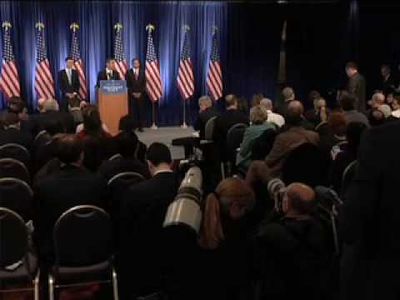
Yesterday, I announced four such Americans to help lead the economic team that will advise me as we seek to climb out of this crisis. Today, I'm pleased to announce two other key members of our team: Peter Orszag as Director, and Robert Nabors as Deputy Director of the Office of Management and Budget.
Before I explain why I selected these outstanding public servants, let me say a few words about the work that I'm asking them to undertake. As I said yesterday, the economic crisis we face demands that we invest immediately in a series of measures that will help save or create two and a half million jobs and put tax cuts in the pockets of the hard-pressed middle class. Many of those new jobs will come in areas such as energy independence, technology, and health care modernization that will strengthen our economy over the long term.
But if we are going to make the investments we need, we also have to be willing to shed the spending that we don’t need. In these challenging times, when we're facing both rising deficits and a shrinking economy, budget reform is not an option; it's a necessity. We can't sustain a system that bleeds billions of taxpayer dollars on programs that have outlived their usefulness, or exist solely because of the power of politicians, lobbyists, or interest groups. We simply can't afford it.
This isn’t about big government or small government. It’s about building a smarter government that focuses on what works. That's why I will ask my new team to think anew and act anew to meet our new challenges. We are going to go through our federal budget, as I promised during the campaign -- page by page, line by line -- eliminating those programs we don’t need, and insisting that those that we do need operate in a sensible, cost-effective way.
Let me just give you one example of what I’m talking about. There’s a report today from -- that from 2003 to 2006, millionaire farmers received 49 million dollars in crop subsidies even though they were earning more than the 2.5 million cutoff for such subsidies. Now, if this is true -- and this was just a report this morning -- but if it's true, it is a prime example of the kind of waste that I intend to end as President.
We're also going to focus on one of the biggest, long-run challenges that our budget faces -- namely, the rising cost of health care in both the public and private sectors. This is not just a challenge but also an opportunity to improve the health care that Americans rely on and to bring down the costs that taxpayers, businesses, and families have to pay.
Now, that's what the Office of Management and Budget will do in my Administration. It will not only help design a budget and manage its implementation, but it's also going to make sure that our government -- your government -- is more efficient and more effective at serving the American people.
And there is no better person to help lead this effort as Director of the OMB than my friend Peter Orszag. Peter's been one of our nation’s leading voices on budgetary issues. It's said that a nation’s budget reflects its values and its priorities. I believe that's true. And I know that Peter will bring to his work at the OMB a set of priorities that I -- and the American people -- share.
Throughout his career, he's made significant contributions in our understanding of all the major economic challenges that we're now confronting -- from reducing medical costs to saving Social Security to fighting global climate change to helping put the dream of a college degree within the reach for more students.
As Director of the Congressional Budget Office, he reenergized and reinvigorated the agency, while shifting its focus to confront the health care crisis that is not only a cause of so much suffering for so many families, but a rapidly growing portion of our budget and a drag on our entire economy.
But it's not simply that Peter’s past career makes him qualified for this new appointment; it's also that he has a vision for the future that I share. He believes, as I do, that even as we take steps to restore discipline to our budget, we also have to take -- take the steps right now that are necessary to solve our immediate crisis. Peter doesn’t need a map to tell him where the bodies are buried in the federal budget. He knows what works and what doesn’t, what's worthy of our precious tax dollars and what is not.
Just because a program, a special interest tax break, or corporate subsidy is hidden in this year’s budget, does not mean that it will survive the next. The old ways of Washington simply can’t meet the challenges of today and tomorrow.
And no one's more able or more qualified to assist Peter in this work than Deputy Director of the OMB that I am nominating, Robert Nabors. Rob will bring to this post experience in the Executive Branch, at the OMB, where he helped the Clinton Administration achieve balanced budgets, as well as in the Legislative Branch, where he led the Appropriations Committee staff as a driving force for a responsible budget. Together, Peter and Rob will help steer our budget through Congress so that I can sign it into law.
Now, let me be clear: These appointments, as well as the appointments that I announced yesterday, are not the sum of my economic team. These appointments are going to work closely with those that I have not ye[t] announced -- those including the secretaries of Energy and Labor, Commerce, and Health and Human Services, as well as others in my Administration -- to design a recovery path for both Wall Street and Main Street, and to put our economy on a path to long-term growth and prosperity.
Because at this moment, we must not only restore confidence in our markets. We also must restore the confidence of middle class families that their government is on their side, that it’s working for them and on their behalf to meet their families’ needs.
That's what I intend to do as President of the United States.