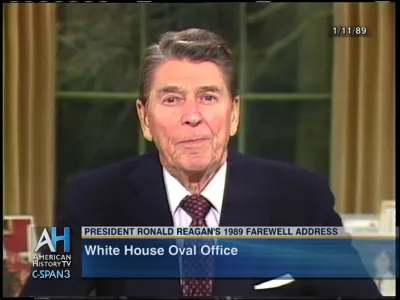
My fellow Americans: 我的美国同胞们:
This is the 34th time I'll speak to you from the Oval Office and the last. We've been together 8 years now, and soon it'll be time for me to go. But before I do, I wanted to share some thoughts, some of which I've been saving for a long time. 这是我第34次、也是最后一次在椭圆形办公室向你们发表讲话。我们一起走过了8年,很快我就要离开了。但在离开之前,我想分享一些想法,有些我已经珍藏很久了。
It's been the honor of my life to be your President. So many of you have written the past few weeks to say thanks, but I could say as much to you. Nancy and I are grateful for the opportunity you gave us to serve. 成为你们的总统是我一生的荣幸。过去几周,你们中的许多人写信表示感谢,但我同样要感谢你们。南希和我非常感激你们给予我们服务的机会。
One of the things about the Presidency is that you're always somewhat apart. You spend a lot of time going by too fast in a car someone else is driving, and seeing the people through tinted glass—the parents holding up a child, and the wave you saw too late and couldn't return. And so many times I wanted to stop and reach out from behind the glass, and connect. Well, maybe I can do a little of that tonight. 总统职位的一个特点是,你总是与民众保持一定距离。你花很多时间坐在别人驾驶的车里疾驰而过,透过有色玻璃看到人们——父母抱着孩子,而你看到挥手时已经太晚,无法回应。很多次我想停下来,从玻璃后面伸出手,与大家交流。今晚,也许我可以做到一点。
People ask how I feel about leaving. And the fact is, "parting is such sweet sorrow." The sweet part is California and the ranch and freedom. The sorrow—the goodbyes, of course, and leaving this beautiful place. 人们问我对即将离开的感受。事实上,"离别是甜蜜的悲伤"。甜蜜的是回到加州的牧场和自由。悲伤的是——当然是告别,离开这个美丽的地方。
You know, down the hall and up the stairs from this office is the part of the White House where the President and his family live. There are a few favorite windows I have up there that I like to stand and look out of early in the morning. The view is over the grounds here to the Washington Monument, and then the Mall and the Jefferson Memorial. But on mornings when the humidity is low, you can see past the Jefferson to the river, the Potomac, and the Virginia shore. Someone said that's the view Lincoln had when he saw the smoke rising from the Battle of Bull Run. I see more prosaic things: the grass on the banks, the morning traffic as people make their way to work, now and then a sailboat on the river. 你们知道,从这个办公室沿着走廊上楼,就是白宫里总统和家人居住的地方。楼上有几扇我喜欢的窗户,我喜欢在清晨站在那里向外眺望。视线越过这里的草坪,可以看到华盛顿纪念碑,然后是国家广场和杰斐逊纪念堂。但在湿度低的早晨,你可以看到杰斐逊纪念堂后面的波托马克河和弗吉尼亚河岸。有人说林肯看到布尔溪战役的硝烟升起时,看到的就是这样的景象。我看到的是更平凡的事物:河岸上的草地,人们上班的早晨交通,偶尔河上的一艘帆船。
I've been thinking a bit at that window. I've been reflecting on what the past 8 years have meant and mean. And the image that comes to mind like a refrain is a nautical one—a small story about a big ship, and a refugee, and a sailor. It was back in the early eighties, at the height of the boat people. And the sailor was hard at work on the carrier Midway, which was patrolling the South China Sea. The sailor, like most American servicemen, was young, smart, and fiercely observant. The crew spied on the horizon a leaky little boat. And crammed inside were refugees from Indochina hoping to get to America. The Midway sent a small launch to bring them to the ship and safety. As the refugees made their way through the choppy seas, one spied the sailor on deck, and stood up, and called out to him. He yelled, "Hello, American sailor. Hello, freedom man." 我在那扇窗户前思考了很多。我一直在反思过去8年意味着什么。脑海中浮现的画面像副歌一样反复出现——一个关于大船、难民和水手的小故事。那是在80年代初,船民潮最严重的时候。水手在中途岛号航空母舰上辛勤工作,该舰正在南中国海巡逻。这位水手和大多数美国军人一样,年轻、聪明、观察力敏锐。船员们在地平线上发现了一艘漏水的小船。里面挤满了希望抵达美国的印度支那难民。中途岛号派出一艘小艇将他们接到船上并送往安全地带。当难民们穿过波涛汹涌的海面时,其中一人看到了甲板上的水手,站起来向他喊道:"你好,美国水手。你好,自由人。"
A small moment with a big meaning, a moment the sailor, who wrote it in a letter, couldn't get out of his mind. And, when I saw it, neither could I. Because that's what it was to be an American in the 1980's. We stood, again, for freedom. I know we always have, but in the past few years the world again—and in a way, we ourselves—rediscovered it. 这是一个意义重大的小瞬间,这位水手在信中写道,这个瞬间在他脑海中挥之不去。当我看到这封信时,我也无法忘怀。因为这就是80年代美国人的写照。我们再次为自由而站。我知道我们一直如此,但在过去几年里,世界——在某种程度上,我们自己——重新发现了这一点。
It's been quite a journey this decade, and we held together through some stormy seas. And at the end, together, we are reaching our destination. 这十年是一段漫长的旅程,我们一起度过了一些风暴。最终,我们一起到达了目的地。
The fact is, from Grenada to the Washington and Moscow summits, from the recession of '81 to '82, to the expansion that began in late '82 and continues to this day, we've made a difference. The way I see it, there were two great triumphs, two things that I'm proudest of. One is the economic recovery, in which the people of America created—and filled—19 million new jobs. The other is the recovery of our morale. America is respected again in the world and looked to for leadership. 事实上,从格林纳达到华盛顿和莫斯科峰会,从1981年至1982年的经济衰退,到1982年底开始并持续至今的经济扩张,我们带来了改变。在我看来,有两大成就,两件我最自豪的事。一是经济复苏,美国人民创造并填补了1900万个新就业岗位。另一个是士气的恢复。美国在世界上重新受到尊重,并被视为领导者。
Something that happened to me a few years ago reflects some of this. It was back in 1981, and I was attending my first big economic summit, which was held that year in Canada. The meeting place rotates among the member countries. The opening meeting was a formal dinner for the heads of government of the seven industrialized nations. Now, I sat there like the new kid in school and listened, and it was all Francois this and Helmut that. They dropped titles and spoke to one another on a first-name basis. Well, at one point I sort of leaned in and said, "My name's Ron." Well, in that same year, we began the actions we felt would ignite an economic comeback—cut taxes and regulation, started to cut spending. And soon the recovery began. 几年前发生的一件事反映了这一点。那是在1981年,我参加了当年在加拿大举行的第一次大型经济峰会。会议地点在成员国之间轮流举行。开幕式是为七个工业化国家政府首脑举行的正式晚宴。我坐在那里,像学校里的新生一样听着,到处都是弗朗索瓦这个、赫尔穆特那个。他们去掉头衔,直呼其名。有一次我侧身说道:"我叫罗恩。"同年,我们开始采取我们认为会点燃经济复苏的行动——减税和放松管制,开始削减开支。很快,经济复苏开始了。
Two years later, another economic summit with pretty much the same cast. At the big opening meeting we all got together, and all of a sudden, just for a moment, I saw that everyone was just sitting there looking at me. And then one of them broke the silence. "Tell us about the American miracle," he said. 两年后,又是一次经济峰会,与会者几乎相同。在盛大的开幕式上,我们都聚集在一起,突然,有那么一瞬间,我看到所有人都坐在那里看着我。然后其中一个人打破了沉默。"给我们讲讲美国奇迹吧,"他说。
Well, back in 1980, when I was running for President, it was all so different. Some pundits said our programs would result in catastrophe. Our views on foreign affairs would cause war. Our plans for the economy would cause inflation to soar and bring about economic collapse. I even remember one highly respected economist saying, back in 1982, that "The engines of economic growth have shut down here, and they're likely to stay that way for years to come." Well, he and the other opinion leaders were wrong. The fact is, what they called "radical" was really "right." What they called "dangerous" was just "desperately needed." 回想1980年我竞选总统时,情况完全不同。一些专家说我们的计划会导致灾难。我们的外交事务观点会引发战争。我们的经济计划会导致通货膨胀飙升并带来经济崩溃。我甚至记得一位备受尊敬的经济学家在1982年说:"这里的经济增长引擎已经关闭,而且可能会持续多年。"但他和其他舆论领袖错了。事实是,他们所谓的"激进"实际上是"正确"的。他们所谓的"危险"恰恰是"迫切需要"的。
And in all of that time I won a nickname, "The Great Communicator." But I never thought it was my style or the words I used that made a difference: it was the content. I wasn't a great communicator, but I communicated great things, and they didn't spring full bloom from my brow, they came from the heart of a great nation—from our experience, our wisdom, and our belief in the principles that have guided us for two centuries. They called it the Reagan revolution. Well, I'll accept that, but for me it always seemed more like the great rediscovery, a rediscovery of our values and our common sense. 在那段时间里,我赢得了一个绰号——"伟大的沟通者"。但我从不认为是我的风格或我使用的词语带来了改变:而是内容。我不是伟大的沟通者,但我传达了伟大的事物,它们并非从我脑海中凭空产生,而是来自一个伟大国家的内心——来自我们的经验、智慧和对指导我们两个世纪的原则的信念。他们称之为里根革命。好吧,我接受这个说法,但对我来说,它更像是伟大的重新发现,对我们价值观和常识的重新发现。
Common sense told us that when you put a big tax on something, the people will produce less of it. So, we cut the people's tax rates, and the people produced more than ever before. The economy bloomed like a plant that had been cut back and could now grow quicker and stronger. Our economic program brought about the longest peacetime expansion in our history: real family income up, the poverty rate down, entrepreneurship booming, and an explosion in research and new technology. We're exporting more than ever because American industry became more competitive and at the same time, we summoned the national will to knock down protectionist walls abroad instead of erecting them at home. 常识告诉我们,当你对某种东西征收重税时,人们就会减少生产。所以,我们降低了人们的税率,人们的产量比以往任何时候都高。经济像一棵被修剪过的植物一样蓬勃发展,现在可以更快、更强地生长。我们的经济计划带来了我国历史上最长的和平时期扩张:实际家庭收入增加,贫困率下降,创业精神蓬勃发展,研究和新技术爆发式增长。我们的出口比以往任何时候都多,因为美国工业变得更具竞争力,同时,我们唤起了国家意志,拆除国外的保护主义壁垒,而不是在国内建立它们。
Common sense also told us that to preserve the peace, we'd have to become strong again after years of weakness and confusion. So, we rebuilt our defenses, and this New Year we toasted the new peacefulness around the globe. Not only have the superpowers actually begun to reduce their stockpiles of nuclear weapons—and hope for even more progress is bright—but the regional conflicts that rack the globe are also beginning to cease. The Persian Gulf is no longer a war zone. The Soviets are leaving Afghanistan. The Vietnamese are preparing to pull out of Cambodia, and an American-mediated accord will soon send 50,000 Cuban troops home from Angola. 常识还告诉我们,为了维护和平,我们必须在多年的软弱和混乱后重新变得强大。因此,我们重建了我们的国防,今年新年,我们为全球新的和平举杯庆祝。超级大国不仅开始削减核武库存——对更大进展的希望也很光明——而且困扰全球的地区冲突也开始停止。波斯湾不再是战区。苏联正在撤离阿富汗。越南准备从柬埔寨撤军,一项由美国调解的协议将很快将5万古巴军队从安哥拉送回家。
The lesson of all this was, of course, that because we're a great nation, our challenges seem complex. It will always be this way. But as long as we remember our first principles and believe in ourselves, the future will always be ours. And something else we learned: Once you begin a great movement, there's no telling where it will end. We meant to change a nation, and instead, we changed a world. 所有这一切的教训当然是,因为我们是一个伟大的国家,我们的挑战看起来很复杂。事情总是这样。但只要我们记住我们的基本原则并相信自己,未来永远属于我们。我们还学到了另一件事:一旦你开始一场伟大的运动,就无法预料它会在哪里结束。我们本想改变一个国家,却改变了世界。
Countries across the globe are turning to free markets and free speech and turning away from the ideologies of the past. For them, the great rediscovery of the 1980's has been that, lo and behold, the moral way of government is the practical way of government: Democracy, the profoundly good, is also the profoundly productive. 全球各国正在转向自由市场和言论自由,远离过去的意识形态。对他们来说,80年代的伟大重新发现是,道德的政府方式也是实际的政府方式:民主,深刻的善,也是深刻的生产力。
When you've got to the point when you can celebrate the anniversaries of your 39th birthday you can sit back sometimes, review your life, and see it flowing before you. For me there was a fork in the river, and it was right in the middle of my life. I never meant to go into politics. It wasn't my intention when I was young. But I was raised to believe you had to pay your way for the blessings bestowed on you. I was happy with my career in the entertainment world, but I ultimately went into politics because I wanted to protect something precious. 当你到了可以庆祝第39个生日的年龄时,你有时可以坐下来回顾你的生活,看着它在你面前流淌。对我来说,人生中有一个岔路口,就在我生命的中途。我从未想过要进入政治领域。年轻时这不是我的本意。但我从小就相信,你必须为所获得的祝福付出代价。我对自己在娱乐界的事业很满意,但最终我进入政治是因为我想保护一些珍贵的东西。
Ours was the first revolution in the history of mankind that truly reversed the course of government, and with three little words: "We the People." "We the People" tell the government what to do; it doesn't tell us. "We the People" are the driver; the government is the car. And we decide where it should go, and by what route, and how fast. Almost all the world's constitutions are documents in which governments tell the people what their privileges are. Our Constitution is a document in which "We the People" tell the government what it is allowed to do. "We the People" are free. This belief has been the underlying basis for everything I've tried to do these past 8 years. 我们的革命是人类历史上第一次真正逆转政府进程的革命,只用了三个词:"我们人民"。"我们人民"告诉政府该做什么;而不是政府告诉我们。"我们人民"是司机;政府是汽车。我们决定它应该去哪里,走什么路线,走多快。世界上几乎所有的宪法都是政府告诉人民他们有哪些特权的文件。我们的宪法是"我们人民"告诉政府它被允许做什么的文件。"我们人民"是自由的。这个信念是我过去8年努力做的一切的根本基础。
But back in the 1960's, when I began, it seemed to me that we'd begun reversing the order of things—that through more and more rules and regulations and confiscatory taxes, the government was taking more of our money, more of our options, and more of our freedom. I went into politics in part to put up my hand and say, "Stop." I was a citizen politician, and it seemed the right thing for a citizen to do. 但早在60年代,当我开始时,我觉得我们开始颠倒事情的顺序——通过越来越多的规则、法规和没收性税收,政府拿走了我们更多的钱、更多的选择权和更多的自由。我进入政治部分是为了举起手说:"停。"我是一个公民政治家,这似乎是公民应该做的正确事情。
I think we have stopped a lot of what needed stopping. And I hope we have once again reminded people that man is not free unless government is limited. There's a clear cause and effect here that is as neat and predictable as a law of physics: As government expands, liberty contracts. 我认为我们阻止了许多需要阻止的事情。我希望我们再次提醒人们,除非政府受到限制,否则人是不自由的。这里有一个清晰的因果关系,就像物理定律一样简洁和可预测:政府扩张,自由收缩。
Nothing is less free than pure communism-and yet we have, the past few years, forged a satisfying new closeness with the Soviet Union. I've been asked if this isn't a gamble, and my answer is no because we're basing our actions not on words but deeds. The detente of the 1970's was based not on actions but promises. They'd promise to treat their own people and the people of the world better. But the gulag was still the gulag, and the state was still expansionist, and they still waged proxy wars in Africa, Asia, and Latin America. 没有什么比纯粹的共产主义更不自由了——然而在过去几年里,我们与苏联建立了令人满意的新关系。有人问我这是不是一场赌博,我的回答是否定的,因为我们的行动不是基于言语而是基于行动。70年代的缓和是基于承诺而不是行动。他们承诺更好地对待自己的人民和世界人民。但古拉格仍然是古拉格,国家仍然具有扩张性,他们仍然在非洲、亚洲和拉丁美洲发动代理战争。
Well, this time, so far, it's different. President Gorbachev has brought about some internal democratic reforms and begun the withdrawal from Afghanistan. He has also freed prisoners whose names I've given him every time we've met. 嗯,这一次,到目前为止,情况不同了。戈尔巴乔夫总统推行了一些内部民主改革,并开始从阿富汗撤军。他还释放了每次我们会面时我都告诉他名字的囚犯。
But life has a way of reminding you of big things through small incidents. Once, during the heady days of the Moscow summit, Nancy and I decided to break off from the entourage one afternoon to visit the shops on Arbat Street—that's a little street just off Moscow's main shopping area. Even though our visit was a surprise, every Russian there immediately recognized us and called out our names and reached for our hands. We were just about swept away by the warmth. You could almost feel the possibilities in all that joy. But within seconds, a KGB detail pushed their way toward us and began pushing and shoving the people in the crowd. It was an interesting moment. It reminded me that while the man on the street in the Soviet Union yearns for peace, the government is Communist. And those who run it are Communists, and that means we and they view such issues as freedom and human rights very differently. 但生活总会通过小事提醒你大事。有一次,在莫斯科峰会的兴奋日子里,南希和我决定有一天下午离开随行人员,去参观阿尔巴特街的商店——那是莫斯科主要购物区附近的一条小街。尽管我们的访问是个惊喜,但那里的每个俄罗斯人都立刻认出了我们,叫出我们的名字并伸出手来。我们几乎被这种热情席卷。你几乎可以在所有的喜悦中感受到可能性。但几秒钟内,一支克格勃小分队向我们挤来,开始推搡人群中的人们。这是一个有趣的时刻。它提醒我,虽然苏联街头的人渴望和平,但政府是共产主义的。那些管理它的人是共产主义者,这意味着我们和他们对自由和人权等问题的看法截然不同。
We must keep up our guard, but we must also continue to work together to lessen and eliminate tension and mistrust. My view is that President Gorbachev is different from previous Soviet leaders. I think he knows some of the things wrong with his society and is trying to fix them. We wish him well. And we'll continue to work to make sure that the Soviet Union that eventually emerges from this process is a less threatening one. What it all boils down to is this: I want the new closeness to continue. And it will, as long as we make it clear that we will continue to act in a certain way as long as they continue to act in a helpful manner. If and when they don't, at first pull your punches. If they persist, pull the plug. It's still trust but verify. It's still play, but cut the cards. It's still watch closely. And don't be afraid to see what you see. 我们必须保持警惕,但我们也必须继续共同努力减少和消除紧张与不信任。我的看法是,戈尔巴乔夫总统与之前的苏联领导人不同。我认为他知道他的社会存在一些问题,并正在努力解决它们。我们祝愿他一切顺利。我们将继续努力确保最终从这个过程中出现的苏联是一个威胁较小的国家。总而言之:我希望这种新的亲密关系继续下去。只要我们明确表示,只要他们继续以有益的方式行事,我们就会继续以某种方式行事,这种关系就会继续。如果他们不这样做,首先要克制。如果他们坚持,就停止合作。仍然是信任但要验证。仍然是玩耍但要切牌。仍然要密切关注。不要害怕看到你所看到的。
I've been asked if I have any regrets. Well, I do. The deficit is one. I've been talking a great deal about that lately, but tonight isn't for arguments, and I'm going to hold my tongue. But an observation: I've had my share of victories in the Congress, but what few people noticed is that I never won anything you didn't win for me. They never saw my troops, they never saw Reagan's regiments, the American people. You won every battle with every call you made and letter you wrote demanding action. Well, action is still needed. If we're to finish the job, Reagan's regiments will have to become the Bush brigades. Soon he'll be the chief, and he'll need you every bit as much as I did. 有人问我有没有遗憾。嗯,我有。赤字就是其中之一。我最近一直在谈论这个问题,但今晚不是争论的时候,我会保持沉默。但有一个观察:我在国会取得了一些胜利,但很少有人注意到,我赢得的任何东西都是你们为我赢得的。他们从未见过我的军队,从未见过里根军团——美国人民。你们通过每一次呼吁和每一封信赢得了每一场战斗,要求采取行动。嗯,仍然需要行动。如果我们要完成这项工作,里根军团必须成为布什旅。很快他将成为领袖,他和我一样需要你们。
Finally, there is a great tradition of warnings in Presidential farewells, and I've got one that's been on my mind for some time. But oddly enough it starts with one of the things I'm proudest of in the past 8 years: the resurgence of national pride that I called the new patriotism. This national feeling is good, but it won't count for much, and it won't last unless it's grounded in thoughtfulness and knowledge. 最后,总统告别演说中有一个伟大的警告传统,我有一个警告在我脑海中已经有一段时间了。但奇怪的是,它从我过去8年最自豪的事情之一开始:我称之为新爱国主义的民族自豪感的复兴。这种民族感情是好的,但如果不以深思熟虑和知识为基础,它就不会有多大价值,也不会持久。
An informed patriotism is what we want. And are we doing a good enough job teaching our children what America is and what she represents in the long history of the world? Those of us who are over 35 or so years of age grew up in a different America. We were taught, very directly, what it means to be an American. And we absorbed, almost in the air, a love of country and an appreciation of its institutions. If you didn't get these things from your family you got them from the neighborhood, from the father down the street who fought in Korea or the family who lost someone at Anzio. Or you could get a sense of patriotism from school. And if all else failed you could get a sense of patriotism from the popular culture. The movies celebrated democratic values and implicitly reinforced the idea that America was special. TV was like that, too, through the mid-sixties. 我们需要的是知情的爱国主义。我们在教育孩子了解美国是什么以及她在世界悠久历史中代表什么方面做得足够好吗?我们这些35岁以上的人是在一个不同的美国长大的。我们被直接教导,作为一个美国人意味着什么。我们几乎是在空气中吸收了对国家的热爱和对其制度的欣赏。如果你没有从家庭中得到这些,你可以从邻居那里得到,从街上参加过朝鲜战争的父亲或在安齐奥失去亲人的家庭那里得到。或者你可以从学校获得爱国主义意识。如果所有其他方式都失败了,你可以从流行文化中获得爱国主义意识。电影颂扬民主价值观,并含蓄地强化美国是特殊的观念。电视在60年代中期以前也是如此。
But now, we're about to enter the nineties, and some things have changed. Younger parents aren't sure that an unambivalent appreciation of America is the right thing to teach modern children. And as for those who create the popular culture, well-grounded patriotism is no longer the style. Our spirit is back, but we haven't reinstitutionalized it. We've got to do a better job of getting across that America is freedom-freedom of speech, freedom of religion, freedom of enterprise. And freedom is special and rare. It's fragile; it needs production [protection]. 但现在,我们即将进入90年代,有些事情已经改变了。年轻的父母不确定对美国的毫不含糊的欣赏是否是教给现代孩子的正确东西。至于那些创造流行文化的人,有根据的爱国主义不再是时尚。我们的精神回来了,但我们还没有将其制度化。我们必须更好地传达美国就是自由——言论自由、宗教自由、企业自由。自由是特殊的、稀有的。它很脆弱;它需要保护。
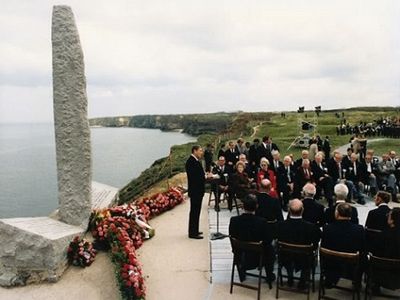
So, we've got to teach history based not on what's in fashion but what's important-why the Pilgrims came here, who Jimmy Doolittle was, and what those 30 seconds over Tokyo meant. You know, 4 years ago on the 40th anniversary of D-day, I read a letter from a young woman writing to her late father, who'd fought on Omaha Beach. Her name was Lisa Zanatta Henn, and she said, "we will always remember, we will never forget what the boys of Normandy did." Well, let's help her keep her word. If we forget what we did, we won't know who we are. I'm warning of an eradication of the American memory that could result, ultimately, in an erosion of the American spirit. Let's start with some basics: more attention to American history and a greater emphasis on civic ritual. 因此,我们必须根据重要性而非流行来教授历史——清教徒为什么来到这里,吉米·杜利特尔是谁,东京上空那30秒意味着什么。你们知道,4年前在诺曼底登陆40周年之际,我读到一位年轻女子写给她已故父亲的信,她的父亲曾在奥马哈海滩战斗。她的名字是丽莎·扎纳塔·亨,她说:"我们将永远记住,永远不会忘记诺曼底的男孩们所做的一切。"好吧,让我们帮助她遵守诺言。如果我们忘记了我们所做的一切,我们就不知道我们是谁。我警告说,美国记忆的根除最终可能导致美国精神的侵蚀。让我们从一些基础开始:更多关注美国历史,更强调公民仪式。
And let me offer lesson number one about America: All great change in America begins at the dinner table. So, tomorrow night in the kitchen I hope the talking begins. And children, if your parents haven't been teaching you what it means to be an American, let 'em know and nail 'em on it. That would be a very American thing to do. 让我提供关于美国的第一课:美国所有伟大的变革都始于餐桌。所以,明天晚上在厨房里,我希望谈话开始。孩子们,如果你们的父母没有教你们作为美国人意味着什么,让他们知道并追问他们。那将是一件非常美国的事情。
And that's about all I have to say tonight, except for one thing. The past few days when I've been at that window upstairs, I've thought a bit of the "shining city upon a hill." The phrase comes from John Winthrop, who wrote it to describe the America he imagined. What he imagined was important because he was an early Pilgrim, an early freedom man. He journeyed here on what today we'd call a little wooden boat; and like the other Pilgrims, he was looking for a home that would be free. 今晚我要说的差不多就是这些了,除了一件事。过去几天,当我在楼上那扇窗户前时,我想到了"山巅之城"。这句话来自约翰·温思罗普,他用它来描述他想象中的美国。他的想象很重要,因为他是早期的清教徒,早期的自由人。他乘坐今天我们称之为小木船的东西来到这里;和其他清教徒一样,他在寻找一个自由的家园。
I've spoken of the shining city all my political life, but I don't know if I ever quite communicated what I saw when I said it. But in my mind it was a tall, proud city built on rocks stronger than oceans, windswept, God-blessed, and teeming with people of all kinds living in harmony and peace; a city with free ports that hummed with commerce and creativity. And if there had to be city walls, the walls had doors and the doors were open to anyone with the will and the heart to get here. That's how I saw it, and see it still. 我在我的政治生涯中一直谈到这座光辉之城,但我不知道我是否完全传达了当我说它时我所看到的景象。但在我心中,它是一座高大、自豪的城市,建在比海洋更坚固的岩石上,风吹日晒,上帝保佑,挤满了各种和睦相处的人;一座拥有自由港口的城市,商业和创造力在那里嗡嗡作响。如果必须有城墙,城墙上要有门,门要向任何有意志和心来到这里的人敞开。这就是我当时看到的,现在仍然看到的。
And how stands the city on this winter night? More prosperous, more secure, and happier than it was 8 years ago. But more than that: After 200 years, two centuries, she still stands strong and true on the granite ridge, and her glow has held steady no matter what storm. And she's still a beacon, still a magnet for all who must have freedom, for all the pilgrims from all the lost places who are hurtling through the darkness, toward home. 在这个冬夜,这座城市的状况如何?比8年前更加繁荣、更加安全、更加幸福。但更重要的是:经过200年,两个世纪,她仍然在花岗岩山脊上坚强而真实地屹立着,无论遇到什么风暴,她的光芒始终稳定。她仍然是一座灯塔,仍然是所有必须拥有自由的人的磁石,是所有来自失落之地的朝圣者穿越黑暗、奔向家园的磁石。
We've done our part. And as I walk off into the city streets, a final word to the men and women of the Reagan revolution, the men and women across America who for 8 years did the work that brought America back. My friends: We did it. We weren't just marking time. We made a difference. We made the city stronger, we made the city freer, and we left her in good hands. All in all, not bad, not bad at all. 我们已经尽了我们的一份力。当我走进城市街道时,最后一句话要送给里根革命的男男女女,送给全美8年来为复兴美国而努力的男男女女。我的朋友们:我们做到了。我们不仅仅是在消磨时间。我们带来了改变。我们使这座城市更强大,使这座城市更自由,我们把她交到了可靠的人手中。总而言之,不错,真的不错。
And so, goodbye, God bless you, and God bless the United States of America. 所以,再见了,上帝保佑你们,上帝保佑美利坚合众国。