Thank you. Everybody, please have a seat, have a seat.
Well, good morning, everyone.
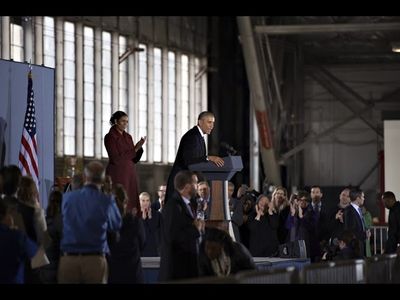
We are gathered in the heart of our nation's capital, surrounded by memorials to leaders and citizens who served our nation in its earliest days and in its days of greatest trial. Today is such a time for America.
Over the past two years, we have faced the worst recession since the Great Depression. Eight million people lost their jobs. Tens of millions saw the value of their homes and retirement savings plummet. Countless businesses have been unable to get the loans they need and many have been forced to shut their doors. And although the economy is growing again, too many people are still feeling the pain of the downturn.
Now, while a number of factors led to such a severe recession, the primary cause was a breakdown in our financial system. It was a crisis born of a failure of responsibility from certain corners of Wall Street to the halls of power in Washington. For years, our financial sector was governed by antiquated and poorly enforced rules that allowed some to game the system and take risks that endangered the entire economy.
Unscrupulous lenders locked consumers into complex loans with hidden costs. Firms like AIG placed massive, risky bets with borrowed money. And while the rules left abuse and excess unchecked, they also left taxpayers on the hook if a big bank or financial institution ever failed.
Now, even before the crisis hit, I went to Wall Street and I called for common-sense reforms to protect consumers and our economy as a whole. And soon after taking office, I proposed a set of reforms to empower consumers and investors, to bring the shadowy deals that caused this crisis into the light of day, and to put a stop to taxpayer bailouts once and for all. Today, thanks to a lot of people in this room, those reforms will become the law of the land.
For the last year, Chairmen Barney Frank and Chris Dodd have worked day and night. Barney and Chris have worked day and night to bring about this reform. And I am profoundly grateful to them. I would be remiss if I didn't also express my appreciation to Senator Harry Reid and Speaker Nancy Pelosi for their leadership. It wouldn't have happened without them.
Passing this bill was no easy task. To get there, we had to overcome the furious lobbying of an array of powerful interest groups and a partisan minority determined to block change. So the members who are here today, both on the stage and in the audience, they have done a great service in devoting so much time and expertise to this effort, to looking out for the public interests and not the special interests.
And I also want to thank the three Republican senators who put partisanship aside, judged this bill on the merits, and voted for reform. We're grateful to them. And the Republican House members. Good to see you, Joe.
Now, let's put this in perspective. The fact is, the financial industry is central to our nation's ability to grow, to prosper, to compete and to innovate. There are a lot of banks that understand and fulfill this vital role, and there are a whole lot of bankers who want to do right -- and do right -- by their customers. This reform will help foster innovation, not hamper it. It is designed to make sure that everybody follows the same set of rules, so that firms compete on price and quality, not on tricks and not on traps.
It demands accountability and responsibility from everyone. It provides certainty to everybody, from bankers to farmers to business owners to consumers. And unless your business model depends on cutting corners or bilking your customers, you've got nothing to fear from reform.
Now, for all those Americans who are wondering what Wall Street reform means for you, here's what you can expect. If you've ever applied for a credit card, a student loan, or a mortgage, you know the feeling of signing your name to pages of barely understandable fine print. What often happens as a result is that many Americans are caught by hidden fees and penalties, or saddled with loans they can't afford.
That's what happened to Robin Fox, hit with a massive rate increase on her credit card balance even though she paid her bills on time. That's what happened to Andrew Giordano, who discovered hundreds of dollars in overdraft fees on his bank statement -- fees he had no idea he might face. Both are here today. Well, with this law, unfair rate hikes, like the one that hit Robin, will end for good. And we'll ensure that people like Andrew aren't unwittingly caught by overdraft fees when they sign up for a checking account.
With this law, we'll crack down on abusive practices in the mortgage industry. We'll make sure that contracts are simpler -- putting an end to many hidden penalties and fees in complex mortgages -- so folks know what they're signing.
With this law, students who take out college loans will be provided clear and concise information about their obligations.
And with this law, ordinary investors -- like seniors and folks saving for retirement -- will be able to receive more information about the costs and risks of mutual funds and other investment products, so that they can make better financial decisions as to what will work for them.
So, all told, these reforms represent the strongest consumer financial protections in history. In history. And these protections will be enforced by a new consumer watchdog with just one job: looking out for people -- not big banks, not lenders, not investment houses -- looking out for people as they interact with the financial system.
And that's not just good for consumers; that's good for the economy. Because reform will put a stop to a lot of the bad loans that fueled a debt-based bubble. And it will mean all companies will have to seek customers by offering better products, instead of more deceptive ones.
Now, beyond the consumer protections I've outlined, reform will also rein in the abuse and excess that nearly brought down our financial system. It will finally bring transparency to the kinds of complex and risky transactions that helped trigger the financial crisis. Shareholders will also have a greater say on the pay of CEOs and other executives, so they can reward success instead of failure.
And finally, because of this law, the American people will never again be asked to foot the bill for Wall Street's mistakes. There will be no more tax-funded bailouts -- period. If a large financial institution should ever fail, this reform gives us the ability to wind it down without endangering the broader economy. And there will be new rules to make clear that no firm is somehow protected because it is "too big to fail," so we don't have another AIG.
That's what this reform will mean. Now, it doesn't mean our work is over. For these new rules to be effective, regulators will have to be vigilant. We may need to make adjustments along the way as our financial system adapts to these new changes and changes around the globe. No law can force anybody to be responsible; it's still incumbent on those on Wall Street to heed the lessons of this crisis in terms of how they conduct their businesses.
The fact is every American -- from Main Street to Wall Street -- has a stake in our financial system. Wall Street banks and firms invest the capital that makes it possible for start-ups to sell new products. They provide loans to businesses to expand and to hire. They back mortgages for families purchasing a new home. That's why we'll all stand to gain from these reforms.
We all win when investors around the world have confidence in our markets. We all win when shareholders have more power and more information. We all win when consumers are protected against abuse. And we all win when folks are rewarded based on how well they perform, not how well they evade accountability.
In the end, our financial system only works -- our market is only free -- when there are clear rules and basic safeguards that prevent abuse, that check excess, that ensure that it is more profitable to play by the rules than to game the system. And that's what these reforms are designed to achieve -- no more, no less. Because that's how we will ensure that our economy works for consumers, that it works for investors, that it works for financial institutions -- that it works for all of us.
This is the central lesson not only of this crisis but of our history. Ultimately, there's no dividing line between Main Street and Wall Street. We rise or fall together as one nation. So these reforms will help lift our economy and lead all of us to a stronger, more prosperous future.
And that's why I'm so honored to sign these reforms into law, and I'm so grateful to everybody who worked so hard to make this day possible.
Thank you very much, everybody.