For our forces in Afghanistan, the Battle of Wanat was one of the most fierce of this entire war. Forty-eight Americans, along with their Afghan partners, were manning their small base, deep in a valley when they were attacked by some 200 insurgents. And those insurgents seemed determined to overrun an even smaller post just outside the base -- an elevated patch of boulders and sandbags defended by just nine American soldiers.
Soon, under the relentless fire, all nine of those men were wounded or killed. Insurgents broke through the wire. And that little post was on the verge of falling, giving the enemy a perch from which to devastate the base below. Against that onslaught, one American held the line -- Just 22 years old, nearly surrounded, bloodied but unbowed -- the soldier we recognize today with our nation’s highest military decoration, the Medal of Honor, Staff Sergeant Ryan M. Pitts.
Now, I don’t want to embarrass Ryan, but the character he displayed that day was clearly forged early. I’m told that in kindergarten, when asked what he wanted to be when he grew up, he drew a picture of a soldier. When he was in the 5th grade, his teacher sent home a note that described Ryan in words that would be familiar to all those who knew him today -- Ryan, she wrote, is "a very special human being."
In Ryan Pitts you see the humility and the loyalty that define America’s men and women in uniform. Of this medal, he says, "It’s not mine alone. It belongs to everybody who was there that day because we did it together."
So I want to welcome those who were there that day -- Ryan’s brothers in arms, and those who are going to be welcoming him into their ranks -- the members of the Medal of Honor Society. We are very proud of them and we are honored by the presence of the families of our fallen heroes as well.
We welcome Ryan’s family, many from New Hampshire, including his wonderful wife, Amy. I have to take a pause because they are actually celebrating -- Ryan and Amy -- their second anniversary today. As Ryan put it, it’s going to be tough topping this one, as anniversaries go. But let me just give you a piece of advice as somebody who now has been married for over 20 years: You should try. I’m just saying don’t rest on your laurels after just two years.
We welcome their gorgeous son, one-year-old Lucas, who Ryan is beginning to teach a love for all things New England -- of course, the Red Sox and the Bruins and the Celtics and the Pats.
I want you to try and imagine the extraordinary circumstances in which Ryan and his team served. This was the summer of 2008, and this was a time when our forces in Afghanistan were stretched thin and our troops were deployed to isolated outposts. They had just arrived in Wanat just days before and they were still building their very small base -- a handful of armored vehicles and fighting positions and foxholes and sandbags.
Wanat, one report later concluded, had "significant vulnerabilities." Parts of the village sat on higher ground. On every side, mountains soared 10,000 feet into the sky. Heavy equipment to help build their defenses was delayed. In the 100-degree heat the soldiers ran low on water. And the aerial surveillance they were counting on was diverted away to other missions.
Early that morning, in the pre-dawn darkness, they spotted several men up the mountains. But before Ryan and his team could take action, the entire valley erupted. Machine gun fire and mortar and rocket-propelled grenades poured down from every direction. And those 200 insurgents were firing from ridges and from the village and from trees. Down at the base, a vehicle exploded -- scattering its missiles, back at our soldiers. It was, said a soldier, "hell on Earth."
Up at their tiny post, Ryan and his team were being pounded. Almost instantly, every one of them was wounded. Ryan was hit by shrapnel in the arm and both legs and was bleeding badly. Already, three American soldiers in that valley had fallen. And then a fourth.
As the insurgents moved in, Ryan picked up a grenade, pulled the pin, and held that live grenade -- for a moment, then another, then another -- finally hurling it so they couldn’t throw it back. And he did that again. And he did it again.
Unable to stand, Ryan pulled himself up on his knees and manned a machine gun. Soldiers from the base below made a daring run, dodging bullets and explosions, and joined the defense. But now the enemy was inside the post -- so close they were throwing rocks at the Americans, so close they came right up to the sandbags. Eight American soldiers had now fallen. And Ryan Pitts was the only living soldier at that post.
The enemy was so close Ryan could hear their voices. He whispered into the radio he was the only one left and was running out of ammo. "I was going to die," he remembers, "and made my peace with it." And then he prepared to make a last stand. Bleeding and barely conscious, Ryan threw his last grenades. He grabbed a grenade launcher and fired nearly straight up, so the grenade came back down on the enemy just yards away.
One insurgent was now right on top of the post, shooting down until another team of Americans showed up and drove him back. As one of his teammates said, had it not been for Ryan Pitts, that post "almost certainly would have been overrun."
Even with reinforcements, the battle was not over. Another wave of rocket-propelled grenades slammed into the post. Nine American soldiers were now gone. And still, the fighting raged. Ryan worked the radio, helping target the air strikes that were hitting "danger-close" -- just yards away. And with those strikes the tide of the battle began to turn. Eventually, the insurgents fell back. Ryan and his fellow soldiers had held their ground.
This medal, Ryan says, is an opportunity to tell "our" story. "There was valor everywhere," according to Ryan. And so today we also pay tribute to all who served with such valor that day. Shielding their wounded buddies with their own bodies. Picking up unexploded missiles with their hands and carrying them away. Running through the gunfire to reinforce that post. Fighting through their injuries and never giving up. Helicopter pilots and MEDEVAC crews who came in under heavy fire. Said one soldier, "Never in my career have I seen such bravery and sacrifice."
And so I would ask all those who served at Wanat -- on the ground and in the air -- to please stand, those of you who are here today.
Most of all, Ryan says he considers this medal "a memorial for the guys who didn’t come home." So today, we honor nine American soldiers who made the ultimate sacrifice for us all.
The son who "absorbed love like a sponge;" the expectant father whose dream would later come true, a beautiful baby girl -- Specialist Sergio Abad.
The boy who dominated the soccer fields, and fell in love with motorcycles, and there in that remote outpost took a direct hit in the helmet and kept on fighting -- Corporal Jonathan Ayers.
The photographer whose beautiful pictures captured the spirit of the Afghan people, and who wrote to his family: "Afghanistan is exactly [where]…I wanted to be" -- Corporal Jason Bogar.
The father who loved surfing with his son; the platoon leader who led a dash through the gunfire to that post to reinforce his men -- 1st Lieutenant Jonathan Brostrom.
An immigrant from Mexico who became a proud American soldier, on his third tour, whose final thoughts were of his family and his beloved wife, Lesly -- Sergeant Israel Garcia.
A young man of deep faith, who served God and country, who could always get a laugh with his impersonation of his commander -- Corporal Jason Hovater.
The husband who couldn’t wait to become an uncle; the adventurous spirit who in every photo from Afghanistan has a big smile on his face -- Corporal Matthew Phillips.
The big guy with an even bigger heart, a prankster whose best play was cleaning up at the poker table with his buddies and his dad -- Corporal Pruitt Rainey.
And the youngest, just 20 years old, the "little brother" of the platoon, who loved to play guitar, and who, says his dad, did everything in his life with passion -- Corporal Gunnar Zwilling.
These American patriots lived to serve us all. They died to protect each of us. And their legacy lives on in the hearts of all who love them still, especially their families. Mothers. Fathers. Wives. Brothers and sisters. Sons and daughters.
To you, their families, I know no words can match the depth of your loss, but please know that this nation will honor your soldiers now and forever. And I would ask the Gold Star families from that deployment to please stand -- including Ali Kahler, age 11, and Jase Brostrom, who this week turns 12. Please stand.
This is the story Ryan wants us to remember -- soldiers who loved each other like brothers and who fought for each other, and families who have made a sacrifice that our nation must never forget. Ryan says, "I think we owe it to them to live lives worthy of their sacrifice." And he’s absolutely right.
As Commander-in-Chief, I believe one of the ways we can do that is by heeding the lessons of Wanat. When this nation sends our troops into harm’s way, they deserve a sound strategy and a well-defined mission. And they deserve the forces and support to get the job done. And that's what we owe soldiers like Ryan and all the comrades that were lost. That’s how we can truly honor all those who gave their lives that day. That’s how, as a nation, we can remain worthy of their sacrifice.
I know that's a view that's shared by our Secretary of Defense and by our Joint Chiefs of Staff and all the leadership here. They’re hard lessons, but they’re ones that are deeply engrained in our hearts.
It is remarkable that we have young men and women serving in our military who, day in, day out, are able to perform with so much integrity, so much humility, and so much courage. Ryan represents the very best of that tradition, and we are very, very proud of him, as we are of all of you.
So God bless you, Ryan. God bless all who serve in our name. May God continue to bless the United States of America.
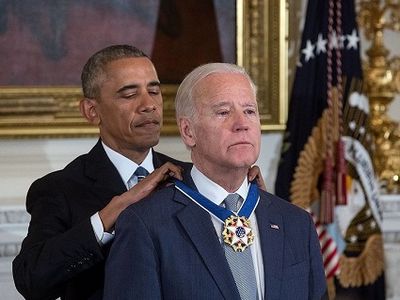
And with that, I would like our military aide to please complete the ceremony.