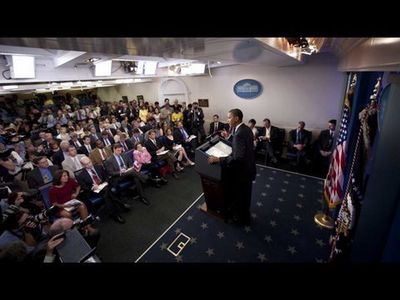
Good afternoon, everybody. Today, I want to start by addressing three issues, and then I'll take your questions. 大家下午好。今天我想先讲三个问题,然后再接受你们的提问。
First, I'd like to say a few words about the situation in Iran. The United States and the international community have been appalled and outraged by the threats, the beatings, and imprisonments of the last few days. I strongly condemn these unjust actions, and I join with the American people in mourning each and every innocent life that is lost. 首先,我想就伊朗局势说几句话。美国和国际社会对过去几天发生的威胁、殴打和监禁行为感到震惊和愤怒。我强烈谴责这些不公正的行径,并与美国人民一道悼念每一位失去生命的无辜者。
I've made it clear that the United States respects the sovereignty of the Islamic Republic of Iran, and is not interfering with Iran's affairs. But we must also bear witness to the courage and the dignity of the Iranian people, and to a remarkable opening within Iranian society. And we deplore the violence against innocent civilians anywhere that it takes place. 我已明确表示,美国尊重伊朗伊斯兰共和国的主权,不干涉伊朗内政。但我们也必须见证伊朗人民的勇气与尊严,以及伊朗社会内部一个值得关注的开放契机。我们谴责任何地方发生的针对无辜平民的暴力行为。
The Iranian people are trying to have a debate about their future. Some in Iran -- some in the Iranian government, in particular, are trying to avoid that debate by accusing the United States and others in the West of instigating protests over the election. These accusations are patently false. They're an obvious attempt to distract people from what is truly taking place within Iran's borders. This tired strategy of using old tensions to scapegoat other countries won't work anymore in Iran. 伊朗人民正在努力就自己的未来展开辩论。伊朗国内的某些人——特别是伊朗政府中的一些人——正试图通过指责美国和西方其他国家煽动选举抗议来回避这场辩论。这些指责完全是错误的。它们不过是企图将人们的注意力从伊朗境内真正发生的事情上转移开。这种利用旧有紧张局势将他国当作替罪羊的老套策略在伊朗已不再奏效。
This is not about the United States or the West; this is about the people of Iran, and the future that they -- and only they -- will choose. 这与美国或西方无关;这是伊朗人民的事,是他们——也只有他们——将选择的未来。
The Iranian people can speak for themselves. That's precisely what's happened in the last few days. In 2009, no iron fist is strong enough to shut off the world from bearing witness to peaceful protests of justice. Despite the Iranian government's efforts to expel journalists and isolate itself, powerful images and poignant words have made their way to us through cell phones and computers, and so we've watched what the Iranian people are doing. 伊朗人民能够为自己发声。这正是过去几天所发生的事情。在2009年,没有任何铁腕能够强大到足以阻止世界目睹和平的正义抗议。尽管伊朗政府努力驱逐记者、孤立自己,强有力的画面和感人的文字仍通过手机和电脑传到我们这里,让我们看到了伊朗人民正在做什么。
This is what we've witnessed. We've seen the timeless dignity of tens of thousands of Iranians marching in silence. We've seen people of all ages risk everything to insist that their votes are counted and that their voices are heard. Above all, we've seen courageous women stand up to the brutality and threats, and we've experienced the searing image of a woman bleeding to death on the streets. While this loss is raw and extraordinarily painful, we also know this: Those who stand up for justice are always on the right side of history. 这就是我们所目睹的。我们看到了数以万计的伊朗人默默前行的永恒尊严。我们看到了各年龄段的人们冒着一切风险,坚持要求自己的选票得到清点、声音被倾听。最重要的是,我们看到了勇敢的女性挺身而出,面对残暴与威胁,我们也感受到了一位女性在街头流血至死的令人揪心的画面。虽然这一损失令人无比痛心,但我们也知道:那些为正义挺身而出的人,永远站在历史正确的一边。
As I said in Cairo, suppressing ideas never succeeds in making them go away. The Iranian people have a universal right to assembly and free speech. If the Iranian government seeks the respect of the international community, it must respect those rights and heed the will of its own people. It must govern through consent and not coercion. That's what Iran's own people are calling for, and the Iranian people will ultimately judge the actions of their own government. 正如我在开罗所说,压制思想永远无法使其消失。伊朗人民拥有集会和言论自由的普遍权利。如果伊朗政府寻求国际社会的尊重,它就必须尊重这些权利,倾听本国人民的意愿。它必须通过共识而不是强制来治理。这正是伊朗本国人民所呼吁的,伊朗人民最终将评判自己政府的行为。
Now, the second issue I want to address is our ongoing effort to build a clean energy economy. 现在,我想谈的第二个问题是我们为建立清洁能源经济所做的持续努力。
This week, the House of Representatives is moving ahead on historic legislation that will transform the way we produce and use energy in America. This legislation will spark a clean energy transformation that will reduce our dependence on foreign oil and confront the carbon pollution that threatens our planet. 本周,众议院正在推进一项历史性立法,它将改变美国生产和使用能源的方式。这项立法将推动清洁能源转型,减少我们对外国石油的依赖,并对威胁我们星球的碳污染提出挑战。
This energy bill will create a set of incentives that will spur the development of new sources of energy, including wind, solar, and geothermal power. It will also spur new energy savings, like efficient windows and other materials that reduce heating costs in the winter and cooling costs in the summer. 这项能源法案将创造一系列激励措施,促进风能、太阳能和地热等新能源的开发。它还将推动新的能源节约措施,比如节能窗户和其他材料,降低冬天的取暖成本和夏天的降温成本。
These incentives will finally make clean energy the profitable kind of energy. And that will lead to the development of new technologies that lead to new industries that could create millions of new jobs in America -- jobs that can't be shipped overseas. 这些激励措施最终将使清洁能源成为有利可图的能源。这将导致新技术的开发,进而催生能够在美国创造数百万新就业岗位的新产业——这些岗位不会被转移到海外。
At a time of great fiscal challenges, this legislation is paid for by the polluters who currently emit the dangerous carbon emissions that contaminate the water we drink and pollute the air that we breathe. It also provides assistance to businesses and communities as they make the gradual transition to clean energy technologies. 在财政面临巨大挑战之际,这项立法的资金来源是那些目前排放着危险碳化物、污染着我们饮用的水源和呼吸的空气的污染者。它还为企业和社区提供援助,帮助他们逐步向清洁能源技术过渡。
So I believe that this legislation is extraordinarily important for our country; it's taken great effort on the part of many over the course of the past several months. And I want to thank the Chair of the Energy and Commerce Committee, Henry Waxman; his colleagues on that committee, including Congressmen Dingell, Ed Markey, and Rick Boucher. I also want to thank Charlie Rangel, the Chair of the Ways and Means Committee, and Collin Peterson, the Chair of the Agriculture Committee, for their many and ongoing contributions to this process. 因此,我认为这项立法对我们国家来说极为重要;它是过去几个月来许多人付出巨大努力的成果。我要感谢能源与商务委员会主席亨利·韦克斯曼;感谢该委员会的同事们,包括丁格尔、埃德·马基和里克·鲍彻。我还要感谢众议院筹款委员会主席查理·兰格尔和农业委员会主席科林·彼得森,感谢他们许多且持续的贡献。
And I want to express my appreciation to Nancy Pelosi and Steny Hoyer for their leadership. 我还要感谢南希·佩洛西和斯特尼·霍耶的领导。
We all know why this is so important. The nation that leads in the creation of a clean energy economy will be the nation that leads the 21st century's global economy. That's what this legislation seeks to achieve -- it's a bill that will open the door to a better future for this nation. And that's why I urge members of Congress to come together and pass it. 我们都知道这为什么如此重要。引领清洁能源经济创建的国家,将引领21世纪的全球经济。这正是这项立法想要实现的目标——它是一扇为这个国家打开更美好未来大门的法案。这就是我敦促国会成员齐心协力通过它的原因。
The last issue I'd like to address is health care. 我想谈的最后一个问题是医疗保健。
Right now, Congress is debating various health care reform proposals. This is obviously a complicated issue, but I am very optimistic about the progress that they're making. 现在,国会正在辩论各种医疗改革提案。这显然是一个复杂的问题,但我对他们正在取得的进展非常乐观。
Like energy, this is legislation that must and will be paid for. It will not add to our deficits over the next decade. We will find the money through savings and efficiencies within the health care system -- some of which we've already announced. 像能源一样,这项立法必须并且将会得到资金支持。它不会在未来十年内增加我们的赤字。我们将通过医疗保健系统内部的储蓄和效率来筹措资金——其中一些我们已经宣布过。
We will also ensure that the reform we pass brings down the crushing cost of health care. We simply can't have a system where we throw good money after bad habits. We need to control the skyrocketing costs that are driving families, businesses, and our government into greater and greater debt. 我们还将确保我们通过的改革能够降低医疗保健的高昂成本。我们绝不能维持一个把钱浪费在不良习惯上的系统。我们需要控制那些正在将家庭、企业和我们的政府推向越来越深债务的飞涨成本。
There's no doubt that we must preserve what's best about our health care system, and that means allowing Americans who like their doctors and their health care plans to keep them. But unless we fix what's broken in our current system, everyone's health care will be in jeopardy. Unless we act, premiums will climb higher, benefits will erode further, and the rolls of the uninsured will swell to include millions more Americans. Unless we act, one out of every five dollars that we earn will be spent on health care within a decade. 毫无疑问,我们必须保留我们医疗保健系统中最好的部分,这意味着允许喜欢自己医生和医疗计划的美国人继续保持。但除非我们修复当前系统中已经损坏的部分,否则每个人的医疗保健都将面临危险。除非我们采取行动,否则保费将进一步攀升,福利将进一步缩减,没有保险的人数将增加数百万。除非我们采取行动,否则十年内我们挣的每五美元中就有一美元将花在医疗保健上。
And the amount our government spends on Medicare and Medicaid will eventually grow larger than what our government spends on everything else today. 而我们的政府在医疗保险和医疗补助上的支出最终将超过政府目前在所有其他项目上的支出。
When it comes to health care, the status Q: uo is unsustainable and unacceptable. So reform is not a luxury, it's a necessity. And I hope that Congress will continue to make significant progress on this issue in the weeks ahead. 说到医疗保健,现状是不可持续、不可接受的。因此,改革不是奢侈品,而是必需品。我希望国会在未来几周内继续在这个问题上取得重大进展。
So let me open it up for questions, and I'll start with you, Jennifer. 现在,我愿意接受你们的提问,先从珍妮弗开始。
Q: Thank you, Mr. President. Your administration has said that the offer to talk to Iran's leaders remains open. Can you say if that's still so, even with all the violence that has been committed by the government against the peaceful protesters? And if it is, is there any red line that your administration won't cross where that offer will be shut off? 提问:谢谢总统先生。您的政府曾表示,与伊朗领导人对话的提议仍然开放。您能否说明,在政府对和平抗议者实施如此暴力之后,这一立场是否依然不变?如果仍然开放,是否存在您的政府不会跨越的红线,一旦越过就会关闭这一提议?
President Obama: Well, obviously what's happened in Iran is profound. And we're still waiting to see how it plays itself out. My position coming into this office has been that the United States has core national security interests in making sure that Iran doesn't possess a nuclear weapon and it stops exporting terrorism outside of its borders. 奥巴马总统:嗯,显然伊朗发生的事情意义深远。我们仍在观望事态的发展。我就任时的立场是,美国拥有确保伊朗不拥有核武器、并停止向境外输出恐怖主义的核心国家安全利益。
We have provided a path whereby Iran can reach out to the international community, engage, and become a part of international norms. It is up to them to make a decision as to whether they choose that path. What we've been seeing over the last several days, the last couple of weeks, obviously is not encouraging, in terms of the path that this regime may choose to take. And the fact that they are now in the midst of an extraordinary debate taking place in Iran may end up coloring how they respond to the international community as a whole. 我们已经提供了一条路径,让伊朗可以伸手接触国际社会,参与其中,并成为国际规范的一部分。是否选择这条道路取决于他们。过去几天、几周我们所看到的情况,对于这个政权可能选择的道路来说,显然并不令人鼓舞。他们目前正处于伊朗内部一场非同寻常的辩论之中,这最终可能影响他们对国际社会整体回应的方式。
We are going to monitor and see how this plays itself out before we make any judgments about how we proceed. But just to reiterate, there is a path available to Iran in which their sovereignty is respected, their traditions, their culture, their faith is respected, but one in which they are part of a larger community that has responsibilities and operates according to norms and international rules that are universal. We don't know how they're going to respond yet, and that's what we're waiting to see. 我们将继续观察事态发展,然后再就如何推进做出任何判断。但重申一下,伊朗面前有一条道路,在这条路上他们的主权、传统、文化和信仰得到尊重,同时他们也是一个更大社区的一部分,承担着责任并遵循普世的国际规则。我们还不知道他们会如何回应,这正是我们等待看到的。
Q: So should there be consequences for what's happened so far? 提问:那么,到目前为止发生的事情是否应该有相应的后果?
President Obama: I think that the international community is, as I said before, bearing witness to what's taking place. And the Iranian government should understand that how they handle the dissent within their own country, generated indigenously, internally, from the Iranian people, will help shape the tone not only for Iran's future but also its relationship to other countries. 奥巴马总统:我认为国际社会正在见证正在发生的一切。伊朗政府应该明白,他们如何处理国内由伊朗人民自发产生的异见,将有助于塑造伊朗的未来以及它与其他国家关系的基调。
Since we're on Iran, I know Nico Pitney is here from Huffington Post. 既然谈到伊朗,我知道《赫芬顿邮报》的尼科·皮特尼在这里。
Q: Thank you, Mr. President. 提问:谢谢总统先生。
President Obama: Nico, I know that you, and all across the Internet, we've been seeing a lot of reports coming directly out of Iran. I know that there may actually be Questions from people in Iran who are communicating through the Internet. Do you have a question? 奥巴马总统:尼科,我知道你,以及整个互联网上,我们一直看到很多直接来自伊朗的报道。我知道可能确实有来自伊朗的问题,人们正在通过互联网交流。你有问题吗?
Q: Yes, I did, I wanted to use this opportunity to ask you a question directly from an Iranian. We solicited questions last night from people who are still courageous enough to be communicating online, and one of them wanted to ask you this: Under which conditions would you accept the election of Ahmadinejad? And if you do accept it without any significant changes in the conditions there, isn't that a betrayal of what the demonstrators there are working towards? 提问:是的,我想借此机会代表一位伊朗人向您提问。我们昨晚从那些仍有勇气在网上交流的人们那里征集问题,其中一个人想请您回答:在什么条件下您会接受艾哈迈迪内贾德的选举?如果您在那里没有任何重大改变的情况下接受选举,那岂不是背叛了那里的示威者正在努力争取的目标?
President Obama: Well, look, we didn't have international observers on the ground. We can't say definitively what exactly happened at polling places throughout the country. What we know is that a sizeable percentage of the Iranian people themselves, spanning Iranian society, consider this election illegitimate. It's not an isolated instance -- a little grumbling here or there. There is significant questions about the legitimacy of the election. 奥巴马总统:嗯,看,我们在当地没有国际观察员。我们不能确定地说全国投票站到底发生了什么。我们知道的是,相当一部分伊朗民众本身——涵盖伊朗社会各阶层——认为这次选举是非法的。这不是一个孤立的事件——不是一点小牢骚。人们对选举的合法性存在重大质疑。
And so ultimately the most important thing for the Iranian government to consider is legitimacy in the eyes of its own people, not in the eyes of the United States. And that's why I've been very clear: Ultimately, this is up to the Iranian people to decide who their leadership is going to be and the structure of their government. 因此,伊朗政府最需要考虑的是在本国人民眼中的合法性,而不是在美国眼中的合法性。这就是为什么我一直非常明确:最终,这要由伊朗人民来决定他们的领导人是谁以及政府的结构。
What we can do is to say unequivocally that there are sets of international norms and principles about violence, about dealing with peaceful dissent, that spans cultures, spans borders. And what we've been seeing over the Internet and what we've been seeing in news reports violates those norms and violates those principles. 我们能做的是明确表示,存在一系列关于暴力、关于处理和平异见的国际规范和原则,它们超越文化和边界。而我们在互联网上和新闻报道中看到的,违反了这些规范和原则。
I think it is not too late for the Iranian government to recognize that there is a peaceful path that will lead to stability and legitimacy and prosperity for the Iranian people. We hope they take it. 我认为伊朗政府现在认识到还有一条和平道路,能够为伊朗人民带来稳定、合法性和繁荣,这还不算太晚。我们希望他们能走上这条道路。
Jeff Mason of Reuters. 路透社的杰夫·梅森。
Q: Right here, sir. Switching gears slightly, in light of the financial regulation and reform that you have made, how do you rate the performance of the Fed in handling the financial crisis? And more specifically, how do you rate the performance of Ben Bernanke, and would you like him to stay on when his term ends in January? 提问:就在这里,先生。稍微换个话题,就您所推行的金融监管改革而言,您如何评价美联储在处理金融危机中的表现?更具体地说,您如何评价本·伯南克的表现,他在一月份任期结束后是否会留任?
President Obama: I'm not going to make news about Ben Bernanke -- although I think he has done a fine job under very difficult circumstances. 奥巴马总统:我不会就本·伯南克的问题发表新闻——尽管我认为他在非常困难的情况下做得很出色。
I would say that all financial regulators didn't do everything that needed to be done to prevent the crisis from happening. And that's why we've put forward the boldest set of reforms in financial regulation in 75 years, because there were too many gaps where there were laws on the books that would have brought about a prevention of the crisis; the enforcement wasn't there. In some cases, there just weren't sufficient laws on the books -- for example, with the non-banking sector. 我想说,所有金融监管机构都没有做到本应做到的一切来防止危机的发生。这就是为什么我们推出了75年来最大胆的金融监管改革方案,因为存在太多漏洞——有些法律本可以阻止危机,但执行不到位;有些领域则根本没有充分的法律,比如非银行部门。
I think that the Fed probably performed better than most other regulators prior to the crisis taking place, but I think they'd be the first to acknowledge that in dealing with systemic risk and anticipating systemic risk, they didn't do everything that needed to be done. 我认为美联储在危机发生前的表现可能好于大多数其他监管机构,但我想他们也会率先承认,在应对系统性风险和预判系统性风险方面,他们没有做到本应做到的一切。
I think since the crisis has occurred, Ben Bernanke has performed very well. And one of the central concepts behind our financial regulatory reform is that there's got to be somebody who is responsible not just for monitoring the health of individual institutions, but somebody who's monitoring the systemic risks of the system as a whole. And we believe that the Fed has the most technical expertise and the best track record in terms of doing that. 我认为危机发生以来,本·伯南克表现得非常出色。我们金融监管改革的核心概念之一是,必须有人不仅负责监控个体机构的健康状况,还要有人负责监控系统整体的系统性风险。我们相信美联储在这方面拥有最专业的技术能力和最好的过往记录。
But that's not the only part of financial regulation. One of the things that we're putting a huge amount of emphasis on is the issue of consumer protection -- whether it's subprime loans that were given out because nobody was paying attention to what was being peddled to consumers, whether it's how credit cards are handled, how annuities are dealt with, what people can expect in terms of understanding their 401(k)s. 但金融监管不仅仅包含这个方面。我们高度重视的一个问题是消费者保护——无论是次级贷款因无人关注向消费者推销了什么而大行其道,还是信用卡的处理方式、年金的运作方式、人们对401(k)退休账户的理解等等。
There's a whole bunch of financial transactions out there where consumers are not protected the way they should, and that's why we said we're going to put forward a consumer financial protection agency whose only job it is to focus on those issues. 市场上有大量金融交易中消费者没有得到应有的保护,这就是为什么我们说要设立一个消费者金融保护机构,其唯一职责就是关注这些问题。
Now, the Fed was one of the regulators that had some of those consumer responsibilities. We actually think that they're better off focusing on issues of broad systemic risk, and we have just one agency that's focused on the consumer protection side. 美联储是曾承担部分消费者保护职责的监管机构之一。我们实际上认为,美联储更适合专注于广泛的系统性风险问题,而我们只需一个机构专注于消费者保护方面。
Q: But is the Fed getting too powerful? 提问:但美联储是不是变得过于强大了?
President Obama: If you look at what we've proposed, we are not so much expanding the Fed's power as we are focusing what the Fed needs to do to prevent the kinds of crises that are happening again. Another good example is the issue of resolution authority. I think it wasn't that long ago where everybody was properly outraged about AIG, and the enormous amounts of money the taxpayers had to put into AIG in order to prevent it from dragging the entire financial system down with it. 奥巴马总统:如果你看看我们的提议,我们与其说是在扩大美联储的权力,不如说是在明确美联储需要做什么,以防止此类危机再次发生。另一个很好的例子是决议权限问题。我认为不久前每个人都对美国国际集团(AIG)感到愤慨,纳税人为了防止它拖累整个金融系统不得不向它投入巨额资金。
Had we had the kinds of resolution authority, the kinds of laws that were in place that would allow a orderly winding down of AIG, then potentially taxpayers could have saved a huge amount of money. We want that power to be available so that taxpayers aren't on the hook. 如果我们当时拥有那种决议权限,拥有那种能让AIG有序清算的法律,纳税人可能就能省下一大笔钱。我们希望这种权力能够到位,这样纳税人就不必为此买单。
All right? Major Garrett. Where's Major? 好了。梅杰·加勒特。梅杰在哪里?
Q: Right here, sir. In your opening remarks, sir, you were -- you said about Iran that you were appalled and outraged. What took you so long to say those words? 提问:就在这里,先生。在您的开场发言中,先生说伊朗的事情让您感到震惊和愤怒。您为什么花了这么长时间才说出这些话?
President Obama: I don't think that's accurate. Track what I've been saying. Right after the election, I said that we had profound concerns about the nature of the election, but that it was not up to us to determine what the outcome was. As soon as violence broke out -- in fact, in anticipation of potential violence -- we were very clear in saying that violence was unacceptable, that that was not how governments operate with respect to their people. 奥巴马总统:我认为这是不准确的。追踪一下我一直在说的话。选举一结束,我就说过我们对选举的性质有深切担忧,但我们无权决定结果。暴力爆发后——事实上,在预期可能发生暴力时——我们就已明确表示暴力不可接受,那不是政府与人民互动的方式。
So we've been entirely consistent, Major, in terms of how we've approached this. My role has been to say the United States is not going to be a foil for the Iranian government to try to blame what's happening on the streets of Tehran on the CIA or on the White House; that this is an issue that is led by and given voice to the frustrations of the Iranian people. And so we've been very consistent the first day, and we're going to continue to be consistent in saying this is not an issue about the United States; this is about an issue of the Iranian people. 所以,梅杰,我们在处理方式上一直完全一致。我的角色是表明美国不会成为伊朗政府的挡箭牌,让他们把德黑兰街头发生的事情归咎于CIA或白宫;这是由伊朗人民主导并发出他们不满声音的问题。所以我们从第一天起就非常一致,我们将继续一致地表明这不是美国的问题,这是伊朗人民的问题。
What we've also been consistent about is saying that there are some universal principles, including freedom of assembly and freedom of speech, making sure that governments are not using coercion and violence and repression in terms of how they interact with peaceful demonstrators. And we have been speaking out very clearly about that fact. 我们一直坚持的另一点是,存在一些普世原则,包括集会自由和言论自由,确保政府不使用强制、暴力和镇压来对待和平示威者。我们一直在非常明确地就这一事实发声。
Q: Are Iranian diplomats still welcome at the embassy on the Fourth of July, sir? 提问:伊朗外交官在7月4日是否仍被欢迎前往大使馆,先生?
President Obama: Well, I think as you're aware, Major, we don't have formal diplomatic relations with -- we don't have formal diplomatic relations with Iran. I think that we have said that if Iran chooses a path that abides by international norms and principles, then we are interested in healing some of the wounds of 30 years, in terms of U.S.-Iranian relations. But that is a choice that the Iranians are going to have to make. 奥巴马总统:嗯,我想你知道,梅杰,我们与伊朗没有正式外交关系。我想我们已经表示,如果伊朗选择遵循国际规范和原则的道路,那么我们有兴趣愈合30年来美伊关系的一些创伤。但这是伊朗人必须做出的选择。
Q: But the offer still stands? 提问:但这一提议仍然有效吗?
President Obama: That's a choice the Iranians are going to have to make. 奥巴马总统:那是伊朗人必须做出的选择。
David Jackson. 大卫·杰克逊。
Q: Thank you, Mr. President. Two of the key players in the insurance industry, America's Health Insurance Plans and Blue Cross-Blue Shield, sent a letter to the Senate this morning saying that a government health insurance plan would "dismantle" private insurers. Why are they wrong? And secondly, this public plan, is this non-negotiable? Would you sign a health care bill without it? 提问:谢谢总统先生。保险业的两个主要参与者——美国健康保险计划和蓝十字蓝盾——今天上午给参议院写了一封信,称政府的健康保险计划将"瓦解"私营保险公司。他们为什么错了?其次,这个公共计划是否不容妥协?没有它您会签署医改法案吗?
President Obama: Well, let's talk first of all about health care reform more broadly. 奥巴马总统:嗯,让我们先更广泛地谈谈医疗改革。
I think in this debate there's been some notion that if we just stand pat we're okay. And that's just not true. You know, there are polls out that show that 70 or 80 percent of Americans are satisfied with the health insurance that they currently have. The only problem is that premiums have been doubling every nine years, going up three times faster than wages. The U.S. government is not going to be able to afford Medicare and Medicaid on its current trajectory. Businesses are having to make very tough decisions about whether we drop coverage or we further restrict coverage. 我认为在这场辩论中,有人认为如果我们维持现状就没问题。这根本不是事实。你知道,有民意调查显示70%到80%的美国人对目前拥有的健康保险感到满意。唯一的问题是,保费每九年翻一番,上涨速度是工资的三倍。按目前趋势,美国政府将无法负担医疗保险和医疗补助。企业不得不做出非常艰难的决定:是取消保险还是进一步限制保险范围。
So the notion that somehow we can just keep on doing what we're doing and that's okay, that's just not true. We have a longstanding critical problem in our health care system that is pulling down our economy, it's burdening families, it's burdening businesses, and it is the primary driver of our federal deficits. All right? 所以,认为我们可以继续现在的方式就没事,这种想法是不对的。我们的医疗保健系统存在长期的严重问题,它正在拖累我们的经济,给家庭和企业带来负担,并且是我们联邦赤字的主要驱动因素。明白了吗?
So if we start from the premise that the status Q: uo is unacceptable, then that means we're going to have to bring about some serious changes. What I've said is, our top priority has to be to control costs. And that means not just tinkering around the edges. It doesn't mean just lopping off reimbursements for doctors in any given year because we're trying to fix our budget. 所以,如果我们从"现状不可接受"这个前提出发,那就意味着我们必须做出一些重大改变。我所说的是,我们的首要任务必须是控制成本。这意味着不仅仅是小修小补。也不意味着仅仅因为要修复预算就随意削减某一年给医生的报销。
It means that we look at the kinds of incentives that exist, what our delivery system is like, why it is that some communities are spending 30 percent less than other communities but getting better health care outcomes, and figuring out how can we make sure that everybody is benefiting from lower costs and better quality by improving practices. It means health IT. It means prevention. 这意味着我们要审视现有的激励机制、我们的医疗服务交付体系是什么样的,为什么有些社区的支出比其他社区少30%却能获得更好的医疗效果,以及如何确保每个人都能从更低的成本和更好的质量中受益,这通过改进实践来实现。这意味着医疗信息化。这意味着预防。
So all these things are the starting point, I think, for reform. And I've said very clearly: If any bill arrives from Congress that is not controlling costs, that's not a bill I can support. It's going to have to control costs. It's going to have to be paid for. So there's been a lot of talk about, well, a trillion-dollar price tag. What I've said is, if we're going to spend that much money, then it's going to be largely funded through reallocating dollars that are already in the health care system but aren't being spent well. 所以所有这些都是改革的起点。我已经非常明确地说过:如果国会送来的任何法案不能控制成本,那不是我能支持的法案。它必须控制成本。它必须有资金保障。所以有很多关于万亿美元价签的讨论。我说过,如果我们要花那么多钱,那将主要通过重新分配已经在医疗保健系统中但未被有效使用的资金来资助。
If we're spending $177 billion over 10 years to subsidize insurance companies under Medicare Advantage, when there's no showing that people are healthier using that program than the regular Medicare program, well, that's not a good deal for taxpayers. And we're going to take that money and we're going to use it to provide better care at a cheaper cost to the American people. So that's point number one. 如果我们在10年内花费1770亿美元补贴医疗保险优势计划下的保险公司,而没有证据表明人们使用该计划比常规医疗保险计划更健康,那么这对纳税人来说不是一笔好交易。我们将把这笔钱拿过来,用来为美国人民提供更好、更便宜的医疗服务。这是第一点。
Number two, while we are in the process of dealing with the cost issue, I think it's also wise policy and the right thing to do to start providing coverage for people who don't have health insurance or are underinsured, are paying a lot of money for high deductibles. I get letters -- two, three letters a day -- that I read of families who don't have health insurance, are going bankrupt, are on the brink of losing their insurance; have deductibles that are so high that even with insurance they end up with $50,000, $100,000 worth of debt; are at risk of losing their homes. 第二,在处理成本问题的同时,我认为开始为没有医疗保险或保险不足、为高免赔额支付大量金钱的人提供保障,也是明智的政策和正确之举。我每天收到两三封信,读到那些没有医疗保险、即将破产、处于失去保险边缘的家庭;他们的免赔额如此之高,以至于即使有保险,他们最终也背负了5万、10万美元的债务;他们面临失去家园的风险。
And that has to be part of reform, making sure that even if you've got health insurance now, you are not worried that when you lose your job or your employer decides to change policies that somehow you're going to be out of luck. I think about the woman who was in Wisconsin that I was with, who introduced me up in Green Bay -- 36 years old, double mastectomy; breast cancer has now moved to her bones and she's got two little kids, a husband with a job. 这也必须是改革的一部分,要确保即使你现在有健康保险,也不必担心当你失去工作或雇主决定更改保险方案时,你会陷入困境。我想到在威斯康星州与我在一起的那位女士,她在绿湾向我介绍了我——36岁,做了双侧乳房切除术;乳腺癌已经转移到骨骼,她有两个小孩,一个有工作的丈夫。
They had health insurance, but they're still $50,000 in debt, and she's thinking, my main legacy, if I don't survive this thing, is going to be leaving $100,000 worth of debt. So those are the things that I'm prioritizing. 他们有健康保险,但仍然背负5万美元债务,她在想,如果她没能挺过这一关,她留下的主要遗产将是10万美元的债务。这些就是我要优先考虑的事情。
Now, the public plan I think is a important tool to discipline insurance companies. What we've said is, under our proposal, let's have a system the same way that federal employees do, same way that members of Congress do, where -- we call it an "exchange," or you can call it a "marketplace" -- where essentially you've got a whole bunch of different plans. If you like your plan and you like your doctor, you won't have to do a thing. You keep your plan. You keep your doctor. If your employer is providing you good health insurance, terrific, we're not going to mess with it. 现在,公共计划我认为是约束保险公司的重要工具。我们说过,在我们的提案中,让我们建立一个体系,就像联邦雇员和国会议员那样——我们称之为"交易所",你也可以叫它"市场"——在那里你实际上有一大堆不同的计划可选。如果你喜欢你的计划,喜欢你的医生,你什么都不用做。你保留你的计划。你保留你的医生。如果你的雇主为你提供了好的健康保险,太好了,我们不会去干涉。
But if you're a small business person, if the insurance that's being offered is something you can't afford, if you want to shop for a better price, then you can go to this exchange, this marketplace, and you can look: Okay, this is how much this plan costs, this is how much that plan costs, this is what the coverage is like, this is what fits for my family. 但如果你是小企业主,如果提供的保险你负担不起,如果你想寻找更优惠的价格,那么你可以去这个交易所、这个市场看看:好的,这个计划多少钱,那个计划多少钱,保障范围是什么,哪个适合我的家庭。
As one of those options, for us to be able to say, here's a public option that's not profit-driven, that can keep down administrative costs and that provides you good, quality care for a reasonable price -- as one of the options for you to choose, I think that makes sense. 作为其中一个选项,我们能够说,这里有一个不以盈利为目的的公共选择,可以降低管理成本,以合理的价格为你提供优质的医疗服务——作为供你选择的选项之一,我认为这是合理的。
Q: Won't that drive private insurers out of business? 提问:那不会把私营保险公司挤出市场吗?
President Obama: Why would it drive private insurers out of business? If private insurers say that the marketplace provides the best quality health care, if they tell us that they're offering a good deal, then why is it that the government -- which they say can't run anything -- suddenly is going to drive them out of business? That's not logical. 奥巴马总统:为什么会把私营保险公司挤出市场?如果私营保险公司说市场提供了最好的医疗服务,如果他们告诉我们他们提供了很好的交易,那为什么政府——他们说政府什么都做不好——突然会把他们挤出市场呢?这不合逻辑。
Now, I think that there's going to be some healthy debates in Congress about the shape that this takes. I think there can be some legitimate concerns on the part of private insurers that if any public plan is simply being subsidized by taxpayers endlessly, that over time they can't compete with the government just printing money. 现在,我认为国会将会就其具体形式进行一些健康的辩论。我认为私营保险公司可能有一些合理的担忧,如果公共计划只是无休止地靠纳税人补贴,久而久之他们将无法与一直印钱的政府竞争。
So there are going to be some I think legitimate debates to be had about how this private plan takes shape. But just conceptually, the notion that all these insurance companies who say they're giving consumers the best possible deal, that they can't compete against a public plan as one option, with consumers making the decision what's the best deal. That defies logic, which is why I think you've seen in the polling data overwhelming support for a public plan. All right? 所以我认为关于这个私人计划如何成型会有一些合理的辩论。但从概念上讲,所有这些声称给消费者提供了最优惠交易的保险公司,竟然无法与作为选项之一的公共计划竞争,让消费者来决定哪个最划算。这违背了逻辑,这就是为什么我认为你在民调数据中看到了对公共计划的压倒性支持。明白了吗?
Q: Is that non-negotiable? 提问:这是否不容妥协?
President Obama: Chip. 奥巴马总统:奇普。
Q: Thank you, Mr. President. Following up on Major's question, some republicans on Capitol Hill -- John McCain and Lindsey Graham, for example -- have said that up to this point, your response on Iran has been timid and weak. Today, it sounded a lot stronger. It sounded like the kind of speech John McCain has been urging you to give, saying that those who stand up for justice are always on the right side of history, referring to an iron fist in Iran -- "deplore," "appalled," "outraged." Were you influenced at all by John McCain and Lindsey Graham accusing you of being timid and weak? 提问:谢谢总统先生。追随梅杰的提问,国会山的一些共和党人——比如约翰·麦凯恩和林赛·格雷厄姆——说直到现在,您对伊朗的回应一直很怯懦软弱。今天听起来似乎强硬了许多,像是约翰·麦凯恩一直敦促您发表的那种讲话,说那些为正义挺身而出的人总是站在历史正确的一边,提到伊朗的铁腕——"谴责"、"震惊"、"愤怒"。您是否受到了约翰·麦凯恩和林赛·格雷厄姆指责您怯懦软弱的影响?
President Obama: What do you think? Look, the -- I think John McCain has genuine passion about many of these international issues, and I think that all of us share a belief that we want justice to prevail. But only I'm the President of the United States, and I've got responsibilities in making certain that we are continually advancing our national security interests and that we are not used as a tool to be exploited by other countries. 奥巴马总统:你觉得呢?看——我认为约翰·麦凯恩在许多国际问题上确实有真诚的激情,我也认为我们都希望正义获胜。但只有我是美国总统,我有责任确保我们不断推进国家安全利益,并且不被其他国家所利用。
I mean, you guys must have seen the reports. They've got some of the comments that I've made being mistranslated in Iran, suggesting that I'm telling rioters to go out and riot some more. There are reports suggesting that the CIA is behind all this -- all of which are patently false. But it gives you a sense of the narrative that the Iranian government would love to play into. So the -- members of Congress, they've got their constitutional duties, and I'm sure they will carry them out in the way that they think is appropriate. 我的意思是,你们一定看到了那些报道。他们把我的一些话在伊朗误译,暗示我在鼓动骚乱者出去继续骚乱。有报道暗示CIA是这一切的幕后黑手——所有这些都完全是错误的。但这让你感受到伊朗政府想要营造的叙事。所以——国会议员们有他们的宪法职责,我相信他们会以他们认为适当的方式履行职责。
I'm President of the United States, and I'll carry out my duties as I think are appropriate. All right? 我是美国总统,我将按照我认为适当的方式履行我的职责。好吗?
Q: By speaking so strongly today, aren't you giving the leadership in Iran the fodder to make those arguments that it is about the United States? 提问:今天说得这么强硬,难道不是给伊朗领导层提供了论据,让他们可以辩称这是美国的问题?
President Obama: Look, I mean, I think that -- we can parse this as much as we want. I think if you look at the statements that I've made, they've been very consistent. I just made a statement on Saturday in which we said we deplore the violence. And so I think that in the hothouse of Washington, there may be all kinds of stuff going back and forth in terms of Republican critics versus the administration. That's not what is relevant to the Iranian people. What's relevant to them right now is, are they going to have their voices heard? 奥巴马总统:看,我认为——我们可以随意解读。我认为如果你看看我发表的声明,它们一直非常一致。我周六刚发表了一份声明,说我们谴责暴力。所以我认为在华盛顿的激烈氛围中,共和党批评者与政府之间可能有各种来回的争论。这对伊朗人民来说并不重要。对他们来说,重要的是他们的声音能否被听到。
And, frankly, a lot of them aren't paying a lot of attention to what's being said on Capitol Hill, and probably aren't spending a lot of time thinking about what's being said here. They're trying to figure out how can they make sure justice is served in Iran. 坦率地说,他们中的很多人并不太关注国会山在说什么,可能也没花太多时间想这里在说什么。他们正在想办法如何确保伊朗的正义得到伸张。
Q: So there's no news in your statement today? 提问:那么您今天的声明没有新意吗?
President Obama: Chuck Todd. 奥巴马总统:查克·托德。
Q: Mr. President, I want to follow up on Iran. You have avoided twice spelling out consequences. You've hinted that there would be, from the international community, if they continue to violate -- you said violate these norms. You seem to hint that there are human rights violations taking place./ 提问:总统先生,我想跟进伊朗的问题。您两次都回避了明确说明后果。您已经暗示国际社会会有后果,如果他们继续违反——您说违反这些规范。您似乎在暗示那里正在发生侵犯人权的行为。
President Obama: I'm not hinting. I think that when a young woman gets shot on the street when she gets out of her car, that's a problem. 奥巴马总统:我不是在暗示。我认为当一个年轻女性下车时被枪击,那就是一个问题。
Q: Then why won't you spell out the consequences that the Iranian -- 提问:那您为什么不明确说明伊朗——的后果呢?
President Obama: Because I think, Chuck, that we don't know yet how this thing is going to play out. I know everybody here is on a 24-hour news cycle. I'm not. 奥巴马总统:因为我认为,查克,我们还不知道这件事将如何发展。我知道这里的每个人都在遵循24小时新闻周期。但我不是。
Q: But shouldn't -- I mean, shouldn't the world and Iran -- 提问:但难道世界和伊朗不应该——
President Obama: Chuck, I answered -- 奥巴马总统:查克,我已经回答了——
Q: -- but shouldn't the Iranian regime know that there are consequences? 提问:——但难道伊朗政权不应该知道有后果吗?
President Obama: I answered the question, Chuck, which is that we don't yet know how this is going to play out. 奥巴马总统:我已经回答了这个问题,查克,那就是我们还不知道这将如何发展。
Jake Tapper. 杰克·塔珀。
Q: Thank you, Mr. President. Before I ask my question, I'm wondering if you could actually answer David's. Is the public plan non-negotiable? 提问:谢谢总统先生。在我提问之前,我想知道您能否回答大卫的问题:公共计划是否不容妥协?
President Obama: That's your question. 奥巴马总统:那是你的问题。
Q: Well, you didn't answer -- 提问:嗯,您没有回答——
President Obama: You think you're going to -- are you the ombudsman for the White House press corps? What's your -- is that your question? 奥巴马总统:你以为你要——你是白宫记者团的监察员吗?你的问题是什么?
Q: Then I have a two-part question. Is the public plan non-negotiable? And while I appreciate your Spock-like language about the logic of the health care plan, the public plan, it does seem logical to a lot of people that if the government is offering a cheaper health care plan, then lots of employers will want to have their employees covered by that cheaper plan, which will not have to be for profit, unlike private plans, and may possibly benefit from some government subsidies, who knows. 提问:那我有一个两部分的问题。公共计划是否不容妥协?虽然我欣赏您对医改计划逻辑的史波克式表述,但对很多人来说,这似乎确实合乎逻辑:如果政府提供了更便宜的医疗保险计划,那么许多雇主会希望用这个更便宜的计划来覆盖员工,这个计划不像私人计划那样以盈利为目的,可能还会从政府补贴中受益,谁知道呢。
And then their employees would be signed up for this public plan, which would violate what you're promising the American people, that they will not have to change health care plans if they like the plan they have. 然后他们的员工就会被纳入这个公共计划,这违反了您对美国人民的承诺——如果他们喜欢自己的计划,就不必改变医疗保险计划。
President Obama: I got you. You're pitching, I'm catching. I got the question. First of all, was the reference to Spock -- is that a crack on my ears? All right, I just want to make sure. No? 奥巴马总统:我懂了。你在投球,我在接球。我理解你的问题。首先,你提到史波克——这是在笑话我的耳朵吗?我只是确认一下。不是吗?
Q: I would never make fun of your ears, sir. 提问:我绝不会取笑您的耳朵,先生。
President Obama: In answer to David's question, which you co-opted, we are still early in this process, so we have not drawn lines in the sand other than that reform has to control costs and that it has to provide relief to people who don't have health insurance or are underinsured. Those are the broad parameters that we've discussed. 奥巴马总统:在回答大卫的问题(你挪用了他的问题)时,我们仍处于这个过程的早期阶段,所以除了改革必须控制成本、必须为没有医疗保险或保险不足的人提供救济之外,我们还没有划定任何底线。这些是我们讨论过的广泛参数。
There are a whole host of other issues where ultimately I may have a strong opinion, and I will express those to members of Congress as this is shaping up. It's too early to say that. Right now I will say that our position is that a public plan makes sense. 还有一大堆其他问题,最终我可能会有强烈的意见,随着方案的成形我会向国会议员表达。现在说这些还为时过早。现在我要说,我们的立场是公共计划是有意义的。
Now, let me go to the broader question you made about the public plan. As I said before, I think that there is a legitimate concern if the public plan was simply eating off the taxpayer trough, that it would be hard for private insurers to complete. 现在,让我回答你关于公共计划的更广泛问题。正如我之前所说,我认为如果公共计划只是在吃纳税人的钱槽,那么私营保险公司确实很难与之竞争。
If, on the other hand, the public plan is structured in such a way where they've got to collect premiums and they've got to provide good services, then if what the insurance companies are saying is true, that they're doing their best to serve their customers, that they're in the business of keeping people well and giving them security when they get sick, they should be able to compete. 另一方面,如果公共计划的结构是必须收取保费、必须提供良好的服务,那么如果保险公司所说的是真的——他们正在尽最大努力服务客户,他们的业务是让人们保持健康、在生病时给予保障——他们应该能够竞争。
Now, if it turns out that the public plan, for example, is able to reduce administrative costs significantly, then you know what? I'd like insurance companies to take note and say, hey, if the public plan can do that, why can't we? And that's good for everybody in the system. And I don't think there should be any objection to that. 现在,如果公共计划例如能够大幅降低管理成本,那么你知道吗?我希望保险公司注意到并说,嘿,如果公共计划能做到,我们为什么不能?这对系统中的每个人都是好事。我认为不应该对此有任何反对。
Now, by the way, I should point out that part of the reform that we've suggested is that if you want to be a private insurer as part of the exchange, as part of this marketplace, this menu of options that people can choose from, we're going to have some different rules for all insurance companies -- one of them being that you can't preclude people from getting health insurance because of a pre-existing condition, you can't cherry pick and just take the healthiest people. 顺便说一下,我应该指出我们建议的改革中有一部分是,如果你想成为交易所的一部分,成为这个市场、这个人们可以从中选择的选项清单的一部分,我们将对所有保险公司实施一些不同的规则——其中之一是你不能因为既有病症而拒绝人们获得健康保险,你不能只挑选最健康的人。
So there are going to be some ground rules that are going to apply to all insurance companies, because I think the American people understand that, too often, insurance companies have been spending more time thinking about how to take premiums and then avoid providing people coverage than they have been thinking about how can we make sure that insurance is there, health care is there when families need it. 所以将有一些适用于所有保险公司的基本规则,因为我认为美国人民明白,保险公司太多时候把更多时间花在想着如何收保费然后避免为人们提供保障,而不是想着如何确保保险和医疗服务在家庭需要时能够到位。
But I'm confident that if -- I take those advocates of the free market to heart when they say that the free market is innovative and is going to compete on service and is going to compete on their ability to deliver good care to families. And if that's the case then this just becomes one more option. If it's not the case then I think that that's something that the American people should know. 但我相信,如果——我把那些自由市场倡导者的话放在心上,他们说自由市场是创新的,将在服务上竞争,将在为家庭提供优质医疗服务的能力上竞争。如果确实如此,那这就只是多了一个选项。如果并非如此,那我认为这是美国人民应该知道的事情。
Q: I'm sorry, but what about keeping your promise to the American people that they won't have to change plans even if employers -- 提问:对不起,但您对美国人民的承诺——他们不必改变计划,即使雇主——
President Obama: Well, no, no, I mean -- when I say if you have your plan and you like it and your doctor has a plan, or you have a doctor and you like your doctor that you don't have to change plans, what I'm saying is the government is not going to make you change plans under health reform. 奥巴马总统:嗯,不,不,我的意思是——当我说如果你有自己的计划并且喜欢它,你的医生有一个计划,或者你有一个医生并且喜欢你的医生,你不必改变计划,我的意思是政府不会在医改下强迫你改变计划。
Now, are there going to be employers right now -- assuming we don't do anything -- let's say that we take the advice of some folks who are out there and say, oh, this is not the time to do health care, we can't afford it, it's too complicated, let's take our time, et cetera. So let's assume that nothing happened. 现在,假设我们什么都不做——让我们假设我们采纳了一些人的建议,说哦,现在不是搞医疗改革的时候,我们负担不起,太复杂了,让我们慢慢来,等等。所以假设什么都没发生。
I can guarantee you that there's a possibility for a whole lot of Americans out there that they're not going to end up having the same health care they have, because what's going to happen is, as costs keep on going up, employers are going to start making decisions: We've got to raise premiums on our employees; in some cases, we can't provide health insurance at all. 我可以向你保证,很多美国人可能不会最终拥有他们现在的医疗保险,因为将要发生的是,随着成本不断上升,雇主将开始做出决定:我们必须提高员工的保费;在某些情况下,我们根本无法提供健康保险。
And so there are going to be a whole set of changes out there. That's exactly why health reform is so important. 所以将会有很多变化。这正是为什么医疗改革如此重要。
Margaret, from McClatchy. Where's Margaret? There you are. 玛格丽特,来自麦克拉奇。玛格丽特在哪里?你在那儿。
Q: Thank you, Mr. President. As a former smoker, I understand the frustration and the fear that comes with quitting. But with the new law that you signed yesterday regulating the tobacco industry, I'd like to ask you a few questions. How many cigarettes a day -- 提问:谢谢总统先生。作为一个前烟民,我理解戒烟带来的挫败感和恐惧。但鉴于您昨天签署的监管烟草行业的新法律,我想问您几个问题。您每天抽几支烟——
President Obama: A few questions? 奥巴马总统:几个问题?
Q: How many cigarettes a day do you now smoke? Do you smoke alone or in the presence of other people? And do you believe the new law would help you to Q: uit? If so, why? 提问:您现在每天抽几支烟?您是独自抽烟还是在他人面前抽烟?您认为新法律会帮助您戒烟吗?如果是,为什么?
President Obama: Well, first of all, the new law that was put in place is not about me, it's about the next generation of kids coming up. So I think it's fair, Margaret, to just say that you just think it's neat to ask me about my smoking, as opposed to it being relevant to my new law. But that's fine, I understand. It's an interesting human -- it's an interesting human interest story. 奥巴马总统:嗯,首先,这项新法律的出台不是为了我,而是为了下一代的孩子。所以我认为,玛格丽特,说你觉得问我抽烟的事很有意思,而不是说这与新法律有关,这是公平的。但没关系,我理解。这是一个有趣的——有趣的人情味故事。
But I've said before that, as a former smoker, I constantly struggle with it. Have I fallen off the wagon sometimes? Yes. Am I a daily smoker, a constant smoker? No. I don't do it in front of my kids, I don't do it in front of my family, and I would say that I am 95 percent cured, but there are times where -- there are times where I mess up. And, I mean, I've said this before. 但我之前说过,作为一个前烟民,我一直在与它斗争。我有时会破戒吗?是的。我是每天抽烟、不停抽烟的人吗?不是。我不会在孩子面前抽,不会在家人面前抽,我想说我已经95%戒掉了,但有时候——有时候我会搞砸。我的意思是,我之前说过这些。
I get this question about once every month or so, and I don't know what to tell you, other than the fact that, like folks who go to AA, once you've gone down this path, then it's something you continually struggle with, which is precisely why the legislation we signed was so important, because what we don't want is kids going down that path in the first place. Okay? 大约每个月我都会收到一次这个问题,我不知道该告诉你什么,除了这样一个事实:就像去互助会的人一样,一旦你走上了这条路,这就是你需要不断斗争的事情,这正是为什么我们签署的立法如此重要,因为我们不希望孩子们一开始就走上那条路。好吗?
Macarena Vidal? 马卡雷纳·维达尔?
Q: Mr. President, you're meeting today with Chilean President Michelle Bachelet. You're meeting next week with Alvaro Uribe from Colombia. Two months ago in Trinidad at the Summit of the Americas, you said that -- you called on Latin American countries to help you with deeds, not words, particularly towards less democratic countries. Have you noticed any particular progress in these two months, and can you give us examples? 提问:总统先生,您今天与智利总统米歇尔·巴切莱特会面。下周您将与哥伦比亚总统阿尔瓦罗·乌里韦会面。两个月前在特立尼达举行的美洲峰会上,您呼吁拉美国家用实际行动而不是言语来帮助您,特别是针对那些不够民主的国家。您在这两个月中注意到什么具体进展吗?能给我们举例吗?
President Obama: Well, first of all, I'm very much looking forward to seeing President Bachelet. I think she's one of the finest leaders in Latin America, a very capable person. If you look at how Chile has handled the recession, they've handled it very well in part because the surpluses that they got when copper prices were high they set aside. And so they had the resources to deal with the downturn. It's a good lesson for the United States. When we had surpluses, they got dissipated. 奥巴马总统:嗯,首先,我非常期待见到巴切莱特总统。我认为她是拉丁美洲最优秀的领导人之一,是一位非常有能力的人。如果你看看智利如何应对经济衰退,他们处理得很好,部分原因是铜价高时获得的盈余被他们存了下来。所以他们有资源来应对经济下行。这对美国来说是一个很好的教训。当我们有盈余时,它们被挥霍掉了。
We think that there's enormous possibilities of making progress in Latin America generally. One of the things that I'll be talking about with President Bachelet is the coordination and cooperation between the United State and Chile on clean energy. We'll have an announcement when we do our press conference after my bilateral meeting on some important clean energy partnerships. We're making important progress when it comes to exchanges on cancer research. We continue to have a robust trade regime with Chile. 我们认为在拉丁美洲整体上取得进展的可能性巨大。我将与巴切莱特总统讨论的事情之一是美国和智利在清洁能源方面的协调与合作。我们双边会晤后的新闻发布会上将宣布一些重要的清洁能源合作伙伴关系。我们在癌症研究交流方面正在取得重要进展。我们继续与智利保持强劲的贸易关系。
And, by the way, Chile has actually entered into some very interesting partnerships not just with the federal government, but also with state governments like California. 顺便说一下,智利实际上已经达成了一些非常有趣的合作伙伴关系,不仅是与联邦政府,还与加利福尼亚等州政府。
So I think the relationship that we have with Chile -- which, by the way, does not fall in line with U.S. foreign policy on every single issue -- but it's a respectful policy. Chile is an important partner. I think that's the model that we want: partnership. The United States doesn't dictate how Chile should view its own interests, but in fact we've achieved great cooperation. And I will be looking at President Bachelet giving us further advice in terms of how we can take the kind of relationship we have with Chile and expand that to our relationships throughout Latin America. 所以我认为我们与智利的关系——顺便说一下,并非在每个问题上都与美国外交政策一致——但这是一种相互尊重的关系。智利是一个重要的伙伴。我认为这就是我们想要的模式:伙伴关系。美国不会指导智利应该如何看待自己的利益,但事实上我们已经取得了很好的合作。我将期待巴切莱特总统给我们进一步的建议,告诉我们如何将我们与智利的关系扩展到我们在整个拉丁美洲的关系中。
Q: But my question is not only about that -- Chile, but about Latin American countries giving you a hand on -- against less democratic countries. 提问:但我的问题不仅是关于智利——而是关于拉美国家在对付不够民主的国家方面给予您的帮助。
President Obama: Well, the point is, is that I think Chile is leading by example. So I'm using Chile as an example. But the same is true in Brazil, for example. I mean, President Lula came in, and he's got a very different political orientation than most Americans do. He came up through the trade union movement. He was perceived as a strong leftist. It turns out that he was a very practical person, who although maintains relationships across the political spectrum in Latin America, has instituted all sorts of smart market reforms that have made Brazil prosper. 奥巴马总统:嗯,重点在于,我认为智利正在以身作则。所以我以智利为例。但巴西也是如此。比如,卢拉总统上任时,他的政治取向与大多数美国人截然不同。他出身于工会运动。他被认为是一个坚定的左派人士。结果证明他是一个非常务实的人,虽然他在拉丁美洲保持着跨越政治光谱的关系,但他实施了各种明智的市场改革,使巴西实现了繁荣。
And so if you take a Bachelet or a Lula, and the United States has a good working relationship with them, then I think that points the way for other countries that may be where the democratic tradition is not as deeply embedded as we'd like it to be. And we can make common cause in showing those countries that, in fact, democracy, respect for property rights, respects for market-based economies, rule of law -- that all those things can in fact lead to greater prosperity, that that's not just a U.S. agenda, but that's a smart way to increase the prosperity of your own people. 所以如果你以巴切莱特或卢拉为例,美国与他们有良好的工作关系,那么我认为这为那些民主传统可能不如我们期望那样根深蒂固的国家指明了方向。我们可以共同向那些国家表明,事实上民主、尊重产权、尊重市场经济、法治——所有这些确实能带来更大的繁荣,这不仅仅是美国的议程,而是提高本国人民繁荣的明智之道。
Okay, Hans Nichols. Hans. 好的,汉斯·尼科尔斯。汉斯。
Q: Thank you, Mr. President. If I can just return to the economy more generally. When you were selling the economic stimulus package, you talked and your advisors and economists talked about keeping unemployment below 8 percent. Last week you acknowledged that unemployment is likely to reach double digits, being 10 percent. Do you think you need a second stimulus package? 提问:谢谢总统先生。如果我可以回到更宏观的经济问题上来。当您在推销经济刺激计划时,您和您的顾问以及经济学家谈到要将失业率保持在8%以下。上周您承认失业率可能会达到两位数,即10%。您认为需要第二个刺激计划吗?
President Obama: Well, not yet, because I think it's important to see how the economy evolves and how effective the first stimulus is. I think it's fair to say that -- keep in mind the stimulus package was the first thing we did, and we did it a couple of weeks after inauguration. At that point nobody understood what the depths of this recession were going to look like. If you recall, it was only significantly later that we suddenly get a report that the economy had tanked. 奥巴马总统:嗯,还不需要,因为我认为重要的是要看经济如何演变,以及第一个刺激计划的效果如何。我认为公平地说——请记住,刺激计划是我们做的第一件事,我们在就职后几周就做了。那时没有人明白这次衰退的深度会有多大。如果你还记得,直到很久以后我们才突然得到经济已经崩溃的报告。
And so it's not surprising then that we missed the mark in terms of our estimates of where unemployment would go. I think it's pretty clear now that unemployment will end up going over 10 percent, if you just look at the pattern, because of the fact that even after employers and businesses start investing again and start hiring again, typically it takes a while for that employment number to catch up with economic recovery. And we're still not at actual recovery yet. 所以,我们对失业率走向的估计出现偏差也就不奇怪了。我想现在很清楚,失业率最终会超过10%,如果你看看这个趋势的话,因为即使雇主和企业开始重新投资和招聘,通常就业数字也需要一段时间才能赶上经济复苏。而我们还没有真正开始复苏。
So I anticipate that this is going to be a difficult -- difficult year, a difficult period. 所以我预计这将是一个艰难的——艰难的一年,一个艰难的时期。
Q: What's the high water mark, then, for unemployment? Eleven percent? 提问:那么失业率的高峰会是多少?11%?
President Obama: Well, I'm not suggesting that I have a crystal ball. Since you just threw back at us our last prognosis, let's not -- let's not engage in another one. 奥巴马总统:嗯,我并不是在暗示我有一个水晶球。既然你刚才把我们上次的预测甩给了我们,我们——我们就不要再做另一个预测了。
Q: Does that mean you won't be making predictions ever? 提问:这是否意味着您永远不会再做预测了?
President Obama: But what I am saying is that -- here are some things I know for certain. In the absence of the stimulus, I think our recession would be much worse. It would have declined -- without the Recovery Act -- we know for a fact that states, for example, would have laid off a lot more teachers, a lot more police officers, a lot more firefighters, every single one of those individuals whose jobs were saved. As a consequence, they are still making their mortgage payments, they are still shopping. So we know that the Recovery Act has had an impact. 奥巴马总统:但我要说的是——我确切知道的几件事是:如果没有刺激计划,我认为我们的衰退会严重得多。没有《复苏法案》,我们知道事实上各州本会裁掉更多的教师、更多的警察、更多的消防员,所有这些人的工作都保住了。因此,他们仍然在支付房贷,仍然在购物。所以我们知道《复苏法案》已经产生了影响。
Now, what we also know is this was the worst recession since the Great Depression, and people are going through a very tough time right now. And I don't expect them to be satisfied. I mean, one thing that -- as I sometimes glance at the various news outlets represented here, I know that they're sometimes reporting of, oh, the administration is worried about this, or their poll numbers are going down there -- look, the American people have a right to feel like this is a tough time right now. 现在,我们还知道这是自大萧条以来最严重的衰退,人们正在经历非常艰难的时期。我不期望他们满意。我的意思是,有时我瞥一眼这里代表的各个新闻媒体,我知道他们有时报道说,哦,政府对此很担心,或者他们的民调数字在那里下降——看,美国人民有权感觉现在是一个艰难时期。
What's incredible to me is how resilient the American people have been and how they are still more optimistic than the facts alone would justify, because this is a tough, tough period. 令我难以置信的是美国人民是多么坚韧,他们仍然比仅凭事实所能证明的更加乐观,因为这是一个非常非常艰难的时期。
And I don't feel satisfied with the progress that we've made. We've got to get our Recovery Act money out faster. We've got to make sure that the programs that we've put in place are working the way they're supposed to. I think, for example, our mortgage program has actually helped to modify mortgages for a lot of people, but it hasn't been keeping pace with all the foreclosures that are taking place. I get letters every day from people who say, you know, I appreciate that you put out this mortgage program, but the bank is still not letting me modify my mortgage and I'm about to lose my home. 我对我们取得的进展不感到满意。我们必须更快地发放《复苏法案》资金。我们必须确保我们实施的项目按预期方式运作。例如,我认为我们的抵押贷款计划实际上已经帮助很多人修改了抵押贷款,但一直没有跟上所有正在发生的止赎步伐。我每天收到人们的来信说,你知道,我感谢你推出了这个抵押贷款计划,但银行仍然不让我修改抵押贷款,我即将失去我的家。
And then I've got to call my staff and team and find out why isn't it working for these folks, and can we adjust it, can we tweak it, can we make it more aggressive? 然后我得打电话给我的工作人员和团队,了解为什么对这些人不起作用,我们能否调整它,能否微调它,能否让它更积极一些?
This is a very, very difficult process. 这是一个非常非常艰难的过程。
And what I've got to do is to make sure that we're focused both on the short term, how can we provide families immediate relief and jumpstart the economy as quickly as possible; and I've got to keep my eye on the long term, and the long term is making sure that by reforming our health care system, by passing serious energy legislation that makes us a clean energy economy, by revamping our education system, by finally getting the financial regulatory reforms in place that are necessary for the 21st century -- by doing all those things, we've got a foundation for long-term economic growth, 我需要做的是确保我们既关注短期——如何为家庭提供即时救济并尽快启动经济;又关注长期——长期意味着通过改革我们的医疗保健系统,通过通过严肃的能源立法使我们成为清洁能源经济体,通过改进我们的教育系统,通过最终落实21世纪所需的金融监管改革——通过做所有这些事情,我们为长期经济增长奠定了基础,
and we don't end up having to juice up the economy artificially through the kinds of bubble strategies that helped to get us in the situation that we're in today. 我们不必再通过那些曾让我们陷入今天困境的泡沫策略来人为地刺激经济。
Okay. I've got time for two more questions. April. Where's April? 好的。我还有时间回答两个问题。艾普尔。艾普尔在哪里?
Q: Right here. 提问:在这里。
President Obama: There you are. How are you? 奥巴马总统:你在这儿。你好吗?
Q: I'm fine. Back on the economy, Mr. President, people are criticizing this road to recovery plan. Specifically, there are reports in The Washington Post that say that the African America unemployment rate will go to 20 percent by the end of this year. And then you had your Chairman of Economic Advisers say the target intervention may come next year if nothing changes. Why not target intervention now to stop the bloodletting in the black unemployment rate? 提问:我很好。回到经济问题上来,总统先生,人们正在批评这条复苏道路。具体来说,《华盛顿邮报》有报道说,非洲裔美国失业率将在今年年底达到20%。而且您的经济顾问委员会主席说,如果情况没有改变,明年可能会有针对性的干预。为什么不现在就进行针对性干预来阻止黑人失业率的流血上升?
President Obama: Look, first of all, we know that the African American unemployment rate, the Latino unemployment rate, are consistently higher than the national average. And so, if the economy as a whole is doing poorly, then you know that the African American community is going to be doing poorly, and they're going to be hit even harder. And the best thing that I can do for the African American community or the Latino community or the Asian community, whatever community, is to get the economy as a whole moving. 奥巴马总统:看,首先,我们知道非洲裔美国失业率、拉丁裔失业率始终高于全国平均水平。所以,如果整体经济状况不佳,那么你就知道非洲裔美国社区将会受到影响,他们将受到更沉重的打击。我能为非洲裔美国社区或拉丁裔社区或亚裔社区做的最好的事情,就是让整体经济运转起来。
If I don't -- hold on one second, let me answer the question -- if I don't do that, then I'm not going to be able to help anybody. So that's priority number one. 如果我不——等一下,让我回答这个问题——如果我不这样做,那我就无法帮助任何人。所以这是第一要务。
It is true that in certain inner-city communities, the unemployment rate is -- was already sky high even before this recession. The ladders available for people to enter into the job market are even worse. And so we are interested in looking at proven programs that help people on a pathway to jobs. 事实上,在某些内城社区,失业率甚至在这场衰退之前就已经极高了。让人们进入就业市场的阶梯更少。所以我们有兴趣研究那些经过验证的、帮助人们走上就业之路的项目。
There was a reason why right before Father's Day I went to a program here locally in Washington called Year Up, which has a proven track record of taking young, mostly minority people, some of whom have graduated from high school, some maybe who've just gotten their GED, and trained them on computers and provide them other technical skills, but also train them on how to carry themselves in an office, how to write an e-mail -- some of the social skills that will allow them to be more employable. They've got a terrific placement rate after this one-year program. 这就是为什么在父亲节前夕,我去了华盛顿本地一个叫"Year Up"的项目,它有良好的记录,能培训年轻人——主要是少数族裔——他们中一些高中毕业了,一些可能刚拿到GED,教他们电脑技术和其他技能,也教他们如何在办公室举止、如何写电子邮件——一些能让他们更有就业能力的社交技能。这个一年制项目的就业安置率非常高。
If there are ways that we can potentially duplicate some of those programs, then we're going to do so. 如果有办法可以复制其中一些项目,我们就会去做。
So part of what we want to do is to find tools that will give people more opportunity, but the most important thing I can do is to lift the economy overall. And that's what my strategy is focused on. 所以我们要做的一部分工作是找到能给人们更多机会的工具,但我能做的最重要的事情是提升整体经济。这就是我的战略重点。
All right. Last Question. Suzanne. 好了。最后一个问题。苏珊娜。
Q: Thank you. Back to Iran, putting a human face on this. Over the weekend, we saw a shocking video of this woman, Neda, who had been shot in the chest and bled to death. Have you seen this video? 提问:谢谢。回到伊朗,从人道角度来看。周末,我们看到了这个名叫内达的女性的震撼视频,她胸部中弹流血致死。您看过这个视频吗?
President Obama: I have. 奥巴马总统:我看过。
Q: What's your reaction? 提问:您的反应是什么?
President Obama: It's heartbreaking. It's heartbreaking. And I think that anybody who sees it knows that there's something fundamentally unjust about that. 奥巴马总统:这令人心碎。令人心碎。我认为任何看到它的人都知道那里有一些根本不公正的东西。
Q: We also have people on the ground who have been saying that the streets are quieter now and that is because they feel that they're paralyzed by fear -- fear of people gone missing, fear of violence, that perhaps this is a movement that's gone underground or perhaps is dying. Do you have any concern over that? 提问:我们在现场的消息人士说,现在街上更安静了,那是因为人们感到被恐惧所麻痹——害怕亲人失踪,害怕暴力,也许这场运动已经转入地下或正在消亡。您对此有何担忧?
President Obama: Yes. I have concern about how peaceful demonstrators and people who want their votes counted may be stifled from expressing those concerns. I think, as I said before, there are certain international norms of freedom of speech, freedom of expression -- 奥巴马总统:是的。我担心那些希望自己的选票被清点的和平示威者可能会因表达这些担忧而被压制。我认为,正如我之前所说,有一些关于言论自由、表达自由的国际规范——
Q: Then why won't you allow the photos -- 提问:那您为什么不允许那些照片——
President Obama: Hold on a second, Helen. That's a different question. And I think it's important for us to make sure that we let the Iranian people know that we are watching what's happening, that they are not alone in this process. Ultimately, though, what's going to be most important is what happens in Iran. And we've all been struck by the courage of people. And I mentioned this I think in a statement that I made a couple of days ago. 奥巴马总统:等一下,海伦。这是一个不同的问题。我认为重要的是我们要让伊朗人民知道,我们正在关注正在发生的事情,他们并不孤单。最终,最重要的将是伊朗国内发生的事情。我们都被人们的勇气所打动。我想我在几天前发表的一份声明中提到过这一点。
Some of you who had been covering my campaigns know this is one of my favorite expressions, was Dr. King's expression that "the arc of the moral universe is long, but it bends towards justice." We have to believe that ultimately justice will prevail. 你们中一些报道过我竞选活动的人知道这是我最喜欢的表达之一——金博士的话:"道德宇宙的弧线很长,但它终将弯向正义。"我们必须相信正义终将获胜。
All right. Thank you, guys. 好了。谢谢你们。