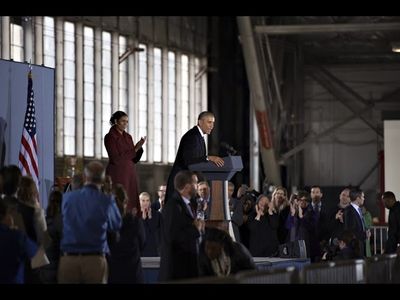
Thank you so much. Thank you. Everybody please have a seat. It is wonderful to see all of you. Thank you, Phyllis, for the wonderful introduction.
I want to thank all the tribal leaders who are here for making this year's conference the most successful yet. I want to acknowledge outstanding members of my team that have helped pull this together, but, more importantly, day in and day out are thinking about what we can do to make sure that all the tribes that are represented have a voice here in Washington.
First of all, my outstanding Secretary of the Interior, Ken Salazar. We are so proud of him. Assistant Secretary for Indian Affairs, Larry Echo Hawk. Hey! And our outstanding solicitor for the Department of Interior, Hilary Tompkins.
Now, today, I'm here not only as President. As I've mentioned before, I am also here as an adopted member of the Crow Nation. So I'd like to recognize my adoptive Mom and Dad, Sonny and Mary Black Eagle, who are backstage. They're going to be coming out here in a little bit.
I'm so grateful they took me into their family. I bet they're grateful that I never went through the "terrible twos" -- or "terrible teens." They got me after I was a little more polished.
Ken Salazar, he works so hard on the issues that matter to all of you. And we also have members of Congress here as well who are great partners in this effort. And I finally -- I want to give a shout-out to the young people who are here as part of the White House program called "Champions for Change." Really remarkable young people. I had a chance to meet them backstage.
There's Teressa Baldwin, who's working to prevent teen suicide among Alaska Natives. LeVon Thomas, who's bringing green jobs to the Navajo Nation. Dallas Duplessis, who started a gardening club to promote healthy eating in Tulalip, Washington. She wrote, "Our goal is not to be couch potatoes, but to grow some potatoes." I think Michelle would like that one.
Standing in this room, with leaders of all ages, it's impossible not to be optimistic about the future of Indian Country. Obviously, we face tough times. But you still believe that tomorrow can be better than today. You're out there making your communities better places to live. What you expect -- and what you deserve -- is a federal government that helps, not hinders, your efforts. You deserve leaders in Washington who fight for you every single day.
That's one of the reasons I ran for this office. When I visited the Crow Nation during the campaign, I said my job was not just to win an election; it was to make sure that Washington starts focusing on you. I promised a true government-to-government relationship -- a relationship that recognizes our sometimes painful history, a relationship that respects the unique heritage of Native Americans and that includes you in the dream that we all share.
And together, we're building that relationship. I told you I would bring tribal leaders to Washington to reflect -- to develop an agenda that reflects your hopes and your concerns. And now, for a third year in a row, we have kept that promise. I told you that when I was President, we wouldn't just pay lip service to the idea of consultation. And today, we're holding every Cabinet agency responsible for working together with Indian tribes.
I told you I'd appoint Native Americans to senior positions in the White House. And I know that many of you have worked with Kim Teehee of Cherokee Nation, my senior policy advisor for Native American issues; and Charlie Galbraith of the Navajo Nation, in our office of Intergovernmental Affairs.
We're working to make our government-to-government relationship even stronger. We asked Congress to recognize the power of tribes to prosecute perpetrators of domestic violence, whether they're Indian or non-Indian. And in the wake of the Carcieri decision, we've asked Congress to restore the Secretary of the Interior's authority to take land into trust for federally recognized Indian tribes.
So this new relationship represents a major step forward. It is change. But I promised even more than that. I told you that as President, I would work with you to tackle the most difficult problems facing Native American families. And that's exactly what we've done. We passed the Tribal Law and Order Act, and began making Indian Country a safer place to live. We permanently authorized the Indian Health Care Improvement Act, and made quality health care accessible to more Native Americans.
Just this week, we streamlined leasing regulations, which will lead to more homes, more businesses, more renewable energy on the reservation. That's what change is.
And finally, we said that even as we include Indian tribes in the broader promise of America, we're going to keep native traditions alive. So when Michelle launched Let's Move! in Indian Country, she brought lacrosse players to the White House, and invited Native American children to plant the "three sisters" crops in the White House vegetable garden.
While our work together is far from over, today we can see what change looks like. It's the Native American-owned small business that's opening its doors, or a worker helping a school renovate. It's new roads and houses. It's wind turbines going up on tribal lands, and crime going down in tribal communities. That's what change looks like.
So we should be proud of what we've done -- together. But of course, that should sharpen our resolve to do even more. Because as long as Native Americans face unemployment and poverty rates that are far higher than the national average, we're going to have more work to do. And I wake up every day focused on how to get this economy growing and create jobs for every American, faster. We're working to rebuild an economy where no matter who you are, no matter what you look like -- black, white, Latino, Asian, Native American -- you can make it if you try.
And that's why I proposed the American Jobs Act -- to help all Americans, including First Americans, make it through these tough times. It's why my administration has addressed the obstacles that are unique to Indian country by guaranteeing loans for homeowners and small business owners and tribes. It's why we're working to equip your communities with high-speed Internet access.
And even as we meet at this moment, we have to prepare the next generation for the future -- which is why, earlier today, I signed an executive order to launch the White House Initiative on American Indian and Alaska Native Education.
Secretary Duncan -- who is here -- Secretary Salazar, they're going to work together on this effort to prepare Native American youth to compete for the high-skilled, good jobs of tomorrow. We're going to find ways to reduce the dropout rate. We're going to help students who've already dropped out re-enter the education system. And we're going to strengthen our Tribal Colleges and Universities. They are cornerstones of their community and they deserve our support.
So we've made progress together. And a lot of that progress is possible because of all of you -- because the ideas that you've shared at the last two conferences, and that you're sharing at this conference.
And that's why I'm looking forward to hearing the results of the discussion that you have today. I want to know what we can do to keep tackling the tough issues -- from education to jobs to health care to public safety.
It would be nice to say that the work was done, but we know the truth. We haven't solved all our problems. We've got a long road ahead. But I believe that one day, we're going to be able to look back on these years and say that this was a turning point.
This was the moment when we began to build a strong middle class in Indian Country; the moment when businesses, large and small, began opening up in reservations; the moment when we stopped repeating the mistakes of the past, and began building a better future together, one that honors old traditions and welcomes every Native American into the American Dream.
We've got to finish what we started. So today, I want to thank all of you for everything that you do. I want to ask you to keep going. And when you go back home, making your communities better places to live, I want you all to know that you've got a partner in Washington. You have an administration that understands the challenges that you face and, most importantly, you've got a President who's got your back.
So thank you. God bless you. God bless the United States of America.