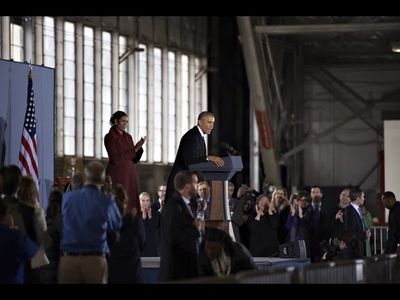
Well, to President DeGioia, thank you so much for the gracious introduction, and thanks for bringing your family -- including JT -- appreciate you. We're going to invite him over, hang out with the girls. He's a pretty good-looking young man. 德吉奥亚校长,非常感谢您热情的介绍,也感谢您带着家人——包括JT——前来,很感激。我们要邀请他过来,和女孩们一起玩。他可是个挺帅气的小伙子。
To Mayor Adrian Fenty, who's doing such a great job in this city, thank you so much for your attendance. To Representative Donna Edwards, who is here and represents Maryland's 4th District, thank you. 阿德里安·芬蒂市长,您在这座城市做得非常出色,非常感谢您的光临。唐娜·爱德华兹众议员,您今天在场,代表马里兰州第四选区,谢谢您。
To Georgetown University students, it is great to be here. Well, it is good to be back. I appeared in this room during the campaign and had a wonderful reception then, and it's wonderful to be back and be with all of you. 乔治城大学的同学们,很高兴来到这里。嗯,很高兴回来。竞选期间我曾在这个房间亮相,当时受到了热情的接待,如今能回到这里与大家相聚,真是太好了。
We're going to talk about the economy today. And I was telling President DeGioia this may be a slightly longer speech than I usually give, but it's a slightly bigger topic, and that is how we are going to deal with so many of our economic challenges. 今天我们要谈谈经济。我跟德吉奥亚校长说过,这可能会比我通常的演讲稍长一些,但话题也稍大一些,那就是我们将如何应对这么多经济挑战。
You know, it's been 12 weeks now since my administration began. And I think that even our critics would agree that at the very least, we've been busy. In just under three months, we've responded to an extraordinary set of economic challenges with extraordinary action -- action that's been unprecedented both in terms of its scale and its speed. 要知道,我的政府上任至今已有12周了。我想连我们的批评者也会承认,至少我们一直没闲着。在不到三个月的时间里,我们以非凡的行动回应了一系列非凡的经济挑战——这些行动无论在规模还是速度上都是前所未有的。
And I know that some have accused us of taking on too much at once. Others believe we haven't done enough. And many Americans are simply wondering how all of our different programs and policies fit together in a single, overarching strategy that will move this economy from recession to recovery and ultimately to prosperity. 我知道有人指责我们一次承担得太多,也有人认为我们做得还不够。而许多美国人只是想弄清楚,我们所有这些不同的计划和政策如何融为一个统一的总体战略,从而推动经济从衰退走向复苏,并最终走向繁荣。
So today, I want to step back for a moment and explain our strategy as clearly as I can. This is going to be prose, and not poetry. I want to talk about what we've done, why we've done it, and what we have left to do. I want to update you on the progress we've made, but I also want to be honest about the pitfalls that may still lie ahead. 所以今天,我想退后一步,尽可能清楚地阐述我们的战略。这将是一篇散文,而非诗歌。我想谈谈我们做了什么、为什么这样做,以及还有什么待办之事。我想向大家通报我们取得的进展,但我也想坦诚前方可能仍存在的陷阱。
Most of all, I want every American to know that each action we take and each policy we pursue is driven by a larger vision of America's future -- a future where sustained economic growth creates good jobs and rising incomes; a future where prosperity is fueled not by excessive debt, or reckless speculation, or fleeting profits, but is instead built by skilled, productive workers, by sound investments that will spread opportunity at home and allow this nation to lead the world in the technologies and the innovation and discoveries that will shape the 21st century. 最重要的是,我要让每一位美国人都知道,我们采取的每一项行动、推行的每一项政策,都源自一个对美国未来更宏大的愿景——一个让持续的经济增长创造优质就业和不断增长的收入的未来;一个繁荣不再由过度举债、鲁莽投机或昙花一现的利润所驱动,而是由熟练而高效的劳动者、由在国内播撒机会并让这个国家在塑造21世纪的技术、创新和发现领域引领世界的稳健投资所构筑的未来。
That's the America I see. That's the America that Georgetown is preparing so many of you for. That is the future that I know that we can have. 那就是我所看到的美国。那就是乔治城大学正在为你们中那么多人做准备的那个美国。那就是我知道我们能够拥有的未来。
Now, to understand how we get there, we first need to understand how we got here. 现在,要理解我们如何抵达那里,我们首先需要理解我们是如何走到今天这一步的。
Recessions are not uncommon. Markets and economies naturally ebb and flow, as we've seen many times in our history. But this recession is different. This recession was not caused by a normal downturn in the business cycle. It was caused by a perfect storm of irresponsibility and poor decision-making that stretched from Wall Street to Washington to Main Street. 衰退并不罕见。市场和经济的自然起落,正如我们在历史上多次所见。但这次衰退不同。这次衰退不是由商业周期的正常下行引起的。它是由一场从华尔街蔓延到华盛顿、再到主街的不负责任和糟糕决策的完美风暴所造成的。
As has been widely reported, it started in the housing market. During the course of the decade, the formula for buying a house changed: Instead of saving their pennies to buy their dream house, many Americans found that suddenly they could take out loans that by traditional standards their incomes just could not support. Others were tricked into signing these subprime loans by lenders who were trying to make a quick profit. 正如广泛报道的那样,这一切始于房地产市场。在过去十年里,购房的公式发生了变化:许多美国人不再积攒一分一厘去购买梦想中的房子,而是发现自己突然能够获得按传统标准其收入根本无法支撑的贷款。还有人被急于赚取快钱的放贷方诱骗签下了这些次级贷款。
The reason these loans were so readily available was that Wall Street saw big profits to be made. Investment banks would buy and package together these questionable mortgages into securities, arguing that by pooling the mortgages the risks had somehow been reduced. And credit agencies that are supposed to help investors determine the soundness of various investments stamped the securities with their safest rating when they should have been labeled "Buyer Beware." 这些贷款之所以如此容易获得,是因为华尔街看到了可观的利润可图。投资银行会把这些存在问题的抵押贷款打包成证券,声称通过把贷款集中起来风险就不知怎的降低了。而本应帮助投资者判断各项投资稳健程度的信用评级机构,却给这些证券盖上了最安全评级的印记,而它们本应被贴上"买家自负"的标签。
No one really knew what the actual value of these securities were, no one fully understood what the risks were. But since the housing market was booming and prices were rising, banks and investors just kept buying and selling them, always passing off the risk to someone else for a greater profit without having to take any of the ultimate responsibility. Banks took on more debt than they could handle. 没人真正知道这些证券的实际价值是多少,没人完全清楚风险有多大。但由于房地产市场一片繁荣、价格持续上涨,银行和投资者就不断买卖它们,总是为了更大的利润把风险转嫁给别人,却不必承担任何最终责任。银行背负的债务超过了它们所能承受的限度。
The government-chartered companies Fannie Mae and Freddie Mac, whose traditional mandate was to help support traditional mortgages, decided to get in on the action by buying and holding billions of dollars of these securities. 政府特许的企业房利美和房地美,其传统使命是帮助支持传统抵押贷款,却也决定加入这场游戏,买入并持有数十亿美元的这类证券。
AIG, the biggest insurer in the world that had a very traditional insurance business that was very profitable, decided to make profits suddenly by selling billions of dollars of complicated financial instruments that supposedly insured these securities. Everybody was making record profits -- except the wealth created was real only on paper. And as the bubble grew, there was almost no accountability or oversight from anyone in Washington. AIG这家全球最大的保险商,本拥有一项非常盈利的传统保险业务,却突然决定通过出售数十亿美元据称能为这些证券提供保险的复杂金融工具来牟利。人人都在创纪录地获利——只不过所创造的财富仅仅停留在纸面上。而随着泡沫不断膨胀,华盛顿几乎没有任何人进行问责或监督。
Then the housing bubble burst. Home prices fell. People began to default on their subprime mortgages. And the value of all those loans and securities plummeted. Banks and investors couldn't find anyone to buy them. Greed gave way to fear. Investors pulled their money out of the market. Large financial institutions that didn't have enough money on hand to pay off all their obligations collapsed. Other banks held on tight to their money and simply stopped lending. 随后房地产泡沫破裂。房价下跌。人们开始违约次级抵押贷款。所有那些贷款和证券的价值暴跌。银行和投资者找不到任何人接盘。贪婪让位于恐惧。投资者把资金撤出市场。手头没有足够现金偿付所有债务的大型金融机构轰然倒塌。其他银行则死死捂住自己的钱,干脆停止了放贷。
Now, this is when the crisis spread from Wall Street to Main Street. After all, the ability to get a loan is how you finance the purchase of everything from a home to a car to, as you all know very well, a college education. It's how stores stock their shelves, and farms buy equipment, and businesses make payroll. So when banks stopped lending money, businesses started laying off workers. When laid-off workers had less money to spend, businesses were forced to lay off even more workers. 而就在此时,危机从华尔街蔓延到了主街。毕竟,能否获得贷款,决定了你能否为购买一切东西融资——从房子到汽车,再到你们都十分清楚的大学教育。这也是商店进货上架、农场购买设备、企业发放工资的依托。
When people couldn't get a car loan, a bad situation at the auto companies became even worse. When people couldn't get home loans, the crisis in the housing market only deepened. Because the infected securities were being traded worldwide and other nations also had weak regulations, this recession soon became global. And when other nations can't afford to buy our goods, it slows our economy even further. 于是当银行停止放贷,企业就开始裁员。被裁掉的工人可支配收入减少,企业又被迫裁掉更多工人。当人们拿不到车贷时,汽车公司的困境雪上加霜。当人们拿不到房贷时,房地产市场的危机只是愈陷愈深。由于这些受感染的证券在全球范围内交易,而其他国家监管同样薄弱,这场衰退很快演变成全球性衰退。而当其他国家买不起我们的商品时,我们的经济会进一步放缓。
So this is the situation, the downward spiral that we confronted on the day that we took office. So our most urgent task has been to clear away the wreckage, repair the immediate damage to the economy, and do everything we can to prevent a larger collapse. And since the problems we face are all working off each other to feed a vicious economic downturn, we've had no choice but to attack all fronts of our economic crisis simultaneously. 这就是我们上任那天所面对的局面——这样一个恶性向下的螺旋。因此,我们最紧迫的任务一直是清理废墟、修复经济受到的直接损害,并竭尽全力防止更大规模的崩溃。由于我们所面临的问题彼此推波助澜、助长着这场恶性经济下行,我们别无选择,只能同时在经济危机的各个战线上发起反击。
The first step was to fight a severe shortage of demand in the economy. So the Federal Reserve did this by dramatically lowering interest rates last year in order to boost investment. My administration and Congress boosted demand by passing the largest recovery plan in our nation's history. It's a plan that's already in the process of saving or creating 3.5 million jobs over the next two years. 第一步是应对经济中需求的严重不足。因此,美联储去年通过大幅降低利率来刺激投资。我的政府和国会则通过颁布我国历史上规模最大的复苏计划来提振需求。
It's putting money directly into people's pockets with a tax cut for 95 percent of working families that's now showing up in paychecks across America. And to cushion the blow of this recession, we also provided extended unemployment benefits and continued health care coverage to Americans who've lost their jobs through no fault of their own. 这项计划已经在过程中,将在未来两年保住或创造350万个就业岗位。它通过为95%的工薪家庭减税,把钱直接放进人们的口袋,如今这笔钱已经出现在全美各地的工资单上。而为了减轻这场衰退的冲击,我们还向那些并非因自身过失而失业的美国人提供了延长失业救济和持续的医疗保险。
Now, you will recall that some argued this recovery plan is a case of irresponsible government spending, that it's somehow to blame for our long-term deficit projections, and that the federal government should be cutting instead of increasing spending right now. So I want to tackle this argument head on. 大家应该记得,有人辩称这项复苏计划是不负责任的政府支出,某种程度上要为我们长期的赤字预测负责,并认为联邦政府现在应当削减而不是增加支出。所以我想正面回应这一论调。
To begin with, economists on both the left and the right agree that the last thing a government should do in the middle of a recession is to cut back on spending. You see, when this recession began, many families sat around the kitchen table and tried to figure out where they could cut back. And so have many businesses. And this is a completely reasonable and understandable reaction. 首先,左翼和右翼的经济学家都认同,政府在衰退期间最不该做的就是削减支出。要知道,这场衰退开始时,许多家庭围坐在餐桌旁,琢磨着能在哪里削减开支。许多企业也是如此。这完全是合情合理、可以理解的反应。
But if everybody -- if everybody -- if every family in America, if every business in America cuts back all at once, then no one is spending any money, which means there are no customers, which means there are more layoffs, which means the economy gets even worse. That's why the government has to step in and temporarily boost spending in order to stimulate demand. That's exactly what we're doing right now. 但如果所有人——如果所有人——如果美国的每一个家庭、每一家企业同时削减开支,那就没人花钱了,这意味着没有顾客,意味着会有更多裁员,意味着经济会进一步恶化。正因如此,政府必须介入,暂时增加支出以刺激需求。这正是我们此刻正在做的。
Second, I absolutely agree that our long-term deficit is a major problem that we have to fix. But the fact is that this recovery plan represents only a tiny fraction of that long-term deficit. As I'll discuss in a moment, the key to dealing with our long-term deficit and our national debt is to get a handle on out-of-control health care costs -- not to stand idly by as the economy goes into free fall. 其次,我完全同意我们的长期赤字是一个必须解决的重大问题。但事实是,这项复苏计划只占长期赤字的极小一部分。正如我稍后将谈到的,应对长期赤字和国债的关键,是控制失控的医保成本——而不是在经济自由下落时袖手旁观。
So the recovery plan has been the first step in confronting this economic crisis. The second step has been to heal our financial system so that credit is once again flowing to the businesses and families who rely on it. 所以复苏计划是应对这场经济危机的第一步。第二步是修复我们的金融体系,让信贷重新流向依赖它的企业和家庭。
The heart of this financial crisis is that too many banks and other financial institutions simply stopped lending money. In a climate of fear, banks were unable to replace their losses from some of those bad mortgages by raising new capital on their own, and they were unwilling to lend the money they did have because they were afraid that no one would pay it back. It's for this reason that the last administration used what they called the Troubled Asset Relief Program, or TARP, to provide these banks with temporary financial assistance in order to get them lending again. 这场金融危机的核心,是太多银行和其他金融机构干脆停止了放贷。在恐惧的氛围中,银行既无法通过自行筹集新资本来弥补那些不良抵押贷款造成的损失,又不愿把手里还有的钱贷出去,因为它们担心没人会偿还。正因如此,上一届政府动用了他们所称的"不良资产救助计划"(简称TARP),向这些银行提供临时财政援助,以促使它们重新放贷。
Now, I understand that TARP is not popular, and I have to say that I don't agree with some of the ways the TARP program was managed, but I do agree with the broader rationale that we must provide banks with the capital and the confidence necessary to start lending again. That's the purpose of the stress tests that will soon tell us how much additional capital will be needed to support lending at our largest banks. 我明白TARP不得人心,我也要说,TARP计划的一些管理方式我并不认同,但我确实赞同其更宏观的理念:我们必须向银行提供重新开始放贷所需的资本和信心。这就是压力测试的目的,它将很快告诉我们,要支撑我们最大银行的放贷业务还需要多少额外资本。
Ideally, these needs will be met by private investors who are willing to put in money to these banks. But where that's not possible, and banks require substantial additional resources from the government, then we will hold accountable those who are responsible, we'll force the necessary adjustments, we'll provide the support to clean up those bank balance sheets, and we will assure the continuity of a strong and viable institution that can serve our people and our economy. 理想情况下,这些需求将由愿意向这些银行注资的私人投资者来满足。但在无法实现的情况下,若银行需要政府提供大量额外资源,那么我们将追究相关责任人的责任,我们将强制进行必要的调整,我们将提供支持以清理那些银行的资产负债表,并且我们将确保一个强健可行的机构得以延续,从而为我国人民和经济服务。
Of course, there are some who differ with our approach. On the one hand, there are some who argue that the government should stand back and simply let these banks fail -- especially since in many cases it was their bad decisions that helped create the crisis in the first place. 当然,也有一些人对我们的做法持不同意见。一方面,有人主张政府应当退后一步,干脆让这些银行倒闭——尤其是因为在许多情况下,正是它们的糟糕决策一手酿成了这场危机。
But whether we like it or not, history has shown repeatedly that when nations do not take early and aggressive action to get credit flowing again, they have crises that last years and years instead of months and months -- years of low growth, years of low job creation, years of low investment, all of which cost these nations far more than a course of bold, upfront action. 但无论我们喜不喜欢,历史一再表明:当各国不采取及早而有力的行动让信贷重新流动时,它们所经历的危机将持续数年数年,而非数月数月——多年的低增长、多年的低就业创造、多年的低投资,所有这些让这些国家付出的代价,远远超过一开始就采取大胆行动所付出的代价。
And although there are a lot of Americans who understandably think that government money would be better spent going directly to families and businesses instead of to banks -- one of my most frequent questions in the letters that I get from constituents is, "Where's my bailout?" -- and I understand the sentiment. 尽管有许多美国人——可以理解地——认为政府的钱最好直接给到家庭和企业,而不是给银行;选民用信件向我提出的最频繁的问题之一就是:"我的救助在哪里?"——我理解这种情绪。
It makes sense intuitively, and morally it makes sense, but the truth is that a dollar of capital in a bank can actually result in $8 or $10 of loans to families and businesses. 这在直觉上说得通,在道德上也说得通,但真相是,银行里1美元的资本实际上能够转化为流向家庭和企业的8到10美元贷款。因此这是一种乘数效应,最终能带来更快的经济增长步伐。这就是我们必须修复银行的原因。
So that's a multiplier effect that can ultimately lead to a faster pace of economic growth. That's why we have to fix the banks. 另一方面,也有一些人不否认我们需要稳固银行体系,但他们认为我们的做法过于胆怯。这基本上就是你们中有些人可能听过的国有化论调。
Now, on the other hand, there have been some who don't dispute that we need to shore up the banking system, but they suggest that we've been too timid in how we go about it. This is essentially the nationalization argument that some of you may have heard. 这种论调认为,联邦政府本应预先介入并接管这些大型金融机构,就像FDIC目前干预较小银行那样;而我们——我政府——没有这样做,是华盛顿纵容华尔街的又一例证——"你们为什么不对银行更强硬些?"
And the argument says that the federal government should have already preemptively stepped in and taken over major financial institutions the way that the FDIC currently intervenes in smaller banks, and that our failure, my administration's failure to do so is yet another example of Washington coddling Wall Street -- "Why aren't you tougher on the banks?" 所以让我说清楚:我们没有采取这一步骤的原因,与我们就政府介入银行所作的任何意识形态或政治判断无关。当然也不是因为我们关心那些管理层和股东——正是他们的行为促成了这个烂摊子。相反,是因为我们认为,预先的政府接管最终可能让纳税人付出更大代价,也是因为它更可能削弱而非建立信心。
So let me be clear: The reason we have not taken this step has nothing to do with any ideological or political judgment we've made about government involvement in banks. It's certainly not because of any concern we have for the management and shareholders whose actions helped to cause this mess. Rather, it's because we believe that preemptive government takeovers are likely to end up costing taxpayers even more in the end, and because it's more likely to undermine than create confidence. 政府应当秉持与医生相同的原则:首先,不要造成伤害。所以请放心——我们将采取一切必要措施让信贷重新流动,但我们会以尽量降低纳税人和更广泛经济风险的方式来做到这一点。为此,除了向银行提供资本的计划之外,我们还启动了一项计划,将政府资源与私人投资结合起来,以清理那些旧贷款和证券——即所谓的"有毒资产"——它们同样阻碍着我们的银行放贷。
Governments should practice the same principle as doctors: First, do no harm. So rest assured -- we will do whatever is necessary to get credit flowing again, but we will do so in ways that minimize risks to taxpayers and to the broader economy. To that end, in addition to the program to provide capital to the banks, we've launched a plan that will pair government resources with private investment in order to clear away the old loans and securities -- the so-called toxic assets -- that are also preventing our banks from lending money. 此外,在这场危机中我们还认识到,受这些堵塞金融体系的有毒资产影响的,并不只有我们的银行。比如AIG,它不是银行,正如我所说,它是一家保险公司——然而由于它选择为价值数十亿美元的高风险资产提供保险,本质上是在一家保险公司之上又搭了一个对冲基金,它的失败可能威胁整个金融体系,并让放贷进一步冻结。
Now, what we've also learned during this crisis is that our banks aren't the only institutions affected by these toxic assets that are clogging the financial system. AIG, for example, is not a bank, it's an insurance company, as I mentioned -- and yet because it chose to insure billions of dollars worth of risky assets, essentially creating a hedge fund on top of an insurance company, its failure could threaten the entire financial system and freeze lending even more. 正因如此,尽管令人懊恼——我向你们保证,没有谁比我更对AIG感到懊恼——我保证——我们也不得不为AIG提供支持,因为整个体系本身已经十分脆弱,如果AIG进入清算破产,它可能遭到严重危及。
And that's why, as frustrating as it is -- and I promise you, nobody is more frustrated than me with AIG -- I promise -- we had to provide support for AIG, because the entire system, as fragile as it is, could be profoundly endangered if AIG went into a liquidation bankruptcy. 这也正是我们需要新的法律授权的原因,以便我们有权介入此类金融机构,就像破产法庭目前处理那些陷入困境但不构成系统性风险的企业那样——这样我们就能以有序的方式重组这些企业,而不至于在金融体系中引发恐慌——而且,顺便说一句,这将使我们能够重组不当的奖金合同,又不会造成政府可以随意更改薪酬规则的印象。
It's also why we need new legal authority so that we have the power to intervene in such financial institutions, the same way that bankruptcy courts currently do with businesses that hit hard times but don't pose systemic risks -- and that way we can restructure these businesses in an orderly way that doesn't induce panic in the financial system -- and, by the way, will allow us to restructure inappropriate bonus contracts without creating a perception the government can just change compensation rules on a whim. 这也是我们正积极行动以解冻银行体系之外的市场、重启该领域放贷的原因,美国实际上有一半以上的放贷发生在那里。为此,我们启动了一项计划,将增加对小企业贷款的担保,并打开汽车贷款和学生贷款的市场。而为了稳定房地产市场,我们推出了一项计划,将使多达四百万负责任的房主免于丧失赎回权,并帮助另外数百万人再融资他们的住房。
This is also why we're moving aggressively to unfreeze markets and jumpstart lending outside the banking system, where more than half of all lending in America actually takes place. To do this, we've started a program that will increase guarantees for small business loans and unlock the market for auto loans and student loans. And to stabilize the housing market, we've launched a plan that will save up to four million responsible homeowners from foreclosure and help many millions more to refinance their homes. 几周后,我们还将重新评估克莱斯勒和通用汽车的状况,这两家公司在我国历史上占有重要地位,在我国经济中也有巨大的影响力——但这两家公司也同样陷入了困境。
In a few weeks, we will also reassess the state of Chrysler and General Motors, two companies with an important place in our history and a large footprint in our economy -- but two companies that have also fallen on hard times. 去年晚些时候,上一届政府向这些公司提供了过渡性贷款,帮助它们在制定可行的商业计划期间渡过难关。不幸的是,它们制定的计划并不达标,所以我们又给它们一些额外时间来解决这些复杂问题。
Late last year, the companies were given transitional loans by the previous administration to tide them over as they worked to develop viable business plans. Unfortunately, the plans they developed fell short, so we've given them some additional time to work these complex issues through. And by the way, we owed that not to the executives whose bad bets contributed to the weakening of their companies, but to the hundreds of thousands of workers whose livelihoods hang in the balance -- entire towns, entire communities, entire states are profoundly impacted by what happens in the auto industry. 顺便说一句,我们这样做不是为了那些高管——他们的错误押注削弱了这些公司——而是为了数十万生计悬于一线的工人——整个城镇、整个社区、整个州都深受汽车产业状况的影响。
Now, it is our fervent hope that in the coming weeks, Chrysler will find a viable partner and GM will develop a business plan that will put it on a path to profitability without endless support from American taxpayer. In the meantime, we're taking steps to spur demand for American cars and provide relief for autoworkers and their communities. And we will continue to reaffirm this nation's commitment to a 21st-century American auto industry that creates new jobs and builds the fuel-efficient cars and trucks that will carry us toward a clean-energy future. 现在,我们殷切希望在未来几周里,克莱斯勒能找到一个可行的合作伙伴,通用能制定出一条无需美国纳税人无休止支持即可走向盈利的商业计划。与此同时,我们正采取措施刺激对美国汽车的需求,并为汽车工人及其所在社区提供救济。我们也将继续重申这个国家对21世纪美国汽车产业的承诺,它将创造新的就业,制造将载我们驶向清洁能源未来的节能型轿车和卡车。
Finally, to coordinate a global response to this global recession, I went to the meeting of the G20 nations in London the other week. Each nation has undertaken significant stimulus to spur demand. All agreed to pursue tougher regulatory reforms. 最后,为协调对这场全球性衰退的全球性应对,我前阵子前往伦敦参加了G20峰会。每个国家都采取了重大刺激措施以提振需求。各方都同意推进更严格的监管改革。
We also agreed to triple the lending capacity of the International Monetary Fund -- which, as many of you know, is an international financial institution supported by all the major economies -- so that they can provide direct assistance to developing nations and vulnerable populations. That's not just charity; because America's success depends on whether other nations have the ability to buy what we sell, it's important that we pay attention to these emerging markets. 我们还同意将国际货币基金组织的贷款能力提高两倍——正如你们中许多人所知,它是一个由所有主要经济体支持的国际金融机构——以便它们能向发展中国家和脆弱人群提供直接援助。这不仅仅是慈善;因为美国的成功取决于其他国家是否有能力购买我们所出售的商品,关注这些新兴市场对我们很重要。
We pledged to avoid the trade barriers and protectionism that hurts us all in the end. And we decided to meet again in the fall to gauge our progress and take additional steps if necessary. 我们承诺避免最终会伤害我们所有人的贸易壁垒和保护主义。我们还决定秋天再次会面,评估进展并在必要时采取额外措施。
So that's where we've been, that's what we've done in the last three months. All of these actions -- the Recovery Act, the bank capitalization program, the housing plan, the strengthening of the non-bank credit market, the auto plan, and our work at the G20 -- all have been necessary pieces of the recovery puzzle. They've been designed to increase aggregate demand to get credit flowing again to families and businesses and to help families and businesses ride out the storm. And taken together, these actions are starting to generate signs of economic progress. 这就是我们一路走来的情况,这就是我们过去三个月所做的事。所有这些行动——《复苏法案》、银行资本化计划、住房计划、对非银行信贷市场的强化、汽车业计划以及我们在G20的工作——都是复苏拼图中必不可少的部分。它们旨在提高总需求、让信贷重新流向家庭和企业,并帮助家庭和企业渡过难关。综合来看,这些行动正开始产生经济向好的迹象。
Because of our recovery plan, schools and police departments have cancelled planned layoffs; clean energy companies and construction companies are re-hiring workers to build everything from energy-efficient windows to new roads and highways. Our housing plan has helped lead to a spike in the number of homeowners who are taking advantage of historically-low mortgage rates by refinancing, which is like putting a $2,000 tax cut in your pocket. 得益于我们的复苏计划,学校和警察部门取消了原定的裁员;清洁能源公司和建筑公司正在重新雇用工人,建造从节能窗户到新公路和高速公路的各种东西。
Our program to support the market for auto loans and student loans has started to unfreeze this market and securitize more of this lending in the last few weeks. And small businesses are seeing a jump in loan activity for the first time in months. 我们的住房计划促成了房主数量的激增,他们利用历史低位抵押贷款利率进行再融资,这相当于把2000美元的减税放进了你的口袋。我们支持汽车贷款和学生贷款市场的计划,在过去几周已开始解冻这一市场,并将更多此类贷款证券化。而小企业数月以来首次看到贷款活动的跃升。
Now, this is all welcome and encouraging news. It does not mean the hard times are over; 2009 will continue to be a difficult year for America's economy, and obviously, most difficult for those who've lost their jobs. The severity of this recession will cause more job loss, more foreclosures, and more pain before it ends. 这些都是令人欣慰和鼓舞的消息。但这并不意味着艰难时刻已经过去;2009年对美国经济而言仍将是艰难的一年,显然,对那些失去工作的人来说最为艰难。这场衰退的严重性意味着在它结束之前,还会有更多失业、更多止赎、更多痛苦。市场仍会继续起伏。信贷的流动仍然远没有达到应有的顺畅。重组AIG和汽车公司的过程将涉及艰难且有时不受欢迎的抉择;我们在这一战线上尚未完成。
The market will continue to rise and fall. Credit is still not flowing nearly as easily as it should. The process for restructuring AIG and the auto companies will involve difficult and sometimes unpopular choices; we are not finished yet on that front. And all of this means that there's much more work to be done. But all of this also means that you can continue to expect an unrelenting, unyielding, day-by-day effort from this administration to fight for economic recovery on all fronts. 而所有这一切意味着,还有更多工作要做。但所有这一切也意味着,你们可以继续期待本届政府以毫不松懈、毫不退让、日复一日的努力,在所有战线上为经济复苏而战。
But even as we continue to clear away the wreckage and address the immediate crisis, it is my firm belief that our next task, beginning now, is to make sure such a crisis never happens again. Even as we clean up balance sheets and get credit flowing again, even as people start spending and businesses start hiring -- all that's going to happen -- we have to realize that we cannot go back to the bubble-and-bust economy that led us to this point. 但即便我们继续清理废墟、应对眼前的危机,我仍坚定地认为,我们从现在起的下一项任务,是确保这样的危机不再发生。即便我们在清理资产负债表、让信贷重新流动,即便人们开始消费、企业开始招聘——这一切都会发生——我们也必须认识到,我们不能回到那个把我们带到这一步的泡沫与破裂循环的经济中去。
It is simply not sustainable to have a 21st-century financial system that is governed by 20th-century rules and regulations that allowed the recklessness of a few to threaten the entire economy. 一个由20世纪的规则和监管所治理的21世纪金融体系——这些规则允许少数人的鲁莽行为威胁整个经济——根本不可持续。一个在某一年里有40%的企业利润来自金融部门的经济也不可持续,而那个金融部门建立在虚高的房价、刷爆的信用卡、过度杠杆化的银行和估值过高的资产之上。
It is not sustainable to have an economy where in one year, 40 percent of our corporate profits came from a financial sector that was based on inflated home prices, maxed-out credit cards, over-leveraged banks and overvalued assets. It's not sustainable to have an economy where the incomes of the top 1 percent has skyrocketed while the typical working household has seen their incomes decline by nearly $2,000. That's just not a sustainable model for long-term prosperity. 一个让最顶尖1%人群的收入飙升、而典型工薪家庭的收入却下降了近2000美元的经济,同样不可持续。这根本不是实现长期繁荣的可持续模式。
For even as too many were out there chasing ever-bigger bonuses and short-term profits over the last decade, we continued to neglect the long-term threats to our prosperity: the crushing burden that the rising cost of health care is placing on families and businesses; the failure of our education system to prepare our workers for a new age; the progress that other nations are making on clean energy industries and technologies while we -- we remain addicted to foreign oil; the growing debt that we're passing on to our children. 因为就在过去十年里,太多人追逐越来越大的奖金和短期利润的同时,我们却继续忽视对繁荣的长期威胁:不断上涨的医保成本给家庭和企业带来的沉重负担;我们的教育体系未能为新时代培养好我们的劳动者;其他国家在清洁能源产业和技术上取得进展,而我们——我们却仍沉迷于外国石油;我们正在传给子孙后代的日益沉重的债务。
Even after we emerge from the current recession, these challenges will still represent major obstacles that stand in the way of our success in the 21st century. So we've got a lot of work to do. 即便我们从当前的衰退中走出来,这些挑战仍将是横亘在我们21世纪成功之路上的重大障碍。所以我们有大量工作要做。
Now, there's a parable at the end of the Sermon on the Mount that tells the story of two men. The first built his house on a pile of sand, and it was soon destroyed when a storm hit. But the second is known as the wise man, for when "the rain descended, and the floods came, and the winds blew, and beat upon that house, it fell not: for it was founded upon a rock." 在《登山宝训》的结尾有一个寓言,讲述了两个人的故事。第一个人把房子盖在沙堆上,风暴袭来时它很快就被摧毁了。但第二个人被称为聪明人,因为"雨淋下来,洪水来了,风吹起,撞击那座房子,它却没有倒塌:因为它建立在磐石之上。"
It was founded upon a rock. We cannot rebuild this economy on the same pile of sand. We must build our house upon a rock. We must lay a new foundation for growth and prosperity -- a foundation that will move us from an era of borrow and spend to one where we save and invest; where we consume less at home and send more exports abroad. 它建立在磐石之上。我们不能在同一堆沙子上重建这个经济。我们必须把房子盖在磐石上。我们必须为增长和繁荣奠定新的基础——一个将把我们从举债消费的时代带入储蓄与投资的时代的基础;一个让我们在国内消费更少、向海外出口更多的时代的基础。
It's a foundation built upon five pillars that will grow our economy and make this new century another American century: 这一基础由五根支柱构成,将推动我们的经济增长,并使这个新世纪成为又一个美国世纪:第一,针对华尔街的新规则,奖励干劲和创新,而非鲁莽的冒险;第二,对教育的新投资,使我们的劳动者更熟练、更具竞争力;
Number one, new rules for Wall Street that will reward drive and innovation, not reckless risk-taking; number two, new investments in education that will make our workforce more skilled and competitive; number three, new investments in renewable energy and technology that will create new jobs and new industries; number four, new investments in health care that will cut costs for families and businesses; and number five, new savings in our federal budget that will bring down the debt for future generations. 第三,对可再生能源和技术的新投资,创造新的就业和新的产业;第四,对医保的新投资,为家庭和企业削减成本;第五,在联邦预算中实现新的节约,为子孙后代降低债务。
That's the new foundation we must build. That's our house built upon a rock. That must be our future -- and my administration's policies are designed to achieve that future. 这就是我们必须建造的新基础。这就是我们盖在磐石上的房子。这必须成为我们的未来——而本届政府的政策正是为实现那个未来而设计的。
Let me talk about each of these steps in turn. The first step we will take to build this foundation is to reform the outdated rules and regulations that allowed this crisis to happen in the first place. It is time to lay down tough new rules of the road for Wall Street to ensure that we never find ourselves here again. 让我依次谈谈这些步骤。为建造这一基础,我们将采取的第一步,是改革那些当初让这场危机得以发生的过时规则和监管。是时候为华尔街制定严格的新行为准则了,以确保我们永远不再陷入今天的境地。
Just as after the Great Depression new rules were designed for banks to avoid the kind of reckless speculation that helped to create the depression, so we've got to make adaptations to our current set of rules: create rules that punish shortcuts and abuse; rules that tie someone's pay to their actual job performance --- a novel concept; rules that protect typical American families when they buy a home, get a credit card or invest in a 401(k). 正如大萧条之后为银行制定了新规则以避免助长萧条的那种鲁莽投机一样,我们也必须对现行规则作出调整:制定惩治走捷径和滥用的规则;把薪酬与实际工作表现挂钩的规则——一个新颖的概念;在普通美国家庭购房、办信用卡或投资401(k)时保护他们的规则。
So we've already begun to work with Congress to shape this comprehensive new regulatory framework -- and I expect a bill to arrive on my desk for my signature before the year is out. 因此我们已经着手与国会合作,塑造这一全面的新监管框架——我期望在今年结束前能有一项法案送到我的案头等待签署。
The second pillar of this new foundation is an education system that finally prepares our workers for a 21st century economy. You know, in the 20th century, the G.I. Bill helped send a generation to college. For decades we led the world in educational attainment, and as a consequence we led the world in economic growth. 这一新基础的第二根支柱,是一个最终能为21世纪经济培养好劳动者的教育体系。要知道,在20世纪,《退伍军人权利法案》帮助了一代人走进大学。几十年来我们在教育普及率上领先世界,因此我们也在经济增长上领先世界。但在这个新经济中,我们已在毕业率、教育成就以及科学家和工程师的培养上落后于世界领先者。
But in this new economy, we've come to trail the world's leaders in graduation rates, in educational achievement, in the production of scientists and engineers. That's why we have set a goal that will greatly enhance our ability to compete for the high-wage, high-tech jobs of the 21st century: By 2020, America will once again have the highest proportion of college graduates in the world. That is the goal that we have set and we intend to do. 正因如此,我们设定了一个将极大增强我们竞争21世纪高薪、高科技岗位能力的目标:到2020年,美国将再次成为全球大学毕业生比例最高的国家。这是我们设定的目标,也是我们决心实现的。
To meet that goal, we have to start early. So we've already dramatically expanded early childhood education. We are investing in innovative programs that have proven to help schools meet high standards and close achievement gaps. We're creating new rewards that tie teachers' performance and new pathways for advancement. And I've asked every American to commit to at least one year or more of higher education or career training, and we have provided tax credits to make a college education more affordable for every American, even those who attend Georgetown. 为实现这一目标,我们必须及早着手。所以我们已经大幅扩大了早期儿童教育。我们正在投资那些已被证明能帮助学校达到高标准、缩小成就差距的创新项目。我们正在创设新的奖励机制,把教师的绩效与晋升新路径挂钩。我已呼吁每个美国人承诺至少完成一年或更多的高等教育或职业培训,并且我们提供了税收抵免,让每个美国人——包括在乔治城就读的人——都能更负担得起大学教育。
And, by the way, one of the changes that I would like to see -- and I'm going to be talking about this in weeks to come -- is once again seeing our best and our brightest commit themselves to making things -- engineers, scientists, innovators. For so long, we have placed at the top of our pinnacle folks who can manipulate numbers and engage in complex financial calculations. And that's good, we need some of that. But you know what we can really use is some more scientists and some more engineers, who are building and making things that we can export to other countries. 顺便说一句,我希望看到的一项变化——接下来几周我会谈到这一点——就是再次看到我们最优秀、最聪明的人投身于制造东西——工程师、科学家、创新者。长久以来,我们把那些能操纵数字、进行复杂金融计算的人放在了金字塔的顶端。这没问题,我们也需要一些这样的人。但你们知道我们真正需要的,是更多的科学家和工程师,去建造和制造那些我们能出口到其他国家的东西。
Now, the third pillar of this new foundation is to harness the renewable energy that can create millions of new jobs and new industries. We all know that the country that harnesses this new energy source will lead the 21st century. Yet we've allowed other countries to outpace us on this race to the future. I don't know about you, but I do not accept a future where the jobs and industries of tomorrow take root beyond our borders. I think it's time for America to lead again. 这一新基础的第三根支柱,是开发利用能创造数百万新就业和新产业的可再生能源。我们都知道,开发利用这种新能源的国家将引领21世纪。然而我们却任由其他国家在这场通向未来的竞赛中超越我们。我不知道你们怎么想,但我无法接受一个让明天的就业和产业在我国的边境之外扎根的未来。我认为美国是时候再次引领了。
So the investments we made in the Recovery Act will double this nation's supply of renewable energy in the next three years. And we are putting Americans to work making our homes and buildings more efficient so that we can save billions on our energy bills and grow our economy at the same time. 因此,我们在《复苏法案》中所作的投资将在未来三年让这个国家的可再生能源供应量翻一番。而且我们正在让美国人投入工作,使我们住宅和建筑更加节能,这样我们就能在能源账单上节省数十亿美元,同时促进经济增长。
Now, the only though that we can truly spark the transformation that's need is through a gradual, market-based cap on carbon pollution, so that clean energy is the profitable kind of energy. 现在,我们能够真正引发所需变革的唯一途径,是对碳排放实施渐进的、以市场为基础的上限,从而让清洁能源成为有利可图的那一类能源。
There are those who've argued that we shouldn't attempt, we shouldn't even be thinking, we shouldn't even be talking about such a transition until the economy recovers. And they are right that we have to take into account the costs of transition. Transitioning to a clean energy economy will not be easy. But we can no longer delay putting a framework for a clean energy economy in place. That needs to be done now. 有人主张我们不应尝试,甚至不应思考、不应谈论这样的转型,直到经济复苏。他们指出我们必须考虑转型的成本,这点没错。向清洁能源经济转型不会轻松。但我们再也不能推迟建立清洁能源经济框架的工作了。这件事现在就必须做。
If businesses and entrepreneurs know today that we are closing this carbon pollution loophole, they'll start investing in clean energy now. And pretty soon, we'll see more companies constructing solar panels, and workers building wind turbines, and car companies manufacturing fuel-efficient cars. Investors will put some money into a new energy technology, and a small business will open to start selling it. That's how we can grow this economy, enhance our security, and protect our planet at the same time. 如果企业和企业家们今天就知道我们要堵上碳排放这个漏洞,他们现在就会开始投资清洁能源。很快,我们就会看到更多的公司在建造太阳能板,工人们在建造风力涡轮机,汽车公司在制造节能型汽车。投资者会把资金投入某项新能源技术,而一家小企业会开张开始销售它。这就是我们能够同时促进经济增长、增强国家安全、保护地球的方式。
Now, the fourth pillar of our new foundation is a 21st century health care system where families, businesses and government budgets aren't dragged down by skyrocketing insurance premiums. One and a half million Americans could lose their homes this year just because of a medical crisis. Major American corporations are struggling to compete with their foreign counterparts. Small businesses are closing their doors. We can't allow the cost of health care to continue strangling our economy. 我们新基础的第四根支柱,是一个21世纪的医保体系,让家庭、企业和政府预算不再被飞涨的保险费拖垮。今年仅因一场医疗危机,就可能有一百五十万美国人失去他们的住房。美国大企业正艰难地与外国同行竞争。小企业纷纷关门。我们不能让医保成本继续扼杀我们的经济。
And that's why our Recovery Act will invest in electronic health records with strict privacy standards that can save money and lives and reduce medical error. That's why we've made the largest investment ever in preventive care, because that's one of the best ways to keep costs under control. 正因如此,我们的《复苏法案》将投资于带有严格隐私标准的电子健康档案,它能省钱、救命并减少医疗差错。正因如此,我们在预防性护理上作出了有史以来最大规模的投资,因为这是控制成本的最佳途径之一。
And included in the budgets that just passed Congress is an historic commitment to reform that will finally make quality health care affordable for every American. So I'm looking forward in the next few months to working with both parties in Congress to make this reform a reality. We can get this done -- and we have to get it done. 而刚刚获得国会通过的预算中,包含了一项对改革的历史性承诺,它最终将让每个美国人都负担得起优质医保。所以我期待着在未来几个月与国会两党合作,把这项改革变成现实。我们能做到——而且我们必须做到。
Now, fixing our health care system will -- will require resources; it's not going to be free. But in my budget we've made a commitment to fully pay for reform without increasing the deficit, and we've identified specific savings that will make the health care system more efficient and reduce costs for us all. 修复我们的医保体系——是需要资源的;它不会免费。但在我的预算中,我们承诺在不增加赤字的情况下全额支付改革成本,并且我们已经确定了具体的节约措施,将使医保体系更高效,并为我们所有人降低成本。
In fact, we've undertaken an unprecedented effort to find this kind of savings in every corner of the budget, because the final pillar in building our new foundation is restoring fiscal discipline once this economy recovers. 事实上,我们已经展开了一项前所未有的努力,在预算的每个角落寻找此类节约,因为建造我们新基础的最后一根支柱,是在经济一旦复苏后恢复财政纪律。
Already we've identified $2 trillion dollars in deficit reductions over the next decade. We need to do more, but we've already done that. We've announced procurement reform that will greatly reduce no-bid contracts and save the government $40 billion. We need to do more, but that's an important start. 我们已经在下一个十年中确定了2万亿美元的赤字削减。我们还需要做得更多,但我们已经做到了这一点。我们宣布了采购改革,将大幅减少非竞争性合同,为政府节省400亿美元。我们还需要做得更多,但这已是一个重要的开端。
Secretary Gates recently announced a courageous set of reforms that go right at the hundreds of billions of dollars in waste and cost overruns that have bloated our defense budget without making America safer. We need to do more, but that proposal by Secretary Gates is right on target. We will end education programs that don't work, we will root out waste and fraud and abuse in our Medicare program. 盖茨部长最近宣布了一套勇敢的改革方案,直指那些让我国国防预算膨胀却未让美国更安全的数千亿美元浪费和成本超支。我们还需要做得更多,但盖茨部长的提议正中要害。我们将终止那些无效的教育项目,我们将根除Medicare医保项目中的浪费、欺诈和滥用。
Altogether, this budget will reduce discretionary spending for domestic programs as a share of the economy by more than 10 percent over the next decade to the lowest level we've seen since we began keeping records nearly half a century ago. And as we continue to go through the federal budget line by line, we will be announcing additional savings, secured by eliminating and consolidating programs that we don't need so we can make room for the things that we do need. 总体而言,这项预算将在下一个十年把国内项目的可自由支配开支占经济的比重降低10%以上,降至我们近半个世纪前开始记录以来的最低水平。而随着我们继续逐项审查联邦预算,我们将宣布额外的节约措施,通过取消和合并我们不需要的项目来获得这些节约,从而为我们确实需要的东西腾出空间。
That's what we're doing now. Of course, I realize that for some, this isn't enough. I know there's a criticism out there that my administration has been spending with reckless abandon, pushing a liberal social agenda while mortgaging our children's future. You've heard the argument. 这就是我们此刻正在做的。当然,我意识到对一些人来说,这还不够。我知道有一种批评说,我的政府一直在毫无节制地挥霍开支,推行自由派的社会议程,同时拿我们子孙的未来做抵押。你们都听过这种论调。
Well, let me make three points. First, as I said earlier, the worst thing that we could do in a recession this severe is to try to cut government spending at the same time as families and businesses around the world are cutting back on their spending. So as serious as our deficit and debt problems are -- and they are very serious -- major efforts to deal with them have to focus on the medium and long-term budget picture, not on the short-term. And that's exactly what we've done. 好吧,让我说三点。第一,正如我先前所说,在如此严重的衰退中,我们能做的最糟糕的事,就是试图在世界各地的家庭和企业都在削减开支的同时削减政府开支。所以尽管我们的赤字和债务问题很严重——确实很严重——应对它们的主要努力也必须聚焦于中期和长期的预算前景,而非短期。而这正是我们所做的。
Second, in tackling the deficit issue, we simply cannot sacrifice the long-term investments that we so desperately need to generate long-term prosperity. That's the argument that some critics have made: Well, you're proposing health care reform, you shouldn't be doing that; you're proposing education investments, you shouldn't be doing that, that adds to the deficit. 第二,在应对赤字问题时,我们绝不能牺牲那些我们急需以创造长期繁荣的长期投资。这是一些批评者的论调:嗯,你在推动医保改革,你不该那样做;你在推动教育投资,你不该那样做,那会增加赤字。
Look, just as a cash-strapped family may cut back on all kinds of luxuries, but will still insist on spending money to get their children through college, will refuse to have their kids drop out of college and go to work in some fast-food place, even though that might bring in some income in the short-term, because they're thinking about the long term -- so we as a country have to make current choices with an eye for the future. 听着,就像一个手头拮据的家庭可能会削减各种奢侈品开支,但仍会坚持花钱让孩子读完大学,会拒绝让孩子辍学去某家快餐店打工,即使那可能在短期内带来一些收入,因为他们着眼于长远——同样,我们作为一个国家,也必须着眼于未来作出当下的选择。
If we don't invest now in renewable energy, if we don't invest now in a skilled workforce, if we don't invest now in a more affordable health care system, this economy simply won't grow at the pace it needs to in two or five or 10 years down the road. If we don't lay this new foundation now, it won't be long before we're right back where we are today. And I can assure you that chronically slow growth will not help our long-term budget situation. That's the second point. 如果我们现在不投资可再生能源,如果我们现在不投资培养熟练劳动者,如果我们现在不投资建立更负担得起的医保体系,那么这个经济在两五年或十年后根本无法以所需的速度增长。如果我们现在不奠定这一新基础,要不了多久我们就会回到今天的境地。我可以向你们保证,长期缓慢的增长无助于我们的长期预算状况。这是第二点。
Third point, the problem with our deficit and debt is not new. It has been building dramatically over the past eight years, largely because big tax cuts combined with increased spending on two wars and the increased costs of government health care programs have pushed it ever upwards. This structural gap in our budget, between the amount of money that's coming in and the amount of money that's going out, will only get worse as the baby boomers age, and will in fact lead us down an unsustainable path. 第三点,我们的赤字和债务问题并非新近才有。它在过去八年里急剧累积,主要是因为大规模减税与两场战争增加的开支以及政府医保项目不断上升的成本叠加,把它越推越高。我们预算中的这一结构性缺口——即流入资金与流出资金之间的差距——只会随着婴儿潮一代的老去而恶化,并事实上会把我们引上一条不可持续的道路。
But let's not kid ourselves and suggest that we can solve this problem by trimming a few earmarks or cutting the budget for the National Endowment for the Arts. That's just not true. 但我们不要自欺欺人,暗示我们能通过削减几项专项拨款或削减国家艺术基金会的预算来解决这个问题。那根本不是事实。除了国防和国债利息之外,我们预算中最大的成本驱动因素是Medicare、Medicaid和社会保障这类权利性项目——它们每一项都一年比一年更昂贵。
Along with defense and interest on the national debt, the biggest cost drivers in our budget are entitlement programs like Medicare, Medicaid, and Social Security -- all of which get more and more expensive every year. So if we want to get serious about fiscal discipline, and I do, then we're going to not only have to trim waste out of our discretionary budget -- which we've already begun -- we will also have to get serious about entitlement reform. 所以如果我们想认真对待财政纪律——而我确实想——那么我们不仅要削减可自由支配预算中的浪费——这我们已经着手做了——我们还必须认真对待权利性项目的改革。
Now, nothing will be more important to this goal than passing health care reform that brings down costs across the system, including in Medicare and Medicaid. So make no mistake, health care reform is entitlement reform. That's not just my opinion -- that was the conclusion of a wide range of participants at the Fiscal Responsibility Summit that we held at the White House in February. And that's one of the reasons why I firmly believe we need to get health care reform done this year. 现在,对实现这一目标而言,没有什么比通过一项降低整个体系成本(包括Medicare和Medicaid)的医保改革更为重要。所以请不要误解,医保改革就是权利性项目改革。这不仅仅是我个人的看法——这也是我们今年二月在白宫举行的责任财政峰会上众多与会者得出的结论。这也正是我坚信我们必须在今年完成医保改革的原因之一。
Once we tackle rising health care costs, we must also work to put Social Security on firmer footing. It's time for both parties to come together and find a way to keep the promise of a sound retirement for future generations. And we should restore a sense of fairness and balance to our tax code including by shutting down corporate loopholes and ensuring that everyone pays what they owe. 一旦我们应对了不断上涨的医保成本,我们还必须致力于让社会保障建立在更稳固的基础之上。两党是时候携手合作,找到一种方式来为子孙后代兑现可靠退休的承诺。我们还应在税法中恢复公平与平衡感,包括堵上企业漏洞,确保每个人都缴纳其应缴的税款。
All of these efforts will require tough choices. All these efforts will require compromise. But the difficulties can't serve as an excuse for inaction -- not anymore -- which brings me to one final point I'd like to make today. I've talked a lot about the fundamental weakness in our economy that led us to this day of reckoning. But we also arrived here because of a fundamental weakness in our political system. 所有这些努力都需要艰难的抉择。所有这些努力都需要妥协。但困难不能成为不作为的借口——再也不能了——这便引出我今天想谈的最后一点。我谈了很多关于我们经济中的根本性弱点,它把我们带到了这个清算之日。但我们走到今天,也是因为我们政治体制中的根本性弱点。
For too long, too many in Washington put off hard decisions for some other time on some other day. There's been a tendency to spend a lot of time scoring political points instead of rolling up sleeves to solve real problems. 太久以来,华盛顿有太多人把艰难的决定推迟到某个别的时间、某个别的日子。这里一直存在一种倾向,就是花大量时间去赚取政治分数,而不是挽起袖子去解决真正的问题。
There's also an impatience that characterizes this town -- an attention span that has only grown shorter with the 24-hour news cycle that insists on instant gratification in the form of immediate results or higher poll numbers. When a crisis hits, there's all too often a lurch from shock to trance, with everyone responding to the tempest of the moment until the furor has died down, the media coverage has moved on to something else, instead of confronting the major challenges that will shape our future in a sustained and focused way. 这座城市还有一种急躁的特性——一种随着24小时新闻周期而愈发短暂的注意力,它坚持要以立竿见影的效果或更高的民调数字来获得即时满足。当危机来袭时,常常会出现一种从震惊到恍惚的摇摆,每个人都对当下的风暴作出反应,直到喧嚣平息、媒体报道转向其他事情,而不是以持续而专注的方式去应对那些将塑造我们未来的重大挑战。
This can't be one of those times. The challenges are too great. The stakes are too high. I know how difficult it is for members of Congress in both parties to grapple with some of the big decisions we face right now. I'd love if these problems were coming at us one at a time instead of five or six at a time. It's more than most Congresses and most Presidents have to deal with in a lifetime. 此刻不能再是那种时刻。挑战太过严峻。利害太过重大。我知道国会两党议员要应对我们眼下面临的一些重大决定有多么艰难。我倒希望这些问题是一次一个地向我们袭来,而不是一次五六个。这比大多数国会和大多数总统一生中所要应对的都要多。
But we have been called to govern in extraordinary times. And that requires an extraordinary sense of responsibility -- to ourselves, to the men and women who sent us here, to the many generations whose lives will be affected for good or for ill because of what we do here. 但我们被召唤在非凡时期执掌国政。这要求一种非凡的责任感——对我们自己,对那些把我们送到这里来的男男女女,对那些因我们在这里所做之事而将受到或好或坏影响的世世代代。
There is no doubt that times are still tough. By no means are we out of the woods just yet. But from where we stand, for the very first time, we're beginning to see glimmers of hope. And beyond that, way off in the distance, we can see a vision of an America's future that is far different than our troubled economic past. It's an America teeming with new industry and commerce, humming with new energy and discoveries that light the world once more -- a place where anyone from anywhere with a good idea or the will to work can live the dream they've heard so much about. 毫无疑问,时局仍然艰难。我们绝还没有走出困境。但从我们所站的位置看,我们正有史以来第一次开始看到希望的微光。而在此之外,在遥远的远方,我们能看见一幅与美国麻烦缠身的经济过去截然不同的未来愿景。那是一个充满新产业和商业的美国,涌动着重新照亮世界的新能源和新发现——一个任何来自任何地方、怀揣好点子或劳动意愿的人都能实现他们耳闻已久的梦想的地方。
That is the house upon the rock -- proud, sturdy, unwavering in the face of the greatest storms. And we will not finish it in one year. We will not finish it in many. But if we use this moment to lay that new foundation, if we come together and begin the hard work of rebuilding, if we persist and persevere against the disappointments and setbacks that will surely lie ahead, then I have no doubt that this house will stand and the dream of our founders will live on in our time. 那就是盖在磐石上的房子——骄傲、坚实、在最猛烈的风暴面前毫不动摇。我们不会在一年内建完它。我们也不会在许多年内建完它。但如果我们利用这个时刻奠定那新的基础,如果我们齐心协力开始重建的艰苦工作,如果我们坚持不懈、对抗前方必然存在的失望与挫折,那么我毫不怀疑,这座房子将屹立不倒,而我们建国者的梦想将在这个时代延续下去。
Thank you. God bless you. God bless the United States of America. 谢谢。愿上帝保佑你们。愿上帝保佑美利坚合众国。