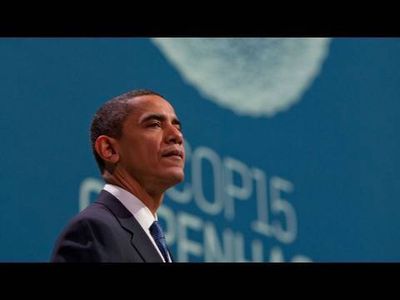
Good morning. It is an honor for me to join this distinguished group of leaders from nations around the world. We come here in Copenhagen because climate change poses a grave and growing danger to our people. All of you would not be here unless you -- like me -- were convinced that this danger is real. This is not fiction, it is science. Unchecked, climate change will pose unacceptable risks to our security, our economies, and our planet. This much we know.
The question, then, before us is no longer the nature of the challenge. The question is our capacity to meet it. For while the reality of climate change is not in doubt, I have to be honest, as the world watches us today, I think our ability to take collective action is in doubt right now, and it hangs in the balance.
I believe we can act boldly, and decisively, in the face of a common threat. That's why I come here today -- not to talk, but to act.
Now, as the world's largest economy and as the world's second largest emitter, America bears our responsibility to address climate change, and we intend to meet that responsibility. That's why we've renewed our leadership within international climate change negotiations.
That's why we've worked with other nations to phase out fossil fuel subsidies. That's why we've taken bold action at home -- by making historic investments in renewable energy; by putting our people to work increasing efficiency in our homes and buildings; and by pursuing comprehensive legislation to transform to a clean energy economy.
These mitigation actions are ambitious, and we are taking them not simply to meet global responsibilities. We are convinced, as some of you may be convinced, that changing the way we produce and use energy is essential to America's economic future -- that it will create millions of new jobs, power new industries, keep us competitive, and spark new innovation.
We're convinced, for our own self-interest, that the way we use energy, changing it to a more efficient fashion, is essential to our national security, because it helps to reduce our dependence on foreign oil, and helps us deal with some of the dangers posed by climate change.
So I want this plenary session to understand, America is going to continue on this course of action to mitigate our emissions and to move towards a clean energy economy, no matter what happens here in Copenhagen. We think it is good for us, as well as good for the world. But we also believe that we will all be stronger, all be safer, all be more secure if we act together. That's why it is in our mutual interest to achieve a global accord in which we agree to certain steps, and to hold each other accountable to certain commitments.
After months of talk, after two weeks of negotiations, after innumerable side meetings, bilateral meetings, endless hours of discussion among negotiators, I believe that the pieces of that accord should now be clear.
First, all major economies must put forward decisive national actions that will reduce their emissions, and begin to turn the corner on climate change. I'm pleased that many of us have already done so. Almost all the major economies have put forward legitimate targets, significant targets, ambitious targets. And I'm confident that America will fulfill the commitments that we have made: cutting our emissions in the range of 17 percent by 2020, and by more than 80 percent by 2050 in line with final legislation.
Second, we must have a mechanism to review whether we are keeping our commitments, and exchange this information in a transparent manner. These measures need not be intrusive, or infringe upon sovereignty. They must, however, ensure that an accord is credible, and that we're living up to our obligations. Without such accountability, any agreement would be empty words on a page.
I don't know how you have an international agreement where we all are not sharing information and ensuring that we are meeting our commitments. That doesn't make sense. It would be a hollow victory.
Number three, we must have financing that helps developing countries adapt, particularly the least developed and most vulnerable countries to climate change. America will be a part of fast-start funding that will ramp up to $10 billion by 2012. And yesterday, Secretary Hillary Clinton, my Secretary of State, made it clear that we will engage in a global effort to mobilize $100 billion in financing by 2020, if -- and only if -- it is part of a broader accord that I have just described.
Mitigation. Transparency. Financing. It's a clear formula -- one that embraces the principle of common but differentiated responses and respective capabilities. And it adds up to a significant accord -- one that takes us farther than we have ever gone before as an international community.
I just want to say to this plenary session that we are running short on time. And at this point, the question is whether we will move forward together or split apart, whether we prefer posturing to action. I'm sure that many consider this an imperfect framework that I just described. No country will get everything that it wants.
There are those developing countries that want aid with no strings attached, and no obligations with respect to transparency. They think that the most advanced nations should pay a higher price. I understand that. There are those advanced nations who think that developing countries either cannot absorb this assistance, or that will not be held accountable effectively, and that the world's fastest-growing emitters should bear a greater share of the burden.
We know the fault lines because we've been imprisoned by them for years. These international discussions have essentially taken place now for almost two decades, and we have very little to show for it other than an increased acceleration of the climate change phenomenon. The time for talk is over. This is the bottom line: We can embrace this accord, take a substantial step forward, continue to refine it and build upon its foundation. We can do that, and everyone who is in this room will be part of a historic endeavor -- one that makes life better for our children and our grandchildren.
Or we can choose delay, falling back into the same divisions that have stood in the way of action for years. And we will be back having the same stale arguments month after month, year after year, perhaps decade after decade, all while the danger of climate change grows until it is irreversible.
Ladies and gentlemen, there is no time to waste. America has made our choice. We have charted our course. We have made our commitments. We will do what we say. Now I believe it's the time for the nations and the people of the world to come together behind a common purpose.
We are ready to get this done today -- but there has to be movement on all sides to recognize that it is better for us to act than to talk; it's better for us to choose action over inaction; the future over the past -- and with courage and faith, I believe that we can meet our responsibility to our people, and the future of our planet.
Thank you very much.