Speech to a Joint Session of the Indian Parliament
President Obama's address to a joint session of the Indian Parliament in New Delhi on November 8, 2010, during his first presidential visit to India. He outlined a vision for deepening the US-India partnership across economic prosperity, global security, and democratic governance, and announced support for India's permanent membership on the UN Security Council.
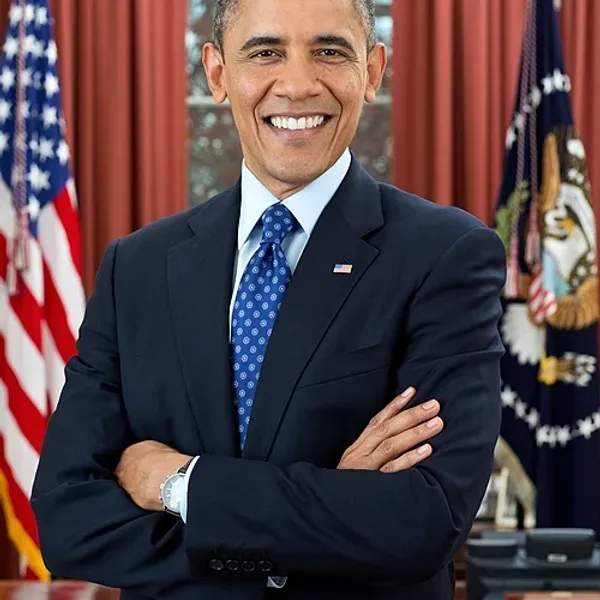
U.S.-India Business Council Summit Address
On November 6, 2010, U.S. President Barack Obama delivered an address at the U.S.-India Business Council Summit in Mumbai, India. This was his first visit to India as president and the longest single-country visit of his presidency. Obama emphasized the U.S.-India relationship as one of the defining partnerships of the 21st century, announcing nearly $10 billion in export deals to India expected to support over 50,000 American jobs. The speech covered cooperation in trade, investment, technological innovation, and infrastructure, as well as the vision for reducing trade barriers and deepening economic ties. The visit underscored the high importance the United States placed on the U.S.-India strategic partnership.
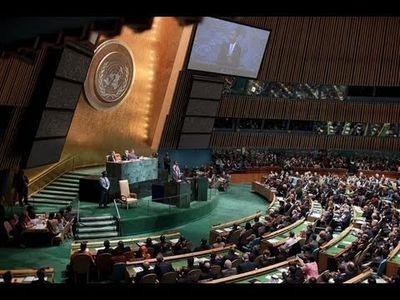
65th Session of the United Nations General Assembly Address
On September 23, 2010, President Barack Obama addressed the 65th Session of the United Nations General Assembly at UN Headquarters in New York. The international community faced multiple challenges at the time: the aftermath of the global financial crisis, a stalled Middle East peace process, ongoing tensions over Iran's nuclear program, wars in Iraq and Afghanistan, and difficult climate change negotiations. In his address, Obama reviewed American efforts in multilateral diplomacy over the past year, including nuclear non-proliferation, restarting Middle East peace talks, and addressing the global economic crisis, emphasizing America's commitment to solving global problems through international cooperation. He called on all nations to share responsibility, maintain international order, and promote development, peace, and human rights. The speech reflected the continuation of the Obama administration's multilateralist foreign policy and was an important declaration of America's effort to reshape its international leadership.
Joint Remarks with President Mubarak, His Majesty King Abdullah, Prime Minister Netanyahu, and President Abbas
On September 1, 2010, President Barack Obama hosted a meeting at the White House to relaunch direct Middle East peace negotiations, inviting Egyptian President Mubarak, Jordan's King Abdullah, Israeli Prime Minister Netanyahu, and Palestinian President Abbas. The summit aimed to resume direct Israeli-Palestinian talks that had been stalled since early 2010, with the goal of reaching a peace agreement within one year. The gathering was overshadowed by a deadly shooting attack in the West Bank just before the meeting that killed four Israelis, underscoring the serious challenges facing the negotiations. In his opening remarks, Obama emphasized the historic significance of the talks and called on all parties to seize the opportunity. Mubarak, Abdullah, Netanyahu, and Abbas then delivered statements outlining their respective positions: Netanyahu stressed security as a precondition for peace, while Abbas demanded a settlement freeze and an end to the 1967 occupation. The meeting represented a major diplomatic effort by the Obama administration to advance the Middle East peace process.
Susan E. Rice's 2010 Stanford Commencement Address: Shaping Change
On 2010-06-13, Susan E. Rice delivered this address at Stanford University's Commencement. Organized around service, courage, and actively shaping change, it joins personal experience, professional judgment, and the public concerns of its moment. The address asks not only what graduates might do next, but also how educated people should understand their abilities, accept public responsibility, and help build a shared future. This edition is based on a complete authoritative transcript and preserves the sequence and character of the original address.
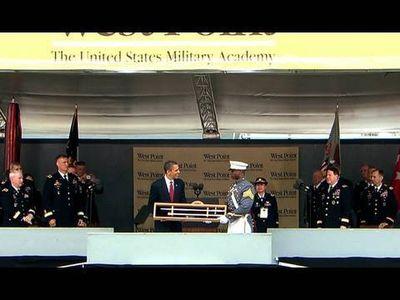
Commencement Address at the U.S. Military Academy
On May 22, 2010, President Barack Obama delivered the commencement address at the United States Military Academy at West Point, New York. It was his second major policy speech at West Point, following his December 2009 announcement of a new Afghanistan strategy. The United States was then engaged in two wars: the combat mission in Iraq was winding down, while the war in Afghanistan had entered a critical phase. Obama paid tribute to the Class of 2010, reviewing their academic and military achievements during four rigorous years, and laid out his vision for American national security strategy. He emphasized that U.S. strength is rooted in economic vitality and educational innovation at home, and must be sustained by diplomacy, development, and intelligence working alongside military power. The address also covered defeating al Qaeda, shaping the international order, and promoting universal values, calling on a new generation of officers to bear the burden of defending the nation and leading the world.
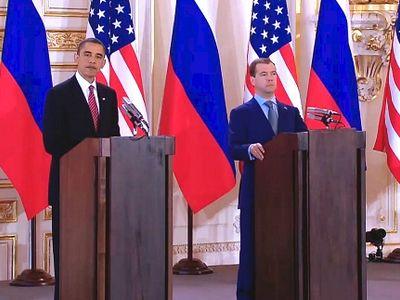
START Treaty Signing Joint Presser with President Medvedev
On April 8, 2010, U.S. President Barack Obama and Russian President Dmitry Medvedev signed the New START treaty in Prague and held a joint press conference. The treaty was a key outcome of Obama's 2009 Prague vision of a world without nuclear weapons and a signature achievement of the U.S.-Russia "reset." With the previous START treaty having expired in December 2009, the new agreement lowered each side's deployed nuclear warhead limit to 1,550, cut delivery vehicles by roughly half, and established a comprehensive verification regime. Obama thanked Medvedev for his leadership, stressed the two nations' responsibility as holders of over 90 percent of the world's nuclear weapons, and called on the U.S. Senate to ratify the treaty. The remarks also addressed Iran sanctions, missile defense cooperation, and the Nuclear Security Summit to be held the following week in Washington, underscoring U.S.-Russia coordination on non-proliferation.
Address to the Troops in Afghanistan
On March 28, 2010, President Barack Obama made an unannounced surprise visit to Afghanistan, delivering an address to U.S. troops and coalition forces at Bagram Air Field. The trip came just over three months after his December 2009 announcement of a new Afghanistan strategy, which included a surge of 30,000 additional American forces. Obama traveled to personally thank the men and women serving far from home, many on their second, third, or fourth tours of duty, and to reaffirm the U.S. mission in Afghanistan — to disrupt al Qaeda, reverse the Taliban's momentum, and build the capacity of Afghan security forces to assume responsibility for their own defense. He stressed that the deployment was necessitated by the lessons of 9/11, and pledged full support to the military in equipment, pay and benefits, healthcare, and veterans' services. The visit came on the heels of the successful Marja operation and early signs of progress in the coalition offensive, while honestly acknowledging difficult days ahead and inspiring the troops with a message of perseverance.
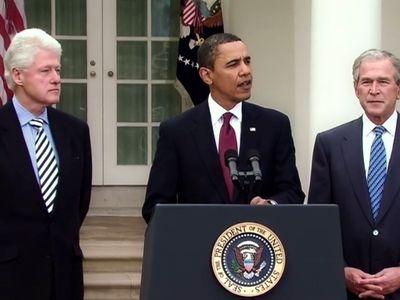
Joint Remarks on Haiti Earthquake Relief Fund
On January 12, 2010, Haiti was struck by a magnitude 7.0 earthquake that caused massive casualties and property damage, with large parts of the capital Port-au-Prince reduced to rubble and hundreds of thousands affected. On January 16, President Barack Obama welcomed former Presidents George W. Bush and Bill Clinton to the Rose Garden of the White House to deliver joint remarks announcing the establishment of the Clinton Bush Haiti Fund, calling on the American people to donate for Haiti's earthquake relief and reconstruction. Obama praised the two former presidents for setting aside partisan differences to lead this urgent fundraising mission. Bush and Clinton each addressed the immediate urgency and long-term nature of the relief effort, urging individuals, corporations, and institutions to support the Haitian people through donations.
Nobel Prize for Peace Acceptance Speech and Lecture
On December 10, 2009, U.S. President Barack Obama received the Nobel Peace Prize at Oslo City Hall, Norway. Less than a year into his presidency, with the United States engaged in two wars in Iraq and Afghanistan, the award sparked considerable controversy. In his lecture, Obama confronted this paradox directly, exploring the relationship between "just war" and "just peace." He articulated the moral boundaries of force, the importance of international institutions and human rights, and the link between economic development and human dignity. He called for expanding moral imagination, acknowledging human imperfection while striving for a better world.
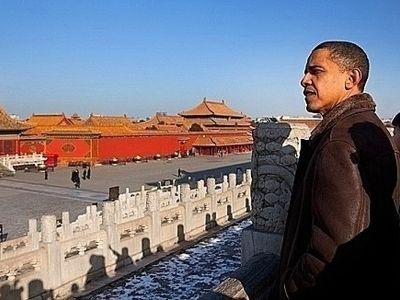
Shanghai Town Hall With Future Chinese Leaders
On November 16, 2009, during his first presidential trip to China, U.S. President Barack Obama held a town hall style dialogue with students from Fudan University, Tongji University, Shanghai Jiao Tong University and other institutions at the Shanghai Science and Technology Museum. The event, held in his first year in office, was aimed at deepening his understanding of China and coordinating positions on global issues such as climate change, clean energy, and nuclear non-proliferation. In his opening remarks, Obama traced the history of U.S.-China engagement back to the 1784 Empress of China voyage, and exchanged candid views with students on Internet openness, universal rights, the Nobel Peace Prize, cross-straits relations, and the war in Afghanistan. Broadcast through the Internet to a wider Chinese audience, the dialogue was widely regarded as a significant public diplomacy effort directed at China's younger generation.
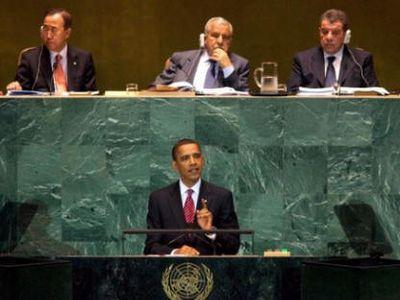
First Speech Before the United Nations General Assembly (64th Session)
On September 23, 2009, U.S. President Barack Obama addressed the United Nations General Assembly for the first time as president, speaking at the 64th session's general debate. Less than nine months into his presidency, he faced the aftermath of the global financial crisis, looming climate negotiations in Copenhagen, a stalled Middle East peace process, and rising nuclear proliferation concerns surrounding North Korea and Iran. Acknowledging global skepticism about American leadership, Obama called for a new era of engagement based on mutual interest and mutual respect. He outlined four pillars for international cooperation: non-proliferation and disarmament, the promotion of peace and security, the preservation of the planet, and a global economy that advances opportunity for all. He stressed that all nations bear both rights and responsibilities, and urged collective action on shared global challenges.