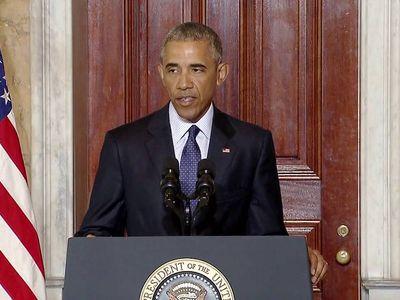
Counter-ISIL Meeting Briefing
On June 14, 2016, two days after the Orlando nightclub shooting, President Obama delivered a briefing following a Counter-ISIL meeting at the Treasury Department. The meeting was originally scheduled as a regular National Security Council session, but the Orlando attack cast a shadow over the proceedings. In the briefing, Obama reported on military, financial, and diplomatic progress against ISIL, emphasizing that the group is losing territory, money, and fighters. He also renewed his call for stricter gun control and forcefully responded to Republican criticism that he avoids the term "radical Islam," arguing that it is a political talking point rather than a strategy, and that painting all Muslims with a broad brush only helps terrorist recruitment. The speech concluded by celebrating America's diversity using the Air Force Academy cadets as an example.
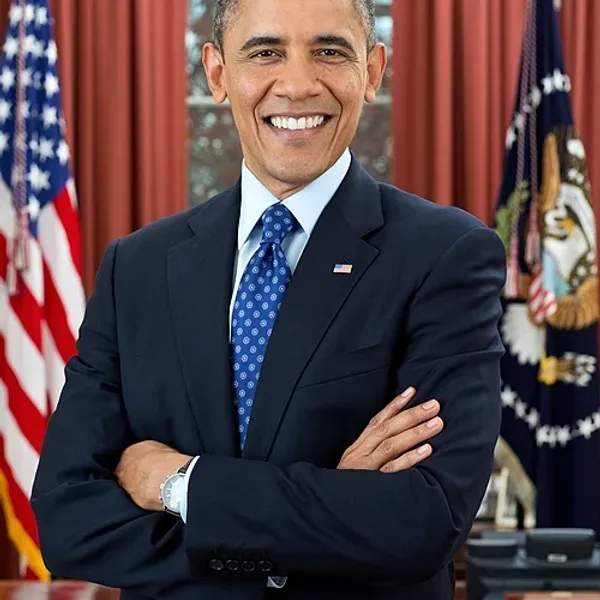
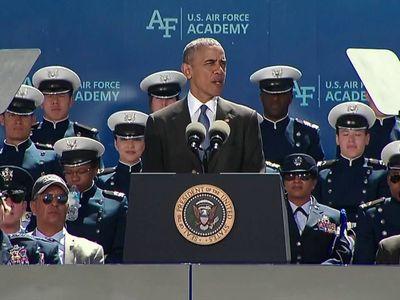
U.S. Air Force Academy Commencement Address
On June 2, 2016, President Barack Obama delivered the commencement address at the United States Air Force Academy in Colorado Springs, Colorado. It was President Obama's final address to a military service academy graduating class during his presidency, serving as a significant reflection on his eight-year tenure as Commander-in-Chief. The speech opened with warm, humorous remarks congratulating the Class of 2016, followed by four key lessons from his experience as Commander-in-Chief: viewing the world with facts and clear-eyed assessment, America's indispensable global leadership, the prudent and proportional use of military force, and the importance of all elements of national power beyond the military. Obama emphasized America's military strength while advocating for wise leadership, diplomatic priority, coalition-building, and values-driven leadership, urging graduates to serve with integrity, service, and excellence in defense of the nation.
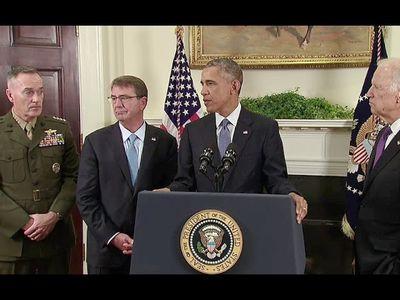
Statement on Afghanistan
On October 15, 2015, President Obama delivered a statement at the White House announcing an adjustment to the U.S. troop presence in Afghanistan. U.S. combat forces had formally ended their mission in late 2014, with the original plan to draw down to a normal embassy presence by the end of 2016. However, given the still-fragile security situation, Taliban resurgence in rural areas, the emergence of ISIL, and remaining al Qaeda elements, Obama decided to slow the drawdown: maintaining 9,800 troops through most of 2016, and keeping 5,500 at bases including Bagram, Jalalabad, and Kandahar by year's end. The statement also emphasized the Afghan government as a reliable partner and political reconciliation as the ultimate solution.
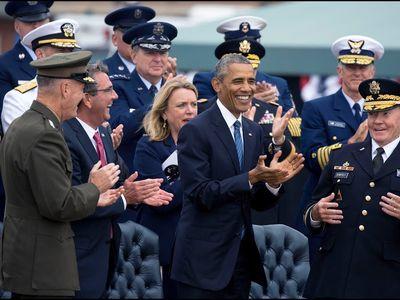
Address at the Military Retirement Ceremony for Gen. Martin Dempsey
On September 25, 2015, President Barack Obama delivered remarks at the retirement ceremony for General Martin Dempsey at Joint Base Myer-Henderson Hall, Virginia. Dempsey, then Chairman of the Joint Chiefs of Staff, was one of Obama's most important military advisors during his presidency, having previously served as Army Chief of Staff. In his speech, Obama reflected on Dempsey's extraordinary forty-five year military career, from his West Point cadet days to commanding divisions on desert battlefields and ultimately leading all of America's armed forces. He notably mentioned the cigar box on Dempsey's desk containing 132 cards of soldiers who died under his command in Iraq, inscribed with the words 'Make It Matter.' Obama also used the occasion to call on Congress to end sequestration and increase defense funding, praised the Dempsey family's service, and announced General Dunford as the incoming Chairman.
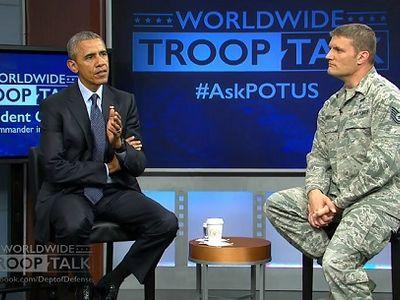
Worldwide Troop Talk at the Defense Media Activity
On September 11, 2015, the 14th anniversary of the 9/11 terrorist attacks, President Barack Obama held a worldwide troop talk at the Defense Media Activity at Fort Meade, Maryland, engaging with U.S. service members across the globe via video. Moderated by Tech Sergeant Nathaniel Parry, the event was broadcast live to troops worldwide and on ships at sea through the American Forces Network. In his opening remarks, Obama honored the victims of 9/11, thanked service members and their families for their sacrifice, and outlined U.S. military strategy in Iraq, Syria, Afghanistan and cybersecurity issues. He then answered questions from troops at the venue, in Afghanistan, Europe, AFRICOM, an aircraft carrier, and via social media, covering topics including the My Brother's Keeper initiative, Russian activity in Syria, the refugee crisis, cyber warfare, work-life balance, and the rewards of the presidency.

Address to the Nation on the Islamic State of Iraq and the Levant (ISIL)
On September 10, 2014, U.S. President Barack Obama delivered a nationally televised address from the White House, formally announcing that the United States would lead a broad coalition to combat the extremist group known as the Islamic State of Iraq and the Levant (ISIL). The speech came after ISIL's rapid rise, its seizure of large swaths of territory in Iraq and Syria, and its killing of two American journalists. Obama outlined a four-point strategy: systematic airstrikes, increased support for ground forces, cutting off ISIL funding and fighter flows, and providing humanitarian assistance. The address marked a major escalation of U.S. counterterrorism policy in the Middle East and sparked broad debate over war powers and regional intervention.
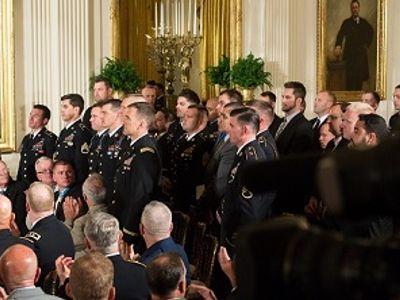
SSG Ryan Pitts Medal of Honor Presentation Address
On July 21, 2014, President Barack Obama presented the Medal of Honor to U.S. Army Staff Sergeant Ryan M. Pitts in the White House East Room. He recalled the 2008 Battle of Wanat, where Pitts held an observation post while seriously wounded and nearly alone until reinforcements and air support turned the battle. Obama honored the nine fallen soldiers, their families, comrades, and all who served, and quoted Pitts saying that the medal belongs to everyone who fought there that day. He also described the battlefield conditions and the individual stories of the nine fallen soldiers. He concluded that troops sent into danger must receive a sound strategy, a defined mission, and the forces and support needed to accomplish it.
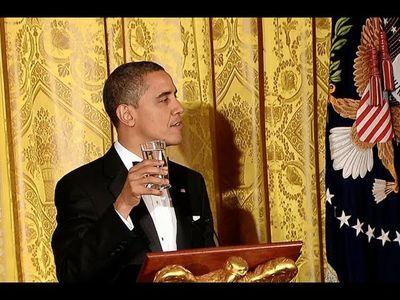
Address Toasting Iraq War Veterans
On February 29, 2012, President Barack Obama hosted a gala dinner at the White House to toast Iraq War veterans and their families. The Iraq War had just concluded, with the last American troops withdrawn in December 2011. Obama thanked Vice President Biden, Secretary of Defense Panetta, and Chairman of the Joint Chiefs Dempsey for their leadership, reflecting on the duty, resolve, devotion, sacrifice, and strength demonstrated by service members during nearly nine years of war. He specifically named the first and last Americans killed in Iraq, honoring nearly 4,500 fallen service members, and pledged to care for veterans and their families. The speech emphasized learning from the Vietnam War era to ensure veterans receive the respect and gratitude they deserve, concluding with a toast.
Address on Veterans Job Corps
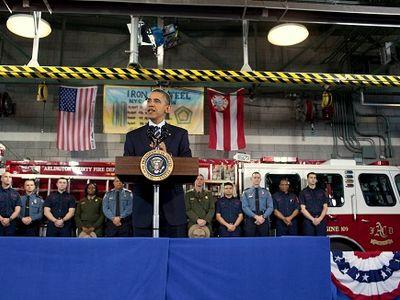
On February 3, 2012, President Barack Obama delivered an address at Fire Station 5 in Arlington, Virginia, unveiling the Veterans Jobs Corps initiative. This fire station was among the first to respond to the Pentagon attack on September 11. With the Iraq War over and the Afghanistan War entering a transition phase, nearly three million service members were returning to civilian life. Obama emphasized that veterans possess unparalleled skills and discipline, making them a valuable national resource. He proposed three measures: helping communities hire veterans as police and firefighters, connecting 20,000 veterans with community and national park rebuilding projects, and providing entrepreneurial training. The speech also urged Congress to extend the payroll tax cut and redirect war savings to domestic nation-building.
Address on Military Strategy Review
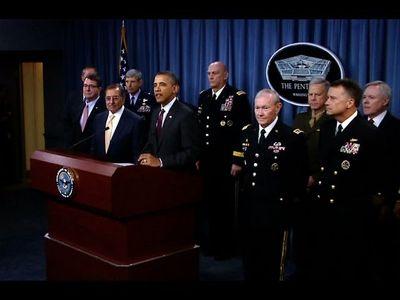
On January 5, 2012, President Obama delivered an address at the Pentagon outlining the United States defense strategy review as the Iraq war ended and the Afghanistan mission began to transition. He argued that the size of the military and defense budgets must be driven by strategic objectives while balancing fiscal discipline with national security. Obama described plans to strengthen the American presence in the Asia Pacific, continue relying on allies and partners including NATO, invest in intelligence, surveillance and reconnaissance, counterterrorism, and countering weapons of mass destruction, and maintain a leaner, more agile force prepared for future threats.
Speech on Ending the War in Iraq Responsibly
On October 21, 2011, President Barack Obama delivered a speech at the White House officially announcing that all U.S. troops would be withdrawn from Iraq by the end of the year, bringing an end to the nearly nine-year Iraq War. The war began in 2003 when the Bush administration launched an invasion citing weapons of mass destruction, later becoming mired in insurgency and sectarian conflict. Obama had pledged to end the war during his campaign and progressively implemented a withdrawal plan after taking office. In the speech, Obama reviewed the drawdown process, articulated the transition of the U.S.-Iraq relationship from military alliance to equal partnership, and envisioned helping Iraq build a stable, secure, and self-reliant nation. He also referenced the killing of Osama bin Laden and the transition in Afghanistan, emphasizing that America was moving forward from a position of strength. This speech marked a major turning point in U.S. Middle East strategy.
Address to the American Legion Conference
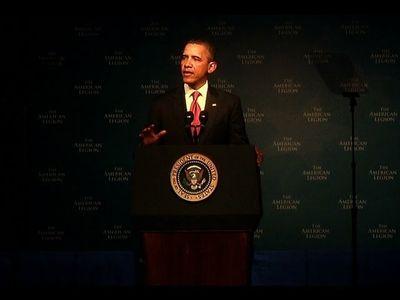
On August 30, 2011, President Obama addressed the American Legion National Convention at the Minneapolis Convention Center. With the tenth anniversary of the 9/11 attacks just days away, Obama paid tribute to veterans of World War II, the Korean War, and the Vietnam War, and particularly honored the 9/11 Generation of service members who had served for over a decade. He outlined the administration's investments in veterans' affairs, including health care, disability claims, homelessness reduction, and treatment for Traumatic Brain Injury and PTSD. Obama also proposed a comprehensive employment initiative for veterans, including reverse boot camps, tax credits for companies hiring veterans, and vocational training. The speech concluded with the story of Frank Buckles, the last American veteran of World War I, emphasizing that America will never forget those who served.