Universities, Innovation and Economic Growth
On 5 February 2025, Imperial College London President Hugh Brady delivered an annual address on how research universities can drive innovation and economic growth in the United Kingdom. Invoking Harold Wilson's white heat of technology speech, he reviewed British scientific achievements while warning about weak R&D investment, pressure on science education, falling international enrolment, and declining quality-related research funding. Brady urged the government's Industrial Strategy to protect excellence-based dual-support funding, strengthen the STEM talent pipeline, and connect Imperial's White City and WestTech initiatives with university-centred innovation clusters across Britain. He also stressed that science depends on international collaboration and called for stronger partnership funds and bilateral programmes.
Lucy Yen's 2024 Keynote Address at the University of Hong Kong
On July 19, 2024, Hong Kong solicitor and first-cohort HKU Law graduate Lucy Yen delivered the Guest of Honour's keynote address at the Faculty of Law's 212th Congregation. Marking the 55th anniversary of legal education at HKU, she recalled the first class of forty students in 1969 and the teachers and practitioners who helped build the Faculty. Yen linked her own decision to study law, made after advice from her father, to the importance of purpose and gratitude. She urged graduates to embrace artificial intelligence while resisting intellectual laziness and preserving love, kindness, empathy, and integrity. She also stressed the value of legal education, an independent judiciary and profession, and the rule of law to Hong Kong. Comparing life to a journey, a classroom, and a storybook, she encouraged continuous learning, courage in failure, service to the community, and deliberate authorship of a purposeful life.
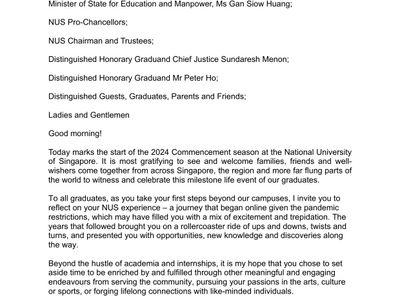
Tan Eng Chye's 2024 Commencement Address at NUS
On July 11, 2024, National University of Singapore President Tan Eng Chye reflected on a graduating class whose university journey began online during the pandemic. He argued that rigorous interdisciplinary training, domain expertise, experiential learning, resilience, and innovation prepared graduates to make an impact in a fast-changing world. Aisha Shamsudin, who navigated family, financial, and mental-health pressures while supporting others, and Ng Jun Kang, who lives with cerebral palsy and hopes to apply computing to real-world problems, illustrated holistic growth and service. Tan then conferred honorary degrees on Chief Justice Sundaresh Menon and former Head of the Civil Service Peter Ho for contributions to justice, public administration, and NUS. He closed with three lessons: remain curious, learn from failure, and aspire to make a difference rather than merely a living, urging graduates to become architects of change, champions of justice, and trailblazers of innovation.
Andrzej Duda's 2024 Address at Fudan University: Peace and Global Justice
During his June 2024 visit to China, Polish President Andrzej Duda addressed students and faculty at Fudan University in Shanghai. This record uses June 27, the publication date of the official English version. Starting with Shanghai's river traffic, he compares Chinese development with Poland's transformation and expresses confidence in young people. He draws on Poland's loss of independence and Europe's wars to argue for peace, sovereignty, and stable borders as conditions for prosperity. He then discusses wealthy countries' responsibilities toward the Global South, rejecting colonial attitudes and national self-interest in favor of equality and global justice. The speech's broad assertions about European wars and borders are preserved as the speaker's historical judgments, not endorsed as independently verified facts. The source is the Polish presidency's official English record, accompanied by a paragraph-aligned Chinese translation.
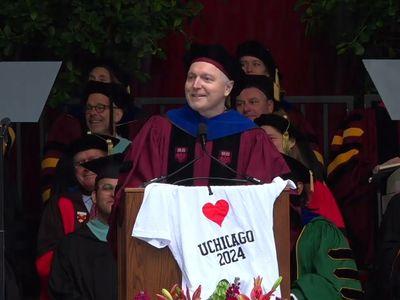
John A. List's 2024 Convocation Address at the University of Chicago: Three Little Secrets to Change the World
On June 1, 2024, economist John A. List shared "three little secrets to change the world" with the University of Chicago Class of 2024. A story about Gary Becker leaving the hospital to attend an academic seminar illustrated the first: meaningful impact requires loving one's work and concentrating on a comparative advantage. Drawing on opportunity cost, List then argued for exploring outside options and quitting ineffective methods without abandoning larger life goals. His third secret was the critical thinking cultivated at UChicago—learning how to think, not what to think. He also urged graduates to remain curious, value what they do not know, resist binary thinking, and share life's burdens with trusted partners while creating change both inside and outside their jobs.
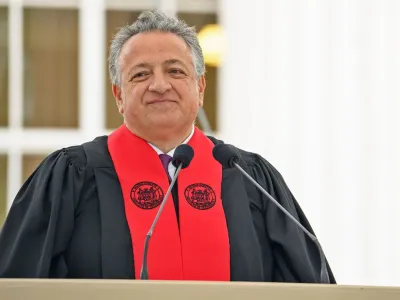
Noubar Afeyan Address to the Class of 2024
On May 30, 2024, MIT alumnus and life-science entrepreneur Noubar Afeyan addressed the Class of 2024 at Commencement. He recalled his childhood in Beirut, Lebanon, his arrival at MIT after emigrating to the United States, and the urgent challenge faced by his Moderna colleagues during the pandemic as they worked to develop a vaccine. Using Mission Impossible as a frame, he urged graduates to accept seemingly impossible missions and use scientific training and teamwork to respond to global crises. He described three actions behind breakthroughs: imagine, innovate, and immigrate—that is, leave familiar ground, enter unknown territory, and find opportunity amid uncertainty. He also reminded graduates to pair technical ability with moral judgment and consider the impact they hope to leave on society.
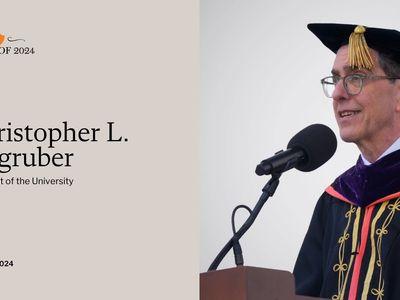
Christopher L. Eisgruber's 2024 Commencement Address at Princeton University: Leaning Into Life, at Princeton and Beyond
On 28 May 2024, Princeton President Christopher L. Eisgruber delivered the Commencement address 'Leaning Into Life, at Princeton and Beyond' to the Class of 2024. He observed that commencement addresses are a curious genre that rarely contains profound wisdom, and joked that he was delivering a 'you are special' speech. He then devoted his time to gratitude and a wish: he thanked the graduates for breathing new life into the campus after the pandemic had eroded social norms, reconstructing and revitalizing countless organizations from a cappella groups and athletic teams to debating societies and laboratories; and he wished that they would lean into life after Princeton and into their communities with the same dazzling energy and imagination, continuing to show up in person and fully. He suggested that happiness often comes from collective human endeavor to produce something of value to society, with goals that need not be grand or newsworthy, and expressed hope that Princeton would remain a source of community and a home in their lives.
Science for Humanity
On 14 March 2024, Imperial College London President Hugh Brady used his annual address to launch the university's new Science for Humanity strategy. Recalling Imperial's founding mission to be useful, he organised the strategy around enabling talent, powering research, and amplifying impact. The speech introduced expanded scholarships and Class of 2030 investment, an Extended Learning Institute, a Future Leaders Academy, a venture fund, and four Schools of Convergence Science. It also proposed the Imperial WestTech Corridor and global hubs in Singapore, Ghana, the United States, and India. Brady placed sustainability at the centre of the strategy, committing Imperial to campus decarbonisation and responsible investment while linking scientific inquiry, innovation, public benefit, and global collaboration.
Jennifer Doudna's 2023 Winter Commencement Address at UC Berkeley: Dream Big, Set Audacious Goals
On December 16, 2023, Nobel laureate and UC Berkeley professor Jennifer Doudna delivered the keynote address at Berkeley's winter commencement. Drawing on themes of adventure, trial, and homecoming in The Odyssey, she recalled the mixture of excitement and fear she felt at her own graduation and urged graduates to embrace risk, take a long view of success, and keep moving forward. Doudna connected those lessons to the approval of the first CRISPR therapy for sickle cell disease, showing how major breakthroughs follow nonlinear paths and depend on fundamental research, collaborative teams, and courageous patients, while also noting barriers of cost and access. She emphasized that education extends beyond textbooks and examinations: failure, friendship, and self-discovery also shape a life. Graduates, she said, should dream big, maintain integrity and empathy, keep learning, treat change as an opportunity, and measure success by positive impact on others.
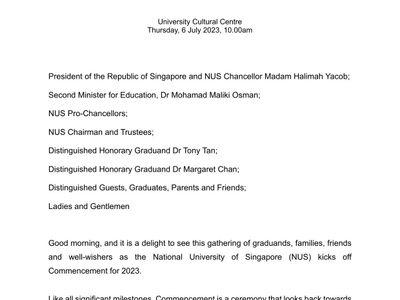
Tan Eng Chye's 2023 Commencement Address at NUS
On July 6, 2023, National University of Singapore President Tan Eng Chye addressed graduates entering a world marked by climate change, geopolitical tension, and technological disruption. Quoting Lee Kuan Yew on Singapore's need to continually reconstruct itself, Tan argued that national success is never guaranteed and that each generation must rely on perseverance, ingenuity, adaptability, and community spirit. He highlighted medical graduate Aqilah Faaiqah, who cared for her ill mother and later created a sourdough business, and engineering graduate Lek Ju Ying, whose twelve-year route through vocational and polytechnic education exemplified determination and peer support. Tan then honoured former Singapore President Tony Tan and former WHO Director-General Margaret Chan for contributions to higher education and global public health. He closed by presenting Commencement as a thread linking past, present, and future, calling on graduates to meet uncertainty with resolve, imagination, and care for community.
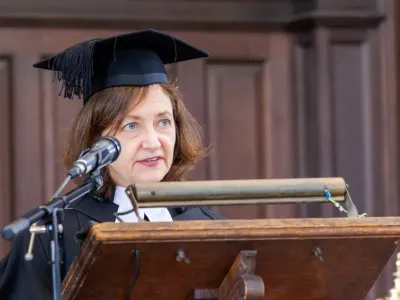
A Relay of Ideas: Sustaining and Renewing Cambridge's Mission
On 5 July 2023, social psychologist Deborah Prentice was formally admitted as the 347th Vice-Chancellor of the University of Cambridge and delivered her inaugural address in Senate House. Answering why she accepted the role, she described her intensive introduction to Cambridge and thanked Acting Vice-Chancellor Anthony Freeling for managing the leadership transition. Prentice argued that Cambridge's discoveries, medical partnerships, and innovation ecosystem serve both its region and global challenges including sustainable aviation, cancer, and children's physical and mental health. She identified nurturing academic excellence as the University's bedrock, locating excellence wherever students and scholars meet for contemplation, conversation, and debate, and defining the Vice-Chancellor as an enabler of those environments. Acknowledging pressures from living costs, the marking boycott, and student mental health, she called for collaboration among Colleges, academic units, student leaders, professional staff, and donors. Using a relay race as her closing metaphor, she pledged to strengthen the University and its community before passing the baton to her successor.
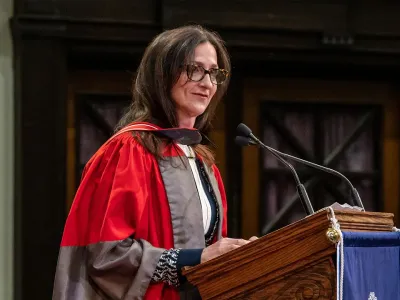
Sara Seager's 2023 Honorary Degree Address at University of Toronto: Trust Your Inner Voice
On June 16, 2023, Canadian-born astrophysicist Sara Seager received an honorary degree from her alma mater, the University of Toronto. Looking back across thirty years of smartphones, artificial intelligence, and exoplanet discoveries, she invited graduates to look at the stars, consider the galaxy's trillions of possible worlds, and revisit the ancient question of whether humanity is alone. She recalled discovering at a U of T astronomy open house that astronomy could be a profession, then trusting her inner voice despite her father's preference that she study medicine. At Harvard, early exoplanet detections faced deep skepticism, but she committed herself to the field and helped establish exoplanet science and the search for life beyond Earth. She encouraged graduates to find work they both love and do well, challenge the status quo, think beyond conventional boundaries, and see every star's potential planets as a symbol of their own unreleased possibilities.