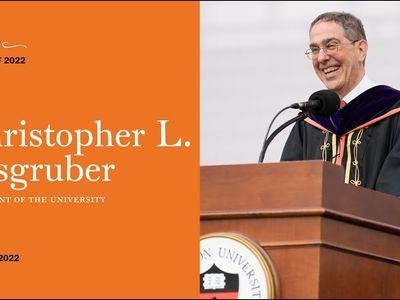
Christopher L. Eisgruber's 2022 Commencement Address at Princeton University: The Value of Persistence
On May 24, 2022, Princeton president and constitutional scholar Christopher L. Eisgruber delivered The Value of Persistence to the graduating class. The pandemic had disrupted part of their college experience through remote learning and changes to campus life. He praised their perseverance through academic and personal challenges while drawing attention to students elsewhere who had left college amid financial pressures and the pandemic. He discussed the importance of completing a degree, urged support for low-income students and those with some college but no degree, and encouraged graduates to thank their supporters and help others cross the finish line. The text follows Princeton’s official remarks as delivered, published that day.
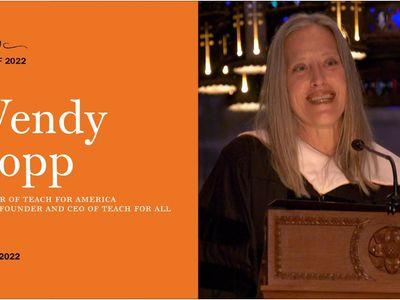
Wendy Kopp's 2022 Baccalaureate Address at Princeton University: Deep Impact
On May 22, 2022, Wendy Kopp returned to Princeton to address the Class of 2022 at Baccalaureate. A 1989 graduate, she developed Teach For America from her senior thesis and later co-founded Teach For All. She recalled the uncertainty of graduation and thirty-three years devoted to educational opportunity, including colleagues persuading her to decline another job and deepen her existing work. That sustained commitment eventually led to international collaboration. She encouraged graduates to choose deliberately how to use their time and energy, align their careers with their values, and pursue lasting impact. The text follows the official prepared remarks published by Princeton that day.
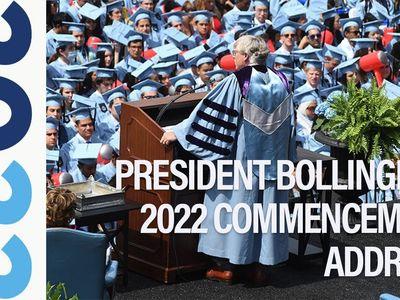
Lee C. Bollinger's 2022 Commencement Address at Columbia University: A New Age of Disinformation
On May 18, 2022, Columbia University President Lee C. Bollinger delivered the Commencement address in New York at the University's first in-person ceremony in three years. After reflecting on the pandemic, climate disasters, resurgent authoritarianism, and racial injustice experienced by the graduates, he turns to what he calls the Age of Disinformation. Bollinger argues that systematic disinformation, accelerated by the Internet, not only pollutes public discussion but also erodes trust in knowledge, facts, and expertise; attacks on expertise are also a familiar tool of fascist and authoritarian regimes. He insists that First Amendment protection should not prevent society from condemning and resisting disinformation, and presents universities as models of good thinking that educate people to respect facts, remain open to relevant ideas, and cultivate intellectual humility.

Randy Schekman's 2022 Commencement Address at UC Berkeley: We Win If Your Mind Is Stretched, but Not Filled
On May 14, 2022, Nobel laureate and UC Berkeley professor Randy Schekman delivered the keynote address at Berkeley's campuswide commencement. With humor, he asked what a university education should leave behind once memorized facts fade: not a mind filled with information, but one stretched by critical inquiry, evidence, and curiosity. He illustrated perseverance and the value of public education through the story of mRNA vaccine pioneer Katalin Karikó, whose path from poverty and emigration through academic rejection ultimately helped save millions of lives. Schekman then connected scientific freedom and discovery to public investment, immigration, and the historic accessibility of the University of California. He urged graduates to defend public higher education as an engine of social mobility so future generations can enjoy the same outstanding opportunities.

Shou Zi Chew's 2022 Graduation Guest Address at UCL
On March 14, 2022, University College London alumnus and TikTok CEO Shou Zi Chew delivered a recorded guest address to graduates in the social and historical sciences. Recalling that he had sat in their place as an Economics graduate sixteen years earlier, Chew described a career with no grand plan: from Goldman Sachs and DST to business school, ByteDance, and TikTok. He argued that growth often comes from working hard with what is available, putting oneself forward, and accepting opportunities despite uncertainty. Chew encouraged graduates to embrace the journey ahead, avoid overthinking, and leave their comfort zones when necessary. In a fast-changing world filled with unfamiliar situations, he urged them to trust the knowledge and skills gained at UCL and to remember the continuing support of professors, friends, and family.
Se-Jung Oh's 2022 Congratulatory Address at SNU's 76th Winter Graduation Ceremony
On February 25, 2022, Seoul National University President Se-Jung Oh delivered a virtual address for the 76th Winter Graduation Ceremony from the university gymnasium. Congratulating graduates unable to attend because of COVID-19, he thanked families, faculty, and alumni for making their achievements possible. Against the pandemic, climate change, international tension, domestic conflict, and a difficult socioeconomic outlook, Oh described three responses to adversity: being defeated, merely enduring and returning to the starting point, or discovering a breakthrough and leaping forward. He urged graduates to choose the third path and find new possibilities within trials. Oh also reminded them that personal accomplishment rests on support from family, teachers, and society. A country can have abundant talent yet still fail if experts and intellectuals lack a spirit of public duty. He asked SNU graduates to carry that duty beyond Gwanak Campus and to sail forward with the university as an anchor of the heart.
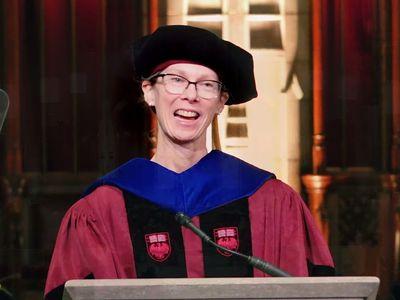
Paul Alivisatos's 2021 Inaugural Address at the University of Chicago: A Journey of Reconnection
On October 29, 2021, Paul Alivisatos delivered his inaugural address as the University of Chicago's 14th president in Rockefeller Memorial Chapel. Beginning with the University's core values and founding president William Rainey Harper's vision of public service, he called for a "journey of reconnection." The University, he argued, should preserve rigorous inquiry, open discourse, free expression, and intellectual diversity while strengthening belonging on campus and deepening partnerships with South Side neighbors, civic institutions, companies, and collaborators around the world. Because challenges such as climate change, inequality, and political division cross disciplinary and institutional boundaries, universities must connect knowledge to society through more open and collaborative forms of engagement and create new public benefits for humanity.
Thomas F. Hofmann's 2021 First Years' Convocation Address at the Technical University of Munich
On October 18, 2021, Technical University of Munich President Thomas F. Hofmann delivered this English-language address at the first-years' convocation on the Garching campus. More than 14,000 new students were returning to campus after a long period of online learning, remote work, and social distancing. Hofmann used the TUM Boring team's victory in Elon Musk's Not-a-Boring Competition—where students built a 22-ton machine and bored a tunnel more than 20 metres long—to frame three lessons: be authentic while respecting diversity and accepting challenges from teammates; remain curious, cross disciplinary boundaries, and embrace adventure; and do not let obstacles dampen the spirit, but learn through experimentation, adaptation, and improvement. He highlighted opportunities in interdisciplinary courses, student initiatives, sport and music, language learning, the EuroTech Universities Alliance, and entrepreneurship, inviting newcomers to make the entire university their laboratory.
Science Minister Announces UKRI's Open Access Policy
On 6 August 2021, UK Science Minister Amanda Solloway announced UK Research and Innovation's new open-access policy at an online roundtable hosted by Imperial College London. Using the rapid sharing of viral genomes, data, and papers during COVID-19, she argued that open research accelerated the development of vaccines and treatments and criticised the continued restriction of publicly funded knowledge by paywalls and embargoes. The policy required UKRI-funded research articles to be fully and immediately open from publication and available for reuse and recombination. Solloway also announced £650,000 for the Octopus research platform and argued that transparency, data, code, materials, and assessment incentives should all form part of an open-research culture.
Universities at a Crossroads
On 2 June 2021, Imperial College London President Alice Gast delivered her annual address, Universities at a Crossroads, online. Against the backdrop of COVID-19 reshaping teaching, research, and daily work, she began with society's growing dependence on technology and reviewed the scientific community's innovation and collaboration during the crisis. Gast argued that universities must confront four realities: insufficient diversity, technology's transformation of education, the need to rethink physical space, and weaker collaboration in teaching than in research. She also announced a scholarship challenge fund and advocated lifelong learning, a flipped workplace, and more open international educational partnerships, urging universities to turn pandemic-driven disruption into lasting reform.
Robert Lopez's 2021 Class Day Address at Yale University: Collaboration
On May 23, 2021, American songwriter and Yale College alumnus Robert Lopez '97 delivered the featured address at a virtual Class Day shaped by the COVID-19 pandemic. Beginning with a squirrel that once entered his dorm room, Lopez presented accepting help and collaboration as essential skills for life after college. He recalled working with Yale friends, Jeff Marx, and his wife Kristen Anderson-Lopez, and used songs from Avenue Q, Coco, and Frozen to explain that talent should serve a community, creative work should improve other people's lives, and collaborators matter more than the work itself. He encouraged graduates to acknowledge their weaknesses, seek partners whose strengths complement their own, and become a helpful “squirrel friend” to others. The text follows publisher-provided manual English captions on Yale University's official video.
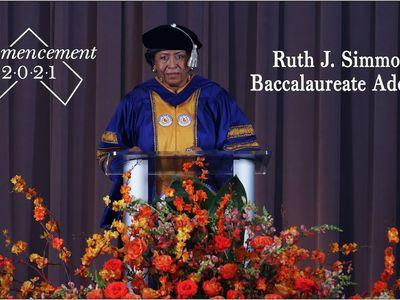
Ruth J. Simmons's 2021 Baccalaureate Address at Princeton University: Let Diversity Inform and Shape Your Life and Work
On May 15, 2021, at Princeton University's 274th Baccalaureate, Ruth J. Simmons delivered the address. The first African American to lead an Ivy League university (as Brown University's eighteenth president), she traced her path from sharecropper's daughter on a Texas plantation to university president, illustrating how education transformed her life and the gift that diversity brings. She recalled her years helping build Princeton's residential college system, observed that engaging with difference is an unparalleled opportunity for growth, and warned graduates against the resurgence of racial-superiority thinking. She urged them, wherever they go, to let diversity inform and shape their life and work, and to be warriors for justice and equal treatment. The text follows Princeton University's complete official remarks published as prepared.