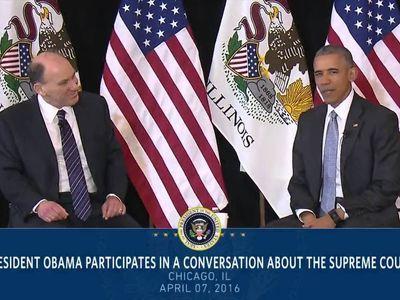
Conversation on the USSC Nomination Process
On April 7, 2016, President Barack Obama returned to his alma mater, the University of Chicago Law School, for a public conversation with constitutional law professor David Strauss on the U.S. Supreme Court nomination process. The event took place amid a constitutional controversy following the death of Justice Antonin Scalia, as Obama had nominated Merrick Garland to fill the vacancy but the Senate Republican majority refused to hold hearings or a vote. During the dialogue, Obama reviewed the historical evolution of the federal judicial appointment system, analyzed how partisan polarization was eroding the legitimacy of the nomination process, outlined his criteria for selecting justices—emphasizing both intellectual integrity and human empathy—and responded to student questions on criminal justice reform, the drone program, voting rights, and diversity. The conversation served as both a profound reflection on the crisis of the Supreme Court nomination system and a civic education for law students from the former constitutional law professor.
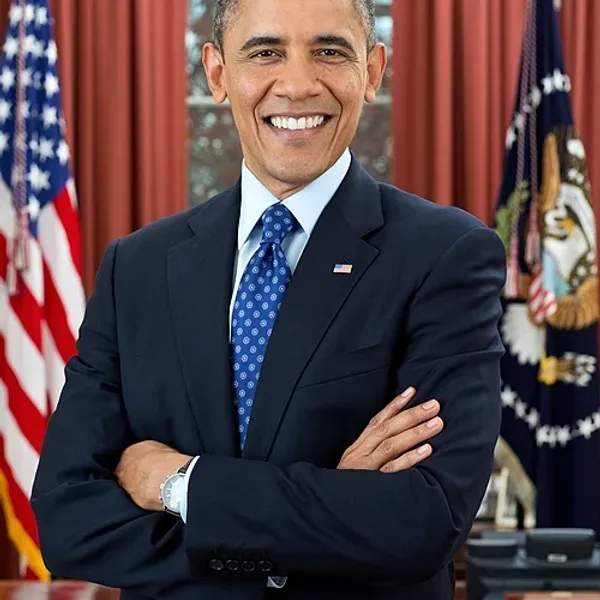
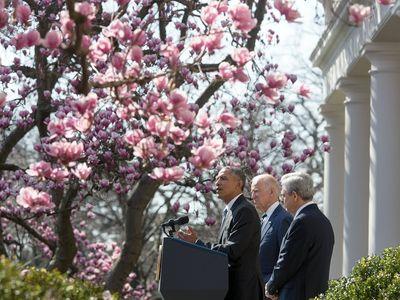
Merrick Garland USSC Nomination Address
On February 13, 2016, conservative US Supreme Court Justice Antonin Scalia passed away suddenly, leaving a vacancy on the Court. On March 16, President Barack Obama formally nominated Chief Judge Merrick Garland of the D.C. Circuit Court of Appeals to fill the seat, in a ceremony at the White House Rose Garden. Garland was widely regarded as a consensus nominee due to his outstanding legal credentials, moderate judicial philosophy, and history of bipartisan support. However, the Republican-controlled Senate refused to hold hearings or a vote, arguing that a president should not fill a Supreme Court vacancy in the final year of a term. The nomination was never confirmed during Obama's presidency, becoming one of the most contentious Supreme Court nomination standoffs in American constitutional history.
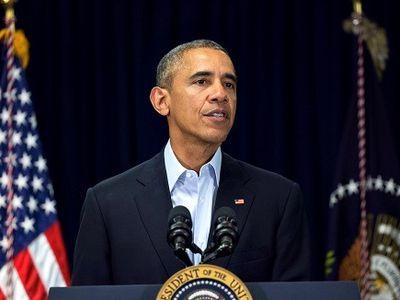
On the Passing of USSC Justice Antonin Scalia
On February 13, 2016, US Supreme Court Justice Antonin Scalia passed away suddenly at age 79 at a ranch in Texas. Serving nearly three decades on the Court, Scalia was one of its most influential justices, known for his originalist and textualist jurisprudence whose distinctive opinions and sharp wit profoundly shaped American law. President Obama delivered a statement in Rancho Mirage, California, offering condolences to the Scalia family, honoring his legal legacy, and stating he would fulfill his constitutional duty to nominate a successor in due time. The vacancy immediately sparked intense political controversy in the Senate over the Supreme Court nomination process.
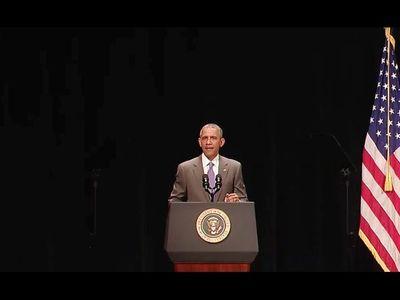
Loretta Lynch Investiture Ceremony Address
On June 17, 2015, President Barack Obama delivered an address at the investiture ceremony of Loretta Lynch in Washington, D.C. Loretta Lynch is the 83rd Attorney General of the United States and the first African-American woman to hold the position. In his speech, Obama reflected on Lynch's life story and professional achievements, praising her outstanding work in counterterrorism, financial fraud, and cybercrime, as well as her integrity and fairness. The address emphasizes the importance of the rule of law, the need for criminal justice reform, and the importance of building strong relationships between law enforcement and communities, expressing high hopes for Lynch's tenure in advancing justice and equality.
A Fair Trial for the Human Rights Act
Sadiq Khan, then Shadow Lord Chancellor and Shadow Secretary of State for Justice, delivered this Department of Law public lecture at the London School of Economics and Political Science on June 9, 2011. Debate in Britain was intensifying over prisoner voting, the sex offenders register, super-injunctions, and proposals to replace the Human Rights Act 1998 with a new British bill of rights. Drawing on the history of the European Convention on Human Rights and its incorporation into British law, Khan explains how the Act preserves parliamentary sovereignty, constrains public authorities, and protects ordinary people. He rebuts widely repeated claims that it is a criminals' charter, acknowledges Labour's own civil-liberties failures in government, and argues that any additional bill of rights must build on the Act rather than replace or weaken it.
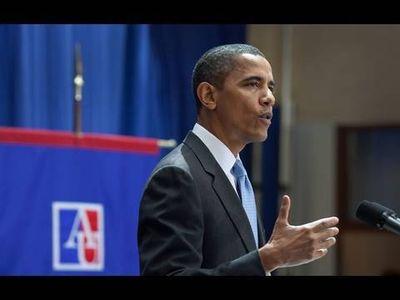
Comprehensive Immigration Reform
On July 1, 2010, President Barack Obama delivered a speech on comprehensive immigration reform at American University in Washington, D.C. The address came shortly after Arizona passed the controversial SB1070 immigration law, reigniting national debate and making immigration a central political issue. Obama emphasized both the necessity of border security—highlighting that the Southwest border was more secure than at any time in two decades—and the impracticality of mass deporting 11 million undocumented immigrants, calling such an effort logistically impossible and morally intolerable. He outlined a comprehensive approach: stricter border enforcement and employer accountability by government, registration, tax payment, fines, and English-learning requirements for undocumented immigrants, and passage of the DREAM Act to protect innocent young people. The speech concluded with Emma Lazarus's words on the Statue of Liberty, appealing for bipartisan cooperation and a return to America's fundamental identity as a nation of immigrants.
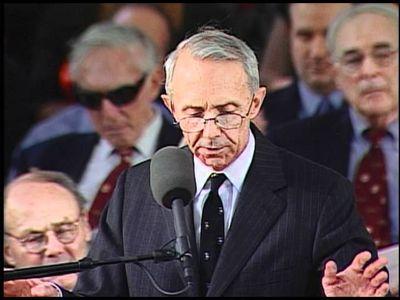
David Souter's 2010 Harvard Commencement Address: Reading the Constitution Beyond Its Literal Text
Retired U.S. Supreme Court justice David Souter delivered this address at Harvard on May 27, 2010. He rejects the idea that constitutional cases can be decided by simply reading fixed words and applying an obvious rule. The Constitution protects liberty, order, equality, security, and other important values that often conflict in real disputes. Through cases involving school desegregation, illegally seized evidence, and national-security detention, Souter shows why judges must confront facts, history, and competing principles through reasoned judgment. He presents constitutional adjudication as an act of trust in an uncertain world and as a continuing effort to honor the promises made to living people.
Nomination of Elena Kagan for U.S. Supreme Court Justice
On May 10, 2010, U.S. President Barack Obama announced at the White House the nomination of Solicitor General Elena Kagan to serve as a Justice of the U.S. Supreme Court, succeeding the retiring Justice John Paul Stevens. Kagan had previously served as Dean of Harvard Law School, becoming the first woman to hold that position, and was also the first woman to serve as U.S. Solicitor General. Although she had never previously served as a judge, her extensive academic and governmental experience made her a notable nominee. This was Obama's second Supreme Court appointment, intended to preserve Justice Stevens's liberal seat. In August of that year, the Senate confirmed Kagan by a 63-37 vote, making her the fourth woman to serve on the U.S. Supreme Court.
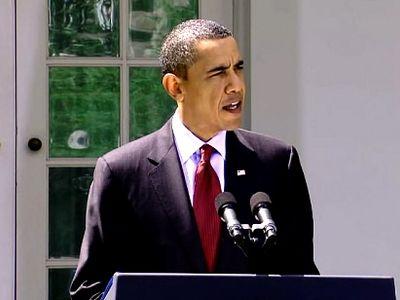
Justice Stevens Retirement and West Virginia Mining Tragedy
On April 5, 2010, a devastating explosion at the Upper Big Branch Mine near Montcoal, West Virginia, killed 29 miners, the deadliest U.S. mining disaster in nearly 40 years. On April 9, President Obama delivered remarks from the White House addressing both the tragedy and Justice John Paul Stevens' announcement that he would retire from the Supreme Court at the end of the current term. Appointed by President Ford, Stevens had served on the Court for nearly 35 years and was renowned for his independence, pragmatism, and commitment to the rule of law. The President mourned the fallen miners, consoled their families, praised the rescue teams, and pledged a thorough investigation to prevent future accidents. He also outlined the qualities he would seek in a successor. The speech demonstrated presidential leadership at a moment of national grief and judicial transition, closing with a fallen miner's farewell letter and a Psalm.
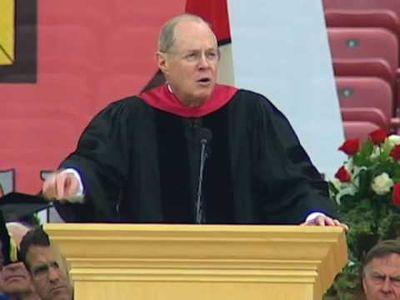
Anthony M. Kennedy's 2009 Stanford Commencement Address: Freedom Under the Law
On 2009-06-14, Anthony M. Kennedy delivered this address at Stanford University's Commencement. Organized around the rule of law, freedom, and civic duty, it joins personal experience, professional judgment, and the public concerns of its moment. The address asks not only what graduates might do next, but also how educated people should understand their abilities, accept public responsibility, and help build a shared future. This edition is based on a complete authoritative transcript and preserves the sequence and character of the original address.
Speech on American Values and National Security
President Obama's major speech at the National Archives on American values and national security, outlining policies including closing Guantanamo Bay prison, banning enhanced interrogation techniques, and reforming military commissions, emphasizing the importance of upholding the rule of law and core values while protecting national security.
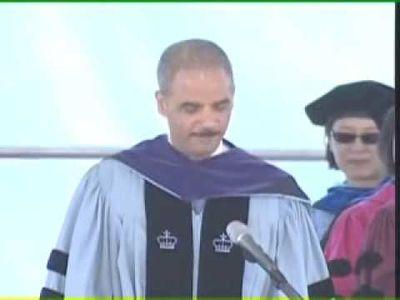
Eric Holder's 2009 Class Day Address at Columbia College: Public Service
U.S. Attorney General and Columbia College and Law School alumnus Eric H. Holder Jr. delivered these remarks at Columbia College Class Day on May 19, 2009. Recalling his New York upbringing, life in Carman Hall, and student activism, Holder describes how Columbia tolerated youthful dissent while forming his sense of public responsibility. He argues that public service is not limited to elected office or government employment but is an obligation shared by every educated person. Amid anxiety following the financial crisis, he urges graduates to look beyond careers offering the greatest financial rewards toward work that rewards the soul and improves the world, using their knowledge and compassion to help children, communities, and overlooked workers. Quoting Tennyson, he closes by asking them to preserve a confident hope grounded in action despite future tests.