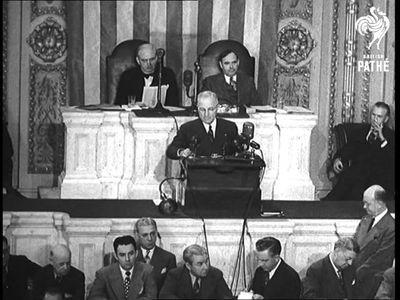
The Truman Doctrine (Address to Congress Requesting Aid to Greece and Turkey)
On March 12, 1947, Harry S. Truman delivered this address before a Joint Session of Congress, requesting $400 million in aid and the dispatch of civilian and military personnel to Greece and Turkey on the grounds that both countries were threatened by communism. The Truman Doctrine declared that the United States would assist 'free peoples' resisting attempted subjugation by armed minorities or outside pressures, establishing the overarching Cold War policy of containing Soviet expansion. It marked a major turning point in post-WWII U.S. foreign policy and, together with the Marshall Plan, formed the two pillars of America's global strategy in the early Cold War era.
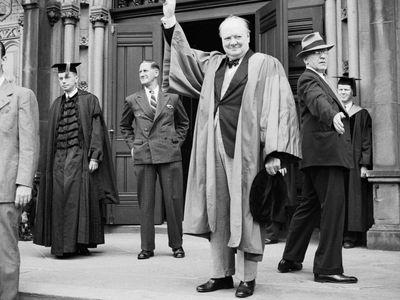
Winston Churchill's 1943 Harvard Address
On September 6, 1943, British Prime Minister Winston Churchill received an honorary Doctor of Laws degree and spoke at Sanders Theatre, Harvard University. With the Second World War at a critical stage, he began with the university's wartime mobilization and argued that “the price of greatness is responsibility,” making clear that the United States could not escape global obligations. Churchill described the Anglo-American Combined Chiefs of Staff, urged that the partnership continue after the war, and grounded it in a common language, legal traditions, and devotion to liberty. He also discussed Basic English, the failure of the League of Nations, and future institutions for world security, declaring that “the empires of the future are the empires of the mind” and calling for a fraternal association of the two peoples in service to humanity.
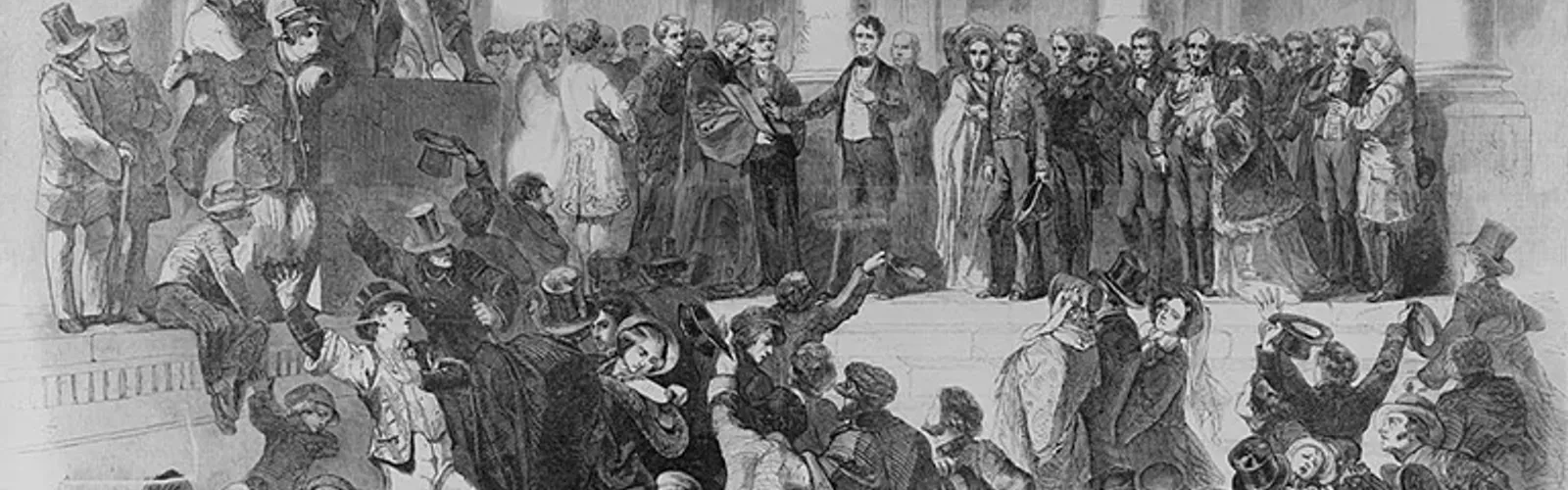
Franklin Pierce's 1853 Inaugural Address
On March 4, 1853, Democrat Franklin Pierce took office as the fourteenth president of the United States at the East Portico of the Capitol in Washington. In the 1852 election, he had campaigned on support for the Compromise of 1850 and preservation of the Union, defeating Whig candidate Winfield Scott. The address reviewed the republic's expansion, advocated peaceful protection of commercial and diplomatic interests, supported further territorial growth, opposed a large standing army, and emphasized integrity, economy, and the division of state and federal powers. On slavery, Pierce said that existing state institutions were protected by the Constitution and pledged to enforce the compromise measures of 1850. His administration later pursued the Gadsden Purchase and enacted the Kansas–Nebraska Act, which removed the Missouri Compromise restriction and helped provoke Bleeding Kansas, further worsening sectional conflict.
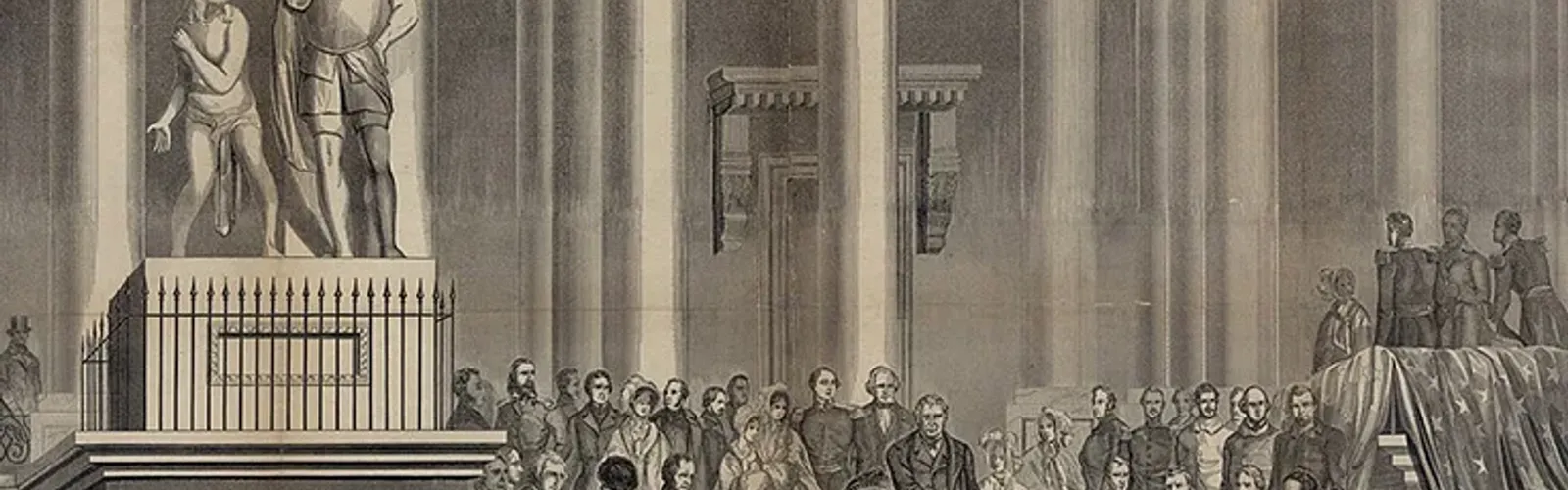
Zachary Taylor's 1849 Inaugural Address
On March 5, 1849, Whig Zachary Taylor took office as the twelfth president of the United States at the East Portico of the Capitol in Washington; because March 4 fell on a Sunday, the ceremony was held one day later. A career soldier with almost no political experience, Taylor won the 1848 election on the strength of his fame from the Mexican–American War victories at Monterrey and Buena Vista. The address presented the Constitution as his guide, emphasized honesty, capacity, and fidelity in appointments, advocated neutrality and exhaustive negotiation before force, and called for economy, debt reduction, conciliation of sectional interests, and preservation of the Union. It did not directly address the dispute over slavery in the new territories. As president, Taylor opposed extending slavery into California and New Mexico. He died in July 1850 after a sudden digestive illness, having served about sixteen months.
James Monroe's 1821 Inaugural Address
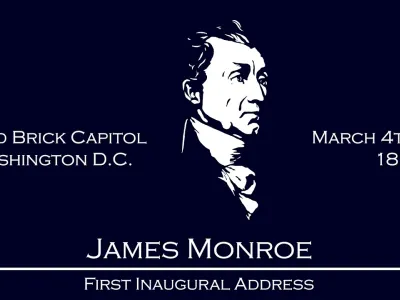
On March 5, 1821, because the scheduled inauguration date of March 4 fell on a Sunday, James Monroe postponed his second inauguration until Monday after consulting Supreme Court justices and took the oath in the House of Representatives Chamber at the U.S. Capitol in Washington. The address reviewed post-War of 1812 coastal fortifications and naval development; discussed the decline in prices and federal revenue following the Panic of 1819, the public debt, and choices involving taxes and loans; described the ratified and exchanged Adams-Onís Treaty and the acquisition of Florida; and reaffirmed U.S. neutrality in the wars between Spain and its American colonies. Monroe also proposed an assimilationist policy of allotting Native lands to individuals and using compensation for ceded territory to support government, farming instruction, and education. The address did not yet formally announce the Monroe Doctrine of 1823.

James Monroe's 1817 Inaugural Address
On March 4, 1817, James Monroe took the oath as the fifth president of the United States on an outdoor platform at the front of the Old Brick Capitol in Washington, on the present site of the U.S. Supreme Court building. The War of 1812 had ended in 1815, peace with Britain had returned, the Federalist Party was declining, and nationalist and politically conciliatory sentiment was rising in what became known as the Era of Good Feelings. Monroe reviewed the achievements of constitutional government, territorial expansion, commerce, and the recent test of war. He emphasized preserving the Union, educating citizens, strengthening coastal and frontier defenses, maintaining the Army, Navy, and militia, building roads and canals, supporting domestic manufacturing, paying the national debt, and enforcing fiscal accountability. He also endorsed continuing the era's assimilationist “civilizing” policy toward Native peoples.
James Madison's 1813 Inaugural Address
On March 4, 1813, James Madison took the oath for a second term as the fourth president of the United States in the House of Representatives Chamber at the U.S. Capitol in Washington. The War of 1812 with Britain had lasted nearly nine months, and the impressment of sailors, sovereignty on the high seas, and the justice of the war remained subjects of domestic dispute. Madison defended the decision to fight, arguing that the United States had resorted to force only after diplomacy and protest failed. He condemned British impressment, its treatment of naturalized citizens, and its use of Native allies, while stressing American population, prosperity, naval achievements, and the public's capacity to bear the costs of war. He called for energetic and systematic effort to secure an honorable outcome. The address was a forceful wartime appeal and also employed the era's derogatory language about Native peoples.