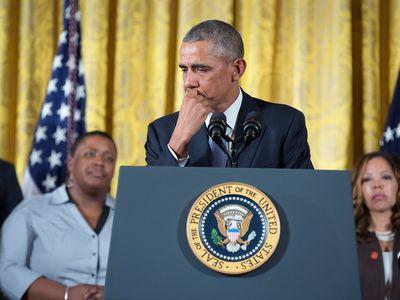
Address Detailing Steps to Reduce Gun Violence
On January 5, 2016, President Barack Obama delivered a speech at the White House announcing a series of executive actions on gun violence reduction. Delivered on the fifth anniversary of the Tucson shooting, the address was deeply emotional, with Obama visibly holding back tears. He recounted mass shootings at Sandy Hook, Aurora, Charleston, and San Bernardino, noting that the United States is the only advanced country where such mass violence occurs with any frequency. Obama outlined four executive actions: expanding background checks, strengthening enforcement of gun safety laws, increasing investment in mental health services, and advancing gun safety technology. He called on Congress to pass legislative reforms and urged voters to make their voices heard in elections. The speech concluded with the story of Zaevion Dobson, a Tennessee teenager who died shielding classmates from gunfire, invoking Dr. King's "fierce urgency of now."
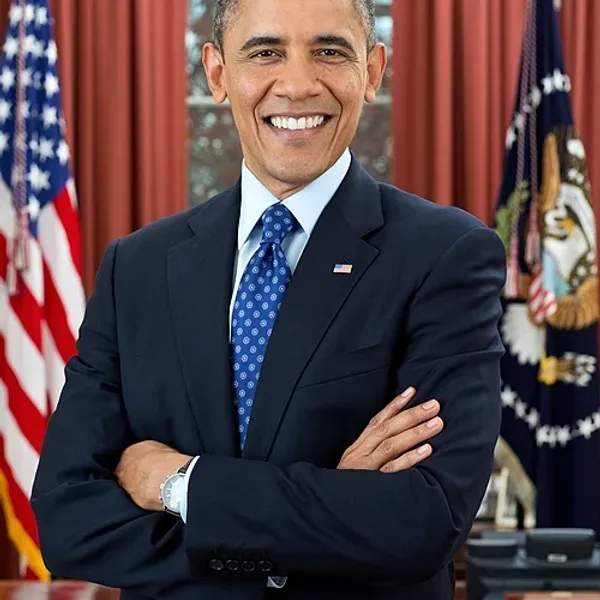
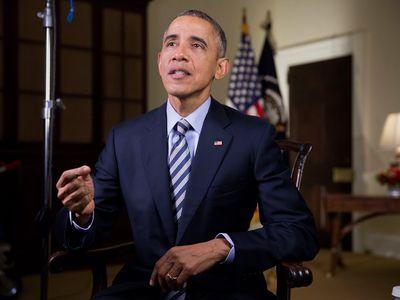
Weekly Address: Making America Safer for Our Children
On January 1, 2016, President Barack Obama delivered his first weekly address of the new year, focusing on the theme of keeping children safe. Over seven years into his presidency, the U.S. economy had recovered from the financial crisis, with the unemployment rate falling from 10% to 5%, health insurance coverage expanding dramatically, the clean energy industry booming, and marriage equality legalized across all fifty states. Yet gun violence remained a persistent epidemic. The third anniversary of the Newtown school shooting had just passed, and Tucson shooting survivor Gabby Giffords continued her recovery. Obama called on Congress to act on commonsense gun safety reforms like background checks, and announced he would explore new executive actions to reduce gun violence and protect America's children.
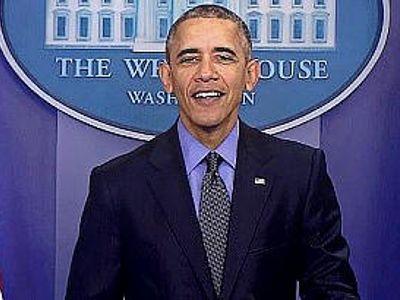
End of Year Press Conference
On December 18, 2015, U.S. President Barack Obama held his year-end press conference at the White House, summarizing the achievements of 2015 and taking questions from reporters. In his opening remarks, Obama reviewed the year's major accomplishments including sustained economic recovery, unemployment falling to 5 percent, healthcare coverage exceeding 90 percent, the Paris climate agreement, the Iran nuclear deal, the normalization of relations with Cuba, and nationwide marriage equality. The press conference covered a wide range of topics including counterterrorism and ISIL, the San Bernardino shooting, Guantanamo Bay, Middle East policy and Syria, congressional legislative agenda, climate change, and criminal justice reform.
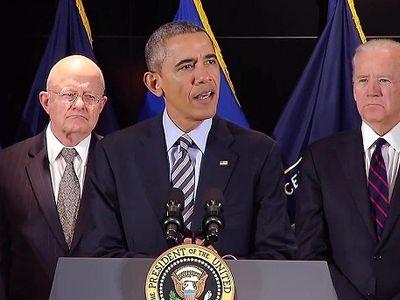
Post Briefing Address at the National Counterterrorism Center
On December 17, 2015, President Barack Obama delivered an address at the National Counterterrorism Center in McLean, Virginia. The speech came shortly after the Paris terrorist attacks and the San Bernardino shooting in California, at a time when many Americans felt anxious and concerned about national security. Speaking after a briefing with his national security team, Obama sought to reassure the American people that the government was taking all necessary measures to protect the homeland. In his remarks, Obama outlined three main fronts of the U.S. counterterrorism strategy: going after terrorist groups abroad, strengthening border and entry security, and domestic prevention with community cooperation. He also emphasized that the unity and resilience of the American people are the greatest weapons against terrorism, urging citizens not to give in to fear.
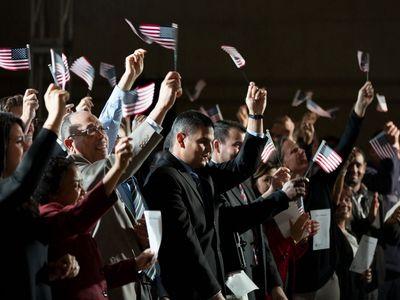
Naturalization Ceremony Speech at the National Archives
On December 15, 2015, President Barack Obama delivered a speech at a naturalization ceremony held at the National Archives in Washington, D.C., welcoming new citizens from more than 25 countries. Against the backdrop of America's founding documents, Obama reflected on America's history as a nation of immigrants -- from Pilgrim settlers to Irish refugees, from Chinese laborers to WWII survivors, generations of immigrants have shaped America. He also acknowledged dark chapters of immigration exclusion in American history, urging vigilance against hatred and bigotry and defending the founding ideal of "E Pluribus Unum." Obama concluded by encouraging new citizens to cherish their citizenship, engage actively in public life, and help write the next chapter of America's story.
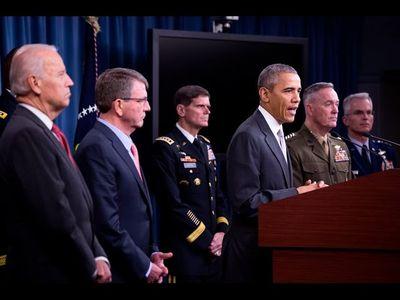
Update on Military Campaign Against ISIL
On December 14, 2015, President Barack Obama delivered remarks at the Pentagon to update the nation on the U.S.-led military campaign against ISIL. The address came amid heightened security concerns following the terrorist attacks in Paris and San Bernardino. Obama outlined a four-front strategy: hunting down terrorists, training and equipping Iraqi and Syrian ground forces, disrupting ISIL's recruiting, financing and propaganda, and pursuing diplomacy to end the Syrian civil war. He announced intensified airstrikes, the elimination of multiple senior ISIL leaders, and territorial gains by local forces in Iraq and Syria. The speech aimed to reassure the public, demonstrate counterterrorism progress, urge allies to increase military contributions, and advance a political solution to the Syrian crisis through the Vienna process.
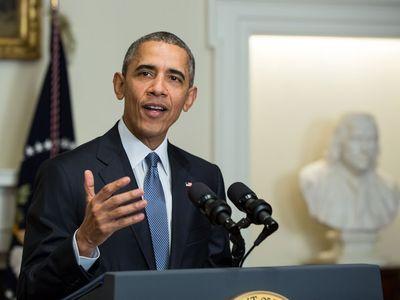
Paris Climate Agreement Address
On December 12, 2015, the 21st Conference of the Parties to the UN Framework Convention on Climate Change reached the historic Paris Agreement in Paris, with nearly 200 nations unanimously agreeing to jointly address climate change, the common challenge of humanity. U.S. President Barack Obama delivered a national address at the White House warmly welcoming the agreement and emphasizing America's leading role in global climate action. The agreement established global temperature targets and built mechanisms for transparency, assessment, and accountability, providing an enduring framework for nations to progressively strengthen their emission reduction efforts. The prior joint announcement on climate change between China and the United States laid important political groundwork for the success of the Paris negotiations, demonstrating the pivotal role of major powers in climate cooperation.
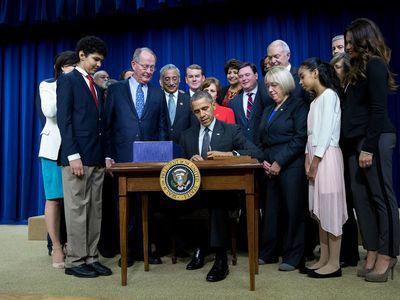
Speech on Signing the 'Every Student Succeeds Act'
On December 10, 2015, President Barack Obama signed the Every Student Succeeds Act at the Eisenhower Executive Office Building in Washington, D.C., formally replacing the No Child Left Behind Act that had been in place for more than thirteen years. The new law marks a major milestone in American K-12 education reform. While retaining the core principles of high standards and accountability, it replaces the previous one-size-fits-all federal mandate approach with greater autonomy for states and school districts to develop improvement plans tailored to local needs. The act also promises to reduce unnecessary standardized testing, expand access to preschool education, support innovative teaching methods, and uphold the core value of education as a civil right, working to ensure every student is prepared for future success.
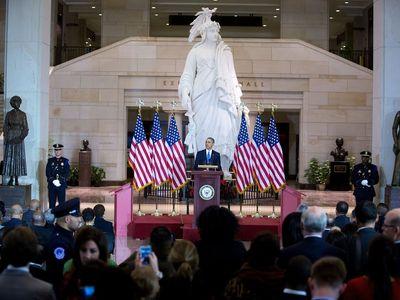
13th Amendment 150-Year Anniversary Address
The 13th Amendment to the U.S. Constitution, ratified on December 6, 1865, formally abolished slavery nationwide and stands as one of the most important milestones in American civil rights history. On December 9, 2015, marking the 150th anniversary of the amendment's passage, President Barack Obama delivered this address at a commemoration held in the U.S. Capitol. Obama reflected on the long struggle from slavery to the Civil War, from Jim Crow to the civil rights movement, emphasizing the cost and meaning of freedom and equality. Quoting Lincoln, he noted that in giving freedom to the slave we assure freedom to the free, and called on the current generation to carry forward the legacy of their predecessors, to continue pushing back against bigotry and discrimination in all its forms, and to advance social justice. The speech is both a tribute to history and a reaffirmation of American ideals and hope for the future.
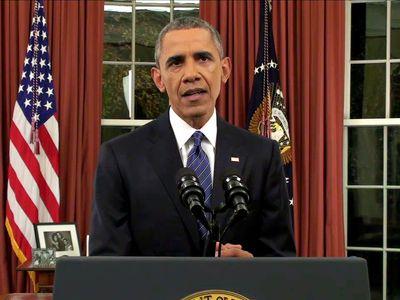
Address to the Nation on Foreign and Domestic Counter-Terrorism Strategies
On December 2, 2015, a mass shooting in San Bernardino, California left 14 people dead. On December 6, President Barack Obama delivered a televised address to the nation from the Oval Office of the White House, outlining America's counterterrorism strategy. This marked the first time Obama addressed the nation from the Oval Office on counterterrorism during his presidency. In the speech, Obama outlined a four-point military and diplomatic strategy against ISIL, called on Congress to take domestic security measures including gun control and visa screening, and emphasized that the fight against terrorism should not be defined as a war between America and Islam, urging unity with Muslim communities to confront the threat of extremism together.
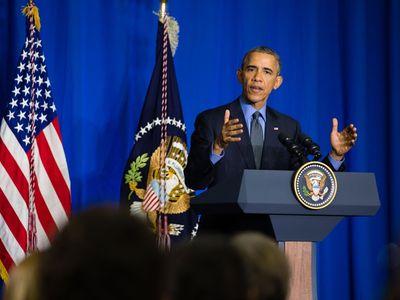
Paris Press Conference
From November 30 to December 12, 2015, the 21st United Nations Climate Change Conference (COP21) was held in Paris, France, attended by leaders of nearly 200 countries. On December 1, U.S. President Barack Obama held a press conference in Issy-les-Moulineaux, Paris. Just two weeks after the Paris terrorist attacks, Obama not only outlined America's position in climate negotiations but also answered reporters' questions on the situation in Syria, counter-terrorism cooperation, and Turkey's border security. The press conference focused on the framework of the Paris climate agreement, the significance of U.S.-China climate cooperation, the Green Climate Fund, and domestic carbon pricing in the U.S., demonstrating American leadership on climate change and confidence in reaching a global agreement.
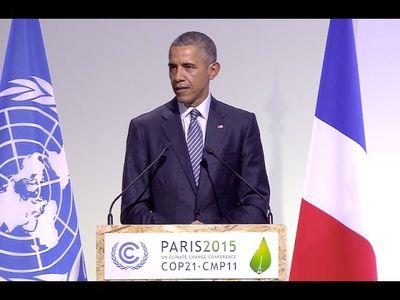
COP21, Session 1 Address
On November 30, 2015, the 21st United Nations Climate Change Conference (COP21) opened in Le Bourget, Paris, France. Leaders from nearly 200 nations gathered to discuss global action on climate change. Then-U.S. President Barack Obama attended the conference and delivered a speech at the opening session, outlining America's position and commitments on climate issues. The conference ultimately produced the historic Paris Agreement, which established a unified framework for global climate action post-2020 and set the goal of limiting global temperature rise to well below 2 degrees Celsius while pursuing efforts to limit it to 1.5 degrees. In his address, Obama emphasized the urgency of climate change and called for collective action to advance the transition to a low-carbon economy.