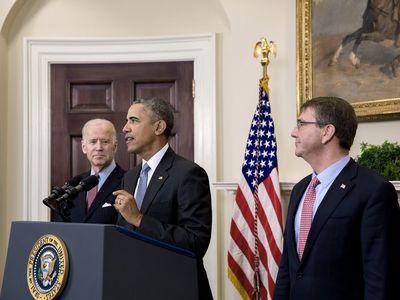
Address on Closing Guantanamo Bay Detention Facility
On February 23, 2016, President Obama delivered a speech at the White House, formally announcing that the Department of Defense was submitting to Congress a comprehensive plan to close the Guantanamo Bay detention facility. This marked a significant step in Obama's efforts to close Guantanamo during his presidency. In the speech, Obama outlined how Guantanamo undermines national security: it is used by terrorists as a recruitment propaganda tool, drains massive military resources, harms U.S. partnerships with allies, and contradicts American values. The plan includes four main elements: continuing transfers of approved detainees, accelerating periodic reviews of remaining detainees, using legal tools to deal with the remaining detainees, and working with Congress to find a secure location within the United States. Obama emphasized that closing Guantanamo would not only save money but, more importantly, uphold American values and the rule of law tradition.
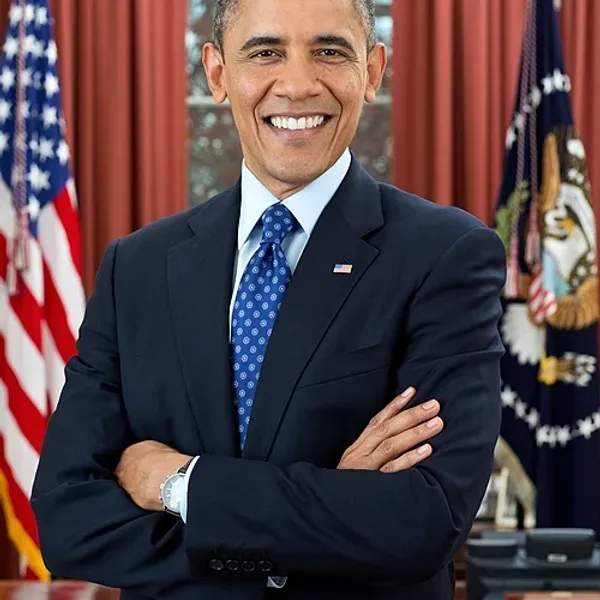
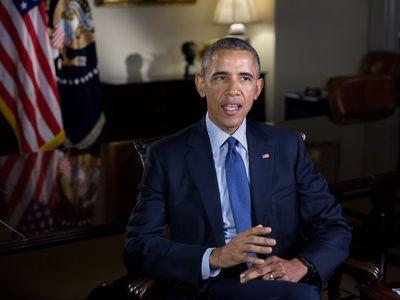
Weekly Address: A New Chapter with Cuba
On February 20, 2016, President Obama delivered his weekly address, officially announcing that he would visit Havana, Cuba the following month. This would mark the first visit by a U.S. President to Cuba in nearly 90 years, representing a significant milestone in the normalization of U.S.-Cuba relations. Since the Obama administration announced the restoration of diplomatic relations with Cuba in December 2014, the two countries have gradually advanced cooperation in diplomacy, trade, and people-to-people exchanges. The visit aimed to further normalize relations, including facilitating trade, internet access, and private enterprise development. Obama also stated he would continue candid dialogue with the Cuban government on differences such as democracy and human rights, and meet with Cuban civil society representatives and entrepreneurs.
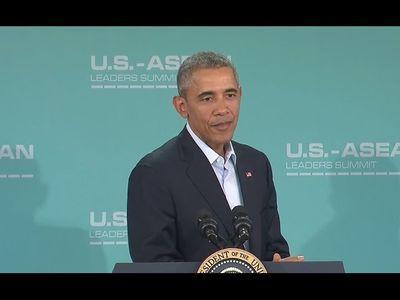
U.S.-ASEAN Press Conference
On February 16, 2016, President Barack Obama held a press conference following the U.S.-ASEAN Special Summit at Sunnylands in Rancho Mirage, California. Obama summarized the summit's achievements in economic cooperation, security, human rights and governance, and transnational challenges, announcing the new U.S.-ASEAN Connect initiative. Just three days after the passing of Justice Scalia, the press conference was dominated by questions on the Supreme Court nomination controversy, the situation in Syria, ISIS in Libya, and the 2016 presidential election, all of which Obama addressed in detail.
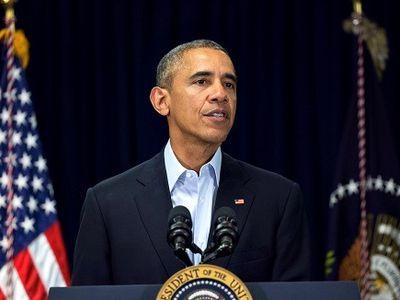
On the Passing of USSC Justice Antonin Scalia
On February 13, 2016, US Supreme Court Justice Antonin Scalia passed away suddenly at age 79 at a ranch in Texas. Serving nearly three decades on the Court, Scalia was one of its most influential justices, known for his originalist and textualist jurisprudence whose distinctive opinions and sharp wit profoundly shaped American law. President Obama delivered a statement in Rancho Mirage, California, offering condolences to the Scalia family, honoring his legal legacy, and stating he would fulfill his constitutional duty to nominate a successor in due time. The vacancy immediately sparked intense political controversy in the Senate over the Supreme Court nomination process.
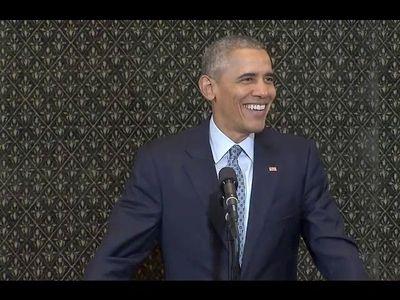
Address to the Illinois General Assembly
On February 10, 2016, exactly nine years after he announced his presidential candidacy on the steps of the Old State Capitol, President Barack Obama returned to Springfield, Illinois, to address the state legislature where he had served eight years as a state senator. Drawing on his personal experience of bipartisan collaboration in the Illinois General Assembly, Obama reflected on the growing polarization in American politics and laid out three concrete proposals for reform: reducing the corrosive influence of money in politics, ending partisan gerrymandering through independent redistricting commissions, and making voting easier and more accessible. Citing Abraham Lincoln's story of re-entering politics from Springfield to fight the expansion of slavery, Obama called on citizens to renew their faith in democracy and bridge partisan divides with respect and reason.
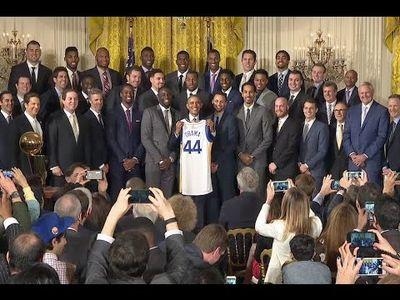
Address Honoring the Golden State Warriors 2015 NBA Championship
On February 4, 2016, President Barack Obama welcomed the 2015 NBA Champion Golden State Warriors to the East Room of the White House, continuing the longstanding tradition of U.S. presidents hosting championship sports teams. The Warriors had won the 2014-15 season title with a 67-15 record, ending a 40-year championship drought, and were off to an astounding 24-0 start that season. In his remarks, Obama humorously praised star players like Steph Curry and Klay Thompson, recounted the franchise's turnaround from years of struggle back to the top, and commended the team's community work, including support for the My Brother's Keeper initiative, anti-gun violence efforts, and charitable giving. Warriors head coach Steve Kerr then shared a lighthearted exchange with the President, inviting him to lead 'Dub Nation' after his time in office.
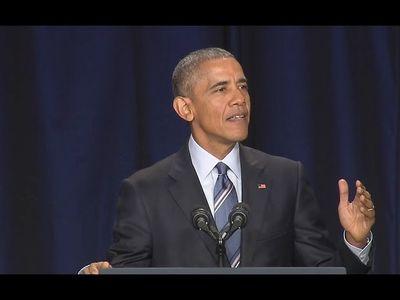
Address at the 64th National Prayer Breakfast
On February 4, 2016, President Barack Obama delivered an address at the 64th National Prayer Breakfast held at the Washington Hilton in Washington, D.C. This annual gathering brings together members of Congress, faith leaders, and people from all walks of life to build interfaith consensus through prayer and fellowship. Obama centered his speech on the verse from Second Timothy -- "For God has not given us a spirit of fear, but of power and of love and of a sound mind" -- exploring how fear erodes the human heart in an age of rapid change, and how faith serves as its antidote. He shared the story of Sergeant Roddie Edmonds declaring "We are all Jews" to save Jewish POWs in the Holocaust, and the story of Muslim American Rami Nashashibi who prayed publicly despite fears after the San Bernardino attack, emphasizing shared humanity and solidarity across faiths.
Islamic Society of Baltimore Address
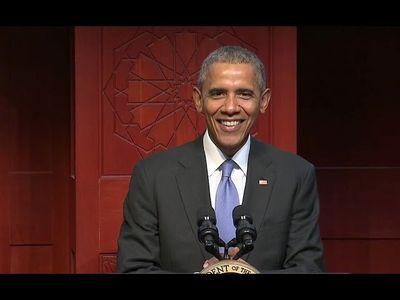
On February 3, 2016, President Barack Obama delivered a speech at the Islamic Society of Baltimore in Maryland, marking only his second visit to a U.S. mosque during his presidency. The address came in the wake of the Paris and San Bernardino terrorist attacks, at a time when anti-Muslim sentiment was rising across America and hate crimes targeting Muslim communities had surged. Obama expressed gratitude and support to Muslim Americans, emphasizing that Islam has been an integral part of American history since colonial times, and highlighting Muslim American contributions in science, sports, the military, and public service. He condemned political rhetoric that conflates terrorism with an entire religion, calling on all Americans to reject prejudice and defend religious freedom as a core value.
Righteous Among the Nations Award Ceremony Address
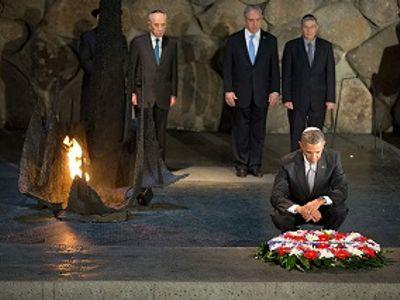
On January 27, 2016, President Barack Obama delivered this address at the Righteous Among the Nations Award Ceremony held at the United States Holocaust Memorial Museum in Washington, D.C. The Righteous Among the Nations is a prestigious honor bestowed by Yad Vashem, recognizing non-Jews who risked their lives to save Jews during the Holocaust. The ceremony posthumously honored four new Righteous individuals: the Zbijewskis of Poland, Lois Gunden of the United States, and Master Sergeant Roddie Edmonds of the U.S. Army. In his speech, Obama reflected on the trauma of the Holocaust, celebrated the extraordinary courage of the four honorees, emphasized the importance of memory and fighting anti-Semitism and all forms of hatred, and called upon governments, faith communities, and every individual to uphold justice and empathy through action.
On Smart Diplomacy with Iran and Release of U.S. Detainees
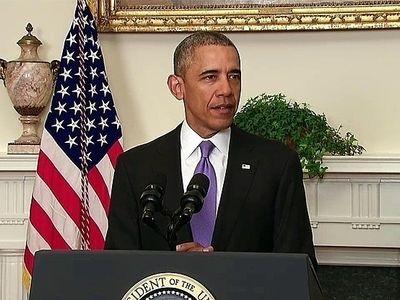
On January 17, 2016, President Barack Obama delivered remarks at the White House announcing the implementation of the Iran nuclear deal and the lifting of related sanctions. Under the agreement, Iran removed two-thirds of its centrifuges, shipped out over 98 percent of its enriched uranium stockpile, and filled the core of its plutonium reactor with concrete. The International Atomic Energy Agency will conduct 24/7 monitoring of Iran's nuclear facilities. Meanwhile, five American citizens detained in Iran were released and returned home, including Washington Post journalist Jason Rezaian, Pastor Saeed Abedini, and former Marine Amir Hekmati. The United States also granted clemency to seven Iranian prisoners on humanitarian grounds. The two sides also resolved a financial dispute dating back more than three decades.
Final Presidential State of the Union Address
On January 12, 2016, President Barack Obama delivered his eighth and final State of the Union Address from the United States Capitol. This speech holds special historical significance, marking the closing chapter of Obama's two-term presidency. Departing from the traditional format of listing annual proposals, Obama cast his vision toward the next five, ten, and more years, centering on four big questions: how to ensure everyone a fair shot at opportunity and security in the new economy, how to make technology work for us rather than against us, how to keep America safe and lead the world without becoming its policeman, and how to make our politics reflect what is best in us. The address both reviewed seven years of achievements including economic recovery, health care reform, and energy transition, and confronted deep challenges such as rising inequality and political polarization, calling on the American people to rise above partisan division and face the future with optimism and unity.
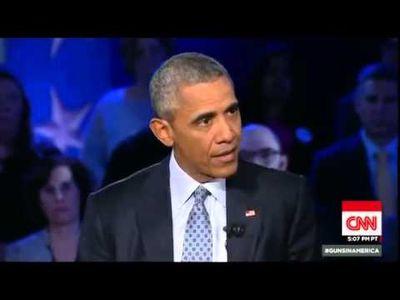
Remarks at a CNN 'Guns in America' Town Hall
On January 7, 2016, President Barack Obama participated in a CNN-hosted 'Guns in America' town hall moderated by Anderson Cooper at George Mason University in Fairfax, Virginia. The live televised event, held shortly after the San Bernardino terror attack, brought together gun rights advocates, gun dealers, shooting survivors, and families of victims. During the town hall, Obama detailed his administration's recently announced executive actions on gun control, including expanding background checks, strengthening enforcement, increasing mental health investment, and advancing smart gun technology. He engaged in vigorous Q&A with the audience, addressing concerns about Second Amendment rights, fears of government 'gun confiscation,' the role of the NRA, and gun violence in Chicago. The National Rifle Association (NRA) was invited but declined to participate.