
Seventh President-Elect Weekly Transition Address
On December 20, 2008, President-elect Obama delivered his seventh weekly transition address, announcing key science and technology team nominations including John Holdren as Director of the Office of Science and Technology Policy and Nobel laureate Harold Varmus as NIH Director. Obama pledged to restore evidence-based science policy, prioritize climate change and clean energy, and reiterated his economic recovery plan investing in infrastructure, health IT, and green energy, urging Congress to reach consensus on a stimulus package.

Paul Nurse's 2003 Oxford Romanes Lecture: The Great Ideas of Biology
On 30 October 2003, geneticist and cell biologist Paul Nurse delivered the annual Romanes Lecture, The Great Ideas of Biology, at the Sheldonian Theatre, University of Oxford. Moving through the history of science, he examined four foundational ideas—the cell, the gene, evolution by natural selection, and life as chemistry—and proposed an emerging fifth: understanding biological organisation through logical structures and information processing. He also connected these ideas to molecular medicine, inherited disease, and cancer, showing how biology moves from description toward explanations of complex systems. Oxford University Press later issued a 24-page Romanes Lecture booklet. The open full text used here is the same-titled Clinical Medicine version, explicitly described as based on the Harveian Oration delivered two weeks earlier, so its occasion-specific wording differs from the Oxford edition; that version relationship is preserved rather than concealed.
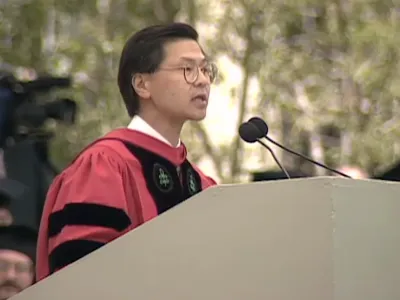
David D. Ho's 1998 MIT Commencement Address
Chinese American physician and HIV/AIDS researcher David D. Ho delivered this address at MIT's 132nd Commencement on June 8, 1998, sharing the program with President Bill Clinton. Ho reflects on his path as an immigrant child, scientist, and graduate of the Harvard-MIT Program in Health Sciences and Technology, explaining how interdisciplinary training prepared him for HIV research. He stresses that scientific advances are collaborative rather than the achievement of a lone hero. Using the global AIDS epidemic, he reminds graduates that the distribution of knowledge, technology, and resources has moral consequences. Confronted with disease, poverty, and unequal health care, he asks young scientists to remain humble, keep working, serve overlooked communities, and repay the opportunities their education has given them.
Mae Jemison's 1996 Stanford Commencement Address: Turning Ability into Action
On 1996-06-16, Mae Jemison delivered this address at Stanford University's Commencement. Organized around action, imagination, and responsibility for changing the world, it joins personal experience, professional judgment, and the public concerns of its moment. The address asks not only what graduates might do next, but also how educated people should understand their abilities, accept public responsibility, and help build a shared future. This edition is based on a complete authoritative transcript and preserves the sequence and character of the original address.
Harold Varmus' 1996 Harvard Commencement Address: Science, Medicine, and Public Responsibility
Nobel laureate and National Institutes of Health director Harold Varmus delivered this address at Harvard on June 6, 1996. Using polio, cystinosis, and Alzheimer's disease, he explains how fundamental research can lead—slowly and unpredictably—to medical progress. Science, he argues, is first of all a way of making judgments from evidence, and major advances require talent, curiosity, money, and strong public institutions. Varmus warns that an aging population and weak research investment will force difficult social choices. Supporting science is therefore not only the work of researchers but a responsibility shared by patients, taxpayers, and citizens.
Edwin H. Land's 1962 Stanford Commencement Address: Solving Problems in Your Own Way
On 1962-06-17, Edwin H. Land delivered this address at Stanford University's Commencement. Organized around creativity, individuality, and problem-solving, it joins personal experience, professional judgment, and the public concerns of its moment. The address asks not only what graduates might do next, but also how educated people should understand their abilities, accept public responsibility, and help build a shared future. This edition is based on a complete authoritative transcript and preserves the sequence and character of the original address.
C. P. Snow's 1959 Cambridge Rede Lecture: The Two Cultures and the Scientific Revolution
On 7 May 1959, British scientist, novelist, and public administrator C. P. Snow delivered the annual Rede Lecture, “The Two Cultures and the Scientific Revolution,” at the Senate House of the University of Cambridge. Drawing on a career that placed him among both scientists and writers, Snow argued that Western intellectual life had split into two mutually uncomprehending cultures: scientists and literary intellectuals. He criticized Britain's early educational specialization for leaving humanistic elites ignorant of modern science and scientists detached from literary experience. More seriously, he said, the divide prevented society from understanding industrialization, educational reform, and the widening global gap between rich and poor. Snow urged the West to expand scientific and engineering education, bridge the intellectual gulf, and support poorer countries with capital, trained people, and education. The lecture sparked an international controversy, and “the two cultures” became an enduring framework for debates over science and the humanities.
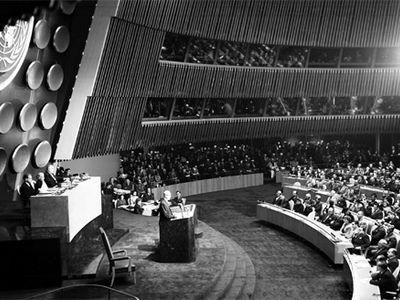
Atoms for Peace
On December 8, 1953, U.S. President Dwight D. Eisenhower delivered the landmark 'Atoms for Peace' speech to the United Nations General Assembly during the early Cold War era. After World War II, both the United States and the Soviet Union had developed nuclear weapons, casting a shadow of nuclear war over the world and causing widespread atomic anxiety. In this speech, Eisenhower first proposed the concept of peaceful uses of atomic energy, calling for the establishment of an International Atomic Energy Agency to regulate nuclear materials internationally and redirect atomic energy from military purposes to peaceful fields such as agriculture, medicine, and energy. This speech not only eased international tensions at the time but also directly led to the founding of the International Atomic Energy Agency (IAEA) in 1957.
The Theory of Relativity and its Influence on Scientific Thought
On 24 May 1922, British astrophysicist Arthur Stanley Eddington delivered the Romanes Lecture, “The Theory of Relativity and its Influence on Scientific Thought,” at Oxford's Sheldonian Theatre. Beginning with the Copernican revolution, he argued that Einstein carried forward the removal of geocentric bias from physics: space, time, length, and mass are not observer-independent absolutes but quantities understood through different states of motion. Using the Michelson–Morley experiment, FitzGerald contraction, the four-dimensional world of events, and the perspective of a freely falling observer, Eddington explained the conceptual force of special and general relativity. He presented gravitation as space-time curvature, joined geometry with mechanics, and placed relativity within a continuing history of scientific revolutions that he expected would eventually become part of educated common sense.
Edward Bagnall Poulton's 1915 Oxford Romanes Lecture: Science and the Great War
On 7 December 1915, British evolutionary biologist Edward Bagnall Poulton delivered the Romanes Lecture, “Science and the Great War,” at Oxford's University Museum. With the First World War already more than a year old, he criticized British government, Parliament, and military institutions for neglecting scientific expertise, and discussed munitions materials, maritime blockade, Germany's food supply, trench-warfare technology, and science education while contrasting the advocate's political habits with the scientific pursuit of truth. The lecture contains emphatic British wartime positions, stereotypes of the enemy, and support for using blockade to produce hunger; it should be read as a historical text from 1915 rather than a neutral modern assessment. This edition follows the formal 1915 Clarendon Press scan and the corrected Wikisource transcription, retaining 106 body-text blocks, including the centered verse and closing Huxley quotation, while excluding title and publication matter, separate notes, the printer's imprint, and two non-text statistical graphs. Overlength blocks were divided only at complete-sentence boundaries, producing 182 paragraph-aligned units.
J. J. Thomson's 1914 Oxford Romanes Lecture: The Atomic Theory
On 10 June 1914, British physicist and Nobel laureate J. J. Thomson delivered the Romanes Lecture, “The Atomic Theory,” at Oxford's Sheldonian Theatre. Distinguishing modern atomic physics from ancient Greek atomism, he argued that theory grows only through the cooperation of thought and fact. Drawing on cathode rays, electrons, X-rays, radioactivity, and cloud-chamber tracks, Thomson showed how experiment had compelled scientists to revise their conception of matter. He reviewed evidence for atoms, the electron as a constituent common to different elements, the relation between internal atomic structure and periodic properties, and emerging ideas about isotopes and atomic aggregation. The lecture both summarized major achievements of early twentieth-century atomic physics and emphasized the extensive unknown regions within the atom that would reshape dynamics and natural philosophy.
Edwin Ray Lankester's 1905 Oxford Romanes Lecture: Nature and Man
On 14 June 1905, British zoologist and evolutionary biologist Edwin Ray Lankester delivered the Romanes Lecture, “Nature and Man,” at Oxford's Sheldonian Theatre. He portrayed humanity as a species that used knowledge to rebel against natural selection and gradually acquire control over nature, discussing disease prevention, population, energy, the study of mind, and scientific education. He then criticized Oxford's curricular dependence on Greek, Latin, and biographical history and argued that knowledge of nature should become central to the education of public leaders. This is a historical text from 1905. Its discussions include early anthropology, eugenic approaches to population, the imagined eradication of disease, and speculation about Martian canals and intelligent life; these claims reflect the scientific and ethical setting of their time and should not be treated as modern scientific or moral conclusions. This edition follows the formal 1905 printed scan and the proofread Wikisource transcription, preserving 69 authentic source paragraphs while excluding title matter, running headers, page numbers, and eleven endnotes.