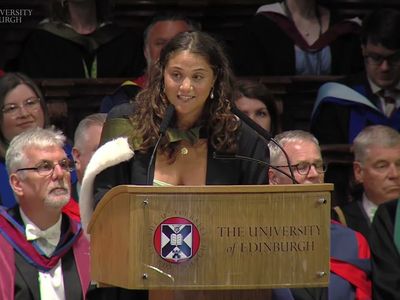
Thank you, fellow graduates, families, friends, and esteemed faculty members. Today we stand at a crossroads: the end of one journey and the beginning of another. As the Biomedical Sciences class of 2025, we gather not just to celebrate degrees earned, but to honour the years that shaped us, challenged us, and ultimately changed us.
It's hard to believe it's been four years since we arrived at the University of Edinburgh—some of us fresh from school, others from gap years, and some crossing continents to be here. We stepped onto this campus and into our first labs as strangers: a little uncertain, a little overwhelmed, but full of potential. The journey hasn't always been smooth.
Let's be honest: we've endured some awful winters. There were days when the winds cut through our jackets. We got blown over in the Meadows. It rained sideways. We got snowed into our flats. And somehow we still showed up to our 9:00 a.m. lectures—mostly. But Edinburgh, this beautiful, inspiring city, was worth it. Even in winter, when the castle emerged from the fog like something out of a myth, it reminded us that we were part of something timeless. We all walked these cobbled streets and found not just a campus, but a home.
And between first lectures and final deadlines, we have made so many memories: the struggle of online exams, trying to maintain eye contact with a camera while your flatmate reheated leftovers in the background; or those brutally cold Edinburgh mornings when we questioned every life decision that led us to a 9:00 a.m. lab practical in January. But then the sun would rise over Arthur's Seat, or the Meadows would bloom in spring, and we'd remember this city is something special.
And so are the friendships we formed here. They started in labs and tutorials, over coffee and tea, or frantic revision in the library trying to memorise 500 flashcards. But they quickly became something deeper: study groups that turned into support systems, flatmates who became family, and partners in procrastination.
We've cheered each other on during dissertations and presentation nerves, and vented to each other when coding in RStudio would keep saying “error” or when our p-values were greater than 0.05. We shared everything from exam stress to spontaneous weekend hikes, and from freshers' nerves to final-year nostalgia. We've had the highs, the breakdowns, and the breakthroughs. We laughed and cried.
We've grown up over these last four years. We've developed critical thinking, research skills, resilience, and maybe a mild caffeine addiction. But more than anything, we've learned how to navigate a complex world with empathy and purpose. And while today is about us, we owe so much to the people who supported us along the way: families, friends, mentors, and those who believed in us, especially when we didn't believe in ourselves. Your encouragement has made this moment possible.
So, what now? Some of us will pursue research, pushing the boundaries of biomedical sciences, neuroscience, pharmacology, and reproductive biology. Some of us will go on to memorise another 1,000 anatomy flashcards. Others will move into medicine, technology, education, or policy. Some might take a break, breathe, and take a well-earned pause. That's okay, too.
No matter where we go, we carry this foundation with us. The University of Edinburgh has not just educated us. It has shaped us into thinkers, scientists, and people with the capacity to make a difference.
So let's go forward with courage, with curiosity, and with confidence, and with the same open minds and hearts that brought us this far. Let's ask the big questions. Let's be bold enough not always to have the answers. And let's stay connected to each other, to the passion that brought us to study, and to the hope that we can build a better world.
Congratulations, Biomedical Sciences class of 2025. For many of us, we've studied the brain. Now, let's go use ours. Thank you.