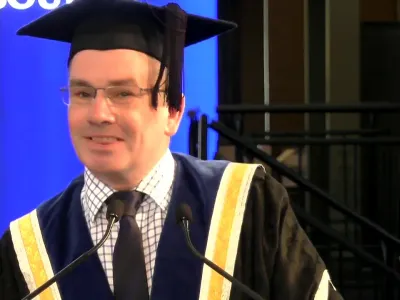
Thank you to the Presiding Chancellor, Presiding Vice-Chancellor, Presiding Academic Board Officer and Presiding Dean. I too would like to pay my respects to the Wurundjeri people on whose land we gather today, acknowledge their elders past and present, and pay respect to any Indigenous people in the audience. Importantly, I want to acknowledge that sovereignty over this land was never ceded.
It is my very great pleasure to deliver the address at the graduation ceremony today, and I am especially pleased to do so as I am a member of the Faculty of Arts, having spent a decade until the end of last year as Head of the School of Social and Political Sciences.
It is wonderful to see another cohort of diverse Arts graduates about to bring a remarkable set of skills and knowledge into the world. You are the best ambassadors that the University of Melbourne has, and I hope that your experiences during your degree travel far and wide with you in your forthcoming endeavours—but that Melbourne stays close to your heart.
In the second half of this year, I became Pro Vice-Chancellor (International) at the University. Given my own tertiary education experience, this might seem slightly odd. Like many people who grew up in Northern Ireland during the Troubles, I couldn't wait to get out of the place.
While the violence I grew up with was unpalatable, I found the everyday sectarianism even more oppressive, as was the translation of every political issue into an ethno-national and religious prism. It wasn't a place that valued diversity, lest it upset the simplistic, divided paradigm through which every issue had to be addressed.
As an undergraduate in England—Nottingham, to be precise—I experienced a multicultural and ethnically diverse student body, but it was, at that time in the late 1980s, almost entirely from the United Kingdom. I returned to Belfast to do my PhD at Queen's University—it just so happened that the best supervisor for me was at Queen's—and encountered an even less diverse environment.
I was a lone political theorist among a group of Irish people doing PhDs on Irish topics—not surprisingly, mainly focused on the Troubles. I couldn't really blame anyone for not wanting to come to Belfast at that time. If people like me who were born there didn't like it, it was a bit much to expect many other people to embrace it! In short, it wasn't an environment set up to welcome international students, and this was reflected in many of the things that were taught and researched.
It is not that long ago that the University of Melbourne, like most Australian universities, contained a similarly narrow constitution and outlook. Nowadays, however, we aspire to a much more international perspective on everything we do. Unlike some of the negative media coverage that presents international students as the cash cow of Australian tertiary education, at Melbourne we aspire to have international students and an international curriculum because we want all our students to have an international experience.
We want our students, wherever they come from in the world, to work with and learn from counterparts from other countries with very different experiences. Importantly, we want that diversity to be reflected in the curricula we teach, and we aspire for our workforce to be composed of outstanding international scholars.
Therefore, the internationalisation that informs our strategy as a university is no longer just about enticing overseas students to Australia, as some of the negative media agenda implies. Important as that is, increasingly our strategy is about providing opportunities for our students to study with overseas partners through, for example, intensive overseas subjects, international internships, and engagement with government programs such as the New Colombo Plan.
There is much ongoing work to do in these areas to meet our aspirations, but our commitment to increasing the internationalisation of the student experience, either here in Melbourne or overseas, is relentless. Our commitment is continual to providing diverse experiences in the lecture theatre and seminar room that enable our students to enter the outside world equipped with skills and knowledge that will help them flourish in a global environment. This reflects the contribution of domestic students to the learning of international students as much as the other way round.
Congratulations again to our students graduating today. As I said, you are our most important ambassadors, reflecting the Melbourne experience and, perhaps sometimes inadvertently, promoting the benefits of your studies with us without knowing it.
Today is a day to celebrate your achievements, and it is a great pleasure to be part of that celebration. At the same time, we celebrate the international experience that is part of coming to Melbourne and to which you have all contributed. Enjoy your day today, and congratulations!