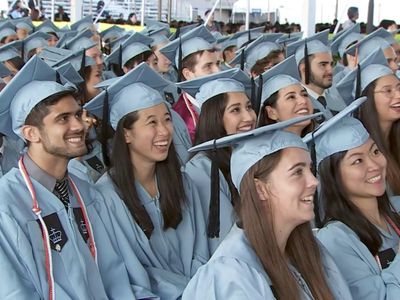
Thank you, Class of 2017. Thank you so much for inviting me to speak at this wonderful commencement ceremony. It's really an honor to come back to Columbia to address this distinguished group of graduates, parents, siblings, and special guests. We've all gathered here to share the joy of this day. First, I want to say to the graduates: I'm so proud of you. You did it. Your families are proud of you. You've earned this day.
I remember sitting where you are 34 years ago, feeling that those were the best years of my life. I found the profession of my life: computer science and artificial intelligence. I found the hobby of my life: bridge. I played 30 hours a week, but to this day President Bollinger hasn't given me a degree in it. And I had my first date while at Columbia, and she became the love of my life. And finally, on my commencement day, I got to sit there and listen to Isaac Asimov, the famous science fiction writer. And all you get is me.
Anyway, I had the best years of my life. That's what you expect me to say, and probably any commencement speaker to say: these are going to be the best years of your life. But I'm not going to say that. I know that these are far from the best days of your lives, and I know that your best days are yet to come. Specifically, I hope that the best years of your lives will be in the next 10 years.
Why 10 years? Ten years seems so far away, but really it is not. Checking back with May 2007 might be a good way to visualize what 10 years can do. It's interesting to remember that in 2007, Steve Jobs introduced the iPhone. Back then, I was using my Blackberry, and my wife was using her Nokia. In 2007, a young senator named Barack Obama decided to run for president. And in 2007, Donald Trump was still saying "you are fired" rather than "make America great again."
So 10 years did a lot, but the next 10 years will do so, so much more than the last 10. Why? Because the next decade will be the age of artificial intelligence, or AI. As students, you've probably seen AI course enrollment go from something like 80 to 800, and that certainly is a leading indicator. I was introduced to AI at Columbia in 1980. As someone who has worked for 37 years in research, development, and investment in AI, I can speak with some authority that AI will be a revolution on the scale of the Industrial Revolution, probably larger, and definitely faster.
But this talk isn't going to be some hand-wavy AI talk. This is an engineer-to-engineer talk. We know that AI works. We know that AI gets better with data and more use. And we know how to extrapolate it to measure its impact in 10 years. So let's first see what AI can do. Let's look at three companies I've had the fortune to invest in.
The first one is an AI image processing company that makes people's selfies more beautiful, so much so that no Chinese movie star that I know would have her photo taken without it. Its user base: 1.3 billion people. We invested in an AI loan company that can approve a loan in a few seconds, with a default rate much lower than a human can do in several days. This company is less than 2 years old, and this year is projected to make 30 million loans, more than any bank I am aware of.
Today, we invested in an AI face recognition company that can recognize any face from three million faces with superhuman accuracy. If this were installed in all the airports around the world, with databases of known terrorists and known wanted criminals, they would never get to enter an airplane. These three AI companies are worth almost 10 billion dollars today, but that is loose change compared to what AI can do in the next 10 years.
In the next 10 years, all financial companies will be turned upside down, with AI replacing traders, bankers, accountants, research analysts, and insurance agents. Last year, my personal AI investment algorithm returned eight times more than my private banker. And that reminds me, when I go home I'm going to fire my private banker. In the next 10 years, AI will replace most factory workers, assistants, advisors, and middlemen. But AI is not limited to simple jobs. AI will replace many reporters, doctors, and, yes, teachers. Not the ones behind me, but other teachers.
Your AI assistant will know better than you what you want to eat tonight, where you want to go on that next vacation, and whom you want to date. And it doesn't stop there. In ten years, mechanical AI will become reliable. AI will be able to drive cars more safely than we do. Sweeping changes, as it were, brought about by the lowly Roomba, will grow up and cook, wash, and handle all the household drudgery for us.
In ten years, because AI will make so much money for humanity, we will enter the age of plenty, making strides to eradicate poverty and hunger, and giving us all more spare time and freedom to do what we love.
But in ten years, because AI will replace about 50% of human jobs, we will also enter the age of confusion, and many people will become depressed as they lose their jobs and the corresponding self-actualization. And many of you will become parents concerned about how to improve the education of your children to prevent them from being replaced by AI.
These predictions are not based on some hand-waving comparison of the number of neurons in the human brain versus AI simulators. They are based on an engineer's extrapolation, based on known algorithms, the real marketplace, and the real workforce.
In my company, we've raised a billion dollars to invest in these developments. Softbank has launched a hundred billion dollar Vision Fund. The tech giants of the last 50 years, IBM, Microsoft, Google, and Facebook, have all declared themselves to be AI companies. So even if you doubt me, you probably should not doubt all of them. So for leading-edge, smart engineers like yourselves, 2027 should be the best times in your lives, unless you miss the AI revolution, in which case it may turn into the worst times in your lives.
So let me now give you three pieces of advice on how not to miss the age of AI, so that you can have the best times in your lives. My first advice is: embrace AI, and align your career by betting on its inevitability. Like all big change, AI requires you to have an open mind. It's okay to be fearful of change. Mark Twain has said, "Courage is the resistance to fear, mastery of fear, not the absence of fear." Your hard work has prepared you to confront, or simply accept, or warmly embrace the changes that will push you in new directions. Given what lies ahead, you must warmly embrace AI.
While the first tools of AI in your industry might appear fragile, be assured they'll get better with more data and with use. The three software companies I mentioned, when they were originally launched, generally made people uglier, not prettier. They lost millions of dollars in bad loans. And when the face recognition looked at me, they thought I was some talk show celebrity.
But given time and more data, the self-learning mode of these AI software made them dramatically better than people. Not only are they more accurate than people, they don't get tired, they don't get emotional, they don't go on strike, and they're infinitely scalable. With hardware, software, and networking costs coming down, all the AI costs is really electricity.
So whatever domain you choose, be the first to use the AI tools. If you're going to be a software engineer, use AI tools to check and optimize your code, to help you find reusable code, or even to write some code for you. Use AI tools to find your team and help you work with your team. If you start your own software company, use AI tools to manage your books and maximize your profits. Use AI tools to replace your customer support and your sales people. And if you're going to start a hardware company, use robots to produce your goods and autonomous vehicles to deliver them.
The symbiotic combination of human and AI is really simply explained as one plus one equals three. For example, if a doctor can correctly diagnose cancer and save 70 lives out of 100, and an early AI tool can save 60 out of 100, perhaps together they will save 80. And when the AI tool gets better and can save 80, perhaps together they will save 90. So do not passively accept AI, but embrace AI, seek out AI, and find every which way that AI can help you.
Learn AI and find clever ways to build that symbiotic relationship early. Just like the first reporter who started using word processing, the first accountant who started using a spreadsheet, and the first photographer who started using Photoshop, you will have an edge. In addition, AI will evolve much faster and much more broadly than these tools, and your edge will grow and become sustainable.
Now, my second piece of advice is: uphold your responsibilities as an engineer. We all know that for centuries physicians took the Hippocratic Oath as a responsibility to treat human life as sacred. In the age of AI, I think an engineer's responsibilities are equally sacred. Why? Because as top engineering graduates from a top school, you are the ones who will write the code for the future. You are the ones with the power. And please remember, as my favorite philosopher, Spiderman, said: "with great power comes great responsibility."
In the age of AI, autonomous and semi-autonomous algorithms will invest money, take care of children, drive cars, and conduct surgery. You will be the ones building these products, which will impact people's possessions, health, and even lives.
As engineers, we cannot abandon our conscience and sense of responsibility. We need to be thorough, diligent, and ethical, not just in the architecture and coding, but also in the design, the testing, how you run your machine learning training, and how you download the parameters that are automatically updated as the algorithms improve. Remember, when the first airbags were launched, they saved many lives, but they also accidentally killed some children due to the lack of adequate design and instructions that consider the children's smaller size.
So your first responsibilities are to your users, and to make your product safe, thoughtful, and usable. More than product safety, you also have a responsibility to foresee and prevent potential risks of technology. So please speak up, as experts and not just as engineers, when things like autonomous weapons or the bartering and sales of privacy data come up.
Your second responsibility is to yourself. In the age of AI, you're not just competing with other people, you're competing with AI. You have a responsibility to yourself to work on the hard problems and stop wasting time on what machines will be able to do. Don't accept a job that doesn't challenge you. Take risks and vigorously and rigorously learn, so that you will become the best in something that is very specific and useful. And be creative and innovative, because AI is great at optimizing, but AI cannot invent something new.
Your final responsibility is to make the world a better place with your choices as an engineer. Choose jobs that save lives, not destroy them. Choose jobs that employ and empower people, not demoralize them. Work for organizations with more compassion than greed, and work for people who care more about world peace than world domination.
And my last advice: be in touch with your heart. Based on the serious tech talk earlier, this may seem a little out of place, but it really comes from my heart. Four years ago, I was diagnosed with fourth stage lymphoma. I faced the real possibility that my remaining time on this earth was measured in months. During that time of ultimate uncertainty, I thought a lot about my life. I came to realize that all of my accomplishments, and even the arrival of AI after 30 years of waiting, really meant nothing to me.
I came to realize that when I spent my life chasing technologies, products, investments, and my career, my priorities were out of order. I neglected my family. My father had passed away. My mother barely remembered me. And my kids had grown up. One of the books I read during my illness was Bronnie Ware's book about the regrets of people on their deathbeds. She found that no one wished they had worked harder or spent more time in the office or accumulated more possessions. People's top wish on their deathbeds was that they had spent more time sharing their love with their loved ones.
Fortunately, I am now in remission, so I am with you today. I'm spending much more time with my family. I moved closer to my mother. I travel with my wife, whether on business or for pleasure. When my kids come home, I don't take two or three days off, I take two or three weeks off.
I also spend more time meaningfully connecting with more people. I spend weekends traveling with my friends. I took my company on yearly trips; last year we went to Silicon Valley, their Mecca. I met with young people who send me questions sometimes on Weibo or Facebook. I reached out to people I offended years ago and apologized to them, asking for their forgiveness and friendship. I wrote a book and shot a documentary to share what I had learned from my near-death experience.
My near-death experience not only changed my life and my values, but it gave me an enlightened view about what AI should mean for humanity. Elon Musk and Stephen Hawking have given us their view, a view where machines supersede humans, where we need to control them or become them. With my near-death experience, I'd like to offer an alternate ending to their prediction of the AI future. Surely AI has, or will beat us on many analytical tasks with definitive decisions and outcomes. But these tasks are not what makes us human. What makes us human is that we are able to love.
The moment when we see our newborn babies, the feeling of love at first sight, the warm feeling from friends when they listen to us empathetically, the feeling of self-actualization when we help someone in need. These all demonstrate that we're far from understanding the human heart, let alone replicating it. But we do know that humans are uniquely able to love and be loved. Humans want to love and be loved. That loving and being loved is what makes our lives worthwhile.
With this belief, we know what we must do. At a minimum, recognize and be thankful that we are loved. We can do better: return the love, or maybe return a little more. Finally, the highest level of love: pay it forward, and give love unconditionally.
Coming back to our AI theme, love is what differentiates us from AI. Despite what we saw in some science fiction movies, despite what these movies may portray, I can tell you responsibly that no AI program of today, nor do I think any AI program in the next 10 years or perhaps in our lifetimes, will love. They don't have feelings, they don't even have self-consciousness. AlphaGo may beat the world champion, but it has no fun playing the game, feels no happiness from winning, and certainly has no desire to hug a loved one after it wins.
In the future, even if an AI medical diagnostic tool is 10 times more accurate than doctors, patients do not want a machine's cold pronouncements, such as "you have fourth stage lymphoma and a 70% chance of dying within 5 years." Patients will want a doctor of love, a doctor who listens to our symptoms and complaints and gives us encouragement, like "Kai-Fu had the same lymphoma and he survived, so you can too."
A doctor of love who is always available to talk to us, and perhaps even visits us at home. This kind of doctor of love will not only make us feel better and give us greater confidence, but give us a placebo effect that will increase our likelihood of recuperation.
This will solve the AI employment problem, that 50% I mentioned, because the number of doctors of love will outnumber today's doctors. The displaced workers can take up careers spreading love and their experiences, whether it's a passionate tour guide, an attentive concierge, a funny bartender, or an infectious sushi chef. With all these new "experts of love" titles, many kinds of service jobs will be created.
And they don't all have to be jobs; they can be volunteers at an orphanage or retirement home. This will give people jobs that AI cannot take away. These people will do the job with pride and a strong sense of self-actualization. Most importantly, this will fill the planet with love and joy.
We've built many task-oriented AIs that are better than our brains. That was my dream 37 years ago, and as a hardcore computer scientist, I'm proud we've come so far. But now I realize that I went after the wrong organ. The most important part of the human body is not the brain, but the heart. That's a lesson that took me, I confess, too long to learn.
My hope is for all of you: as your careers blossom and your lives take shape, that you approach your lives with all the brains that you certainly have, but also, above all, with all the hearts that you can muster. It will be up to you to carry this forward. I have confidence that if you let your heart be the guide, you will find your way through the massive changes that lie ahead and surely make the next 10 years the best years of your lives. Thank you, Class of 2017.