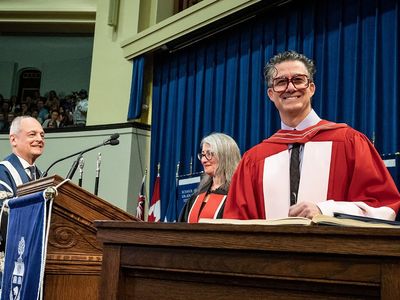
Chancellor Patten, President Gertler, Professor Cowen, Dean Brown, honoured guests, family and friends, and above all the graduates of the Dalla Lana School of Public Health and the Factor-Inwentash Faculty of Social Work: when President Gertler told me last December that the University of Toronto would grant me this honour, I was thrilled.
That joy lasted six full months, until a few days ago when I realized I had to write this speech. Then it went downhill. I am not nervous about public speaking, but I usually improvise. Reading a required written speech is unusual for me, so my apologies.
I realized that a convocation address must first congratulate the graduating class, and second reflect on the path that brought the speaker to the podium, offering a few seeds of wisdom that might germinate later. The first part is easy. Whether receiving doctorates, master's degrees or diplomas, you have earned something rare and special. You are graduates of one of the world's most respected universities. Congratulations.
When I received my Bachelor of Science in 1989 and Master of Science in 1993 in this hall, what I felt most was enormous relief. Completing exams, credits, a dissertation and countless other requirements was no small task. I also felt a profound urge to party. Assuming you feel something similar, I will keep the rest as brief as possible so the party can begin.
I want to discuss two themes that played outsized roles in bringing a child from Scarborough, Ontario, before you today. My route from University of Toronto student to this podium was a long and very strange global journey of fun, folly and discovery. Calling it meandering would be an understatement.
After my bachelor's degree, I spent a gap year travelling alone in Central Africa, hitching rides by truck, barge and dugout canoe across Kenya, Uganda, Tanzania, Rwanda and Zaire. There was a cobra in a canoe, a charging silverback gorilla, being held at machine-gun point twice for exchanging currency on the black market, and eating crocodile without being eaten by one. It was dangerous—please do not tell my mother—but profoundly formative. I learned the world was vast, crazy, dangerous and strange, yet I could navigate it.
Back in Toronto, I entered the new molecular-genetics graduate program. After two and a half years, against nearly everyone's advice, I chose not to transfer from the master's to the Ph.D. program because I had a chance to move to Paris—something every young person should do if given the opportunity.
After a year in France, I set out to hitchhike to India. I was kidnapped one night on the way to Germany, proving that hitchhiking really is dangerous. I escaped and continued east as far as Ukraine, only to end up in Gothenburg, Sweden—which anyone with even a basic sense of geography knows is not on the road to India.
Years of science followed in Dallas, Helsinki and San Francisco before I reached Boston and became a Harvard Medical School professor. Along the way I failed to complete two Ph.D. programs in two countries, although I did complete a third in another country.
The wisdom in this winding tale is simple: when given a choice of roads, choose the road less travelled. If there is no road, even better—grab a machete and cut through life's jungle, forging your own path. You will colour your life in hues you did not know existed, and prepare yourself for whatever comes. Nothing will shock or shake you.
My second theme should be close to graduates who chose public health and social work, fields that show you aspire to make an impact. I also wanted to make an impact when I graduated, but had no idea how.
I began to understand as a postdoctoral fellow in Professor Irving Weissman's Stanford laboratory. He had launched therapeutics companies based on laboratory science. That was the model. I had studied stem cells and how their aging contributes to disease and functional decline. Now I needed a discovery that could translate into therapy.
I opened my Harvard laboratory in 2007 and soon tried to use messenger RNA to alter cell fate and convert differentiated cells back into stem cells. After three years of blood, sweat and tears, we succeeded. In the process, we developed the mRNA technology I used to help found Moderna in 2010.
I always believed the technology would create new therapeutic modalities because I knew the science was powerful and simple. I did not foresee it emerging on such a large stage as a vital clinical tool during the contagion we have all lived through and continue to experience.
I often said I would hang up my hat once something I worked on helped patients. I have abandoned that notion. I now understand that it is my duty to keep trying to make a positive impact throughout my life.
Accordingly, I am involved in too many biotechnology companies developing medicines for conditions ranging from snakebite envenoming to multiple sclerosis. Fingers crossed that these efforts make an impact. Fingers crossed that you graduates make an impact too. But before you do, do not forget to make that left turn at Albuquerque. Thank you.