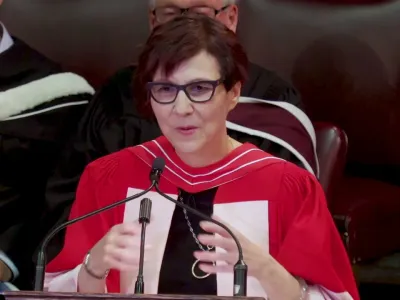
What a great honour it is to be here on the territories of the Huron and the Seneca, and most recently the Mississaugas of the Credit, especially on your special day, graduates. Congratulations. I can see the love your families and friends have for you. They arrive with huge smiles, many cameras, flowers and a few teddy bears. I want you to carry the love you feel here today into everything you do.
Love and courage are the two essential ingredients for defeating darkness and hate. The love given and modelled to you by your friends, your families and those who came before you will be your greatest source of strength in the years ahead. You have been given knowledge by the University of Toronto; now you must give it away generously, with love and courage.
You need the moral courage to stand up when others tell you to sit down, to speak when others want you silent, and to step forward when others want you to remain a bystander. You must stand with the whistleblowers and morally courageous people of our time so they are not alone.
The moral weakness of the world's leaders means that we have weak leadership at this moment. It is up to us—the people, as it has always been—to lift up humanity so that everyone can live with dignity, wherever they are in the world. As a poem says, “They'll be trembling in their palaces as we are singing in the prisons.” Or, to give it a contemporary turn, they will be trembling in the White House while we sing at the borders for children who should never be separated from their families.
Canada's troubling history of separating First Nations, Métis and Inuit children has taught us that. It is not enough to say we are sorry. We must learn from the past and look for examples of people who have shown moral courage.
I was blessed to know Shannen Koostachin, a First Nations teenage girl who spent her life fighting for safe and proper schools. She wanted to grow up and become someone important, she said, and you cannot do that when you receive half the education funding of everyone else. I have been inspired by Jordan River Anderson, a little boy who died after spending two unnecessary years in hospital because Canada and Manitoba argued over who should pay for his home care simply because he was First Nations.
I have also been inspired by Ella, who sits in the front row as my special guest today. When we filed our human-rights complaint and all our funding was cut, I received a beautiful drawing in the mail that read, “Dear Cindy, here is some M-U-N-Y for the kids. Love, Ella.” Inside was her change. I still have it today. Ella has cheered for justice from the very beginning.
I have been inspired by people on this stage: Cheryl Regehr, who put up with me as my Ph.D. supervisor; Barbara Fallon, a dear friend who combines love and research; Bob Rae, who tries to teach me about politics, although I am not sure one lifetime will be enough; and our friends at OISE and the medical school.
Children are especially good teachers. They are both the most courageous and the most loving. When they understand that First Nations children still receive less public funding than others, they do not merely wring their hands in disbelief. Like courageous people at the U.S. border today, they stand up, speak and demand a better country. They ask us adults to live up to the aspirations we value most, not only as Canadians but as human beings and as a human family.
I have also learned from our ancestors. One I wish to honour today is Peter Henderson Bryce. He graduated from the University of Toronto when Canada was only nine years old. He became Canada's first public health officer and wrote Ontario's first health code, which spread across the Americas. He served as president of the American Public Health Association and was regarded as a leading expert on infectious disease.
He is credited with saving at least fifteen thousand lives by stopping an infectious train from travelling from Montreal and spreading disease west to Ottawa and Toronto. For that alone he should be remembered. But he was forgotten because of what he did at the age of fifty-one.
Bryce became chief medical health officer at the Department of Indian Affairs and surveyed the health of children in residential schools. He found that they were dying at a rate of twenty-four percent a year; tracked over three years, the rate was forty-eight percent. Most shocking, Bryce reported that the City of Ottawa received three times as much health-care funding as all First Nations people across Canada.
He told the Canadian government that medical science knew what to do: equalize funding, provide proper nutrition, and stop housing sick children with healthy ones. Their lives could be saved. The government replied that this would cost fifteen thousand dollars and its one-hundred-million-dollar budget could not absorb it, so the answer was no.
What did Dr. Bryce do? Somehow his report appeared on the front pages of newspapers across Canada. No one knows exactly who was responsible, but the government suspected Bryce and began persecuting him. It cut his research funding, blocked his conference presentations and tried to discredit him.
The man who said no was Duncan Campbell Scott. Some of you may remember him from English literature classes as a Confederation poet. For fifty-two years, however, his day job placed him in charge of the residential-school file at the Department of Indian Affairs.
Bryce refused to be silenced. He knew it was not enough to speak once for these children; he had to keep speaking even when it seemed no one was listening, because he hoped that one day someone would. He also believed that when people learned of these wrongs, they would stand for justice, humanity and dignity.
Some did, including Samuel Hume Blake, another University of Toronto law graduate. He said that by failing to remove preventable causes of death, Canada had brought itself into “unpleasant nearness to manslaughter.” Bryce was pushed out of public service in 1922, but used the opportunity to publish another pamphlet, The Story of a National Crime, distributing it even more widely than his 1907 report.
That same year, Duncan Campbell Scott received an honorary doctorate here at the University of Toronto and was president of the Royal Society of Canada. Bryce died in obscurity in 1932. Scott received great honours, was named a person of national historic significance and was taught in high-school English classes, where I first encountered him. I thought his poetry was terrible even then, before I knew what his day job had been.
That was how things stood for many years, but you know how stories of justice, dignity and right finally winning can end. The day before Prime Minister Harper apologized for the wrongs of residential schools, I went to Beechwood Cemetery with brightly coloured flowers representing the children Bryce had tried to save. I went to thank him.
Walking through the national cemetery, I saw all the tall monuments. I am a girl from the bush in northern British Columbia, and I could never understand why people built such things. Finally, an elder explained: “They are there to weigh them down.” That made sense. I found Bryce in a small valley beneath a modest headstone. I thanked him, laid down the flowers, and told him about the case we had filed against the Canadian government exactly one hundred years after his report reached the Evening Citizen. I promised to return when the children won.
It took nine years to keep that promise. In January 2016, I put on my gumboots, walked down the snowy hill and, beneath a blue sky, read Dr. Bryce the decision. I was alone in the cemetery, with one trail of footsteps. Yet I knew that trail had been trodden by many others: parents who tried to keep their children safe at home, grandparents who prayed for them, people like Bryce who raised the alarm throughout the history of residential schools, and many of you who wish you could have been there to help.
Working with the Bryce family, we later placed a historical plaque beside his grave. He is now taught in elementary schools and appears on their walls of heroes. A health centre here at the University of Toronto bears his name.
What of Duncan Campbell Scott, who lacked moral courage and was rewarded for moral cowardice? Thanks to courageous residential-school survivors and historians, he is now remembered not only as a Confederation poet. His burial plaque at Beechwood Cemetery, just over the hill from Bryce's grave, now contains the words “Confederation poet” and “cultural genocide” together.
One more thing: Scott's former office still stands in Ottawa. About sixty years after he moved out, the Aboriginal Peoples Television Network moved in and made it its first Ottawa bureau.
Bryce and Scott teach us that doing the right thing is not always supported or rewarded. They remind us to find the moral courage to do right even when it costs us, and to stand beside friends who show that courage. They also teach us never to reward moral cowardice.
At this moment, when we must give life to human values, we will need all our courage, all the glitter children can bring and all the love you have been given to defeat the darkness. But we will defeat it. We must not be the bystanders of our age. We cannot stand aside while humanity faces one of its greatest challenges. We must sing at the borders while they tremble in the palaces.
We need people exactly like you—every one of you graduates. You may not feel ready or worthy to be courageous, but you are humanity's best chance. If you ever need courage, look to the sky and remember your ancestors. Every one of them was courageous. They stood against winds of discrimination, harm and hatred so you could be here today. I can see in your faces and those of your families that their sacrifice was worthwhile.
President, Chancellor, it is a great honour to be here. I will tell you one more secret: earning a Ph.D. is actually easier than becoming an honorary graduate, because to receive this I had to try to behave for my entire life—or at least avoid being caught misbehaving too often. My warmest congratulations to you all.