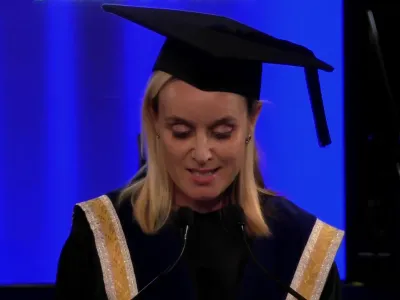
Today in my address, I'm going to talk about endurance, why it matters, and why I believe that we all have it in us to endure and succeed despite the obstacles we might face.
I would say that at this point in time, endurance is somewhat out of fashion. Whilst there is some criticism of society's focus on the short term, on the whole, we still laud overnight success. We encourage quick wins and dream of unicorn start-ups. We idolise instant billionaires, we praise sprinters, and we hope for new records.
But these moments, these feats, these people—they are exceptions. The reality is that some things will take time, and we must endure through hardships, failures and setbacks to get where we want to be. Among you, I am sure there will be millionaires, perhaps a billionaire as well. But I would argue that this shouldn't be the measure of your success, your guiding goal, or the way you think about your contribution to the world. And so, I turn to endurance.
Endurance is the ability to continue, to last, especially when things are difficult. If you have endurance, you can withstand tough situations and recover. With endurance comes patience and acceptance, but most importantly persistence.
Some of the greatest feats of humanity have required endurance. We have advanced as beings only because those involved had focus, persistence and endurance. We need only think of the great explorers, enduring months at sea, crippling illnesses and homesickness so acute it was thought to be a contagious and fatal disease.
The boat for Sir Ernest Shackleton's Antarctic expedition of 1914 was called Endurance. The expedition lasted two years, and they subsisted on seal meat and blubber for six months. He later wrote, “We had suffered, starved and triumphed, grovelled down yet grasped at glory. We had reached the naked soul of man.”
We see endurance in other fields as well. We have had medical advances that have changed our lives. We need only think of vaccines to realise how much we owe to teamwork, persistence and endurance. The idea of vaccinations was first introduced in 1796. The concept was propelled further by other scientists, saving us from early death. From this very University, alumnus Professor Ian Frazer was the leader of the groundbreaking Gardasil vaccine.
These medical professionals have dealt with criticisms, setbacks and inconclusive studies along the way, but they have persisted; they have endured—and for this we should be grateful.
It is through endurance that we get an insight into the human spirit: prisoners of war, faced with deprivation, starvation and dehumanised in every way possible, and yet they endured and survived. Every so often, we hear about inspiring feats of endurance that test strength and the human spirit. A human has spent 73 days living underwater; another, 438 days living in space. Someone has endured 264 hours without sleep, and another has spent 86 hours running constantly.
There was Aron Ralston, who severed his own hand to escape a climbing accident that left him trapped for five days between two boulders. There are those who survive against all odds: Juliane Koepcke, the sole survivor of a plane crash in the Amazon, wandered through a crocodile-infested jungle for nine days before being rescued; and there is Lincoln Hall's survival on Mount Everest, after literally being left for dead.
You might wonder: could I handle that? Do I have it in me? I think you do. Amazing survival stories extend to babies. We are born to endure.
When we think of contributions to the world through persistence and endurance, examples abound from the University of Melbourne. There are many notable alumni: a Prime Minister, the Honourable Julia Gillard; the former Human Rights Commissioner, Emeritus Professor Gillian Triggs; and the long-respected philosopher Peter Singer, who has changed the way many people think about the world over decades and decades of contribution.
Ahead, you might face endurance of a different kind. You might have to endure to get your voice heard, to get funding for an idea, to get voted in, or to change something you think is wrong in this world. There were over 22 unsuccessful attempts to recognise same-sex marriage under federal law in this country before it was passed. And don't even start me on how long it took women to get the vote—some women are still waiting.
To turn to the world of finance, it has taken decades for climate change to be considered an investment risk and for fiduciary duty to be about more than just financial returns. It has taken a long time for those in financial markets to talk about responsible investment and sustainability. For all these advances, people have had to persist, to be tolerant, and to endure.
Endurance has been a theme of both my personal and professional life. In the year 2000, when I was 24 years old, I watched the Olympics in my hometown of Sydney and felt inspired. I wondered: could I ever go to the Olympics? Was it too late? The only thing I was any good at was swimming, but I wasn't a sprinter.
I'd done some ocean swims of one and two kilometres, but I didn't win or even rank. Feeling inspired, I decided to set a goal to swim the Rottnest Channel in Western Australia, a distance of 20 kilometres. When I first read about the swim, I felt nervous. When I first told someone I was thinking of doing it, I felt ridiculous. But I set a plan, I trained, and I did it. It was a feat of physical endurance for me.
On the day of the swim, the conditions were bad. The “Fremantle Doctor,” a howling wind that comes up in the afternoon in Perth, was up before the sun had a chance to rise. The race organisers contemplated calling off the event but decided to let it go ahead. Seventy-five swimmers pulled out before the start, 215 were rescued at the five-kilometre mark, and a further 240 at the 10-kilometre mark.
Of the 170 solo swimmers who started, only 66 finished. I was number 66; I was the last official swimmer to cross the line. The crossing took me nine hours and 42 minutes of constant swimming. Before the event, I had only swum for three hours. I never would have thought I could swim for that long.
Three months later, I went to America with a goal to swim around New York City, a distance of 46 kilometres. This goal was frightening. When I arrived in New York, I couldn't look around, because I knew that from the street, as far as I could see in every direction was the distance I had to swim. But I did it—in 15-degree water, water I found so freezing that my fingers splayed, making it hard to swim properly. I made it in eight hours and 32 minutes.
These swims taught me a lot about endurance and our capabilities as humans. I had always been called small, diminutive and fragile. I was never referred to as strong, or even sporty—but I became an endurance athlete because I planned, I trained, and I persisted.
I see my professional career as an endurance event as well. As you know, I work in the area of ethics in finance. If ever there were an area that requires endurance, this might well be it. I'm not sure we will ever be able to say that we are truly there with having an ethical finance system. But we must persist in trying to achieve it.
There are pressing global issues, from climate change to poverty to gaping inequality. All these issues require the assistance of finance and individuals like you. There is an opportunity for you to contribute, to help create a better and fairer world.
When I first had a role in the “Integrity Office” of an investment bank, people laughed about the words ethics and finance going together. Now it is common. When I first talked about creating a Hippocratic Oath for bankers, people thought it could never take off, but now each CEO of our big banks is a signatory. When I first worked in tobacco-free investment, it was standard practice for superannuation funds to be invested in tobacco stock. Now the majority of Australian funds exclude tobacco in line with global health priorities.
All these steps forward have required endurance and a belief in a bigger picture—a belief that I can contribute to a better and fairer world.
Finally, I always wanted to be a writer, from the time I was very young. Yet it wasn't until this year that I became the author of two books, one as co-author with Professor Paul Kofman. And 20 years after graduating with a degree in journalism, last year I got my own column in the Australian Financial Review.
So, as you think about what lies ahead for you, I encourage you to think big and to think long-term: to think about enduring legacies, lasting change and great contributions. Your experience with endurance has already begun, because you are graduates. Many people cannot apply themselves to the task of finishing a university degree. So you, my friends, are already examples of the practice of endurance.
As you go ahead from here, I encourage you to persist, to be patient when needed, to be accepting when required, but to draw on endurance to contribute to a better world with the knowledge you now have from your studies completed here at the University of Melbourne.