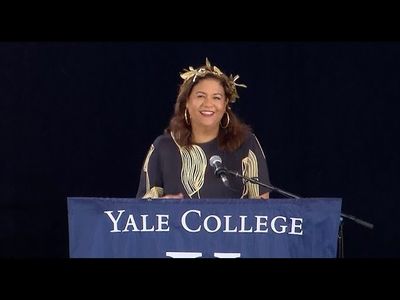
Hello everybody. It is wonderful to see you all today. There are lots of us. I am tremendously honored to have been chosen to be your Class Day speaker, and I would like first to thank President Salovey, Dean Lewis, the members of the Class Day Committee, whom I had the wonderful chance to get to know before coming today, and the countless and tireless organizers of Yale's Commencement Weekend ceremonies.
I also thank the members of the Board of Trustees who have joined us today, the heads and deans of Yale College, the members of the Senior Class Council, the faculty, staff, parents, siblings, aunties, uncles, cousins, friends, and alumni in attendance, and, of course, the glorious members of the Class of 2023. We are so proud of you, we are so proud of you. And we are here to honor your many achievements at Yale, to recognize this milestone that you've reached and to celebrate you as a class, as you mark your time together as Yale students.
I've had the vantage point of four decades of reflection since I graduated from here as a Yale senior in the Class of 1984. There are at least two of my classmates here. Yale? Okay, wavey-wavey, I see you, Class of 1984. I work now in philanthropy, but along that road from graduation I've done a lot of different things, and I became a tenured Yale faculty member, of which I'm so proud. So, though I'm doing different work now, I come to you always as a teacher. I became a poet, so I come to you with belief in the power of the word.
My cherished sons who are here today graduated in the Yale Classes of 2020 and 2021, which as you can figure means that mother didn't get graduation. So here we all are today and I come to you so importantly, as a Yale mom.
I live and work in New York now, but in the math of my life, I've lived longer in this city than anywhere else for almost 20 years. So I come to you as a New Havener, proud citizen of this city that I love. Whenever I return to New Haven, if it's springtime, I know exactly how sweet and soft the air will be. I know which trees will be lush and in bloom and I know the sounds that we will hear throughout Yale's campus. Sounds of particular bird song that I've missed other places and the countless chattering of people saying goodbye for the summer or for the unseen future.
I learned more as a Yale undergraduate than I could possibly recount. How to row six-seat in a shell, how to dance salsa and merengue, how to read texts closely until meaning and pattern and nuance came into clarity. How to work harder than I ever imagined and have more fun than I ever dreamed of. From crew, I learned to try things I'd never done before. In that sometimes precarious boat, I learned that without shared mission and communication, the boat can stop dead in the water.
From literary study, I learned that complexity and contradiction can be understood simultaneously through clear language and that the human experience can be lived in infinitely different ways. I learned that hard work can yield tremendous results and that when you learn your friends dances, you share culture and connect in joy. You have to dance.
When I graduated from this university, I never supposed that I would come back to live here and when I did return as a faculty member and then a department chair, I had the privilege of teaching and learning with Yale students and colleagues for 15 years. I believe classrooms are sacred spaces where we wrestle together with difficult things, where we learn through argument and in the case of arts and culture, where we behold with wonder the power and beauty with which artists show us who we humans are.
For 13 weeks a semester we are together in community and year after year I saw the revelations that can happen in the commitment of that shared work and purpose. The classroom for me is a hive of intensity and love, love for each other and for the work at hand, and I have experienced that love and connection to endure whenever I see or hear from former students. All of these remarkable things that have fundamentally shaped me happened here at Yale and in New Haven, and New Haven will always be my home.
Over in that direction, toward East Rock, is where I lived and raised my children in the most beautiful neighborhood, in the most beautiful house with a magic garden, with a magnolia tree with the scientific name Magnolia acuminata 'Elizabeth' that my late husband planted as a gift. Over there on College Street is where my husband and his brothers had their restaurant, the legendary Cafe Adulis, where generations of Yale and New Haven folks were introduced to food from the Horn of Africa and enjoyed dishes with jazzy names like Shrimp Barca and Two Tomato Gig.
And just right over there through Phelps Gate is the civic heart of New Haven itself. City Hall, the public library, the New Haven Green where so much community gathering and building has happened over the centuries. It was on the New Haven Green that Center Church in the early 1700s began holding the commencement exercises for Yale students before we came here to the old campus.
Throughout 1839 and 1840, it was on the Green that a group of Africans from what was then called Mendeland, captives from the slave ship Amistad, were let out for daily exercise during the trial that would ultimately win them their emancipation. I picture that. The New Haven Green is common land, as first called by the city's founders. Then as now in the ideal, it is a space of encounter and empathy.
Today I wanna tell you a story about something that happened in a close by New Haven neighborhood about 200 years ago. Some of you may know this story, but I believe that many of you are hearing it for the first time. I first learned of it from two extraordinary members of this Yale community, my friends Michael Morand at the Beinecke and Professor David Blight. I then learned more through research and through a wonderful documentary called What Could Have Been, made by a born-and-raised New Havener who works at the Beinecke, Tobias Cropper.
The story tells of a wild and beautiful idea presented in this city on September 7th, 1831. That was the day a proposal for a black college was announced to the broader public of New Haven. This dream, which was the vision of black and white abolitionists, would have been the first black college in the United States.
Imagine for a moment this dream of freedom made real, decades before slavery would end in this country and a century and a half before Yale enrolled significant numbers of students of color, significant numbers, and before any of the other great HBCUs that are a part of the landscape of American higher education today had been built, this college would have stood on Wallace and Water Street, a stones throw from where we are now.
The plan was for a 20-acre campus. A main building had been identified and secured, and the college would have offered a wide-ranging, innovative curriculum, one grounded in classical, agricultural, and mechanical instruction. It would have been led, by design, by integrated leadership and funded by subscribers up and down the Eastern Seaboard: a truly visionary idea, carefully planned and ready for execution.
But to the vast majority of white, land-owning New Haveners who governed the town in 1831, the Black college was not seen as a proposal for possibility and progress, the liberation that comes from learning, or the limitless opportunities that lie at the heart of education. In town meetings discussing the matter, participants said the Black college was, quote, 'incompatible with the prosperity, if not the existence, of the present institutions of learning.'
They derided the idea of Black students interacting with Yale students in all of the pride, they said, of supposed equality. They said the college was destructive of the best interests of the city. And so within days of the college announcement, New Haven's mayor, a Yale graduate, organized an opposition on the green. At City Hall, New Haven's white townspeople quickly gathered, the leading voices of whom were also Yale graduates and together they voted to reject the black college. The vote was a resounding 700 to four and that was that.
Now I am a literary scholar. My teaching and scholarship and present work always exist within a deep understanding of history, and historical research illuminates and feeds much of my poetry. As I have learned since I was a Yale student myself, the beauty of the study of history is that we find the truth hiding in plain sight. It provides revelation. The truth is in court records, it's in the census, it's in the way we've marked the land.
It's in the stories our elders carry and in records of community meetings, the story of the black college has always been there, but it has only recently become more known and explored right here on this campus as it should be.
The university is now reckoning directly with this story and others, evolving as it must in order to move forward as an ever more just and truthful institution. History enables us to ask better and more informed questions. And so I asked today, what might have happened if that dream of the black college had come to pass in 1831? How would it have transformed this community, not just intellectually, but spatially?
Today where we see the intersection of 91 and 95, we would see the college and imagine today a New Haven with a vibrant and easily reachable waterfront where that college had welcomed students for two centuries. Imagine the black college's educated and empowered leaders standing alongside Yale's and New Haven's for generations, for 200 years, building and enriching this great city. We can envision and explore the possibilities and we can understand what was lost.
Remember: though higher education was once nearly unimaginable for so many Americans, they did imagine it. Women imagined it. People who were not wealthy or white imagined it. People who were immigrating to the United States imagined it before it was available to them all across the land. As the 19th and 20th and 21st centuries progressed, those many different dreams of freedom began to blossom.
All those many institutions—land-grant universities, women's colleges—that were ultimately built to serve the full American population; all the people who yearned for empowerment and enlightenment that deep knowledge and critical thinking grant; and Yale itself would open its doors wider and wider to educate more people.
I believe the imperative to help empower other people through education is still urgent today. We do not become educated for ourselves alone. We become educated for others. I believe the dream of freedom for everyone has still not fully been made real.
The Yale I first came to in 1980 as an undergraduate, only a few years after the first women had graduated, and then as a professor in 2000, is the place where I learned to think; where I learned history, culture, and interdisciplinary analysis; where I sometimes fought to be taken seriously and was taken seriously; where I found my voice; and where, despite the powerful teachings in Black culture that came from my own household to be shared with whoever would take those lessons, I first learned about the extraordinary field called African American Studies.
And in that field we see questions of power and freedom and humanity being asked and speculated upon and answered for so many of the questions that are still before us today. African American studies sits at the heart of understanding this country and American culture and its lessons and teachings and inspirations are there for everyone.
My professional journey has taken me from journalist to professor, to scholar, to poet to memoirist, and now to philanthropy and my work leading the Mellon Foundation. I never expected to go through the unusual door that is philanthropy when I sat where you are in 1984, I did not even know what philanthropy was. But today I stand at the helm of the nation's largest funder of arts and humanities, stewarding its considerable resources and serving as the voice of its clarion call to lift up creativity, artistic practice and the humanistic tradition at every turn.
The Greek root of the word philanthropy translates to love of humankind: philein, meaning to love; anthropos, meaning humankind. Love of humankind. And so when I look across my professional journey ending with love of humankind, I can see that the through line is no different than that which animated my teaching in a Yale classroom.
The will to share beauty and understanding, empathy, curiosity, the belief in learning history with open eyes so we can better understand who we are and more importantly, who we can become and the belief that with these tools we can truly become a more just society, animated at every turn by the love of humankind.
One of our signature projects is the Mellon Monument Projects, which is guided by these same principles. The goal of this project is for our country's monuments and memorials to reflect our actual history in the United States. Not mythology, not misrepresentation. We are asking questions about power. We are supporting visionaries in our communities who are creatively working to ask and to answer who is remembered in public space and who is not, which histories are deemed important and which acts and actors are venerated? And most importantly, how do we tell the stories of who we are?
We support a monument honoring the hundreds of thousands of people who passed through the Angel Island Immigration Station in San Francisco Bay; the history-telling mural panels of the Great Wall of Los Angeles by the artist Judy Baca; and the Totem Trail in Juneau, Alaska, which, with totem poles, commemorates the legacies of the Tlingit, Haida, and Tsimshian peoples.
We're supporting public remembrances of the Rapid City Indian Boarding School children in the Black Hills of South Dakota, the undertold histories of Appalachia, and a museum that tells the stories of the coal miners in West Virginia. Memorials that mark the protests for LGBTQ rights at Stonewall in New York City and a new monument in Newark to Harriet Tubman whose courage in leading so many people to literal freedom is an inspiration to each and every one of us.
All across the country, we at Mellon are asking everyone to see and to recognize the expansive and tangled, multivocal and magnificent American story. For my colleagues and me, history is not who was right versus who was wrong. It is instead understanding humanity and its many contradictions and its countless collective endeavors.
You beautiful graduates have gone to school at a place where the study of history is central to the university's identity. This great university teaches us we do not close our eyes to history, we reckon with it. And this great university taught me that it was imperative that I share with you today the history of the black college and the town where we gather today. And so from this story, I draw a direct line to our country and what we're dealing with in 2023.
In 2023, if you were enrolled at a public university in some states, the things you all learned in Ethnic Studies and Gender Studies and other areas of study here soon could not be taught to you in your classrooms. Right now in the United States, books are being banned at the highest rate since the American Library Association first began keeping records. Five times as many books were challenged last year as when you entered Yale in 2019. Right now we're feeling the impact of these bigger and bigger steps toward restriction, censorship and disempowerment in education.
And I must ask, what exactly do those who are banning education fear? Is knowledge itself feared, is freedom of mind feared, is a truly functional, multivocal, mutually respectful democracy feared? Is an educated populace that can make meaning of our lives and think productively about how to make our lives better for ourselves and for others, is that what makes people keep the freedom of deep learning from others? I reflect on these questions, real questions, not rhetorical questions.
And I hear the rallying cry of Tracie D. Hall, the warrior poet-librarian, leader of our nation's American Library Association. When she says, as she does repeatedly, 'Free people read freely.' Free people read freely.
So why do we learn at all? We learn so we can grapple with hard things. We learn to move further toward illumination. We learn to engage with the indelible human spirit, imagining ourselves in the lives of others in other places, in other times. We learn and we understand that we are not alone. That we are, in fact, joined in many different ways that transcend the particularities of our race, our gender, our backgrounds. We learn because learning is exhilarating.
I have been a poet longer than I've been a scholar or a professor or a leader in philanthropy. And Yale is also a place that has always valued poetry and has always served as a caretaker for its enduring art. Its daily craft, its careful analysis and its deep purpose. I believe that poetry is the soul distilled. It is the highest form of power and precision in language. It brings us enlightenment in its many forms, written, recited, sung aloud. It brings us inspiration if we think of the Latin inspirare, meaning to breathe into.
Poetry comes from the bodies of the poets into the bodies of others as breath. Poetry is what Adrienne Rich called 'the dream of a common language,' the shared understanding we hope to have.
So I wonder, what is the common language of a Yale education in all its varied expressions and the common objective of the opportunities you as Yale graduates will generate for others in the years to come. We poets from time immemorial have tried and tried and tried to define freedom and found it ineffable. Pauli Murray, the great jurist, Episcopal priest, poet, and graduate of Yale Law School, who is now—I guess you all are over there—immortalized as the namesake of one of our residential colleges. So here, Pauli Murray and here everybody, Pauli Murray.
They wrote a couplet of freedom that is very, very resonant today. And I imagine that couplet as a response to those townsmen of New Haven 200 years ago who voted 700 to four to reject the black college.
Pauli Murray wrote, 'Always the dream was the same, always the dream was freedom.' To gesture again to my work at Mellon, one of my proudest projects is happening right here in New Haven, imagined and led by the poet, memoirist, and Yale Law School graduate Dwayne Betts.
Dwayne began to understand the true liberatory power of books through deep reading and study in solitary confinement while incarcerated, beginning as a 16-year-old in an adult prison, where he spent eight years. At the age of you students here across those eight years, someone slid a book of poems under the door of his solitary cell and that began his own journey to becoming a poet and so much more. His project is called "Freedom Reads". It aims to put 500-book libraries in every single prison in this over-prisoned country.
It is a simple idea, a beautiful idea, and a resonant idea for our time together today. It is a dream coming true.
The hard work and study you have done and all you have found in books here at Yale has expanded your minds and souls. That right must be afforded to everyone, including people who are incarcerated. Because if we here deserve the power, the imagination, the historical perspective, the sharpened thinking, the other worlds, the empathy, the knowledge of books, then so too do people everywhere. And that is something we can do book by book, idea by idea, soul by soul, freedom dream by freedom dream.
As we come toward conclusion, I look around at you seniors, ready to receive your hard-earned degrees, and I see so much beauty, so much beauty. And I know a couple of you, and I especially love one of you. So I know who you all are and in talking to you all, I know who you are. You are beautiful, I see your action and your optimism, your love, and your connection to each other, even as these years at college have no doubt been challenging.
Even as you have experienced something few other Yales have undergone, a global pandemic and all of the challenges it brought to your lives and your learning. Even then, I see and feel your lack of cynicism, your rejection of resignation, your refusal to choose despair over joy—your life force. And I see a multigenerational community of your loved ones, and they are the wealth that you, Class of 2023, also hold. The place you come from and the people who love you have shaped you just as much as your college education.
Here are just a few final things that I as the mom of two Yale graduates and the professor auntie of countless others would offer to you as you leave for your unseen future. No classroom, not even a Yale classroom has taught you everything you need. Be an autodidact, push past where your knowledge stops. Keep reading, keep asking questions. Keep seeking out new ideas, new experiences, new perspectives forever.
Nurture a sound mind and a sound body. Rest to rejuvenate, eat well and healthfully. Be physically ready for all that life will call you to intellectually, emotionally and spiritually. Strong communities are shaped most, I believe, by potent, useful, loving and well-intentioned challenges from within. I learned that here at Yale in action. Speak up and be courageous even when you are afraid. Speak truth to power. Take someone with you, by which I mean: bring into the room the voices that are not in the room.
And, as I always have to offer, the great poet Gwendolyn Brooks, whose poems taught me so much, wrote: 'Conduct your blooming in the noise and whip of the whirlwind.' There is no quiet. The times will always be challenging. 'Conduct your blooming in the noise and whip of the whirlwind.' And finally, never forget to live fully and consciously, with joy and gratitude for this gift of life, animated by the superpower of love.
Class of 2023, we honor you. We celebrate you and we love you. And before we go and truly celebrate at all the festivities that have been planned for you, I leave you graduates with one question. What will you do to make the dream of freedom real for everyone? I cannot wait to see what you will do. With love, congratulations dear members of the Class of 2023. Thank you. Thank you.