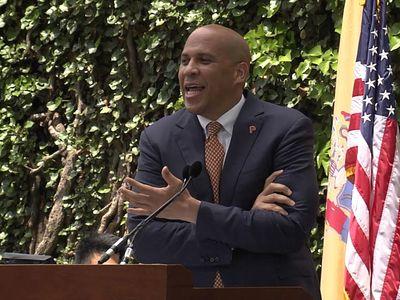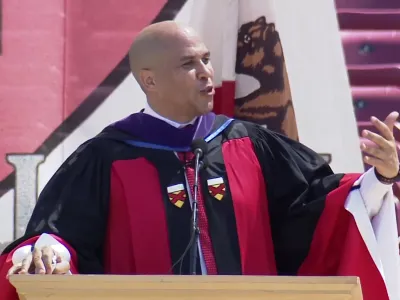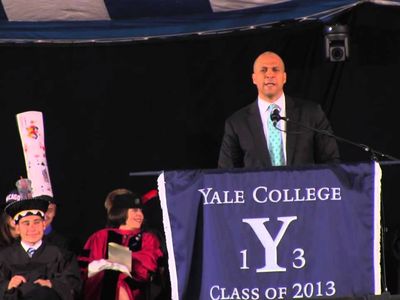
I'm a little bit choked up right now, because it is so good to be back here. But just these hats now have me in this weird state of pride and patriotism, as well as dismay that your ascending president here did not know—who's a great man, and a Stanford man too, I must say—did not know that that cat was Boba. In a style that only President Barack Obama could confuse—he's like a Vulcan mind trick or whatever—that is not Darth Vader's hat, that is Boba Fett, for crying out loud.
I was here during the time of Levin. I heard so much about this man, extraordinary. I want to welcome him. I'm so excited about your presidency. Thank you for having me here as well.
I want to say also, the hat I see over here shows you the change of time, because it was a hat that used to fill me full of enmity and anger, and I would want people to take it off immediately. Now it fills me with a sense of national pride and love. And it's a Boston hat, for crying out loud.
So look, this is incredible for me to be back here. I was a law student at Yale, and many people might think that's what defined my experience with the law school. But I probably had one of the greatest Yale experiences imaginable, because for two of my years I lived with—so I just cannot take this opportunity to say thank you to one of the more extraordinary men I've met in my academic journey, who was the master of Pierson College.
So I have a strange approach to my remarks today, and it has a lot to do with Pierson College. Now I am confident that nobody at Pierson College knows what I am about to tell you. Pierson College was named for—this you do know—was named for Abraham Pierson, who was the first director of Yale University, known as really the first president of this great college.
But Pierson, Abraham Pierson, actually spent his time before he came to Yale in Newark, New Jersey. His father was one of the founders of the great city of Newark. And for me, this was a powerful revelation, as I began to get clarity about what my life purpose was: to join this incredible city in a cause that I thought was far greater than myself.
As I read more about Abraham Pierson while living at Pierson College, I saw one weird similarity to his life and to mine. His father helped found Newark, but really what he helped found was a religious institution. It was a Puritan endeavor to find a space of gravity and divinity here on earth. While me, on the other hand, I at Yale University am proud to stand before you right now having founded a religiously based group while I was here. It is known—and I hope some people here are affiliated—as the great Eliezer Society. Thank you very much for the one person who is a part of Eliezer here.
But in truth, Eliezer is one of my proudest Yale affiliations. I say that with all sincerity. We started Eliezer with a young rabbi. I met him on his 21st birthday. He was a Hasidic Chabad rabbi—and no, I don't have something caught in my throat. For those of you who are not Jewish, this was a Hasidic rabbi who was an extraordinary man. It was five of us around the table at the Taft apartments who, on a Shabbat night, celebrated this wonderful, wonderful organization's beginning.
Now, I am a non-Jew. I am a Christian. But this was extraordinary. We started a society named after Eliezer, who is from the Torah. Actually, he is a non-Jew himself, and he was sent by Abraham to find a wife for his son. Interestingly, the word Eliezer really means the servant of Eli, actually. And in many ways, the spirit and the vision we had for this organization, founded with a rabbi, was to try to find ways to serve all.
And so today I want to do something a little different than you were probably expecting from this Christian man from Newark, New Jersey. But in honor of a man named Abraham Pierson, who had a spiritual drive that helped found the city that I now lead as mayor, I want to do something that has probably never been done before at this university. I want to stand here as a Christian boy, in all of my non-Jewish self, and give you all a dvar Torah.
Now, for those who have no idea what a dvar Torah is, it actually is to speak on a religious view from the Torah, or for many of you, the Old Testament. And for those of you who want some clarity—for those Jews, and those of you who are Baha'i, Jain, Sikh, Christian—we can have a conversation afterwards if you need some help or translation with this.
But actually, I want to go to the subject of vision. I was taught this in a black church in New Jersey, and re-taught it, learned it studying Torah here at Yale. There's this wonderful phrase many of you might know: without vision, the people will perish. And being that I saw no heads nod up and down on that verse, I guess Rick Santorum is right, this is a godless university.
So I want to speak just very quickly of two stories about this idea of vision, and why I actually do believe that without vision, the people will perish. Now, I'm going to borrow from two traditions in my family, from the African American oral tradition. And now you have to understand that my tradition, the oral tradition in my family, strangely was very bifurcated. There was a tradition that my father and my grandfather upheld, and there was one that my mother and my grandmother upheld—a matriarchal tradition and a patriarchal tradition.
And I saw that actually in my last graduation right here at Yale University, because my parents would come up to me, with my mom saying very different things than other people. You know, she would come up to me and remind me—what I want to remind you all—that this should be a day of gratitude. She would wrap her arms around me and say, be thankful today. Be thankful to the people in the corporation. Be thankful to the faculty and the professors.
She reminded me, like I want to remind you, that we should be thankful to our families. As my mom once said, behind every successful child is an astonished parent. And I know there's a lot of astonishment here today. She also reminded me to be thankful for those people who at this university take pride in your graduation: those people who serve you food, those people who do the lawns, those people who clean bathrooms, those people who work so hard to make this university function.
But the nurturing tradition of my mother and grandmother was really wonderful. My father and my grandfather had a different way of giving me love, and I feel so extraordinarily blessed to have both of these traditions. Because my father and my grandfather, having gone to every single one of my graduations, their role was to tease me as much as possible. My father would always remind me, whenever I tried to get proud in a moment like this, he would say, boy, don't walk around here like you hit a triple, because you were born on third base.
I graduate from high school—I'm feeling proud, president of my class, honor society, I was an All-American high school football player on the way to Stanford—and he looks at me, and looks at me hard, and says, son, don't be too proud today. I know you're going off to Stanford, but you got into Stanford because of a 4.0 and 1,600—4.0 yards per carry and 1,600 receiving yards your senior year.
I graduated from Stanford. My father and grandfather crowd around me. They grabbed the program and they said, uh, I see you didn't graduate magna cum laude, uh, you didn't graduate summa cum laude, you just graduated. Thank you. Lottie, I'm out.
Coming to my graduation, my final graduation, my father walks up to me and says, it's about time, boy. You got four degrees in the month of July, and you're not hot as a politician. My father still looks at me and says—and so my parents have their stories, two of which I want to share with you, and then I'm done, about vision.
And please understand that when my mom—my sweet mother, my sweet grandmother—when they tell a story, they each have a penchant for accuracy and detail. When they tell me a story, even if I've heard it before, I pay attention, because I'm going to learn something and get another fact. When my father and my grandfather—two extraordinary men, I love them dearly—but when they tell a story, they have a penchant for hyperbole and exaggeration. Their stories get so dramatic.
My father, I tell you, he says, son, I was born poor. Now, he would heckle me if I said that: don't you tell those people I was poor, because I was just po', po'. I couldn't—and I'm telling you, the weather changed over the times he tells stories. Every single story was a storm, but then eventually the hail began. And I'm telling you, the hail moved from every single ball a sport has: it was first the hail the size of golf balls, then the hail the size of baseballs, eventually we moved on to beach balls, for crying out loud, then there was galactic hail.
And I would try to catch my dad's inconsistencies. He would tell me the story about the mountains of North Carolina. He would start the story about the steep hill, almost a cliff, he had to climb just to get to school. And then he'd tell me some story and forget, and before I knew it he was going home up another steep cliff. I don't know what kind of geographical anomaly he grew up in.
And I finally—I know again this is a dvar Torah, so I can't tell you I broke a Ten Commandment, but there's one about honoring your mother and father—my father started a story telling me, son, when the tsunami hit our town. And I'm like, dad, stop. I'm sorry, man, there's no way you could have had a tsunami in the mountains of North Carolina. And my dad crosses his arms and gets indignant. He doesn't retreat. Who cares if you've got your facts wrong? He looks at me and says, boy, I'm telling you the tsunami hit. It was a long time ago, before the internet.
And so, two stories about vision. The first one I want to tell you is a part of my father and my grandfather's tradition. As Stephen Colbert says, it has a high level of truthiness—what's not quite true. And this story about vision is very simple. I was at a very young age, the youngest elected person in my city at that time.
I was on the city council in Newark, New Jersey. And I was also at the same time serving on the board of trustees at Stanford University. And so I had this interesting experience of leaving the board of trustees, essentially, to fly to California to serve on the board of trustees of that university. And I did it five times a year.
And one day I'm in a council meeting, in a fight—and I don't know what kind of cities you guys come from, but when I say a fight, I mean a literal fight. Someone had me in a headlock, two people around my legs. And my aide bursts into the council chambers and says, Cory, you gotta go, man. Your plane leaves in 15 minutes. You gotta get on your plane. And then he pauses for a second, looks at what he's watching, and he goes, you know what, forget it. You're going to miss this plane. It's only 15. You can't make it, Cory. It's impossible.
Now what my aide didn't realize at that point is that he let that word slip, a word that I had been taught is a word I had to reject: this word impossible. And as soon as he said it, I knew he knew what was coming. Something I tended to do back then, which is I put my hand on my hip, and I looked at him, and I said, you know something? My mama told me ain't no such thing as impossible. And—thank you for applauding, but he didn't applaud, he just rolled his eyes at me. He goes, here we go.
And so he ran and got the car and drove it around to the front of city hall. I charged out of city hall, dove into the car, and we raced off to Newark Airport. Now I am the mayor of the city now, so I cannot tell you we broke any traffic laws. As I was walking around with dignitaries from the university, I could not tell them that I broke any laws while I was here as well.
But we get to the airport, and those people who know advanced mathematics—you know the equation that has been tested by the smartest people on the planet, usually at airports—and tests this theory that simply says, the more of a hurry you are in, the longer the line at the airport.
And so I walk into the foyer. I see the counters there, long line. But I, Cory Booker, being called to prove that impossible things are possible—I'm here to attack the cynicism of the non-believers. And so I do what I have to do in the cause of honor and righteousness. And now there is carry-on baggage being thrown at the back of my head. It's not Mother's Day, but I'm being—and I lean at the counter, and I say, ma'am, I'm on flight 2222 going to San Francisco. Please give me my ticket.
And the woman looks at me and she goes, sir, I don't know if you're aware, but that flight leaves in six minutes. They probably closed the door already. I'm sorry, sir, you can't get on that plane. It's impossible. This woman did not know my mother. So I put my hand on my hip, and I said, you know something, ma'am? My mama told me ain't no such thing as impossible. And then let me tell you, I don't care if you're Irish, if you're Italian, if you're Korean, if you're Colombian, if you're from New Jersey—
And so I put my hand on my other hip, and I said, and my grandmama told me that black people been making a way out of no way. And so at this point she must have known my aim, because she rolled her eyes too, and she says, you can go ahead and try. She hands me my ticket.
Well, at this point I throw my bag over my shoulder and I start sprinting through that airport, jumping over bags, dodging people, running through the airport like a man from a commercial we don't talk about anymore. The older people get that joke a lot better than the younger ones. And I get about 25 yards from the gate, and there's this woman putting the combination on the door, and I scream at her, I go, stop!
And this woman swings around, sees a former tight end from Stanford University barreling down on her. She drops her clipboard, pins herself against the wall, and she goes, what's wrong? I go, ma'am, I am on that plane. And she goes, no, you're not. And I said, you don't understand, I tell you I'm on that plane.
She goes, sir, I am sorry, we have given away all the seats. You cannot get on this plane. It's impossible. She didn't know my mama. So I put my hand on my hip and I said, ma'am, my mama told me ain't no such thing as impossible. Switch my hands and I said, and my grandmama told me black people were making a way out of no way for a long time.
And my great-grandmother—we call her Big Mama—ma'am, she is a Christian woman, and she told me I can do all things. And before I can finish that quote from Philippians, before I can get deep up in the Bible, she goes, stop, sir, please. We can't have any air rage, sir, please. She goes, you're right, okay, you're right. There's one seat left on the plane, and if it's acceptable, sir, it's acceptable.
I took my tie and I dabbed the sweat off my brow, and I looked at her, and I said, that'll be acceptable. And so she opens the door. And I'm an '80s TV guy, I had to walk like George Jefferson, because I just moved on up, and I'm not going down. And the woman at the gate at the plane says to me, incidentally, sir, hurry up because we need to take off.
Where are you sitting? And I looked at her, where am I sitting? There. I'm in first class. And this was the first time I had flown first class. And they have seats in first class that are made for former tight ends from Stanford University. They are wide seats. And I sat down feeling the room that I had.
And then they come over and offer you a drink. Now I don't drink, I usually just have water on planes. But this was first class, I decided to make an exception. I look at the woman and I say, would you please—now I have my drink, we've pulled back from the gate, we're going down the runway, and the captain comes on the speaker and says, I would like to welcome you all to flight 48.73. I had a nice drink, I had a wide seat, I was first class, but I was headed in the wrong direction.
Now, why do I tell you this story, in the spirit of the patriarchs of my family? Because the first thing about vision I want you to understand, to understand deep in your heart as you enter a world with aspirations, with goals, is to always understand that first class in life has nothing to do with where you sit on an airplane. First class in life has nothing to do with the clothes you wear, or the car you drive, or the house that you live in. First class is about, and always will be about, the content of—
I found first class from the high-rise projects of Newark to the nice homes of Beverly Hills. I found first class in drug treatment centers in my city to the nicer homes by the park. I have seen first class having nothing to do with material things. This world will give you messages that will try to tell you different every day. It's going to try to take you from a great national tradition of citizenship, and it's going to try to move you into the currents now where people want to consider you more as consumers. America must get back to seeing citizenry at first.
This is the challenge of our age: the distractions that we get. And it's more than that. It's like the old African proverb, understanding our relationships to each other, understanding that we all have an interwoven destiny. First class is knowing that our country has an incredible Declaration of Independence, but the testimony of America, generation after generation, has been more about a testimony of interdependence.
This African proverb that says simply—something I should have learned as I raced for that plane—that if you want to go fast, go alone, but if you want to go far, go together. We need each other more than we know. We have interwoven destinies.
Life is not like United Airlines. We're all on the same plane. When we hit turbulence, it shakes us all. We may not realize it, but it does. When we have a hole in the fuselage, it threatens all of our well-being. And if we go down, we don't go down where the first class lands safely and those in economy are the ones that die. We go down, we go down together.
But I know from my experience, from the gains that we're making in Newark, that if we come together, if we work together, if we stand together, if we see each other—if we see the divinity of each other—then we will never go down. We will rise, we will rise, and we will rise.
My mom and my grandmother are great for telling stories that are the unvarnished truth. When I was a young man—now a city councilperson, then ran for mayor—I lost my first election. And that's a great piece of advice: if you're going to have a spectacular failure, have it captured by a documentary team.
My first election, I was horrible, lost. But it got into a documentary called Street Fight that won the Tribeca Film Festival, and then had an ignominious ending because it lost in the Academy Awards to March of the Penguins. I'm a vegetarian, but I make an exception for penguin meat, I must say—flightless rodents.
But in the years between my loss and my eventual victory, I kept living in these high-rise buildings that became public housing projects—low-income families and great Americans. I still say it's one of the greatest places I've ever lived in my life. These buildings, some of the greatest leaders and teachers were some of the elders in these buildings, holding them together with their spirit and their courage and their grit and their conviction.
I watched not just the older folks, but I watched the kids. Eight years of living there, I watched the kids grow up. There was a group of kids that used to hang in the lobby of my building. Guys, and I tell you, they were funny, they were amazing. I would come home at the end of long days, or even when I was hanging out with my friends, and I would hang out 15, 20 minutes in the lobby just talking with the kids. Sometimes I watched them get older, and I saw one in particular. He reminded me of my dad. He had that quick wit, that great swagger, he had an intelligence about him.
He was my father incarnate. They were both so similar—born to single moms, they were both so similar—they compelled me both.
Well, as I got older, and as I got closer to my narrow election, I saw some things that troubled me. One, I came home and they started showing colors. I started seeing signs that they were with the Bloods and getting involved with gangs. I then started coming home and the lobby would smell like marijuana. And so I realized that I had to do something to intervene, and I started taking them out. I said, hey guys, let's go to a movie. Any movie that you want to see, let's go. And they chose this movie that I thought was about home improvement, called Saw.
And I started taking them out to the diners to eat something. And I started bringing friends of mine who had been involved with gangs but had gotten out, and we had these amazing sessions of mentorship and conversation. But suddenly I got busy chasing after something really important. I was running for mayor. I was going after the big brass ring. I was going after something where I could make a difference. This was so important, and so I didn't have time to follow up on all the details, because I was getting busy going after something so important.
Well, I'll tell you that I started coming home, and even though I didn't have a chance to follow up on the connections I was trying to make, or take them to the movies anymore, or take them to the diners, the resiliency and the joy and the laughter of the kids was always there. I remember in the heat of the election they would tease me and chant things.
When I came home one night, I came home and they all had my lawn signs up, and they gave me a little parade as I walked into the building, shaking the dozen or two lawn signs at me. And I felt so proud, and I did a funny walk. And then I scratched my head and I wondered to myself, where'd somebody's lawn is kind of naked now?
Well, I got elected. I won a big victory, and now I was mayor-elect, getting calls from presidential candidates, getting calls from around the country. I was important, and I had an important mission. I was running after that mission. Violent crime in my city at the time was spiking up, and I was on a mission to stop it.
Every time there was a shooting in my city, whether it was two in the afternoon or two o'clock at night, I was there standing around with people. I would charge to them and say, this is not who we are. We're Newark, New Jersey. We're better than this. We're stronger than this. Like a pastor in a church, I was giving testimony to everybody of who we were.
And I was the mayor, so important people wanted to hear what I had to say. People would come out of their buildings and talk to me, and I would try to cater to them and encourage them. The press would meet me on the corners and they would interview me, because I was so important. And I'll never forget, one month into my time as mayor, I got another call for a shooting.
It was on Court Street in our city. And I go down there, and I do the same thing. I'm going to people, telling them about our plans, telling them that we had to pull together, that we were going to fight through this crime, we're going to drive down the violence. I barely paid attention to the dead body on the sidewalk and another one being rolled into an ambulance.
After that night of being important, of being the mayor of New Jersey's biggest city, I went back to my home in the high-rises of Brick Towers. I sat there with my BlackBerry, reviewing the incident reports of the day. And then it came to that shooting.
And I looked at my BlackBerry, and I saw the name. It was the kid from my lobby. It was the young man who was my father. It was this smart and charismatic young man who God had put in front of me every single day. I looked at my BlackBerry praying that the name would somehow change, praying that it was a mistake, or maybe not the same young man. But it was him.
I went to the funeral home on the day that we had services, and I did not feel like the mayor. I didn't feel mayoral, I didn't feel important. All I could do was stand in the back of that funeral home. All I could do was feel a darkness covering my heart as I watched everybody come to this kid's corpse. There were teachers, and there were community activists, and there were politicians, there were people from the buildings, there were his classmates. It was a packed funeral home, and I didn't want to talk to anybody. All I could do was stand at the back and look.
And I started to feel mocked—not inspired, but mocked—by the words of our common ancestry. I felt they were haunting me. I would hear things in my head, like Martin Luther King, who said so correctly that we will have to repent today, not for the vitriolic words and violent actions of the bad people, but for the appalling silence and inaction of the good people. I was the good person. I had to repent.
I stood there as people came over to me, and I could barely talk. Finally I had enough. I had to get out of there. I walked out of the funeral home, drove to city hall, climbed the steps in this historic building, stormed into my office, closed the door behind me, locked the door. And here I stood in this palatial office of importance where legendary names had sat before me.
And suddenly all I did was feel like a little kid again. I found a corner with a chair, and I sat down. How could we all be there for his death? How could we all crowd a funeral home for his death? Where were we? God had put him right in front of my face, but I was charging off to do important things, so I could not see what was right in front of me.
I tell you, Class of 2013, you will have days just like this. You'll feel an unconquerable sadness descend upon your being. You will have days like this, I promise you. I take no joy in telling you that there'll be mornings that you'll wake up and you'll feel the weight of shame weighing you down in your bed, that you don't want to get up. I tell you, you will. There'll be fear or pain or sorrow, or even the stinging malaise of depression, when you can't even find your enthusiasm. You'll have days like this.
And I've come to realize that in life, real courage is not giving a big speech. Real courage is not running into a burning building, or leading a charge up a hill. It is when the chorus of chaos, when the penetrating pain, when the shame descends upon you in a loud, ringing cacophony, that real courage is holding on to that still voice in your head that says, I must keep going. It's that voice that says to you that nothing is a failure if it's not final, if I keep going.
That voice that says to you, get out of bed no matter what, keep going. That voice that says to you, I will not quit, I will not give up. No matter how dark the day is, no matter how big my mistake, I won't give up. And when the world beats me down, I won't lose the lessons I can gather while I'm on my knees. I won't lose the lessons that I can find in my lowest pits of despair, because when I emerge, it's those lessons that will define my being.
And so on that day, in a corner of city hall in Newark, New Jersey, I found the lesson that I hold dear. It's a lesson of vision: that as you put your sights on your goals, no matter how great and compelling they are, as you look into the distance, don't forget about what is right in front of you today. Because no matter how great your dreams, no matter how great your destiny, never forget that the biggest thing you can do in any day is a small thing.
I've learned now that love is not a destination, it's a way of being. Excellence is not something you seek afar, it's something you manifest every single day. And the greatest people are not people who preach a good sermon, not people who give a good speech. It's the people who embody their spirit and their essence in everything they do. They know that the change they need to make is going to be small acts of kindness, decency, and love.
It's like the story of Gandhi. This great man who did the big thing, took on the British Empire, but yet as he ran for a train and jumped up upon it, and people pulled him in, one of his sandals fell off onto the train tracks. Everybody around him just felt a sense of sorrow: oh, it's a shame, Mahatma Gandhi's sandal fell off.
But Mahatma Gandhi didn't miss a beat. He reached out and pulled off his other shoe and threw it out on the tracks. The man who pulled him up said, Gandhi, why did you do that? And the great man looked puzzled. He goes, because whoever found that one sandal—wouldn't it be great if they found another one to go along with it?
This is how we're called to live. We all will be charging forth from this day to do important things. We all will be busy. But I've seen it in my work in Newark: the true heroes are those people who do the small things. Alice Walker's book In Search of My Mother's Garden—to paraphrase her, she says it so eloquently—that the real revolutionary is always concerned with the least glamorous of things: the raising of a child's reading level from third grade to fourth, to filling out food stamps for people, because folks got to eat, revolution or not.
To taking time to listen to your elders and write things down, because they are our connection to our past and the inspiration for our future.
This is who we must be: people of great goals and big ambitions, but who never yield from telling our authentic truth in every single day. My father and mother told me before I ran for office, just knock on folks' doors, Cory. It's so important. I go wide open so I can convince them. She said, no, because in life always remember this: who you are speaks so loudly, people can't hear what you say. Be love, be kindness, be justice. Don't let it be something you—
So I want to end with one final vignette. See, I left Yale and moved to Newark, New Jersey. I feel so connected to this place here, from Pierson College to my friends at Eliezer. I feel so connected here. But I tell you with all sincerity, I had some great professors—Fisk, Amar, Coleman—so many men and women who taught me so much. But I will tell you this, I still tell you to this day: I got my BA from Stanford, but my PhD on the streets of Newark, from folks who cared enough about me.
One of those people, that I end with, is a man named Frank Hutchins. Frank was one of the most legendary tenant organizers in Newark's history. In the 1970s, he led the longest rent strike in our public housing projects, in one of our public housing projects in the Central Ward of Newark.
And this man I met in my first months in Newark. I was still a law student here. And he would always say, until his final years, he would always say, I knew you were somebody. You see, he saw things in me that I didn't see in myself. He saw things in me that he cared about and loved, and wanted to do everything he could to make manifest in this world.
So Frank took me under his wing. Some of my most early battles, in order that this young graduate of Yale Law School, were by his side, taking on slumlords, defending the rights of residents, championing those who might have been poor but had rich spirits. But I tell you this, I've learned about life: the days go so slowly, but the years took their toll on Frank, and his health started to deteriorate. His eyes actually started to fail.
And we started this little funny thing we would do every time we would see each other. I would knock on his door—I knew he couldn't see me—but I'd say, Frank, it's Cory. And he would say, I know. I see you, Cory Booker. I see you. I used to love it. I look forward to him saying that. Frank, it's Cory. I would take him out to go shopping. He couldn't even see, but he wanted me to take him to the movies. And I said, Frank, I know this great movie about home improvement, Saw V.
In his final days at hospice, I would go visit him, bring him food and drink, because the people told me there that sometimes he gets so excited that he'd eat something if I showed up. One day I came, and the people told me it would not be long. And I knew this would be the last time I was with him. I walked in, and part of me was frustrated that there weren't thousands of people around his bedside—people who had heat and hot water, and a roof over their heads, and dignity and housing because of him. But I knew that that room was crowded with a chorus of angels.
I could see that it was his final moment. His breath was so rapid and strained, and I sat with him for what seemed like hours. And eventually I would leave. Now, Frank only said two things to me in that room, and they both were things he forced out of his mouth. One of them was something that we must say more to the people in our lives. But the last thing he said, that I hold dear in my heart, was this. This man, completely blind in a hospital bed, said to me in the most profound and penetrating way, for his last time, he said, I see you.
Class of 2013, I see you. I see that you're stronger than you know, more beautiful than you realize, more powerful than you can imagine. But you must imagine it. As one great author said, the most common way people give up their power is not realizing they have it in the first place. I see you, Class of 2013.
I see you: that in the harsh winter of this weary world, I see that you, like Camus said, are the invincible spring. I see you. I see that in a nation dashed with doubt, you are the hope. I see that in a nation that's dismayed by darkness, you are the light. I see that in a country fraught with fear, you are courage, and that in a nation blinded with bigotry, you are the love. I see you, Class of 2013.
And I want you to be like me: every time you hear the national anthem, don't just get up and go through the routine and say those words. Please hear them anew, for the first time. Hear those five words at the beginning of that song as a challenge to you: Oh, say, can you see? Take that challenge to your heart. Oh, say, can you see—that in this world, as Frederick Douglass says, you won't get everything you pay for, but you definitely will pay for everything that you get. So pay with your love, pay with your kindness, pay with your decency.
Oh, say, can you see—like Martin Luther King said, the change will never roll in on the wheels of inevitability. It must be carried in on the backs of warriors of love. See yourself as those warriors. Oh, say, can you see—that in this world we have work to do. Oh, say, can you see—that in this world that poverty and its ravages can be a day that we only find them in our history books.
Oh, say, can you see—that the blinds that divide us, of race and religion, of Democrat or Republican, will one day be the ties that bind us in one destiny, in one nation, in one country. Oh, say, can you see—a day that every one of our children, no matter what their background, will have pathways of excellence, that will have opportunities to have privileged educations like this one, that now are for the favored few, but one day can be for the abundant all.
Oh, say, can you see—a world where indeed, as it says in the Torah, that righteousness will roll down like water, and justice like a mighty stream. And dear God, if you can see it, then be it.
And if you be it, and somebody dare come up to you, as you manifest your truth, as you manifest your love, as you manifest your decency and kindness every day—if someone dare come up to you and say, you're one of those optimists, those Pollyanna-ish people, those dreamers; what you live, and what you talk about, and what you preach, not with words but with your deeds, all of that I think is just a bunch of hooey; it's impossible—I want you to put your hand on your head and tell them: my mama told me ain't no ...