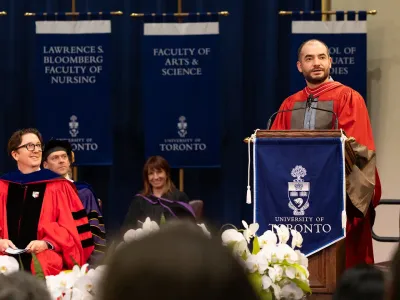
Hi, everyone. It is really nice to be here. I want to thank everyone for setting this up, for organizing this, and for giving me this honorary degree. It is extremely meaningful to receive it. Almost exactly twenty years ago, I received my bachelor's degree from the University of Toronto in this very hall. This is now my fourth degree from the University of Toronto, and I had an extremely wonderful time here.
I spent a total of ten years at the university. I did my undergraduate degree here, learned a lot, and was also a graduate student. I was able to go deeply into whatever interested me and truly become a researcher. It was wonderful to study with Geoff Hinton; the fact that he was at this university was one of the great strokes of luck in my life. I feel enormous gratitude to the university. I could not have asked for a better way to become educated, mature, and become a scientist.
When I was a student, the University of Toronto was doing the best and most revolutionary AI research anywhere. It was the most exciting work, and I feel very lucky that I was able to contribute to it as a graduate student.
That was a long time ago. As I understand it, one is supposed to offer sagacious advice in a convocation speech. I will do a little of that, but only a little, because this speech will be somewhat different. I will offer one useful state of mind which, if adopted, makes everything much easier: accept reality as it is, try not to regret the past, and try to improve the situation.
I say this because it is so hard to adopt. It is easy to dwell on a bad past decision, a bad stroke of luck, something that happened, or something unfair. You can spend so much time thinking that way, when it is much better and more productive to say, “Okay, things are the way they are. What is the next best step?”
Whenever I do this myself, everything works out much better. But it is hard. It is a constant struggle with one's emotions. That is why I mention it: perhaps some of you will adopt it yourselves. This is a reminder to adopt this mindset as best one can, and it is also a reminder to myself.
The reason this will not be the most conventional convocation speech is that something a little different is happening. Right now, all of you—all of us—live in the most unusual time ever. People may say that often, but I think it is actually true this time, and the reason is AI.
From what I hear, today's AI has already changed what it means to be a student to a considerable degree. But its impact goes beyond that. What happens to the kind of work we do? Work is beginning to change in unknown and unpredictable ways. Some kinds of work may feel it sooner and others later. You can look at what AI can do and what people say about it, and wonder which skills will remain useful and which will become less useful. At the current level, the question is how it will affect our work and our careers.
The real challenge with AI is that it is unprecedented and extreme, and the future will be very different from today. We have all spoken to a computer and had it speak back to us. That is new: computers did not do this in the past, but now they understand you, answer you, speak in a voice, and write some code. It is quite extraordinary, yet there are also many things AI cannot do and many ways in which it is deficient.
It still has a lot of catching up to do, but it is evocative enough that you can imagine what it might become in some number of years. Some people say three, others five or ten. It is hard to predict the future.
Slowly but surely—or perhaps not so slowly—AI will keep getting better. The day will come when AI can do all the things we can do, not merely some of them. Anything I can learn, and anything any one of you can learn, AI could do as well. How can I be so sure? The reason is that all of us have a brain, and the brain is a biological computer. If a biological brain can do these things, why could a digital computer—a digital brain—not do the same? That is the one-sentence explanation for why AI will be able to do all those things.
Then you can start asking what will happen when computers can do all our jobs. Those are enormous and dramatic questions. Thinking about them already feels intense, but that is only part of the intensity. What will we, collectively, want to use these AIs for? To do more work? Grow the economy? Conduct research and development? Carry out AI research? The rate of progress will then become extraordinarily fast, at least for a time.
These possibilities are so extreme and unimaginable. I am trying to draw you, at least a little, into the headspace of the radical future that AI creates. Yet it is very difficult to imagine, internalize, and truly believe on an emotional level. Even I struggle with it. And still, the logic seems to dictate that it is very likely to happen.
What does one do in such a world? There is a saying: “You may not take interest in politics, but politics will take interest in you.” The same applies to AI many times over. Simply by using AI and looking at what today's best AI can do, you develop an intuition. As AI continues to improve in one year, two years, and three years, that intuition will become stronger. Much of what we are talking about now will feel more real and less imaginary. In the end, no amount of essays and explanations can compete with what we perceive with our own senses and see with our own eyes.
With the very smart, superintelligent AI of the future, there will be profound issues around making sure that these systems say what they mean and do not pretend to be something else. I am condensing a great deal into a very short time here. But overall, simply looking at what AI can do and not ignoring it will, when the time comes, generate the energy required to overcome the enormous challenge AI will pose.
In some sense, AI presents the greatest challenge humanity has ever faced. Overcoming it will also bring the greatest reward. Whether you like it or not, your life will be affected by AI to a great extent. Looking at it, paying attention, and then generating the energy to solve the problems that arise—that is going to be the main thing. I will stop here. Thank you so much.