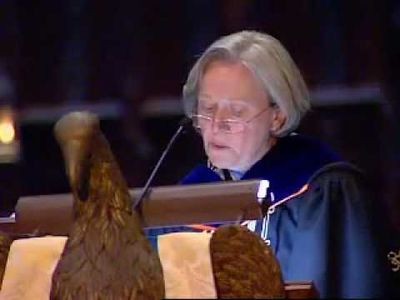
I'm glad I'm parachute-qualified, you should have issued me a bungee cord up here, Madam President. Well, good afternoon, and thank you for that very warm welcome. It is an extraordinary pleasure to be back at Princeton, and an honor to help celebrate the Class of 2009's graduation, and every Princeton graduate's dream: to share a few thoughts with you today.
Upon receiving the invitation to speak here, in fact, I immediately asked my head designated thinker how long I'd be allowed. Twenty-five minutes, he replied. Twenty-five minutes? I asked how can I possibly tell them all that I know in 25 minutes? Well, sir, he answered, I'd speak slowly.
Actually, this being Princeton, I know there's an English major out there who undoubtedly recognizes that my speechwriter borrowed that from George Bernard Shaw. But I want to assure you that my speechwriter, who was of course a fellow Princeton graduate, did put a ... I'm only as good as the material they give me.
President Tilghman, thank you for your very kind words of introduction. They are more than generous. In fact, I have to confess, I wish my parents could have been here with us to hear them. My father would have enjoyed your gracious introduction, and my dear mother would have believed every word of it.
In turn, though, Madam President, thank you for your magnificent leadership here at this extraordinary institution. You have navigated the always tricky waters that swirl around institutions of higher learning with great skill and a deft, steady hand. The university has achieved a great deal on your watch, from innovations in science and education, and the creation of the Princeton Neuroscience Institute, to the establishment of the Center for African-American Studies.
And I've been very pleased to see there's also been a timely, renewed emphasis on security studies at the great Woodrow Wilson School. So thank you for your exceptional leadership, your superb example, and your impressive vision. Our university has been very fortunate to have had you at its helm.
Well, let me assure the Class of 2009 that I'm keenly aware that I am all that stands between them and a good party. Actually, I understand that graduation celebrations have already been going on for some weeks now, and that you've been celebrating with appropriate zeal and gusto. In fact, I heard there was very nearly trouble at a party attended by some Woodrow Wilson School seniors a few weeks ago in Manhattan.
Now, I'm not sure how Princeton students had the time to be at a party in the city on a weeknight, as reportedly there still is a moderately demanding curriculum here. But apparently they did. And the way I heard it, a Woodrow Wilson School student leaned over to the guy next to him and asked, want to hear a Harvard joke?
Giving the Princeton student a hard look, the guy next to him replied, before you tell that joke, you should know something: I'm six-five and weigh 230 pounds, and I go to Harvard. The guy right here next to me is six-two, weighs 225, and he goes to Harvard too. And the guy next to him is six-three, weighs 230, and he goes to Harvard as well. Now, you still want to tell that joke? No, I guess not, the Woodrow Wilson School student said, not if I'm going to ...
Of course, those Harvard students could still be smarting from being defeated by Princeton in basketball, lacrosse, and lightweight crew this year. They're just so sensitive.
When I told my wife that I was asked to deliver the Baccalaureate address, she asked me, did you ever think back when you were a graduate student at Princeton that one day you'd be asked to give a commencement week speech? And I confessed that, of course, I hadn't. The Baccalaureate address was the last thing on my mind when I was studying here.
In fact, I'm reluctant to share what was on my mind as I struggled through Professor Bob Willig's advanced microeconomics class. In truth, when I started that class, I didn't know anything about supply and demand curves, what each represented, which went up and which went down.
And I am not making this up. What I did know is that I'd better figure it out pretty quickly. In any event, I can now say that all that squirming in the seats paid off, and that's a tribute to Professor Willig and all the other professors, preceptors, and staff who helped me become a proud graduate of this great university.
So let me take a moment, if I could, to thank the faculty and staff, including a personal note of appreciation to Professor Emeritus Dick Ullman, my dissertation adviser while at Princeton, and a mentor ever since. As I know everyone here recognizes, a key strength, perhaps the strength of Princeton, has always been its professors, devoted to scholarship, teaching, and mentoring, professors who go out of their way to support us during our time here, who often sacrifice their research and projects to help us with ours. They, and all the staff here, help make these hallowed halls so special.
And I'd ask that you join me in thanking them for all they have done for so many of us.
Of course, along with the president, I also want to recognize the proud parents here today. Although the focus this week rightly is on the graduates, you, the parents of the Class of 2009, deserve congratulations and thanks for helping your favorite student reach this day too.
And not just for being the national Bank of Mom and Dad, though I know your graduates appreciate that. More importantly, you've served as sources of energy and encouragement, as advisers and counselors, and as cheerleaders and admirers for your members of the graduating class. And for embodying all these qualities, we need to say thanks and congratulations.
Finally, of course, congratulations to the Class of 2009. You've worked hard here at Princeton over the last four years, and you should feel rightly proud of all that you have accomplished to get to this day. But today, with your accomplishments in mind, I'd like to do more than just congratulate you. I want to challenge you. For at present, perhaps more than ever before, your communities, your nations, and our world need talented people like you to help tackle the pressing issues we face.
So this afternoon I want to challenge you to respond to this need, and to make a commitment to something larger than self, to a greater good, to public service. As all here know, ours is a time with no shortage of pressing issues. As unemployment rises, as layoffs mount, as foreclosures stack up, and as federal, state, and local governments steel themselves for budget cuts, routine responses won't do.
As the divide between rich and poor increases in many countries, as preventable diseases take millions of lives, and as basic human rights issues persist, the old ways have become stale. We need thoughtful, hardworking, talented people like you to help find and implement better solutions. We need you, and those like you, to choose careers in public service and to help solve the many problems before us.
You might suspect that someone who wears a uniform would think of public service solely in terms of military service. And I'm very grateful for those who have committed to serve our country in uniform and who have chosen the path of military service.
So let me say thank you to this Ivy League school for proudly supporting its ROTC program, and let me offer special congratulations to the soon-to-be commissioned members of the Class of 2009: Alec Williams, Patrick Gallagher, Cameron Heggy, Brandon Riley, Jordan Blasik, Clay Perier, Rich Hegner, Katrina Johns, Wyatt Yanis, and Rhodes Scholar and Class of 2009 salutatorian Steven Hammer. Well done to each of you. By the way, Steve, I need your email address. We look forward to seeing you after Oxford.
But while military service is important, it is only one of many forms of public service. Indeed, the ranks of Princeton civilians who served in Iraq were led by my great diplomatic wingman, Ambassador Ryan Crocker, a Woodrow Wilson School fellow. And my first diplomatic partner when we were in Mosul in 2003 was an exceedingly talented Woodrow Wilson School graduate, Herold Mustafa, who spoke fluent Kurdish and Arabic. They, and many other Princeton graduates and graduates of other great schools, helped us turn around a faltering effort and give new hope in the land of the two rivers.
But of course, public service need not entail putting oneself in harm's way in foreign countries. While the challenges are different, our own neighborhoods and communities also require creative solutions. Indeed, you can be a servant of the greater good with a private sector career as well. Our nation's history is full of examples of captains of industry and masters of the universe who made tremendous contributions of good citizenship.
Such individuals represent the best of what John Milton, writing at the time of the English Civil War, called on good citizens to do: actively and forcefully participate in the shaping, and the serving, and the protecting of society. And in these respects, all graduates can serve, and all can contribute.
So whether you follow in the footsteps of diplomats, soldiers, foreign aid workers, health care professionals, educators, entrepreneurs, environmentalists, financiers, legal advocates, or political figures, there are countless ways to serve the public good, and numerous issues that would benefit from your focus. But this afternoon, again, I'd like to challenge you to consider a career in public service.
You all have big brains and amazing talents, or you wouldn't be sitting here today. By now you also have a sense of your strengths, and probably of your weaknesses, and this is the time to ask yourself: what pressing needs can I help address? Now, as I issue this challenge, I'm well aware that it is indeed just that, a challenge. Public service is certainly not easy.
The sacrifices that it entails are real and tough. As I'm sure you're all aware, it's possible that you'll work twice as hard to earn half as much. On top of that, the issues with which you will grapple in public service are difficult, complex, and seemingly intransigent. You'll likely face a lack of full resources to address those issues. The choices are never easy, and the solutions are seldom perfect.
In case all of this reminds you of Dante's warning, abandon hope all ye who enter here, let me make clear some of the powerful, albeit less tangible, rewards of public service.
First, the biggest and most important reward of public service is the gratification that comes from being part of worthwhile endeavors. As 1985 Princeton graduate and First Lady Michelle Obama recently said, a public service, there is nothing more fulfilling. It's an opportunity to put your faith into action in a way that regular jobs don't allow, a great way to demonstrate one's values and to give back to the community.
Second, public service offers the chance to work hard at work worth doing, what Teddy Roosevelt called the best prize that life has to offer. Those of you graduating today already know of this benefit. No one, after all, can earn a Princeton degree without a great deal of hard work. You know personally the satisfaction that comes from achieving a worthwhile goal through hard work. And in public service, similarly, there is great reward to be found in grappling with the toughest of problems and in helping find solutions to them.
Third, working in public service alongside others committed to serving a greater good fosters an uncommon level of camaraderie and sense of teamwork. There are few more rewarding experiences than linking arms with others and striving to achieve goals that are uniquely challenging and important. Nowhere is this exemplified better than on the battlefield, where troopers routinely put their lives on the line, above all for the troopers on their left and right. The relationships forged between men and women of the brotherhood of the close fight often are the most intense imaginable.
But all forms of public service require shared perseverance in the pursuit of a worthy cause and offer similar opportunities for camaraderie. Indeed, Woodrow Wilson noted that in public duty there is a reward awaiting you which is superior to any other reward in the world: that is, the affectionate remembrance of your fellow man, their honor, their affection. No man could wish for anything more, or find anything higher than that, to strive for.
Lastly, public service provides an unparalleled opportunity for relatively young professionals to exercise and develop leadership skills. These skills, faculty please cover your ears, cannot be taught in the classroom. They come only from experience, from doing, from applying what one learns in an academic environment in real life, together with real people. It is by this way, in that setting, that the theoretical, rational consumer of economics theory and Professor Willig's lectures becomes the often less than rational citizen of the real world.
In fact, this thought reminds me of an event from the early stages of my career, when I learned firsthand that undergraduate learning has to be complemented with on-the-ground experience. I was a brand new second lieutenant, out of my first field exercise with my platoon. We'd had a long day and didn't crawl into our sleeping bags until shortly before midnight.
I'd only been asleep for an hour or so when my platoon sergeant, a wise old Airborne veteran, elbowed me and woke me up. Sir, he said, look up and tell me what you see. And I replied, I see a million stars, platoon sergeant. And what does that tell you, sir? the platoon sergeant asked.
I thought for a few moments, and wanting to impress my platoon sergeant, gave an answer that I thought he would conclude to be truly profound and indicative of a keen intellect. Astronomically, I said, it tells me that there are millions of galaxies and potentially billions of planets.
Theologically, it tells me that God is great and that we are but small and insignificant. Meteorologically, it tells me that we're going to enjoy a beautiful day for training tomorrow. There was a long pause as my platoon sergeant considered my weighty answer. After a while, I finally asked him, what does it tell you, platoon sergeant? Well, sir, he replied, it tells me that ...
Well, regardless of the truth to that story, I can attest to the fact that I learned the most about leadership from getting my hands dirty and my boots dusty. Marine Lieutenant Donovan Campbell learned similar lessons following his graduation from Princeton in 2001. He learned how to lead under fire when he deployed with his Marine platoon to help prevent Ramadi, the capital of Iraq's difficult Anbar Province, from falling into chaos.
In his book Joker One, a Marine platoon leader's story of courage, leadership, and brotherhood, Campbell recalls how he developed leadership skills while in combat, learning to balance the often competing demands of accomplishing his unit's mission and taking care of his troopers at the same time. While, again, the challenges one faces in other forms of public service may not be the same as those on a battlefield, they are no less real and provide ample opportunity to lead.
Indeed, young leaders in public service often find themselves entrusted with a level of responsibility that outpaces that of their contemporaries in the corporate world, and there are countless opportunities to develop hands-on leadership skills and a host of other public service endeavors.
So again, I challenge each of you to pursue a path of public service, not only because the world needs you, but also because doing so will provide you with work worth doing, with unique opportunities for camaraderie, and with considerable scope to develop your leadership potential. Why me? you might be asking yourself. The answer, of course, is that the problems that beset our local, national, and international communities call for public servants who are our best and brightest. And because Princeton has uniquely prepared you for such service.
Your education here has emphasized broad knowledge, critical thinking, and the ability to communicate your thoughts coherently, and the quality and character of such a background are particularly well suited to public service, where the problems are complex and the resources thin.
You may be surprised at how the knowledge and skills you've acquired here at Princeton, whether in the social sciences, the natural sciences, or the humanities, will serve you as you serve others. When I first went to Iraq in 2003, my soldiers and I were often greeted by Iraqis who would say to us, thank you, American, we love democracy.
What is it? I also remember being pulled aside after a provincial council meeting by an Iraqi business professor from Mosul University. This was right after I'd given a particularly impassioned, and I thought persuasive, explanation of the virtues of free market economics. You know, General, this Western-educated professor told me, the idea of free markets scares 95 percent of the people on this council.
In truth, these reactions were not entirely unfamiliar to me, because as a graduate student here I learned to work in an environment in which not everyone thinks the same way, whether they come from a military background or from a variety of other backgrounds, for that matter. I was, moreover, aware of the uneven spread around the world of what we know as liberal democratic thinking.
So as we came to grips with the fact that the 101st Airborne Division was going to have to do nation building in northern Iraq in 2003, something for which we were not ideally prepared when we began the fight to Baghdad, I found myself thinking back to my political philosophy and government classes, and yes, even to Professor Willig's microeconomics course.
Given my time here and my later stint as an assistant professor at West Point, I knew how to convey basic ideas about the concepts of market-based economics, the importance of majority rule and minority rights, the idea of basic freedoms, and the need for limits to avoid infringing on the rights of others. I could explain what I knew to the Iraqis we met, and I'd like to think we were all better for it.
You are also uniquely prepared to accept the challenge of public service because, as Princeton graduates, you've been imbued with a culture that values the ideals of service. And in making the decision to serve the public good, you would be guided by the principles you learned here. Recall that it was Princeton President Woodrow Wilson who coined Princeton's informal motto, in the nation's service, in a speech he delivered here in 1896. And since that time, our university has expanded the motto to, in the nation's service, in the service of all nations.
These aren't just words. Countless Princetonians have upheld our university's motto, from the Princeton veterans who served and sacrificed and are memorialized by the bronze stars on the windowsills of your dorm rooms, to Wendy Kopp, Class of 1989, who wrote her senior thesis about novel ways to attract the best and brightest to teach and then created Teach for America, to some of our nation's notable modern senators like Bill Frist, Class of 1974, Bill Bradley, Class of 1965, Jack Danforth, Class of 1958, Paul Sarbanes, Class of 1954, and Claiborne Pell, Class of 1940.
Unfortunately, to be sure, some of those rival schools to the north have been producing more presidents of late, and I'd ask some of you here to vow, to resolve, to change that. But seriously, in rising to meet the challenges of public service, you can take confidence from the fact that each of you will be following in the footsteps of a long line of distinguished Princeton graduates.
You can also take courage in the fact that you have the vitality and energy of youth on your side. Recall the words of traveler and adventurer Richard Halliburton, Class of 1921, who in his wonderful book A Royal Road to Romance wrote movingly about the sense of possibility that he felt as a young man venturing out into the world. Realize your youth while you have it, he wrote. Don't squander the gold of your days. Live, live the wonderful life that is in you. Be afraid of nothing.
My mother made me read that book one summer when I was in high school. In truth, I'd much rather have been playing baseball or hanging out at the town pool. Heck, I'd rather have been mowing the lawn than reading that book on some days. But in the end, I appreciated her encouragement, for Halliburton told a wonderful tale of the adventures he had after graduating from Princeton, as he sought to realize his youth while he had it. And his account of his experiences remains inspirational to this day.
So today, in the spirit of Richard Halliburton, I encourage you to be afraid of nothing, and to take advantage of your youth in choosing to help confront the challenges that lie before us.
You stand at the threshold of a world of choices, with a great education and a wealth of energy. Thousands of Princetonians before you have stood in the same position. Those we often praise most for their impact on our world have chosen the path of public service. They made the bold choice that the hard work of public service was worth it, whatever it took. And as an old mentor, General Jack Galvin, used to say, the bold move is usually the right move. So be bold, and fearless, in channeling your energy into the undaunted pursuit of worthwhile work.
Each of you entered this university four years ago with lofty hopes and high aspirations. You've achieved a great deal, and you'll soon receive one of America's most coveted diplomas. Whether you've spent these past four years in Terrace or Cottage, Witherspoon or ... art history, you have a great deal to be proud of, and I offer heartfelt congratulations to all of you on your accomplishments.
But, as President Tilghman noted, there's a reason a graduation ceremony is called a commencement and not a termination. It's a beginning, not an end. And now our world awaits the impact you will make after your long-awaited walk through FitzRandolph Gate. Be bold in your commitment to serve. Be determined not to waver in seeking opportunities to work hard at work worth doing. Good luck, Godspeed, and go Tigers.