Sec. Hillary Rodham Clinton: Let us imagine, for a moment, that we are gathered together late in the evening on December 9th, 1948.
World War II is over, but peace is far from secure. Soviet troops blockade West Berlin. In Czechoslovakia, a coup has toppled the last democracy in Eastern Europe. In South Africa, apartheid is becoming the law of the land. Economies around the world remain in ruins. Forty million displaced persons are trapped in refugee camps. And in Paris, negotiators from 58 disparate and rivalrous nations struggle to agree on a version of peace to replace the horrors of war.
Already debate has raged. Through 300 meetings and over 3000 hours. Yet still in question is whether the new United Nations can do what the old League of Nations could not – offer the world a roadmap for peace and prosperity strong enough to withstand the appeals of demagogues and the ravages of poverty and fear.
The outcome rested on the persuasive powers, the diplomatic skill, the dogged persistence of one woman. An American woman, in her 60s, with only four years of formal education, but schooled in the real world. Eleanor Roosevelt had seen humanity at its finest, and its cruelest. Dead boys on the fields in France. Soup kitchens and empty store fronts in the Great Depression. Hospital corridors filled with wounded soldiers in Pacific war zones. Refugee camps filled with Holocaust survivors and those displaced by war.
“Dear Lord,” she often prayed, “help me to remember someone died for me today… help me to remember to ask and answer am I worth dying for.”
For nearly two years, she had pushed and prodded a fractured world to rally around a Universal Declaration of Human Rights… around the radical idea that all human beings are born free and equal in dignity, that human rights are not granted by governments – they are the birthright of every woman, man, and child.
It was an idea so powerful that it could change the course of history. But getting agreement on a single text was fiendishly difficult. The delegates drafted, revised, rewrote, and argued. It was so grueling that at one point, a representative from Panama reminded his colleagues that diplomats had human rights, too.
Now, with midnight approaching and December 9th drawing to a close, it was time for a final vote. Eleanor knew she had the support to win, but she worried that any dissent would wreck the fragile consensus she had negotiated.
Early in the morning of December 10th, forty-eight nations representing the vast majority of the world’s people voted in favor of the Universal Declaration of Human Rights. The Soviets abstained, but not a single country dissented.
A silence overtook the chamber. Then all the members of the UN rose as one to honor the moment and applaud the woman who had made it happen.
Eleanor believed it was a landmark comparable to the French Declaration of the Rights of Man and the American Bill of Rights – a new Magna Carta for all people. Not perfect, but a “compass” pointing the world toward freedom and dignity.
She also understood that this victory was only the beginning of what she called “the long trek” to make human rights a human reality.
History has proved her right. If Eleanor were here today, I think she would be appalled, but not surprised, to see dictators still oppressing their people, from Moscow to Beijing and beyond. You’d see authoritarians growing in influence… corruption and economic injustice still deeply entrenched, and in too many places, getting worse… you’d see racism and xenophobia still turning us against one another.
But I think she would also be proud of what we’ve accomplished.
The Universal Declaration has become the single most widely translated single document in the history of the world.
Generations of activists, leaders, and ordinary citizens have carried its principles forward. They have fought and organized and campaigned to tear down barriers that prevented people from enjoying the full measure of freedom, the full experience of dignity, and the full benefits of citizenship.
They’ve built a system of international law and institutions to protect the freedoms spelled out in the Declaration, and to hold violators accountable. They’ve woven human rights into domestic constitutions and made them a crucial test of any government’s legitimacy.
In country after country, human rights have come to be seen not as a high-minded luxury but as a core national interest. In many places, racist laws have been repealed, legal and social practices that relegated women to second-class status have been abolished, the ability of religious minorities to practice faith freely has been secured. Command economies have fallen and free markets have risen. Extreme poverty has receded and war has become less frequent. The language and law of human rights have enabled people to reclaim ownership of their own lives.
Millions whose lives were once narrowed by injustice or oppression are now able to live more freely and participate more fully in the political, economic, and social lives of their communities.
So yes, today the world is safer, richer, freer, and fairer than it was in 1948.
Yet 70 years after that historic night in Paris, forces are at work from both the left and right to undo the progress in the name of nationalism, populism, religion, and ideology. Our long trek remains far from finished.
I come here today not just to remember Eleanor, but to remind us that we have urgent work ahead. I want to thank Kate O’Regan and the Bonavero Institute for giving me this opportunity. I am grateful to Helena Kennedy, Helen Mountfield, all our distinguished panelists, Mansfield College, and Oxford University.
The cause of human rights has been close to my heart for a long time. Looking back now, I can see how lessons from my family and faith about treating others as equals — and expecting as a girl to be respected – along with the activism of the 1960s and the work I did as a young lawyer, put me on this path.
I learned that human rights are not just the stuff of philosophy or high diplomacy but must be the substance of everyday life. As Eleanor famously said, they begin in the small places close to home.
That’s what I saw when I went door-to-door gathering evidence about the barriers preventing children with disabilities from getting an education.
I learned it in Alabama when I went undercover to expose continuing racial segregation in schools and in South Carolina, where I investigated the plight of teenagers jailed in adult prisons as though they were hardened felons.
I saw it in the faces of abused and neglected children in my work at Yale-New Haven Hospital, which led to my first article on the legal rights of children.
But I couldn’t have imagined in 1974 the long and winding path that would bring me here today. But I knew that I wanted to devote my life to widening the circle of justice and opportunity.
There were still too many of our fellow men and women whose human suffering we failed to see, to hear, and to feel… too many excluded from the fundamental rights proclaimed in the Universal Declaration.
That’s what led me to provide legal services to poor families in Arkansas and then across America, and to fight for universal health care as First Lady.
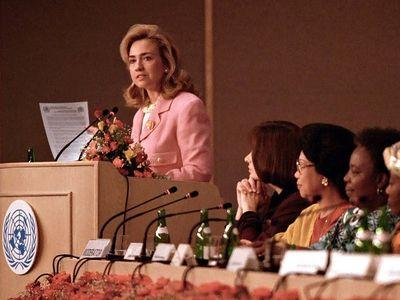
It led me to Beijing in 1995, to declare that human rights are women’s rights and women’s rights are human rights.
And to Geneva sixteen years later, to say that human rights are also gay rights and gay rights are human rights.
It’s why, as Secretary of State, I made it a priority of American foreign policy to stand up for survivors of mass rape and human trafficking, for persecuted religious and ethnic minorities, and for imprisoned journalists and dissidents – like the blind, barefoot human rights lawyer who took refuge in our embassy in China.
It’s why I ran for President of the United States and fought for a hopeful, inclusive, big-hearted America – an America I still believe in, and always will.
So that’s what brings me here today. We have arrived at a moment of peril like none we’ve seen since the end of the Cold War.
Today, the human rights that Eleanor Roosevelt fought for – and the democracies devoted to their protection – are under siege from within and without and in need of both defense and renewal.
To turn back a rising tide of authoritarianism, we must hold fast to the principles of the Universal Declaration and offer a compelling new vision of democracy that delivers a better life for people everywhere – with less inequality and more opportunity, unity, and decency.
As Eleanor said, “to stand still is to retreat.”
Now is the time for leaders to stand up, bravely and firmly, for the values we share and the future we need. And for citizens to support and join them.
What we need is an authentic, grassroots revival of the democratic spirit and the struggle for justice. We’re starting to see it emerge, driven by popular movements around the world – from Black Lives Matter activists demanding racial justice to women courageously declaring “Me Too” …to tens of thousands protesting attacks on an independent judiciary in Poland…to people demonstrating against corruption and impunity in Guatemala and Nicaragua.
It’s time for all of us, in whatever way we can, to heed the courage of activists like Malala… [who is here with us today]… She didn’t ask to become a global symbol of the struggle for the human rights of girls seeking an education. She wanted to live her life and go to school. But after the Taliban shot her in the head, there was no way she was going to back down.
It’s time for us to heed the courage of Nadia Murad, who endured slavery and rape at the hands of ISIS but refused to hide her face in shame and instead forced the world to confront the atrocities committed against the Yazidis and the horror of sexual violence as a weapon of war. Last week she won the Nobel Peace Prize, but what she deserves even more is to see her message turned into action everywhere that women’s human rights are threatened.
Now is the time to bring human rights out of the ivory tower and diplomatic conferences and into those small places close to home…into neighborhoods and schools, offices, factories, and farms…into the hearts and daily interactions of men and women everywhere who will never read the lofty language of the Universal Declaration and yet embody its aspirations and must share in its promise.
As Eleanor also said, our ideals “carry no weight unless the people know them, unless the people understand them, unless the people demand that they be lived.”
To succeed, we’ve got to be clear-eyed about the many challenges we face.
Recent history has delivered bitter disappointments. The exuberance of the Arab Spring gave way to civil war in Syria, chaos in Libya, and a return to dictatorship in Egypt. In Myanmar, high hopes for democratic progress have foundered as the military wages a campaign of atrocities against the Rohingya and imprisons journalists – like the Reuters reporters Wa Lone and Kyaw Soe Oo – who have done the business of reporting the truth.
There was a time not that long ago when many of us believed that the appeal of democracy, combined with diplomatic engagement and expanding trade, would slowly but inexorably lead closed societies to open up and embrace human rights.
But in China, Xi Jinping has consolidated more power than any leader since Mao.
And in Russia, where Vladimir Putin has tightened his grip, journalists and dissidents like the Ukrainian filmmaker and political prisoner Oleg Sentsov are jailed, beaten, or murdered with impunity.
Even in what we once thought of as sturdy democracies, freedom is under threat – and when freedom is threatened human rights, obviously, are vulnerable.
By Freedom House’s count, more than 70 nations curtailed civil liberties and political rights in 2017, the twelfth year in a row in which freedom contracted around the world. It’s a reminder of how fragile an experiment self-government really is. When viewed against the sweep of human history, how fleeting.
There may be no such thing as a “sturdy” or “consolidated” democracy. It is always at risk and always in need of defense.
We see it in Turkey and the Philippines, where strongmen are conducting ruthless campaigns of repression.
We see it here in Europe. Last month, the European Parliament initiated an Article 7 disciplinary process against Hungary’s right-wing nationalist government for failing to respect human rights and the rule of law. The independence of the judiciary, civil society, and academia – including Central European University – are all under attack.
A similar story is unfolding in Poland. If you haven’t read Anne Applebaum’s haunting recent essay in the Atlantic Magazine, I hope you will.
And as we are all too well aware, the crisis extends to my own country, the world’s oldest democracy.
I don’t use the word crisis lightly. True, there are no tanks in the streets of Washington or New York. But our democratic institutions and traditions are under threat on many fronts.
The President is degrading the rule of law, delegitimizing our elections, spreading corruption, undermining our national unity that makes democracy possible, and discrediting truth, facts, and reason.
From day one, the Trump administration has shown hostility to civil rights that previous generations fought to secure and defend – from the Muslim travel ban to the barring of transgender Americans from serving in the military to the unspeakable cruelty inflicted on undocumented families arriving at our southern border, including separating children, some as young as eight months, from their parents.
As in so many other societies, the United States is facing a toxic backlash to years of social and economic change, playing to our ugliest impulses, not our better angels. Our divisions make us targets for foreign manipulation, which seeks to sow chaos and pit us against each other.
And even as we face the resurgence of the old challenges of nationalism, tribalism, and authoritarianism, new threats are already upon us, especially at the intersection of technology and autocracy.
Technology and globalization were supposed to bind the world closer together, break down the barriers rulers use to hold their people back, and spur more openness, innovation, and freedom.
Now, to a large degree, that did happen. And yet, we’ve learned the hard way that technology is a double-edged sword, not just carrying democratic values to oppressed people but also giving authoritarians the tools to tighten control and counterattack at the foundations of open societies.
The whole world now knows that Putin’s Russia is waging cyberwarfare and manipulating social media to influence elections and referenda and to polarize and cripple democracies across the west.
It’s not just the United States ,but in Germany, France, Spain, Italy, the Baltic countries and beyond, Kremlin-backed hackers and propogandists have sought to inflame divisions and advance an extreme right-wing agenda.
Here in the UK, senior lawmakers like Damian Collins, a Tory, and Labour’s Tom Watson, have called for a full and independent investigation into Russia’s role in the Brexit referendum. Collins, who has led the Parliamentary inquiry, warns of “a crisis” in British democracy (and I quote) “based on the systematic manipulation of data to support the relentless targeting of citizens” (unquote).
And while Moscow coopts the open internet for its own purposes, Beijing is working tenaciously to end it altogether.
Chinese authorities are stepping up their already prodigious censorship and control of the web through what is known as “The Great Firewall of China,” intimidating, imprisoning, or exiling anyone who dares challenge their restrictions.
But Beijing is not content to merely repress its own people, but also bullies foreign tech companies, nations, and international organizations alike to accept its vision of an internet divvied up between all-controlling national governments.
At home, Beijing is using artificial intelligence to construct a fearsome new 21st century model of totalitarian repression.
In the western Xinjiang Province, Chinese authorities have deployed a vast surveillance system of checkpoints and high-tech cameras that use facial- recognition to track the Uighur population. This feeds into what UN officials have described as a “massive internment camp shrouded in secrecy” that holds between 100,000 to one million Uighurs. And there are credible reports of mass detention, torture, and brainwashing.
This is just the beginning. China is exporting the tools they’re testing to other countries, from Malaysia to Zimbabwe. The government also is collecting enormous amounts of data on all its citizens and designing a nation-wide Social Credit Score system to track their daily lives, reward behavior the state approves, and punish those who step out of line.
It’s like an episode of Black Mirror – in fact, I believe it was an episode of Black Mirror.
Think of all this as a beta test… an experiment in constructing a terrifying new high-tech gulag, where Big Brother is everywhere and privacy and dignity are obsolete.
Putin, for one, understands the power of what China is pioneering. He has predicted that whoever dominates artificial intelligence will, and I quote “become the ruler of the world.”
When you add it all up – democracies in turmoil, autocrats ascendant, a dystopian future taking shape before our eyes – it sounds daunting. And it is. All of us who care about the legacy of the Universal Declaration of Human Rights should be very worried.
But let us view this challenge not as an omen of defeat, but as a call to action. As Eleanor said, “courage is more exhilarating than fear, and in the long run, it is easier.”
Think of what she faced in 1948: A rapidly changing world with powerful new technologies. Authoritarian menaces in Moscow and elsewhere on the rise, trying to undermine democracies. America and Europe deeply divided. Actually… this all sounds pretty familiar, doesn’t it?
And as my friend Michelle Bachelet, the former two-time president of Chile, said last month in her first speech as UN High Commissioner for Human Rights, “This is a time of many setbacks for human rights, but, she went on, it is also one of great opportunity.”
So there is a way forward. And let me suggest some priorities for the work ahead.
Above all, democracies have got to stick together. We need to have each other’s backs.
For example, when Saudi Arabia tried to punish Canada for speaking out on behalf of human rights, in particular, the women who had campaigned for the right to drive and then were rounded up and imprisoned in the kingdom, the silence from Ottawa’s supposed allies was shameful. Every democracy in the world should be standing with the Canadians.
Benjamin Franklin told his fellow patriots after they signed the Declaration of Independence that we must all hang together, or most assuredly, we shall all hang separately.
This is not the forum to lay out a full coordinated strategy for confronting Russia and China, and other human rights backsliders and abusers, but Putin and Xi and other authoritarians do understand strength -- and that’s what we must demonstrate.
And on China in particular, let me say: as the West considers the future of this enormously complex and important relationship, as we debate how and when to compete and cooperate, human rights must be front and center.
And let’s not be fooled by the masquerade that countries like Hungary and Turkey are still real democracies, just illiberal ones. “Illiberal democracy” is a contradiction in terms.
To be a democracy takes more than an election – even a free and fair one. It also requires free expression and a free press, the rule of law and an independent judiciary, vibrant civil society and transparent and responsive institutions that are accountable to all citizens and protect their rights equally. Without these things, illiberal democracy is no democracy at all – it’s just authoritarianism by another name.
I hope the European Union – and the people of Europe – will resist the backsliding we’re seeing in the east. It’s disheartening to watch conservatives in Brussels vote to shield Viktor Orban from censure – including British Tories. They’ve come a long way from the party of Churchill and Thatcher.
The slide toward autocracy is at least as grave a threat to the European project as the financial crisis or Brexit. It’s also a threat to NATO. The treaty that created the alliance made it very clear: NATO is, quote, “founded on the principles of democracy, individual liberty and the rule of law,” unquote. If those values fail, so will the alliance.
And we also can’t be taken in by self-styled realists or the admirers of strongmen who argue that human rights are luxuries that must be sacrificed in pursuit of stability and security.
Clamping down on freedom can create the illusion of security. So can building walls and turning away refugees. But over the long term, repression undermines stability and creates new threats. Autocracy is brittle. The illusion of stability fades, but people’s yearning for freedom does not.
So democracies sticking together is the first thing we must do.
Here’s a second: Now more than ever, let us be unwavering, unambiguous, and unequivocal in defending the achievements of the human rights movement and championing our values.
There have long been critics who dismiss this movement as western imperialism or who would have us practice a form of moral relativism. There are others who claim to cherish human rights, but their concern only extends as far as their own tribe. These are attacks on the concept of universality that lies at the heart of the Declaration.
Now, it’s obviously true different cultures have different conceptions of liberty and the relationship between the individual and the state. It’s also true that people will think differently about those close to them – their kin and country – than they do about people far away who they’ve never met and who may look, love, and worship very differently than they do.
But the drafters of the Declaration understood all this. They came from different cultures and faiths and disagreed about many things. But they recognized a fundamental truth of human nature – one at least as powerful and hard-wired as the fears that pit us against each other and make us crave security and stability. The truth that people everywhere yearn for freedom and dignity, regardless of race or creed. Even if we don’t always recognize or honor it in each other, that yearning is there. We have that much in common, at least.
That’s why they changed the document’s name, late in the process, from the International Declaration of Human Rights to the Universal Declaration of Human Rights, a declaration on behalf of every person on the planet.
It’s also worth noting that in the decades after the Declaration, the human rights movement wasn’t spurred primarily by imperialist western powers or overbearing NGOs, it was carried forward by freedom fighters battling colonialism and activists standing up to repression. I wonder what they would think of critics who confidently declare that human rights are incompatible with certain cultures or faiths and that democracy will never take root in some regions of the world.
Tell that to the dissidents who’ve risked their lives from Tiananmen to Tahrir.
You don’t stand in front of a tank because of a foreign idea imposed on you from afar. You do it because the drive for freedom is so powerful that it’s worth dying for.
That’s what has fueled every movement for human rights, every campaign for democracy, every struggle against oppression all over the world. The freedom to live up to one’s own God-given potential. The potential within every person to join freely with others to shape their communities and their societies, the potential to share life’s beauties and tragedies, laughter and tears with the people we love – that potential is universal.
Another criticism comes from those who say that economic rights have been neglected or sacrificed in pursuit of civil and political rights.
I share the concern about the staggering levels of economic inequality in many countries, including the United States. I do not believe that capitalism is fundamentally incompatible with democracy, but unregulated, predatory capitalism is. Massive inequality, corruption, and unrestrained corporate monopoly power are fundamentally anti-democratic.
But here, too, we are presented with a false choice. Political and economic rights must go hand-in-hand.
As Dr. Martin Luther King once observed: “What does it profit a man to be able to eat at an integrated lunch counter if he doesn’t have enough money to buy a hamburger?”
And the reverse is also true. I’ll never forget what one Egyptian man said on his way to vote for the first time after the fall of Mubarak. “Freedom is a blessing… It’s more important than food and water…When you eat in humiliation, you can’t taste the food.”
We must understand – as Eleanor Roosevelt did – that dignity requires both. It was there in FDR’s famous Four Freedoms. The freedom from want stood with the freedom of expression and worship, and the freedom from fear.
That’s why, in addition to political rights, the Declaration proclaims the right to work in a job of your choice, with fair conditions and fair pay – enough to provide a life of dignity for your family – as well as the right to form or join a union. It recognizes the right to education…and to security in old age, or in the event of unemployment or disability.
As the 1993 Vienna Declaration put it, human rights are “indivisible, interdependent and interrelated.” It’s self-defeating to pit some rights against others. But it’s true that we have much work to do to make the Declaration’s economic and social rights a reality in all people’s lives.
So all of us in the human rights movement should say loudly and clearly:
Yes, economic rights are human rights, and human rights are economic rights.
A living wage and access to health care, education, housing, and clean air and water – these are not privileges, they’re fundamental rights. And we should hold governments accountable for them, just as we do when it comes to protecting political and civil rights.
Because if economic rights are human rights, economic policy is human rights policy. And abuse of economic policy – policy that perpetuates injustice and inequality – is a human rights abuse.
And that leads to a third priority – which I also consider an urgent imperative: Democracies must deliver on the promise of a better life for their people.
The mounting pressures our societies face from migration, automation, corruption, and fragmentation demand what Franklin Roosevelt called “bold persistent experimentation.”
Champions of democracy can’t let ourselves be pigeonholed as defenders of a discredited status quo. Instead, we have to offer a compelling future, especially for young people who came of age in the shadow of the global financial crisis.
I still believe what I said every day in my presidential campaign: we have to make our economies and our democracies work for everyone, not just those at the top.
We need to break the stranglehold on economic and political power held by a small group of powerful interests and billionaire families, reduce inequality, and produce both more economic growth and more economic fairness.
And there are bold, creative proposals worth exploring, like putting a price on carbon pollution and using the money to fund clean energy and to send dividends back to working families. That would lower emissions and raise incomes at the same time – not to mention weaken petro-dictators like Putin.
Or taxing net worth instead of annual income, which would reduce inequality and provide the resources needed to make major new investments in infrastructure and education.
We should explore how to make a universal basic income work in a way that preserves dignity and a sense of purpose.
And we need to reform corporate governance and break up monopolies and oligopolies. Now the list goes on. Because making our democracies deliver also requires making government more ethical, transparent, and responsive.
In the United States, that means getting dark money out of our politics and doing more to get the voices of marginalized groups into our politics – including by securing voting rights and the actual process of voting: protecting the integrity of our elections.
And on both sides of the Atlantic, we have to address the challenge of migration with courage and compassion.
In the United States, I continue to advocate for comprehensive immigration reform with a path to citizenship for undocumented immigrants already in the country – and an end to the administration’s cruel abuses at the border.
Here in Europe, I add my voice to those warning of the risks of giving up on Schengen and the great benefits that freedom of movement have delivered. Look, I know very personally how hard this issue is, how deep the emotions run. I’m not talking about open borders, I’m talking about immigration laws enforced with fairness and respect for human rights.
Of course, security and the rule of law must be upheld. Of course, nations have a right and duty to control their borders, in concert with their neighbors. But we can’t let fear or bias force us to give up the values that have made our democracies both great and good.
Our goal should be to build societies that are secure and welcoming, where everyone counts and everyone contributes – people who are newcomers to our lands and people who have lived in the same place for generations.
Now, obviously I realize that the priorities I’ve outlined here will be more difficult to achieve because the current American administration seems to value the flattery of dictators more than the solidarity of democracies. And Europe’s woes compound our challenge.
Without the leadership from governments that we’ve counted on in the past, the role of civil society, academia, the press, and the business community in advancing human rights is more important than ever.
There’s a simple metaphor that helps explain what it takes to support thriving, free societies. It’s like a three-legged stool: One leg is a responsive and accountable democratic government, the second is a fair and growing economy, and the third is a vibrant civil society. If any leg of the stool goes wobbly, that’s trouble, and the others have to be twice as strong.
Today that means powerful corporations like Google and Facebook are going to have to decide whether to stand on the side of human rights and democracy or give in to the allure of untapped markets and cave to pressure from authoritarians in places like Beijing and Moscow.
Given the scale of the repression that is occurring China, I hope that Google will listen to the pleas of its own employees and refuse to be complicit, regardless of how many advertising dollars are at stake. It is better to be on the right side of history.
And let’s be clear: digital rights are now human rights.
The Universal Declaration was decades ahead of its time when it confirmed that all people everywhere have the right “to seek, receive and impart information and ideas through any media and regardless of frontiers.”
That’s why, eight years ago, as Secretary of State, I called on the world to recognize and respect every person’s right to connect to a free and open internet.
Today, there are new fights to join. Data is the now world’s most valuable commodity. And I want you to think about it as a commodity. It is the fuel for artificial intelligence and the lifeblood of the global economy. So it is past time to demand that all nations and corporations respect the right of individuals to control their own data.
This goes beyond what we normally think of as privacy rights – it’s about preserving and promoting individual autonomy in the digital age.
There is important work being done right now by technologists like Tim Berners- Lee, the inventor of the world wide web, and Ro Khanna, the U.S. Congressman representing Silicon Valley. They’re trying to develop guidelines for how this could work. Human rights advocates from all over the world should be part of this discussion.
None of this will be easy. We have given away our data, we have given away our privacy all too easily and willingly. And now, we’ve got to take it back. But the fight for human rights never is easy and the risks are real. Denis Mukwege, the Congolese doctor who also received the Nobel Peace Prize last week for treating thousands of survivors of rape, survived himself an assassination attempt. And after recovering, he kept on working.
Today, the we are waiting anxiously for news about the fate of Jamal Khashoggi a Saudi journalist who dared to raise his voice in dissent. If reports of his murder, perhaps inside the Saudi Consulate, are true, it is both a grave crime and a reminder of the sacrifices made every day in the name of human rights.
So it is imperative we continue to support the men and women on the front lines of this struggle, and not to lose heart while we are doing so.
Authoritarians may be riding high right now. But in the long run the desire for freedom, respect, and dignity cannot be denied – even when the opposition seems strongest and the tools at hand weakest.
This is why I love the story of the Helsinki Accords. When they were signed in 1975, many in the West dismissed the ambitious human rights provisions as not worth the paper they were printed on. The Soviets would obviously disregard them. All it would do is hand the Kremlin a public relations victory for having signed it. Indeed, Brezhnev believed he had scored such a coup that he ordered the full text of the Helsinki Accords printed in Pravda.
But then something unexpected happened. Behind the Iron Curtain, activists and dissidents felt empowered to begin agitating and working for change. The Accords gave them cover for the first time to talk openly about human rights, and it gave them a focal point around which to organize and build networks. Soviet officials were caught in a bind: They couldn’t condemn a document the Kremlin had signed, but if they enforced its provisions the entire authoritarian system would break down.
But in the years that followed, the shipyard workers of Solidarity in Poland, reformers in Hungary, demonstrators in Czechoslovakia all seized on the fundamental rights ratified at Helsinki. They at least rhetorically held their governments to account for not living up to the standards to which they had agreed. And as Communism crumbled, it became clear the Soviets had made a mistake: They underestimated the people living under the yoke of oppression and the universal yearning for freedom.
Again, Eleanor Roosevelt said, “never belittle the value of words, for they have a way of getting translated into facts.”
That is really what this is all about. To continue translating the words of human rights into facts on the ground, into the reality of people’s everyday lives… into those small places, close to home…“so close and so small that they cannot be seen on any map of the world.”
That’s where “every man, woman and child seeks equal justice, equal opportunity, equal dignity without discrimination… Unless these rights have meaning there, they have little meaning anywhere… Without concerted citizen action to uphold them close to home, we shall look in vain for progress in the larger world.”
Remember, in the small places, close to home: That’s where rights become real and where they must be defended. Not just by governments, but by all of us.
It is in those small places where we will reap the rewards of freedom, dignity, and equality…face-to-face with our neighbors, classmates, and colleagues. With our fellow citizens.
So as we face the enormously complex challenges of mass migration, artificial intelligence, cyberwarfare, what we need most is actually quite simple – we have to rediscover our common humanity. Not an abstract warm feeling for the entire species. But the ability to see ourselves in others, not just when it’s easy but when it’s hard.
That is the root of the Golden Rule that I was taught as a girl in Sunday school and that in one form or another appears in every great faith: “Do unto others as you would have them do unto you.” Because they are you, and you are they.
It starts with listening to each other…and hearing each other…beyond the echo chambers and polarized news feeds…putting ourselves, the best we can, in each other’s shoes – especially if our views seem miles apart, trying to find common ground on which we can stand.
That’s how we nurture what Michael Ignatieff calls the ordinary virtues: trust and tolerance, forgiveness, reconciliation, and resilience. If people’s eyes glaze over when you talk about human rights, talk about trust and tolerance, and forgiveness, and reconciliation, and resilience. Try to practice radical empathy. It is a time, as it says in the Old Testament Chapter of Isaiah, for all of us to become repairers of the breach.
To hold on to the courage of our convictions. To be willing to go forward ourselves and support others who do. Eleanor Roosevelt risked her reputation, her physical safety – we know of at least seventeen assassination threats – her livelihood to champion the Declaration. And on her deathbed, she continued to call out a message to generations to come: “Staying aloof is not a solution; it is a cowardly evasion.”
We cannot afford to be aloof. We cannot afford to be cowardly. As the drafters of the Universal Declaration stood together 70 years ago, so must we stand together to produce its benefits.
So let us continue the long trek that they began… toward a future where democracy flourishes, autocracy fails, and every man, woman, and child has the freedom to pursue their own God-given potential. Thank you all very much.