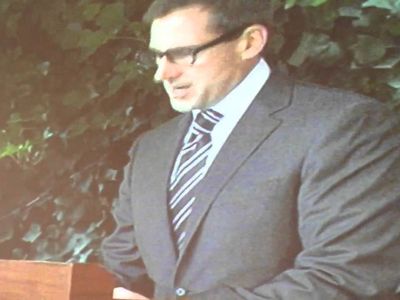
Faculty, parents, friends, family, graduates.
I am extremely honored to be here today. As some of you may know, Princeton is one of the world's great universities. A place of intellectual and artistic excellence, a bastion of knowledge, a football powerhouse.
I don't aspire to change the world with my words this morning.
I think that we all can agree that most of these Class Day speeches are forgotten almost as soon as they are delivered. Witness Brooke Shields, Katie Couric, and especially Stephen Colbert. He is the worst.
I can only hope that this address will resonate for generations to come. That your children, and your children's children, will continue to reap the benefits of what I have sown here today.
I would like you all to do something for me: turn and look at the person on your left. Now turn and look at the person on your right.
What do we learn from this exercise? We learn that nobody looks each other in the eyes anymore.
As human beings, we should naturally crave contact with one another. But sadly, as the world grows more and more technologically advanced, we lose our ability to connect as human beings.
The Internet, texting, tweeting, iMail, email, Gmail, iChat, Facebook, FaceTime, LOL, TMI, BFF, NSFW, OMFG … LMFAO.
When I was in college, I wouldn't “text” a girl to ask her out on a date. I would ask her in person, one human being to another. And when she said “No,” which she always did, I would suffer the humiliation and self-loathing that a young man needs for his, or her, personal growth.
A text does nothing more than protect us. It protexts us, if you will. It keeps us safe. It is like a warm blanket that insulates us from the truth—the truth of how unappealing I was to Amy Miller. Well, look at me now, Amy. Princeton Class Day speaker. Suck on that.
My point is, I suffered. You should have to suffer, too.
When I was in college, we had libraries, with actual books. I had a library card, with which I could borrow a book, take that book home, read that book, eventually forget that I had that book, and then never return that book.
Unlike a Kindle or an iPad, books had a certain smell. A certain feel. They had their own fascinating history. Countless readers before me had touched that book, breathed on it, stuck their gum between the pages. Maybe left Dorito fingerprints. A book was perspiration, and flakes of dead skin, and dandruff. It was the DNA of generations of college students before me. And, like bowling shoes, it's best not to think about it too much. Books were magical then.
When I was in college, if we didn't know something, we didn't Google it. We just made an educated guess, or we made it up. We pretended that we knew, and that was good enough.
If a person believed that they were right, it was just as good as actually being right. And if you weren't right, you could leave before anyone had time to check your facts. Those days are gone now. Everybody knows everything.
I Googled myself this morning. Yes, I know that sounds like a euphemism for something gross … and it should, I suppose, because it too is an exercise in self-love.
So I Googled myself, looked up my name, curious to see what others might be saying about me … and you know what I found? Lies. Conjecture. Half-truths. Then I went on Facebook: more of the same Internet mendacity—groundless accusations, blatant falsehood, gross inaccuracies, hurtful slander. So hurtful, in fact, that I had to take the painful but necessary step of unfriending my 86-year-old mother.
What is her problem?
When I was in college, we didn't have cell phones. We had one dormitory landline. We didn't call home very much. It was expensive and inconvenient.
These days, the modes of communication are many and varied. Kids and their parents are in constant contact.
When I was in college, I would call my parents for three reasons: when I needed money, when I was thinking about changing my major, and when I got a person pregnant.
Today, parents are much more attuned to their children's college experience. But I wonder: is this right? Isn't college supposed to be the time when you go from hating your parents to just simply not caring about them?
When I was in college, we didn't have Facebook; we had the phone book. And we did not use Twitter. We used good old-fashioned gossip. If you wanted to talk about someone, you could do it face to face, right behind their back.
Have we forgotten the beauty of a handwritten letter, lovingly delivered three to six weeks later? Do we no longer need the encyclopedia? Almost 300 pounds of readily accessible knowledge?
We have lost touch with our simpler selves, and by “we” I mean you. You are young … and because of that, you are wrong.
Could we, for just a moment, embrace our analog past? Is it possible to escape the constant barrage of electronic information? Wouldn't it be nice not to receive 17 emails a day from Michael Yaroshefsky?
A few years ago, I bought a tiny, 150-year-old general store in Massachusetts. A Norman Rockwell study. Here, kids buy penny candy and ice cream; their parents drop by for a cup of coffee and to say hello to their neighbors. It is a place of community, a place of true human connection and kinship. When it came up for sale, there was a real danger that this wonderful piece of history would cease to exist, so I bought it.
But I didn't buy it for financial gain. God knows, there's not a lot of money in penny candy. And I didn't buy it to preserve it as a local landmark.
I bought this quaint little anachronism because I wanted people to think I was a really nice guy.
A kind, generous, giving man who cares about history and about the people in this little Massachusetts town. I am not that man, but fortunately, people think that I am.
And that's what we need more of these days: perceived heroes.
Heroism is not about doing heroic things. Heroism is about how heroic other people believe you to be. I could go visit some sick children in the hospital … but if there aren't any cameras there, did it really happen? Who would I really be helping aside from those in need? If a tree falls in the woods and no one is there, does the tree get credit? What does it do for the tree?
Doug Davis is a hero. He scored a buzzer-beating shot to defeat Harvard and win the Ivy League. Do we need to examine Doug Davis's motivations in winning that game? Does Doug Davis strive for excellence selflessly? Or does he do great things for the recognition, the accolades, and the reverence, like a normal human being?
I can't answer that, because I don't know Doug Davis. Doug Davis doesn't even sound like a real name. But I would venture to guess that Doug Davis seeks the love of others because he has not yet learned to love himself.
But that, of course, is purely conjecture.
But I digress.
When I was about to graduate from college, I was preparing to enter law school. I remember that I was filling out my application to Stanford, and I came to the essay question, which was: “Why do you want to be an attorney?” I really had no idea. It sounded good. My parents had worked extraordinarily hard to give me a great education, and I felt that I owed them some sort of valid career choice.
So I sat down with my folks and asked them what they thought, and they proceeded to give me the best advice that I had ever received or would ever receive. Their words were profound, wise, and they completely altered the rest of my life.
They said … something like “blah, blah, blah, follow your dreams, blah, blah, blah.” I don't remember exactly what it was, but I didn't go to law school.
Ultimately, that was the right choice for me. I wouldn't have been happy as an attorney, and they knew it. They also understood that it was my future, my life. They very wisely advised me to do what I knew I already wanted to do. As Harry Truman once said, “The best way to give advice to your children is to find out what they want, and then advise them to do it.”
In conclusion, I would like to leave you with a few random thoughts. Not advice per se, but some helpful hints.
Show up on time. Because to be late is to show disrespect.
Remember that the words “regime” and “regimen” are not interchangeable.
Get a dog, because cats are lame.
Only use a “That's what she said” joke if you absolutely cannot resist.
Never try to explain a “That's what she said” joke to your parents.
When out to eat, tip on the entire check. Do not subtract the tax first.
And every once in a while, put something positive into the world.
We have become so cynical these days. And by “we,” I mean us.
So do something kind, make someone laugh, and don't take yourself too seriously.