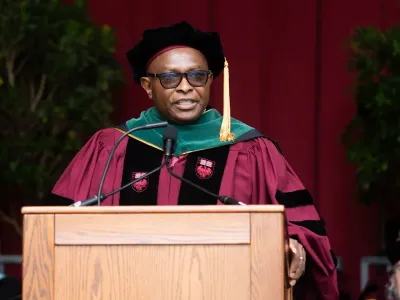
President Alivisatos, Provost Baicker, deans, Board of Trustees, members of the faculty, family and friends: good morning, and congratulations, Class of 2025. It is my great honor to be the first to celebrate you today and to welcome the families, friends and loved ones who helped bring you to this important milestone. Please give yourselves a well-deserved round of applause.
Today, you are graduating from one of the finest universities in the world. I remember being in your shoes—proud, excited and, yes, a little uncertain about what would come next. You are stepping into a world marked by profound uncertainty, a world where the very institutions that foster knowledge, discovery and care are being tested. Longstanding norms are being challenged, and global alliances are being rewritten.
We are living through a moment when truth is contested, science is politicized, and public support for higher education and medical research is no longer guaranteed. The funding streams that have powered progress, saved lives and opened minds face growing threats. But it is precisely in moments like this, when our foundations feel unsteady, that we must recommit ourselves to excellence and forge a stronger future for our country and the world.
Right now, the world needs you. The world needs your voice, your vision and your courage to become advocates—not just for what is, but for what could be. Sitting here today, you are probably thinking: what's next for me? How will I grow, and how will I contribute during such uncertain times? To answer this, I want to offer a few reflections from my own story and a question I have often been asked: how did a kid born 6,000 miles away in Nigeria end up in Chicago, standing before you with the privilege of leading one of the best cancer centers in the world?
I grew up in Nigeria under military dictatorships and unstable democratic civilian governments. My mother was an elementary-school teacher who watched over us with fierce love and high standards. My father was a respected high-school principal who spent his days mentoring students and his nights reminding me that to whom much is given, much is expected. They taught me that no dream was too big, and that true failure was not falling short but failing to try.
My parents' example of discipline and compassion—two universal principles that must be joined for both individual and societal success—sparked a curiosity in me that deepened once I entered medical school. It was in medical school that I took an elective course in immunology. My professor, believe it or not a proud UChicago alum, introduced us to the immune system's remarkable ability to defend the body.
I was struck by the idea that our own immune cells could tell what belonged and what did not; that the immune system could distinguish friend from foe with such incredible precision. Bacteria, viruses, fungi and other parasites are constantly trying to invade us, but our immune system can rapidly understand what, when and how to attack versus what to protect. I did not know it then, but that idea would become the foundation for my life's work.
Over the next 17 years, I embarked on a nonlinear journey that ultimately led me to specialize in gynecologic oncology. My path in the United States began as a resident in obstetrics and gynecology at Yale University School of Medicine. I was an international graduate trainee, and I was warmly welcomed by the incredible faculty, whose mentorship and support were invaluable.
In one example, I was called to the office of my department chair, Dr. Fred Naftolin, to explore a very difficult research question in reproductive biology that could benefit women globally. The question was simple: why does southwestern Nigeria have the highest rate of twin pregnancies in the world? In some parts of southwestern Nigeria, the frequency of twin deliveries is one in 25—one in 25 deliveries are twins.
As I immersed myself in this research question, the amazing experience allowed me not only to showcase my God-given talents, but taught me and exemplified the United States' leadership in tackling humanity's toughest challenges for the greater good. America welcomed me with open arms, changed my life and empowered me to focus on making a difference for others, and to reciprocate the extraordinary kindness I received. That kindness was extended not just to me, but to my entire family—my wife and our three kids.
As I continued my career, I could have chosen any specialty. So why did I focus on cancer? Because it touches all of us. This year alone, two million Americans will be diagnosed with cancer, and there will be an estimated 600,000 deaths. Globally, there are 20 million new cancer diagnoses. In fact, one in four people will receive a cancer diagnosis in their lifetime.
Look around and know that practically everyone here has a friend, family member or colleague who has survived cancer, is currently living with cancer, or has died of it. For me, this is personal. My own father lost his life to this dreadful disease.
I share this not to darken a bright day—in fact, Chicago weather is fantastic today—but to make an important point: even when challenges seem insurmountable, progress is possible. This is as true personally as it is for society. Fifty years ago, a cancer diagnosis was grim and treatment options were few. But today, because of investment in research and science, and federal funding through the National Institutes of Health and the National Cancer Institute, cancer mortality rates in the United States have declined by more than 30 percent in the last 30 years.
In the year 2000, there were eight million cancer survivors in the United States. Today, in 2025, there are 21.6 million survivors. That is the power of excellence. That is the power of science combined with commitment to new discoveries and to each other. That is what becomes possible when we believe that every life matters.
What does that look like in practice? As a clinician caring for patients with ovarian cancer, I always celebrated with them as they completed treatment and went into remission. But deep down, I also felt uneasy, because there was an undeniable truth: there was a 70 to 80 percent chance that the cancer would return within the next 12 to 18 months.
This unease drove me to ask bigger questions of myself. What more could I do to prolong remission or try to prevent relapse altogether? It made me return to what had inspired me in my studies: the extraordinary ability of the immune system to identify and eliminate threats. Could we train the immune system to target cancer? Could we use the body's own intelligence to prevent relapse?
At the time, many doubted this was possible. The field of cancer immunotherapy was on the margins, and the science was dismissed as unworkable and unworthy of funding. But many of us persevered. What we learned, often in small steps, was that the immune system can in fact recognize and fight cancer. It just needs the right tools.
In my research, we were able to develop vaccines that generated immune responses against ovarian cancer and prolonged remission. We were also able to engineer a patient's own immune cells, grow them into large numbers—often billions of these cancer-fighting immune cells—and infuse them back into patients as living drugs. Today, immunotherapy has become a standard treatment option for many cancers, and we are still moving forward.
If there is one lesson I hope you remember from today, let it be this: when I faced a choice between accepting limits and pursuing new possibilities, I chose to push forward. That decision changed my life's trajectory, allowing me to grow not only as a doctor and scientist, but as a human being. By relentlessly pursuing progress, we can free ourselves from past limitations.
You have been shaped by a UChicago education that demands rigorous thought and bold inquiry. It does not promise that you will have all the answers, but it prepares you to ask the right questions and keep asking. Graduation is just the beginning of your education. Your degree is not just a piece of paper; it is a license—a license to keep learning, a license to keep growing, and a license to make a difference.
Since becoming director of the University of Chicago Medicine Comprehensive Cancer Center, I have worked with an incredible team to bring UChicago's values to life. In 2027, we will open a state-of-the-art cancer pavilion, a place where cutting-edge research and compassionate care will exist under one roof. It will be a home for discovery, a home for healing, a place of dignity, and a place that reflects what we can accomplish when we combine scientific excellence with human empathy.
I know these are complicated times, but I believe eliminating cancer will be one of humanity's greatest and least controversial achievements. Therefore, our work continues. There are new cures for cancer that need to be uncovered, new discoveries waiting to be made, and more lives to be saved that were previously unsavable. This will happen when truth is prioritized, science is protected, and people come first.
I want to leave you with a quote from someone who has long inspired me, Winston Churchill. During World War II, Churchill praised the Royal Air Force by saying, “Never in the field of human conflict was so much owed by so many to so few.” Never was so much owed by so many to so few.
Today, our society is at another such inflection point, with truth in conflict with misinformation and understanding in conflict with divisiveness. But when I look at all of you—your promise, your energy, your commitment—I see that same kind of “few” Churchill talked about. In the years ahead, you will be called upon to carry great responsibility. You will be called to lead, to challenge what is, and to reimagine what could be.
You are the few, just as Churchill said, upon whom so much depends, because, as my father reminded me so many years ago, so much has been given to you. When I think of Churchill's few, I think of you—not because you will have to change the future by yourselves, but because I know your education, values and courage have uniquely prepared you to work with and inspire others.
Class of 2025, you have earned your University of Chicago degrees, and it is my privilege to declare that we now hold our highest hopes for you. Go forth. You are unstoppable. Never hesitate to ask why. Follow your dreams, fulfill your commitments to humankind, and beat the odds. Together, you will make this country and the world a better place. Congratulations once again, Class of 2025.