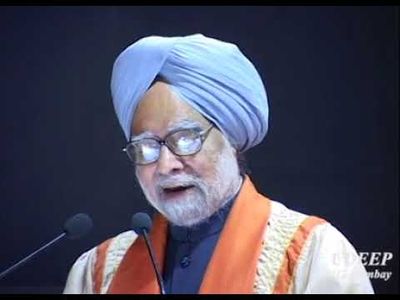
I am delighted to be here at your prestigious institution on this auspicious day. I wish each one of you a life of purposeful action and professional fulfillment. Standing here this afternoon, my thoughts go back to the early days after Independence, when our national leaders built great institutions of learning to help lay the foundations of a new India. The Indian Institutes of Technology were part of this great nation-building effort. I salute the memory of all those who dedicated their lives to building this and other great institutions of academic excellence.
The IITs have become an integral constituent of what is known as “Brand India,” like our nuclear-science institutions to which Dr. Kakodkar has dedicated his life, like Mr. Premji's Wipro and Mr. Narayana Murthy's Infosys, and like so many other centers of research and teaching that have given generations of young Indians opportunities my own generation could only dream of.
Today, as we celebrate the Golden Jubilee of IIT Bombay, we feel a sense of pride. But that pride must be tempered by concern that we still do not have enough such institutions to offer adequate development opportunities to all our bright young women and men.
Every year, when I see how many hundreds of thousands of students apply to these institutions and how high the minimum admission cutoffs have become, my heart is pained by the limits we are placing on the opportunities available to our youth.
That is precisely why our government took the initiative to expand opportunities for higher and technical education in India. During the last eight years, Indian higher education, as well as secondary and technical education, has experienced a quantum jump in investment and in the number of student places created. I compliment my colleague Shri Kapil Sibal for leading this effort.
Our government has opened new IITs, new IIMs, and new institutions for teaching and research in the sciences. We have increased investment in school education and scholarships for disadvantaged sections of society. We have established new institutions across the country so that our children can obtain the best available education closer to home.
One major challenge is to ensure that this quantitative expansion in institutions and places also fosters qualitative improvement in higher education. India currently lags behind many countries in research and development, and we must work much harder to bridge this knowledge gap.
I am happy that IIT Bombay has made research a priority. I am told that several centers at the Institute are engaged in research in important areas. They include the National Centre for Photovoltaic Research and Education, the one-megawatt National Solar Thermal Test Facility, and the Indo-US Clean Energy Centre for Photovoltaics. I am sure these efforts will produce very useful results.
As India's economy grows larger and more developed, so too must our knowledge base. A developing country like ours has to catch up with more developed nations, and this process depends vitally on our ability to harness human resources for development.
Another challenge is to ensure that our investment in higher education contributes more directly to nation-building. Here the IITs face the immediate task of making their curricula more relevant to our needs. I know this is the subject of lively discussion among your faculty and alumni. How do we encourage engineering graduates to apply their professional knowledge more directly to development?
That would be in keeping with the vision for the IITs articulated by Pandit Nehru when he laid the foundation stone of IIT Bombay. He said that their role would be “to provide scientists and technologists of the highest caliber who would engage in research, design and development to help build the nation toward self-reliance in her technological needs.”
Over the years, many of our best IIT students have migrated abroad in search of better opportunities. I do not grudge that. Some have returned home to serve our motherland; others serve it from some of the world's finest institutions. Many IIT graduates also move away from their core disciplines into management, finance, marketing, and even the civil services. Without doubt, they have much to contribute in those new fields.
The students graduating today have a long list of IIT Bombay alumni to inspire them. Each of the preceding forty-nine convocations produced a very talented group of young women and men. They have contributed across many disciplines and added luster to India's global image.
Several have risen to leading international positions, including Arun Netravali, former head of Bell Laboratories, and Nitin Nohria, then Dean of Harvard Business School. One of our brightest Cabinet ministers, Shri Jairam Ramesh, is an IIT Bombay alumnus, as is Shri Nandan Nilekani, who carried the enormous responsibility of implementing India's ambitious program to provide every citizen with a Unique Identification number.
India needs millions of engineers and millions more technically qualified workers and skilled professionals. There was a time when engineers such as M. Visvesvaraya and K. L. Rao led our power and irrigation projects and were regarded as national leaders. Today India needs national leaders from engineering and science—not only from politics, sport, and cinema.
Friends, India is on the move, and you enter a world of opportunity. How you use these opportunities, how you shape them, and how you create new opportunities for later generations of young people will shape the future of this ancient land.
I know that recently we have lived through a period of excessive pessimism and negativity. Some of this is natural. Our society is experiencing a “revolution of rising expectations”: hopes are high but often unrealized, and that breeds cynicism. Your challenge is to retain hope and optimism while surmounting the obstacles you face.
When I look back on my own life, I am humbled and gratified by how far my generation has traveled. I studied by the light of a kerosene lamp in a dusty village with no electricity, school, or college, and I walked miles to school. In all these respects there has been enormous improvement during sixty-five years of independent India.
Even so, our progress has often fallen short of people's expectations, especially those of the young. The scale of the task before our nation is daunting, but what we have achieved gives us confidence and hope.
India's journey—and IIT Bombay's—over the past sixty-five years is a matter of great pride. After half a century of zero economic growth from 1900 to 1950, we registered growth of 3.5 percent for three decades after Independence, from 1950 to 1980. From 1980 onward, over the next three decades, we nearly doubled that rate. Between 2003 and 2008, we showed that India could advance at the still higher rate of 9 percent.
These are not just numbers. They become employment opportunities for new generations, create income and possibility, and increase government revenues so that we can invest more in education and health care and in eradicating poverty, hunger, disease, and illiteracy.
I know that India's economy slowed during the past year, but this is neither inevitable nor irreversible. The fundamentals are sound. With greater effort to mobilize our latent physical and human resources, we can return to the annual growth rate of 8 to 9 percent achieved from 2003 to 2008. The large investments we have made in human-resource development over the last eight years will help make that possible.
Science and technology must play a major role in transforming our economy. The country's educated youth must lead social and economic change. I am confident that young people like you will take the flag from our hands and march forward. I am confident that your generation will make us proud, and I am confident about India's future because you are that future.
As you enter a new phase of life, never forget those who made it possible for you to be here today: your parents, family and friends, your teachers, and the society around you that enabled you to receive a good education and build the foundation of your professional life.
May your path be blessed. Jai Hind!