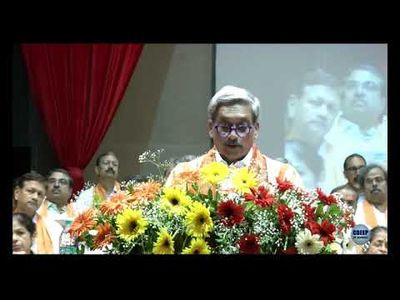
Respected Dr. Yusuf Hamied, Shri Dilip Sanghvi, Professor Margaret Gardner, members of the Board of Governors and Senate, teaching and non-teaching staff, patrons, friends from the media, parents, and most importantly graduating students—my greetings to you all. Growing up in a middle-class family in a small town in Goa, I never imagined I would graduate from this prestigious institute. When I did, I never imagined I would one day deliver its convocation address. It took me thirty-nine years to return in this role, and I hope many of you will do so much sooner.
At a young age I absorbed a deep commitment to discipline, work ethic, integrity, simplicity, and patriotism, which I attribute to my association with the RSS. But IIT fired my imagination, expanded my sense of capability, and opened gates of possibility. I cannot know how life would have unfolded without my fulfilling, eventful, adventurous years on this campus and in Hostel Four. Life would not have been the same.
On a lighter note, many people now know that I lived in Hostel Four. Whenever an IIT Bombay alumnus comes to meet me, the first thing he tells me is that he too lived there—regardless of which hostel he actually occupied.
The world I entered as a new IIT graduate was vastly different from the one you enter. During my first year, Steve Jobs had not founded Apple and Bill Gates had only begun writing his first software in BASIC. Today, even the handheld devices of junior employees possess computing power that would have astonished NASA's senior scientists then. This journey reflects humanity's immense progress over forty years, and India too has advanced significantly.
Technology has transformed medicine, communication, shopping, banking, and government. Doctors can operate on patients miles away. Twenty years ago, a call from Mumbai to Pune required a trunk connection and shouting; today, we can video-chat almost anywhere at negligible cost. The next ten years, let alone forty, are impossible to predict because change is accelerating. Professional requirements will change just as rapidly. Jobs unknown a few years ago are now in demand, while many current jobs will vanish. You must continuously develop your skills to remain relevant and competitive.
Yet rapid change has left many people almost untouched. Old challenges persist, new ones have emerged, and technology has not transformed the lives of millions for whom a mobile phone still seems magical. If we do not bridge the digital divide, we will jeopardize the progress we seek.
India has primary-school enrollment of about 97 percent among children aged six to fourteen, yet 24 percent of Class V children cannot read simple English sentences, 57 percent of Class III children cannot read Class I text in their own language, and 74 percent of Class V pupils cannot solve simple division. Primary education determines the nation's future. Early learning gaps are difficult to repair, and poor learning outcomes are, in my view, India's greatest challenge because they weaken our foundation.
Health care is another major challenge. Gandhi said true wealth is not gold or silver but good health; that is true of nations as well as individuals. The health of our citizens, especially women and children, needs significant improvement. Malnutrition is widespread, and India has about fifty million people with diabetes—more than the population of 206 countries. The World Health Organization estimates that high blood sugar causes nearly 3.4 million Indian deaths each year, imposing enormous economic and opportunity costs.
Environmental problems are also grave. Delhi's Yamuna inspires disbelief and disappointment. Chennai has a seventy-two-kilometer open channel carrying sewage through the city and damaging soil and groundwater. Across India, perennial rivers have become seasonal or vanished. Dams and reservoirs are partly filled, and per-capita water availability has fallen from three thousand to 1,123 cubic meters, compared with a global average of six thousand.
Air quality in parts of India is far beyond danger levels. When I was young, urban air quality was hardly discussed, but as Defense Minister in Delhi I saw many people wearing masks to filter the air. With water sources declining and air quality deteriorating, how will we face the future?
Another concern is the absence of reasoned debate about development. As Goa's Chief Minister in 2012, I initiated what became one of India's best solid-waste plants, with three more state-of-the-art facilities planned. The site had been a foul, polluting dump for more than two decades, yet people protested the cleanup and plant on environmental grounds. How could a facility that processes garbage into biofuel and biofertilizer threaten the environment? Today there is no foul odor even inside, dignitaries visit it, and schoolchildren tour it daily.
This is how technology can address national and environmental problems. Fear of the unknown naturally produces resistance, but we must explain technology's transformative power. Technology and sound policy can also bridge rural-urban gaps in physical and social infrastructure. Development is not the birthright of urban elites; rural India, where most people live, urgently needs an equitable share.
Development in rural areas faces many obstacles even though young people in smaller cities have the same aspirations as those in Delhi or Mumbai. Environmental protection matters, but opponents of rural development must recognize the consequences of inequality. Only about 2 percent of doctors serve rural areas, where 68 percent of Indians live, even though many doctors were educated with taxpayers' money. Rural citizens also need doctors, roads, infrastructure, and opportunity.
Agriculture presents another challenge. About 47 percent of India's workforce produces only 16.5 percent of GDP, and agriculture's share will decline as the economy grows. If its labor share remains unchanged, inequality will worsen. Small landholdings deny many farmers economies of scale, while most agricultural workers own no land and farm because no other opportunity exists. Mechanization, necessary to meet the goal of doubling farm income, will also displace labor.
How will we meet those workers' employment needs and aspirations? Romanticizing poverty and flawed development policy have prevented alternatives. The World Bank estimated that 68 percent of Indians lived on less than $3.10 a day. We cannot free them from this trap without models of equitable development.
Democracy is one of India's greatest strengths, but it is both an art and a science with its own method. In many failed democracies, democracy and development did not advance together, producing exploitative systems. Except for the two-year Emergency during my IIT days, India has preserved democracy's spirit for seventy years. Yet elected governments have sometimes sacrificed development to politics and power. Many of our problems originate in a lack of commitment to governance and development.
Democratic development has a price, and part of it is patience. Development is complex and requires balancing multiple, sometimes conflicting interests. Demands for instant results often derail reform. Long-term change cannot be judged instantly, and what comes quickly can also disappear quickly.
Democracy is not merely politics, politicians, and power; it is people, participation, and purpose. Citizens should not cede their central role to politicians and then expect miracles. They must participate maturely and pragmatically, demanding accountability and transparency while providing leaders space and support to succeed. Reckless opposition based on political preference is not responsible citizenship, and in wishing for a leader or party to fail we must not inadvertently wish for India to fail.
Social inclusion is another major challenge. India has many marginalized groups, and marginalization is more complex than religious or caste identity. Reducing empowerment to tokenism and identity politics often worsens the problem. Dalits and tribal communities have been historically marginalized, a truth we must acknowledge and correct. Beyond them, economics is another vital lens: poverty is indifferent to caste and religion, and economically marginalized people must be brought into the mainstream.
We must also integrate women into every sphere. Women are among our greatest social and economic strengths. As Swami Vivekananda emphasized, discriminatory treatment of women contributed to India's decline; we must reverse it completely.
Technology creates challenges even as it enables progress. Cars are becoming driverless, factories use robots, farms will require fewer farmers, and surgeries once requiring four or five doctors may now need one or two with robotic tools. If doctors can become redundant, almost any professional can. How will we find work for the millions of young people emerging from educational institutions, and what will be the social consequences?
Population is another major issue. India had 1.36 billion people and was expected to become the world's most populous nation by 2022. Having 65 percent of citizens under thirty-five is a great strength, but much growth occurs in low-income groups with limited access to quality education and health care. With 18 percent of the world's population on about 2.4 percent of its land, excessive growth consumes resources needed for development.
Balance is necessary, but it must not be coerced by the state; citizens themselves must own it. Enforcement such as one-child policies has failed. The challenge is to create a bottom-up, nationwide consciousness about population balance.
Skill development is equally urgent. Only about 2 percent of India's workforce was skilled, compared with 54 percent in Singapore, 49 percent in Israel, and 42.2 percent in the United States. One report said 80 percent of Indian engineers were unemployable. Some might have been better served by developing employable skills rather than earning engineering degrees. A degree is not an end in itself.
The skills shortage produces both unemployment and a lack of talent for companies serving domestic and international markets. In earlier times, parents and masters transmitted skills to children and apprentices; today we lack such a system. Prime Minister Narendra Modi has placed strong emphasis on skill reform, and the IITs must help raise India's skill level.
These problems cannot be solved only by gray-haired men in corridors of power. Answers must come from young minds like yours—not only in dinner conversations or social-media posts but through your career choices. Many of you will attend leading business schools or become technology entrepreneurs, investment bankers, or Fortune 500 executives. Some should choose less glamorous, lower-paid, often thankless but deeply meaningful and high-impact paths.
Speaking of thankless work, I remember serving as mess coordinator at IIT. If the food or menu went wrong, students complained loudly; when things went well, no one offered appreciation. There I learned that public service is thankless but important. We should practice it in the spirit of Karma Yoga, doing our best without expecting reward.
In three days India would enter the seventieth year of independence. What we do over the next five years would determine the India seen at the seventy-fifth anniversary. I urge you to choose careers that profoundly improve our social landscape.
India has many engineering colleges, but most produce graduates with few employable skills. Why should IIT graduates, who received the country's best engineering education, not enter academia, lead these colleges, and transform their quality? Why not run schools and improve primary learning? Teaching is a nation's most important profession. IIT graduates should commit to social causes, and some should join the Armed Forces, whose role in peaceful development and security requires bright minds.
Some of you should enter politics and government. I am often called India's first IIT-educated Chief Minister. That gives me personal pride but should concern the institution: why have the IITs not trained more people for one of the nation's most important jobs? If you think politics is too dirty to enter, that is precisely why you should enter it.
For those seeking deep challenges, this is the best and most exciting time to contribute to nation-building. Do not complain. Every reason for complaint also contains a hundred opportunities to become excited about one great idea and commit to it.
Patanjali wrote that when a great purpose or extraordinary project inspires you, your thoughts break their bonds, your mind transcends limitations, and you discover yourself to be far greater than you dreamed. Take up one great idea and work on it for five years, if not for life. See how the work transforms not only the nation but also you.
Determined, intelligent, consistent participation can make a difference in many areas, gathering momentum and attracting like-minded people until it becomes a movement. In 2012, a young woman from Nagaland named Temsutula Imsong came to Varanasi and was distressed by filth along the Ganges. She began cleaning alone; her effort grew into a movement, restored ghats dirty for decades, and expanded into education about separating waste at source and composting.
Goa was preparing India's first biogas bus, fueled by local garbage, and aimed within two years to power much of public transport with household waste. Source separation is essential to this effort and to Swachh Bharat. Every Indian household should separate its waste. If even 20 percent of you adopt a noble cause in education, health, environment, governance, or another public field and innovate with commitment, no force can stop India's transformation.
Do not limit yourselves to obvious, glamorous careers or define entrepreneurship only by high valuations, stock options, NASDAQ, and Forbes. Give it a powerful social dimension. As global challenges grow more complex, the IITs have a moral duty to provide enterprise and intellectual firepower. By IITs I mean not their walls, but minds shaped within them. The Bhagavad Gita says that whatever great people do, others follow; whatever standards they set, the world pursues. You are sparks of this Institute's greatness, so set high standards and pursue them relentlessly.
You will not discover those standards easily. Identify what interests you and gives life meaning, then enter it boldly. The process is iterative: take risks and be ready to fail many times before succeeding. Successful people share long lists of failures; the path to success usually passes through failure. Do not fear it.
Graduates of prestigious institutions often fall into a self-created image trap: believing that because of our reputation we cannot fail. That makes us less prepared for failure and less respectful of it. If failure troubles you, set goals so high that even failing in the attempt counts as success.
Never let association with a prestigious institute create arrogance, ego, elitism, or superiority. This education is the nation's contribution to our lives, a truth that should make us humble and responsible.
Finally, a nation needs a strong binding force. The more valuable the pearls, the stronger the string must be. India's proud past, present, and future can be joined only by patriotism. Discuss, debate, and disagree as much as you wish, but when you act, keep the nation first. Go forward, be the change, serve society, and leave indelible footprints. Jai Hind.