Today is August 11. One hundred and ten years ago, Khudiram Bose made the supreme sacrifice on this day for the motherland. I bow to that brave revolutionary and pay homage to him on behalf of the country. Those who sacrificed their lives and everything they possessed for freedom became immortal and a source of inspiration.
We did not have the good fortune to sacrifice our lives in the freedom struggle, but we are fortunate that we can live for a free India and experience a new joy by dedicating our lives to nation-building. The confidence and enthusiasm I see on your faces today assure me that we are moving in the right direction.
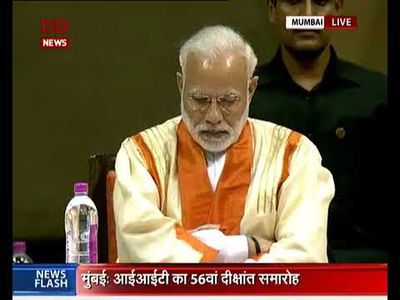
Friends, IIT Bombay is among the institutions of free India that were conceived to give nation-building a new direction through technology. You have pursued this mission consistently for the last sixty years. A journey that began with one hundred students has now reached ten thousand, and in that time you have established yourselves among the world's leading institutions.
The Institute is celebrating its diamond jubilee, but even more important are the diamonds sitting before me today: those receiving degrees and those who, after graduating from here, are making India proud across the world. I sincerely congratulate all the Indian and international students receiving degrees, as well as their families.
Today IIT Bombay has awarded Dr. Romesh Wadhwani the degree of Doctor of Science, and I convey my best wishes to him. Throughout his life, Romesh Ji has worked to connect technology with the needs of ordinary people. Through the Wadhwani Foundation, he has taken on the great task of creating an environment for employment, skills, innovation, and entrepreneurship. As an institution, you can take pride that many graduates like Wadhwani Ji are contributing actively to the country's development.
IIT Bombay's sustained work over the last six decades has earned it a place among the country's selected Institutions of Eminence. You have just been informed that you will receive financial assistance of one thousand crore rupees for developing the Institute's infrastructure. I congratulate you and the entire team on this achievement.
The nation is proud of the IITs and of what IIT graduates have achieved. Their success inspired the creation of engineering colleges across the country and helped India become one of the world's largest pools of technical talent. The IITs built Brand India globally over many years. Their graduates went to America and excelled first as university students and then as technologists, entrepreneurs, executives, and academics.
Many IIT students built India's information-technology sector brick by brick—or rather, click by click. Indians in IT were once known as hardworking and intelligent mainly in other countries, especially the United States. Now India itself has become a destination for IT development.
Today IIT graduates are at the forefront of some of India's best start-ups, including ventures solving national problems. Those already in the start-up movement, or planning to launch a company after college, should remember that today's largest corporations were yesterday's start-ups, born of idealism combined with hard work and diligence. Keep going, do not give up, and you will succeed.
You have been fortunate to live on a campus like this, in a city like Mumbai—with a lake on one side, hills nearby, and sometimes crocodiles and leopards sharing the campus.
It is still August, but I am sure the mood is indigo today. The last four years must have been a wonderful learning experience: college festivals, inter-hostel sports, student-faculty associations, and, yes, some study as well. You have received the best our education system can offer. Students from different states, languages, and backgrounds come together here in the pursuit of knowledge and learning, representing India's diversity.
Friends, IIT Bombay is among the institutions working on new technologies for a New India. Innovation and new technology will determine how, and how far, the world develops over the next two decades. The role of IITs is therefore extremely important. Whether in 5G broadband, artificial intelligence, blockchain, big-data analysis, or machine learning, these technologies will be crucial to smart manufacturing and the vision of smart cities.
The new building to be inaugurated shortly will be important in this effort. It will house the Department of Energy Science and Engineering and the Centre for Environmental Science and Engineering. Because energy and the environment are among the greatest challenges facing India and the world, I am confident that an excellent research environment in these fields will soon be created here.
I have also been told that the building will include a solar laboratory to support research in solar energy. Biofuel, alongside solar power, will be a major source of clean energy in the coming years. As I said in Delhi on World Biofuel Day, the technology of this field should be taught and researched in engineering institutions large and small.
The country and the world know IITs as the Indian Institutes of Technology, but for us their definition has changed somewhat. These institutions are no longer confined to studying technological subjects; today the IITs have become India's Instruments of Transformation.
When we speak of transformation, IITs are a major source of the start-up revolution now advancing across the country. The world regards them as a nursery of unicorn start-ups—ventures taking off in India that may one day be worth more than a billion dollars. They embody technologies in which the world sees the future. Dozens of the world's billion-dollar start-ups were founded by IIT graduates, and today I see before me many founders of future unicorns.
Innovation and enterprise will be the foundation stones of India's development into an advanced economy. They can sustain long-term, technology-led growth. That is why we launched programs such as Start-up India and the Atal Innovation Mission, whose results are now visible. India has become the world's second-largest start-up ecosystem. More than ten thousand start-ups have been nurtured, and extensive arrangements have been made to fund them.
India has also been moving steadily upward in the Innovation Index, showing the world the results of our holistic approach from education to the wider environment. Special attention has been paid to higher-education infrastructure, scientific temper, and an environment for research. Innovation is the buzzword of the twenty-first century. Any society that does not innovate will stagnate. India's emergence as a start-up hub shows that the drive to innovate is strong, but we must build further and make India the most attractive destination for innovation and enterprise.
Government effort alone cannot do this. It will happen through young people like you. The best ideas do not come from government buildings or fancy offices; they arise on campuses like yours, in young minds like yours.
My appeal to you and to other young people is: Innovate in India, innovate for humanity. From mitigating climate change to raising agricultural productivity, from cleaner energy to water conservation, and from combating malnutrition to managing waste effectively, let us affirm that the best ideas will come from Indian laboratories and Indian students. For our part, we are doing everything possible to foster research and innovation.
Over the last four years, seven new IITs, seven new IIMs, two IISERs, and eleven new IIITs have been approved. A program called RISE—Revitalizing Infrastructure and Systems in Education—has been launched, with a target of mobilizing more than one lakh crore rupees over four years. New institutions and infrastructure are essential, but the skilled people created there are even more important, and the government is giving them close attention.
Our campuses currently train nearly seven hundred thousand engineers, but some graduate with degrees alone because their skills have not developed as expected. I appeal to the professors and experts here to consider how quality can be improved and to offer recommendations. Ensuring not only quantity but quality is our collective responsibility, and the government is also working toward that goal.
You may know of the Prime Minister's Research Fellows scheme, under which resources are provided to one thousand talented engineering students for research and selected students can enter leading institutions such as the IITs and IISc for doctoral work. The fellowship offers an excellent opportunity to pursue research while remaining in India, and IIT Bombay students should take advantage of it.
Friends, those present here today are either teachers or future leaders. You will work in policy-making for the country or for institutions. Having prepared yourselves for new start-ups through technology and innovation, you will certainly have a concrete vision of how to proceed.
Giving up old ways is not easy, whether for society or for systems of governance. Imagine how hard it is to persuade habits formed over thousands of years, and systems operating for hundreds of years, to change. Yet when dedication, motivation, and aspiration stand at the center of thought and action, every obstacle can be overcome.
The government is working with the aspirations of millions of young Indians in mind. I ask you to cast away the dilemma of whether you will succeed or whether you should act, and focus instead on your aspirations. High goals and expansive thinking inspire you; indecision confines your talent.
Aspiration alone, however, is not enough: setting a goal is also essential. Those graduating today, and those who will graduate in the years ahead, will join existing institutions or lay the foundations of new ones. I hope that in every such endeavor you will consider the needs of the country and its people. There are many problems, and you can find solutions to them.
The government stands beside every effort and every idea that can improve the ease of living for 1.25 billion citizens. That is why, whenever I speak with students, scientists, and entrepreneurs like you, I discuss city-based science clusters around institutions such as the IITs. The idea is to let students, teachers, people from industry, and start-ups work and conduct research and development together according to one another's needs.
Consider the part of Mumbai where your Institute is located. I am told that Greater Mumbai has nearly eight hundred colleges and institutes, with about nine hundred thousand young people studying in the region. As we gather for this convocation in IIT Bombay's diamond-jubilee year, I would like to connect you with a solemn pledge: can IIT Bombay become a city-based center of excellence?
You know that the government has given the Indian Institutes of Management greater autonomy through legislation and emphasized a more active role for their alumni, including representation on their boards of governors. Institutions like the IITs should consider similar measures to benefit from their alumni.
Alumni would gain an opportunity to do more for their alma mater, while their knowledge and experience could help the institution reach new heights. Every student before me is a future alumnus or alumna, and IIT Bombay alone has more than fifty thousand alumni whose strength can be put to use.
Friends, you have worked extremely hard to reach this point. Some classmates will have arrived after struggling against deprivation. You have remarkable ability and are receiving excellent results today, yet millions of equally hardworking young people could not reach this place—not because they lack talent, but because they lacked opportunity and guidance.
By mentoring them, you can bring new light, energy, and spirit into many lives. It would be even better if IIT Bombay developed an outreach program for nearby schools and brought children onto campus to inspire them toward scientific research. The Atal Tinkering Labs program is already introducing schoolchildren across the country to technologies such as artificial intelligence and 3D printing. School outreach would support that mission, and perhaps those young minds will sometimes inspire older people like us, and all of you, with their new ideas.
The degree awarded to you today symbolizes your dedication to your goal. Remember that it is only a milestone; the real challenge awaits you in the outside world. Your families' hopes, the hopes of 1.25 billion fellow citizens, and your own hopes are attached to everything you have achieved and will achieve. What you do will help build the future of new generations and strengthen the New India.
May you succeed in fulfilling those millions of expectations. Once again, I offer you my best wishes and congratulations. I am grateful for the opportunity to spend time among you. Thank you very much.