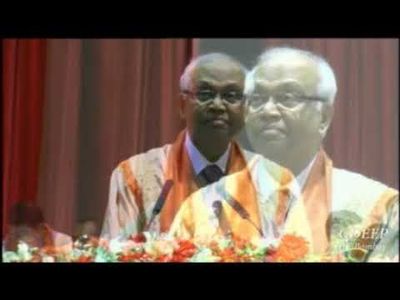
It is a rare privilege and a great honor to deliver the convocation address at one of the world's most admired institutions. IIT Bombay has shown how great ambition, combined with the right environment, can create a world-class institution that reaches unusual heights of excellence and relevance.
My association with IIT Bombay is long-standing. I once served on its Board of Governors, played a small role in creating the Shailesh J. Mehta School of Management, and participated in forming and developing the admired IITB-Monash Research Academy, whose Research Advisory Council I now chair. I am pleased to acknowledge my friend Professor Alan Finkel, Chancellor of Monash University, and our Monash colleagues here today.
I begin by congratulating today's graduates. India's image is changing from that of a third-world country to potentially the world's third most powerful country, and you will build that future India. You enter a world that is exciting and challenging: a VUCA world—volatile, uncertain, complex, and ambiguous. Fortunately, your alma mater has equipped you with the skills and tools to face it confidently.
You have an inspiring past and an even more inspiring future. Graduates of this institution include iconic achievers from Nandan Nilekani to Nitin Nohria, Kanwal Rekhi to Manohar Parrikar, and Arun Netravali to Narendra Karmarkar. IIT Bombay has integrated education, research, and innovation seamlessly. Education disseminates known knowledge; research creates new knowledge; innovation converts knowledge into wealth and social good.
I want to place a new challenge before the class of 2014. Making high technology work for the rich is easy, and making low technology work for the poor is easy. Making high technology work for the poor is difficult. I urge you to take up that challenge, which can change the game not only for India but for the whole world.
Let me begin the innovation story with what I said when I received the J. R. D. Tata Corporate Leadership Award in 1998. I called for a powerful national innovation movement and said the “I” in India should stand not for imitation and inhibition but for innovation; the “I” in IIT, industry, and every individual Indian should also stand for innovation. Only an innovative India could show the world that we were not a hesitant nation unsure of our place, but a confident one ready to claim its rightful position among nations.
I am happy to see a nationwide innovation movement spreading. Government policy evolved from the Science Policy Resolution of 1958 to the Technology Policy Statement of 1988, the Science and Technology Policy of 2003, and the Science, Technology and Innovation Policy of 2013. The years 2010–2020 were declared India's Decade of Innovation.
The Prime Minister's National Innovation Council, of which I was a member, helped establish thirty-one innovation councils in states and union territories. Industry has also created bodies such as the Reliance, Thermax, and KPIT Technologies innovation councils, which did not exist five years earlier.
Yet India's international innovation ranking sends a mixed message. India fell in the World Innovation Index from 64th in 2012 to 66th in 2013 and 76th in 2014. At the same time, Indian innovation changed the vocabulary of innovation: terms such as inclusive, reverse, frugal, and Gandhian innovation, scarcely used five years earlier, now shape worldwide discussion. Kevin and Jackie Freiberg even wrote Nanovation about the Tata Nano—not nanotechnology, but India's ability to innovate under constraints.
Why, then, did the index fall? As a member of its International Advisory Board, I have argued that current measures may not fully reflect a nation's true innovative capacity. The index uses research spending as a share of GDP, high-technology exports, per-capita electricity use, and ease of doing business—areas where India performs poorly—and focuses largely on technological innovation. It overlooks game-changing business-model, workflow, delivery-system, and organizational innovations in which India excels.
It also counts innovation by formal systems for people but not grassroots innovation by people for people. The National Innovation Foundation, which I chair, lists more than two hundred thousand grassroots innovations, yet none counts in the index. Understandably, the index needs measurable inputs and outputs, but we must go beyond current methods to assess genuine innovative capacity.
Can we make a high-quality hepatitis B vaccine that costs twenty dollars per dose available for forty times less, not merely 40 percent less? Can a ten-thousand-dollar artificial foot cost three hundred times less? Can cataract surgery cost one hundred times less than three thousand dollars? Can a ten-thousand-dollar electrocardiogram machine cost twenty times less? Incredible as it sounds, Indian innovators have achieved all these apparently impossible feats. A new term, “Indovation,” has begun to circulate.
Such Indovation achieves what appears impossible: affordable excellence. We usually assume that affordable things cannot be excellent, and excellent things cannot be affordable. Indian innovators have shown a special talent for making the impossible possible.
Let me illustrate with the Anjani Mashelkar Inclusive Innovation Award, created in my mother's name. It recognizes technology that includes millions of resource-poor people, provided it represents affordable excellence and is not merely “best practice” but “next practice.” One award went to the twenty-eight-year-old innovator Myshkin Ingawale. He learned that village women were dying of anemia because low hemoglobin levels were not detected in time, partly because many were reluctant to give blood.
Ingawale set out to create a non-invasive diagnostic tool, something never achieved before. Using photoplethysmography, spectrophotometry, and advanced photon-scattering software, he created ToucHb. This was technological excellence based on cutting-edge science, not jugaad. He also reduced the cost per test from one hundred rupees to ten, achieving affordable excellence.
ToucHb was technological innovation, but affordable excellence can also be non-technological. Aravind Eye Care performs ultra-low-cost cataract operations at quality exceeding international benchmarks by redesigning workflow and using scarce, highly paid surgeons more efficiently: instead of one surgeon performing every step, each professional carries out a specific task.
The Aravind model has spread to seventeen countries. Similar workflow innovations allow Narayana Hrudayalaya Hospital in Bangalore to perform open-heart surgery for about three thousand dollars, with success rates matching Western hospitals. Its affordable-excellence model was soon to be deployed in a two-thousand-bed hospital in the Cayman Islands.
Here is the challenge for IITians. Affordable excellence does not mean producing cheap, low-performance copies of technologies from rich countries for poor consumers. Can you harness sophisticated science and technology—or truly creative non-technological innovation—to provide quality goods and services affordable to many, not only a privileged few?
In cost terms, getting “more from more” is easy, and getting “less from less” is easy. The latter is the jugaad that has sometimes damaged Indian innovation's reputation: cost becomes the only consideration, with insufficient regard for safety or the environment. That is not my vision of India. IITians must accept the challenge of getting “more from less for more people,” not simply more profit.
The late C. K. Prahalad and I described this “More from Less for More,” or MLM, paradigm in our July–August 2010 Harvard Business Review article, “Innovation's Holy Grail.” It was the last paper written by the legendary C. K. The article explained how scarcity combined with aspiration helped India develop its own innovation model. It sparked worldwide debate, and only six months later the World Economic Forum held a special session on the idea.
Four contextual strengths helped India build affordable excellence. First, four decades of socialist policy kept out much foreign capital and technology but stimulated local innovation. India developed low-cost nuclear weapons, space-launch vehicles, and supercomputers and retained the habit: the Mangalyaan Mars mission cost about eighty million dollars, not a billion. During the thirty minutes of this address, it would travel roughly six thousand kilometers toward Mars.
Second, because the Indian economy did not begin growing rapidly until the 1990s, local firms remained small and learned to undertake small projects with extraordinary capital efficiency—a good habit formed in hard times and retained in better ones. Third, firms knew that serving only the rich would restrict their market. They targeted aspiring middle-class families living on about five thousand dollars a year and were forced to create products spanning the entire economic pyramid.
Fourth, and most important, was India's innovation mindset. Some leaders dared to question conventional wisdom. Tiny research budgets, small scale, low prices, and great ambition created a need to think and manage differently. Extreme scarcity combined with extreme aspiration ignited Indian innovation.
Affordable excellence is now spreading worldwide. My TED talk on the subject quickly received more than half a million views. Emerging economies are interested because income inequality between the top and bottom of the economic pyramid is increasing and causing social disharmony. Reducing that inequality will take generations, but we can still create equality of access to education, health, communications, financial services, and more. Innovation that produces affordable excellence offers a path.
The clearest example is the spread of more than nine hundred million mobile phones to slum dwellers, rickshaw drivers, and others. This revolution combined policy, technological, and uniquely Indian business-model innovation. The European Commission invited me to prepare a strategy paper on organizing inclusive innovation for accelerated inclusive growth. At an EU conference in Brussels, my appeal was summarized as using affordable excellence to create the magic of access equality despite income inequality—a need shared by Europe, India, and China.
The European Union was considering affordable excellence for its Horizon 2020 program after recognizing that quality, sustainability, and affordability together—not only quality and sustainability—would shape competitiveness. General Electric CEO Jeffrey Immelt likewise warned that if established firms did not develop innovations in poor countries and take them global, emerging-market competitors would.
Examples were already visible. Mahindra & Mahindra sold small tractors to American hobby farmers, challenging John Deere. China's Haier sold products such as a wine cooler for half the leading price and captured 60 percent of the U.S. market within two years. GE responded with “reverse innovation”: its portable Vscan ultrasound, developed in China, cost about fifteen hundred dollars instead of twenty thousand and succeeded in rich and poor countries alike.
GE Healthcare's Bangalore team also built a high-quality portable ECG machine for six hundred dollars rather than the standard ten thousand. Many companies are pursuing affordable excellence, and leading academics have joined them. Harvard researchers led by George Whitesides created a twenty-five-dollar detector for health workers in the world's poorest regions to monitor diabetes, detect malaria and pollutants, and perform tests normally requiring machines costing thousands.
These are our problems. Why should we wait for MIT, Harvard, or Stanford to solve them? Looking at the talent before me, I know our IITs can do it. Did we not create Aakash, the thirty-five-dollar tablet? We did. We should do more. IIT Bombay's mandate is “excellence and relevance,” and relevance must be directed toward affordable excellence. Contrary to popular belief, relevance and excellence can coexist: Whitesides's twenty-five-dollar sensor appeared in one of the world's leading scientific journals.
I greatly admire Techfest, IIT Bombay's student-organized festival that has captured young innovators' imagination in India and abroad. I suggest that Techfest 2015 adopt a single theme: affordable excellence. For two years I have presented the Gandhian Young Technological Innovation Awards through a national competition and personally witnessed young people's power to apply cutting-edge technology to affordable excellence.
An innovator has been defined as someone who does not know that something cannot be done—and young people do not know that it cannot be done. Give India's youth challenges in affordable excellence, and they will show how the impossible becomes possible. Techfest should begin such an event and help create a national movement.
I remind the class of 2014 that our dream is not about “some Indians” doing well, but India doing well. It is not only about creating “value for money” but “value for many,” and about moving rapidly through affordable excellence toward a truly inclusive society.
Affordability brings equity; excellence brings competitiveness. Affordable excellence can put smiles on the faces of all seven billion people, not only a few. I urge the class of 2014 to accept this grand challenge.
There is no limit to human imagination or achievement. Your climb up the limitless ladder of excellence will take you to unparalleled heights if you place no limit on what you imagine you can achieve. Together with the spirit of “Yes, I can,” this will enable you to achieve so much that you, your family, your alma mater, and your country will be proud. I extend my best wishes for this exciting journey.