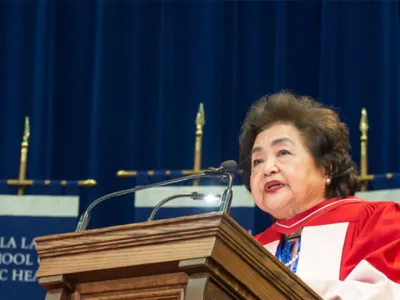
Chancellor Patten, President Gertler, Dean Mishna, Dean Brown, distinguished guests and the graduating Class of 2019: I thank you from the bottom of my heart for the honour of receiving an honorary degree from this great institution, which I am very proud to call an alma mater.
To the graduating class, my heartiest congratulations on this great achievement. Your hearts must be filled with joy and pride, along with deep gratitude to those who gave you loving care and support, and to your professors for the knowledge and wisdom they imparted to you.
As a young teenager, I witnessed and survived the catastrophic atomic bombing of my beloved city of Hiroshima. Despite the massive trauma, many survivors were determined to live and rebuild their lives and community. Watching the selfless and inspirational adults around me help the injured, hungry and homeless led me to choose social work as my profession.
Comprehending the nature of the catastrophe, survivors transcended their personal tragedies and recognized a moral responsibility to warn the world about the dangers of the dawn of the nuclear age. Known as hibakusha, we committed ourselves to ensuring that the inhumanity and immorality of nuclear weapons would never again be inflicted on other human beings. We have spoken out around the world for many decades.
When I arrived at the University of Toronto's School of Social Work, I vividly remember my first lectures and discussions about human rights: the right to life, and the worth and dignity of every individual—the very basis of democracy. For someone like me, who had grown up in a militaristic and totalitarian society and had little exposure to democracy after the war, it was a mind-boggling and uplifting experience.
I also learned that fieldwork was essential to developing the ability to integrate such philosophical concepts into practical skills. I consider this my most fundamental lesson. It became the central guiding principle of my activism.
Over the years, I have been disconcerted not only by the growing threat of nuclear weapons, but also by widespread denial and complacency about the risks of their proliferation, possible use and very existence. Beyond the catastrophic dangers, nuclear-armed states spend billions of dollars every year modernizing their arsenals. Squandering precious resources on weapons of mass destruction rather than meeting basic human needs is unacceptable and wasteful.
The year 2017 brought a historic victory in our long struggle to abolish nuclear weapons. On July 7, a broad majority of the international community—122 nations—adopted the Treaty on the Prohibition of Nuclear Weapons at the United Nations. This groundbreaking treaty would outlaw nuclear weapons as a first step toward their total elimination.
The treaty resulted from collaboration among progressive non-nuclear-weapon states; United Nations agencies such as the World Health Organization; the International Committee of the Red Cross; and more than five hundred nongovernmental organizations in over one hundred countries, including health-professional organizations.
The International Campaign to Abolish Nuclear Weapons, ICAN, played a significant role in coordinating this work. Facing hostility and derision from nuclear-weapon states and their allies, diplomats and citizens held fast to their vision of human security. ICAN's efforts were recognized with the Nobel Peace Prize.
Based on my own experience of activism, I have a few pieces of advice for you. First, think beyond yourselves. Life has far more meaning when you do things for the collective good—things you do not strictly have to do, but which ultimately give your existence a sense of purpose.
Second, get involved. Take action, make things happen and be agents of change.
Third, persist and persevere.
Fourth, unshakable visionary love is the only power that can overcome the problems besetting our world.
Rather than pitying myself as a victim of the atomic bomb, I have tried to understand the meaning of my experience and what could be done to prevent it from ever happening to anyone else. To that end, I educated myself, worked with like-minded people, spoke out and advocated change.
In this ultimate David-and-Goliath struggle, I have persevered through difficult times. Thank you, and once again, my heartiest congratulations.