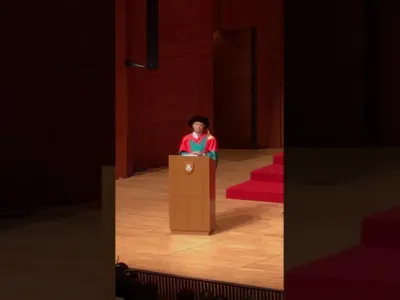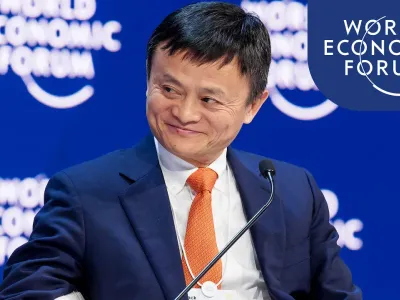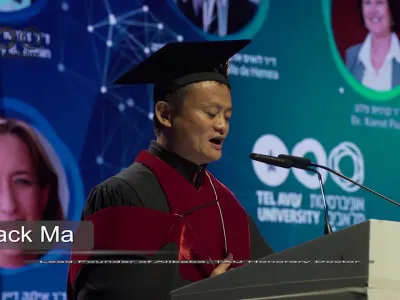
Good evening, Professor Franklin, good evening, Professor Kraft, good evening Dr. Yanna, and my fellow doctors, faculty, students. Thank you so much. I'm so touched and moved by sitting there watching the whole ceremony. It reminds me of my wedding. It's so good. It's such an honorable day, a great day for me, and I think a great day for all the entrepreneurs, and a great day for Alibaba.
According to the traditional education system, I was not considered to be a good student. I tried three times for university and failed, and I never thought I could be a doctor, even in my dream. Thank you, Tel Aviv, for recognizing me.
But one thing I want to share with everybody here: never give up. Don't be disappointed about yourself. If you fail, if you fail in the university, don't worry, wait for 20 years. You might be joining a better university like Tel Aviv. And if you fail to apply for jobs again and again, don't be disappointed. You should probably think about starting a company, and that company one day may become an Alibaba.
When I arrived in Israel, my friend said a hundred and twenty years ago here was only sand and trees. When I stand here at this great land, with your vision, your creativity, and your wisdom, I feel so honored to be given this honor.
And I think I also have the honor to be among my fellow doctors, who are scientists, governors, presidents, journalists, artists. I'm extremely honored to be among you, and I'm very humbled to do that. And I would take this opportunity to say this honor does not belong to me. This honor is a recognition to all the great entrepreneurs who are fighting for their lives, fighting for the future on the way.
Coming to Israel is a dream that I had for many years. The day when I arrived a few days ago, it was so different from what I heard. People say it's not safe, that this place has bombs and machine guns. But when I arrived, I saw this is so peaceful, with a prosperous economy and innovation in technology. And I think it's too late, I should have been here earlier. And I think because of this great university, I should come here more and more.
And one thing we learned: you should not read about Israel, you should come here, feel it, and touch it. And this time I brought 40 senior management of Alibaba Group. The purpose of coming here is to learn, to feel, and to touch.
Many, many years ago, when I started Alibaba, during my tough days, a friend of mine said to me: if you want to be stronger, please go to Israel. And in my mind, Israel really represents wisdom, innovation, and persistence.
Alibaba's mission is to help small business. We believe small is beautiful, and small is powerful. And Israel proves small is powerful, and it is on the way to small is beautiful. And we think beautiful means peace, beautiful means green, and beautiful means inclusiveness.
In the past 19 years, I have had so many troubles. Alibaba suffered a lot. We failed, we had a lot of setbacks, we had a lot of mistakes. For more than thousands of times, I said to myself and to my colleagues: never give up. Today, when we come here, we find people here are born to believe "never give up". And it is this spirit that made Israel the miracle in only 70 years.
Here there's not even one diamond, but you have the biggest diamond exchange in the world. You don't have any car, you don't manufacture cars, but you have the best technology on car manufacturing. You don't have oil, you don't have water, or any resources, but you make yourself so strong.
When Alibaba was founded, we didn't have money, we didn't have technology, we didn't have resources, we didn't have relationships. Nobody believed we could be successful. And 19 years passed, we made a lot of mistakes and a lot of failures and setbacks, but the only thing we did right is never give up. So we both had nothing when we started, but there's one thing we all have: the most precious thing in this world, that's the human brain.
And the most valuable asset we have is that we've all gone through tough days, tough experiences, and a lot of failures and mistakes. So it is because of our tough lives that make us different. And today, Jewish people got 22% of the Nobel Prizes, and you only have 0.3% of the population of the world.
These days I met so many great scientists, philosophers, entrepreneurs, and I asked them why Israeli people are so smart. They told me because they've been homeless, and the only thing nobody can take away from them is the brain. The Jewish people pay attention to education, pay attention to the brain, not assets, not money. And here I strongly feel that life could be very tough, that our wisdom, our courage, and our love all come from tough lives.
In Israel I learned one word: chutzpah — the courage to challenge convention. And I believe this is the spirit that belongs to the 21st century, and this is the spirit that belongs to the tech revolution, and belongs to the future.
The world is entering the third technology revolution. The world is going to have a big change. We are going to enter into a new, completely different world. We're moving from IT to DT. It's not about technology, it's about a mindset. It's not the difference of the technologies, it's the mindset of thinking differently. IT is looking for standardization, scale, and DT is looking for individualism, personalized, and customized. We believe everybody is born unique and different. Every race, every people, every nation in this world is unique.
In the past we made people like machines. In the future we will make machines like people. In the future we will make sure people live better. Machines should do the jobs machines can do. Don't worry about machines overwhelming human beings. Human beings have the heart, machines only have chips. So don't worry about it. Machines could be smart, machines could be faster, machines could be stronger, but machines will never have love.
And I think if you want to be successful, you should have IQ. If you want to be successful, you should have EQ. But if you want to be respected, you should have LQ, the Q of love. Human beings have much more things that machines cannot do.
In the IT age, IT is to control the mind. In the DT age, DT is to create the mind. IT makes yourself stronger, DT makes other people stronger. We know only when other people are good can we be good. If the neighbors are good, we can be good. So the future economy is about sharing, the future economy is about transparency, the future economy is about responsibility.
And by standing on this land, I understand how important peace is. The first technology revolution, directly or indirectly, caused World War I. The second technology revolution caused World War II. Now we are entering the third technology revolution. Human beings should have no wars. But if there's going to be a war, the war should be against poverty, disease, and the environment. And this is the common problem, and this is the disaster we face. And this is what the third technology revolution should do. And human beings should be united.
Every year, the number of people who die of cancer is almost the same as the number that died in the First World War. Every year, the number of people who die of poverty, disease, and pollution is bigger than the number that died in the Second World War.
So we think we should work together to solve the problem, for the future, for the young people, for the next generation, to make the world much more peaceful, green, and sustainable.
And I would like to say thank you so much again for this splendid, unforgettable event. And I think this honor and the ceremony is a call for us to do more, sacrifice more, and take more responsibility. Yalla, let's go together. Thank you.