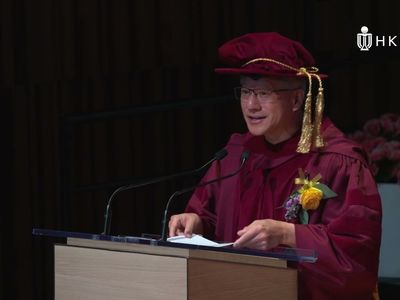
Pro-Chancellor, Chairman, members of the Court and Council, esteemed fellow honorary doctorates, distinguished guests, graduates, ladies and gentlemen, thank you for this extraordinary honor. I am a proud honorary alumnus of HKUST.
I'm also delighted to be here today to celebrate with all the graduates this extraordinary milestone, and the beginning of a very important journey in your lives. And also to congratulate all the parents and families that have supported you. This is a big day for them, as it is for you. Congratulations!
HKUST is one of the world's top science and technology universities, and a leading institution in AI and data science research. You're a major part of China's significant contributions to open science research, helping to advance AI worldwide. The Hong Kong universities' AI research papers are among the top most cited globally. Open research is one of the miracles of modern science, and perhaps the ultimate form of global cooperation — one that we must protect.
HKUST emphasizes innovation and entrepreneurship, and has helped transform this region into the Greater Bay Area of China, brimming with startups. HKUST alums have founded more than 1,800 startups that are in operation today, 10 unicorns, and 14 successful exits.
NVIDIA has also benefited from being in this region. In China, we came over 25 years ago. NVIDIA design centers in Hong Kong, Pudong, Beijing, Shenzhen have many proud HKUST alums and longtime colleagues who have helped me build NVIDIA. They've also helped build China's technology ecosystem from the very beginning. We've had the benefit and the great joy and privilege of watching the amazing technology industry form in China.
As I was coming today, my colleagues — proud HKUST alums — reminded me to take a picture with you. [Applause]
This is an extraordinary time for you to graduate. This is an extraordinary time for NVIDIA. The age of AI has started. A new computing era that will impact every industry and every field of science.
We have reinvented every layer of the computing stack: from coding software with rules and logic, to machine learning on observed data; from code that runs on CPUs, to neural networks processed on GPUs. The software industry is racing to adopt machine learning and generative AI, while the hardware industry is racing to modernize the trillion dollars of traditional computing infrastructure.
AI is revolutionizing science. In my Supercomputing 2018 conference address, I first discussed the fusion of principled methods and artificial intelligence in scientific computing. Since then, artificial intelligence and machine learning have been integrated into nearly every field of science.
AI is helping to analyze data at incredible scales, accelerate simulations, control experiments in real time, build predictive models that revolutionize fields from drug discovery to genomics to climate science. Using AI, we can study physical systems at a scale previously unimaginable.
The transformative impact of AI has been recognized at the highest levels. Geoffrey Hinton and John Hopfield received the Nobel Prize in Physics for their pioneering work on neural networks. Demis Hassabis, John Jumper, and David Baker received the Nobel Prize in Chemistry for groundbreaking advances in protein structure prediction.
These breakthroughs are just the beginning. Enterprises and companies around the world are racing to adopt AI to accelerate innovation and boost productivity. Soon, companies will have AI agents working alongside teams across every organization — from marketing, sales, supply chain, chip design, software development, and more.
In heavy industries and manufacturing, investments in robotics are surging, triggered by a new breakthrough in physical AI. Just as we saw rapid advances in cognitive intelligence foundation models, we're seeing rapid advances in physical intelligence foundation models. The age of robotics is coming.
As AI transforms every industry, a new industry will emerge to produce and generate AI. As AC power generation plants and the electric power industry emerged from the last Industrial Revolution, AI factories and the generation of digital intelligence will now emerge from the age of AI.
Twenty-five years after NVIDIA created the first GPU, we have reinvented computing and sparked a new Industrial Revolution. AI is certainly the most important technology of our time, and potentially of all time.
I'm thrilled to see so much energy focused on advancing the science of AI, as well as using AI to advance science — at HKUST and across all of China.
I'm so excited for all of you graduates. I wish I were starting my career at this time. The whole world is reset. You're at the starting line with everybody else. An industry is being reinvented. New industries are being created. You now have the instruments necessary to advance science in so many different fields.
The greatest challenges of our time — unimaginable challenges to overcome in the past — all of a sudden seem possible to tackle.
Congratulations on your graduation. Congratulations on your milestone. I look forward to many of you joining NVIDIA someday. Thank you again for this great honor, and for recognizing the life's work of many of us at NVIDIA.
[Applause]