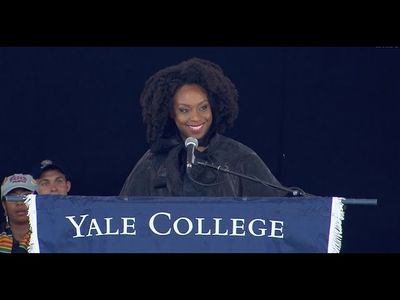
Thank you for the warm welcome. Congratulations, graduates, Class of 2019.
So last year the Class Day speaker was Hillary Rodham Clinton. This year you got me. And so I want to start by telling you how sorry I am. By the way, considering the last three years, I imagine it must have been refreshing for last year's class to hear from a person who is articulate, experienced, thoughtful, literate, measured, and with an adult's vocabulary.
It's been ten years since I was here in graduate school. I wasn't always happy here, for reasons having to do more with me than with Yale. So it wasn't a—it was me. But I wouldn't change any of it. It's good to be back, and to be reminded of spending hours in Atticus Bookstore, and getting dinner at the Indian restaurant that my husband and I loved, and attending seminars in Professor Thompson's house, which was full of objects that he collected in Central Africa in the 1960s.
And there was also the slightly awkward seminar I took on African literature, in which my own novel was part of the curriculum. I just sat there and said nothing, and I wasn't sure what to do with my face.
But most importantly, being here at Yale afforded me many opportunities to engage in that activity that is essential for a fiction writer: eavesdropping. I did it in the library, in the gym, by walking a little too close to people in the hallways. For a writer, almost nothing is out of bounds if it leads to collecting material for fiction. And Yale, having such a wide range of interesting people—I mean, just look at your hats—the material I collected here was absolute gold.
Thank you so much. I'm very honored and very happy to be your Class Day speaker. Thank you for inviting me.
I know you're all excited to be graduating, and while I congratulate you, I also want you to know that it only goes downhill from here. When I graduated from undergrad, I felt unmoored. The structure of expectations was gone. No more classes to attend, no more papers to write, and the world felt wide open, disorienting, dizzying.
I was full of contradictions, and I was in a battle with myself about my contradictions, because I did not know then that it is human and okay to have contradictions. I was full of uncertainty, and I did not know that confidence is a journey, a continuous journey, and not an absolute destination. And I want to tell you this now to save you years of figuring it out yourself.
There are days when you will be bursting with certainty, and days when you will be flattened by doubts. And it helps a little to keep in mind how universal this is. There are so many things I said I would never do when I was younger, and I now do many of them. I would give you detailed examples, but I don't want to unnecessarily alarm you. The point is: be open to changing your mind. It is often a sign of growth. Be open to the possibility that you might be wrong.
Ideology is a good thing, but if you find that you hew unquestioningly to every orthodoxy of the ideology you subscribe to, then maybe it's time for some agility in your thinking—a small shift, for example, a sign that shows that you know that there are complicated shades of gray everywhere. I would suggest, in general, that you marry being idealistic with being pragmatic, and it helps to think of purism as too expensive, as something you cannot afford.
So politics is awful in all sorts of ways, but refusing to participate is not the answer. Sometimes you have to get in there to be able to walk towards changing it to what you want it to be. Engage with the world as it is, otherwise you won't really get anything done. But as you do so, it is important to have, as your guiding light, a clear vision of what the world should be.
I think of my writing as my vocation. It is what I am on earth to do. But there are people who know me not for my writing but for my speaking about feminism. I did not set out to be a feminist icon—and I'm still hoping that somebody will make me a hat that says "feminist icon." I happened to have a platform from my writing, and I happen to feel strongly about justice in general, but the equality of women in particular. And I began to use that platform to talk about what mattered to me. And it happened to resonate with people who already were thinking about the same things.
It also happened to irritate quite a few people.
I remember a man who spent a lot of time trying to explain to me why his wife always had to submit to him. I was a bit confused about why anybody would be so insistent on the idea that the rightful place for a fellow human being was a place of permanent subjugation. Why would a well-balanced person need another person to submit? The world is full of people like that man. Is it necessarily my responsibility to educate them? No. Do I want to? Yes. Why? Because I think it's worthwhile to give people—most people—the benefit of the doubt.
Because I think it's worth trying to change a person's mind if that will lead to a greater human good. And because, full disclosure, I happen to have a mild case of a messiah complex. I want to change a small slice of the world.
So will trying to get a man to see the full humanity of women mean that he might, for example, stop justifying domestic abuse? Maybe, maybe not. But I want to try. I see it as trying to walk towards making a small slice of the kind of world I want to live in.
I have a dear friend who lives in Lagos. Her name is Bisi, and she's an utterly brilliant and humane gynecologist, and she has a daughter who clearly inherited her mother's genes. This daughter grew up in Nigeria and was then sent to a private secondary school in the UK. She excelled, and she was at the top of her class in every subject. And so they were recently thinking about where she would go to university. And because I deeply admire the American liberal arts curriculum, I told her that I thought she would benefit from going to university in the U.S. rather than the UK.
Her response, in a very calm sixteen-year-old voice, was, "I don't want to go to America because I don't want to die." The starkness, the directness of her words, threw me off for a moment. Obviously she meant guns. Her mother later told me that she had been particularly scarred by the video of a white policeman shooting a black man in the back.
There is a figurative Igbo expression for a certain kind of unease, a disruption, a troubledness. That expression is ephemeral, and it translates literally to "things are not standing well." The awkward beauty of this expression—"things are not standing well"—best captures my sense of America today. To say that things are falling apart, or have fallen apart, might sound as though one is susceptible to melodramatic exaggeration. But things are not standing well. Wherever you might be on the ideological spectrum, things are not standing well, if fear is in the air that Americans breathe.
I bring this up because I want to suggest that, as you graduate in this time, you ask yourself the question: What should America be? Should America be a country where fear is always an option for children in school, where a child can go to school and never come home because that child has been murdered by another child with a gun? Should America be a country where black people live in fear of their lives because members of the police do not seem to think of them as full human beings? Should America be a country where women are in fear of not having full autonomy over their bodies?
Is a country still a full democracy if fear is in the air its citizens breathe? Should America be a country of patriots—people inspired by love and pride—or should it be a country of nationalists—people inspired by hatred of enemies, many of those enemies real and many more conceptualized?
Answer that for yourself, and then make the case for that America—not only in obvious ways such as how you vote, but also in smaller ways: how you treat other people, how you think of other people, the things you refuse to condone, the people whose grievances you refuse to dismiss, the acts of kindness you do, the people you choose to listen to and to hear. And truly hearing people can often be the best way of showing them that they matter.
So, going by historical precedent, a Yale degree makes you more likely than the average graduate to become a president, or a senator, or a Supreme Court judge. A Yale degree makes you more likely to become a person who, in different capacities, will be responsible for policies and actions that will affect the lives of millions. By the way, this is proof, if we ever needed proof, of how fair America's unimpeachable meritocracy is. The point, though, is that a Yale degree will open doors.
There are people who will resent you for having a Yale degree, but there are many more people who will accord you the automatic assumption of competence.
If your degree does end up propelling you to power, remember that if power were a jacket, it is most flattering on all body types when worn very lightly. If you end up working in a nonprofit, remember that the best charity is that which does not perpetuate itself. Never forget that human beings—actual human beings with dreams and hopes and fears, with pride and favorite foods and things they dislike and like—are the focus of your charity. Numbers and statistics and language can sometimes make the real humanity of people invisible.
And sometimes people you expect to be grateful for your charity will not be, at least not in the way you want or expect, because it can be complicated to be the recipients of charity.
If your job involves traveling around the world, remember that local knowledge is always best. Yes, read the country reports written by the CIA, or whoever writes those reports, but place a higher value on local knowledge: local newspapers, literature, the person who picks you up from the airport.
And if you are one day robed in corporate power—and some of you here certainly will be—please hire women as executives, and not just in change-management. Have an on-site daycare. Make paid family leave standard, ordinary. If you find yourself with power in the world of journalism, banish forever the practice of false equivalence. Journalism should be about the truth, not about balance. If you're reporting on the fact that climate change exists, you don't need to bring in a hack to show the other side, because there is no other side.
And if you do become a journalist, please learn how to say "I'm sorry." Journalism seems to be a profession whose practitioners have great difficulty in saying "I'm sorry" without hedging or equivocating.
And speaking of saying sorry: knowing how to say "I'm sorry"—and mean "I'm sorry"—will serve you well no matter what course your life takes. And if you are one of those people whose tongues seem unable to form those words, "I'm sorry," there is hope. Practicing in front of a mirror helps. Don't change the subject. Don't pretend that nothing happened. Don't buy a gift and deflect. Don't ride it out in silence hoping it will go away. Just say "I'm sorry," a few times if necessary. And of course it helps if you actually mean it.
But please do not ever apologize for existing, or for taking up space in the world, or for having a well-considered opinion. And I say this particularly to women, whose socialization teaches them—teaches us—to shrink ourselves, as though our responsibility is never first to ourselves but always to others. And we end up sometimes feeling guilty for wanting the things we want, for wanting to be our own selves first.
The messages that society sends us can be conflicting: that tension between telling you to value yourself, that you matter, and then that other message that tells you to put other people first and to serve. It is possible—it is necessary—that you find a balance between the two, but you will have to figure it out yourself. But if I can offer a useful guiding principle, it is this: you do not have to make room in—
So one enduring lesson I learned here at Yale is always to look at primary sources first, and I've held on to that lesson. It is, I think, a useful lesson, especially in this age of easy outrage, when so many people are quick to react to an isolated report, or something received second or third hand. So I once read a book review, and based on that review I decided not to read the book, because it didn't sound like my sort of thing.
Many years later I read the book, because I was at a writing retreat and it was sitting there on a shelf, and I thought I would just read one page—and then I couldn't stop. I loved it, and I could not believe how that reviewer—
So if you choose to participate in the cult of the outrage of the day on social media, and if you're quick to jump in with your blistering take—and I understand that the adrenaline boost can be addictive—but before you jump into the fray, look at primary sources first. And remember that context is always queen. This is also, I think, a good way of testing your own beliefs. Take a little time to find out what was actually said or done, and if you have context, then maybe—maybe—you might just start to—
Having said that, I do sometimes worry that American education has created a class of brilliant, talented people—but people who are nonetheless afraid to say the wrong thing, even in ostensibly safe spaces. If the walled inside of college was safe, then you should know that the world outside of college is not. And I urge you always, always, to honor the doubts that you have, to honor the questions that you have. Don't silence yourself.
So I want to tell you about a conversation that happened among a group of people recently—people who were acquaintances, if not friends, but who all generally were on the same side. And I might or might not have been eavesdropping on their conversation. They were talking about a politician, and one of them said that the politician was a racist because that politician supported school choice. Another one then asked tentatively, "But how?" And the response from everyone else in this group was a lot of eye-rolling and a lot of sneering.
And then finally one person gave a treatise on how supporting this politician was just supporting racism. In the end, nobody had explained why supporting school choice was horrible—and there is a valid argument to be made for that position—but this young person was left not knowing what that argument was, and perhaps also left feeling heavier with several layers of shame.
I worry that the spaces occupied by the educated in this country have become places where curiosity is considered passé. It is now an environment where everyone is already supposed to know, supposed to guess it, and those who don't are seen as morally lacking. If there is a lesson here, it is that you should always remember that a self-righteous sneer is not an argument. Don't be that person who attacks or demeans because you are unable to convince. I know that the idea of bringing receipts is a thing in your generation. It would have been nice if someone in that group had brought receipts.
Make the argument. Clarify. Explain. Do the work. Cite statistics if you need to. And bring the damn receipts.
When I started out writing, I was doing what I loved, what gave me the greatest joy, and I hoped also to be read. And today I feel grateful to be read, to be taken seriously, to be here. My work is very important to me; it's central to my life. But the moments of greatest joy for me are not necessarily those that have to do with my success. So please—nurture your ambitions. Seek to be successful. But keep in mind that there are hollows that success will not fill.
And yes, this is where I talk about love. I have a Swiss friend who once lived in D.C. but now lives in Zurich, and I asked him what he had made of America when he lived here. And he said, "Americans don't have friends because they are too busy working." He meant, I think, people who live in America, whether citizens or not. And so I urge you, Class of 2019, to prove him wrong. Have friends—many friends, or just one friend. Hold your family close, and family doesn't necessarily mean those to whom you're related by blood or by social institution. Hold your friends close.
Stand up for your loved ones. Tell the people you love that you love them—tell them often. Find reasons to laugh. Gravitate towards people with whom you never feel that pressure to perform or to be what you're not.
One of the tenets I try to live by is: never admire quietly. If I admire something about someone, I let them know. We do not always recognize what is beautiful in ourselves, in our spirits, until somebody has pointed it out to us. And remember that people will hardly ever forget small acts of kindness. I remember once, during a public event, I was exhausted. I was a little grumpy—actually, I was very grumpy. And I was surrounded by people, none of whom seemed to see my exhaustion.
And then my friend Sheila, who was there, sort of looked at me and said, "She's tired." And I almost burst into tears, because I felt so wonderfully seen.
Be kind. Paying attention is one of the most beautiful acts of kindness. The people you will come across in your life will not forget when you are kind, and they wish you well as you go out into the world. I wish you courage. I wish you joy. And on a final note, as you navigate the world, it might be helpful, from time to time, to remember that—congratulations. [Applause]