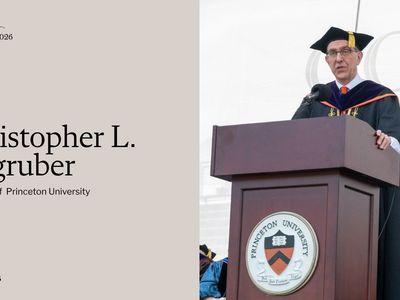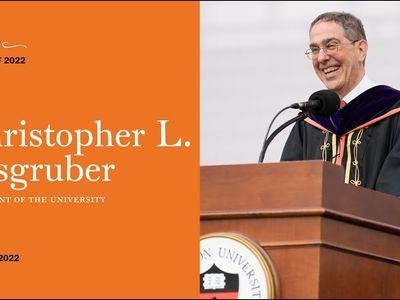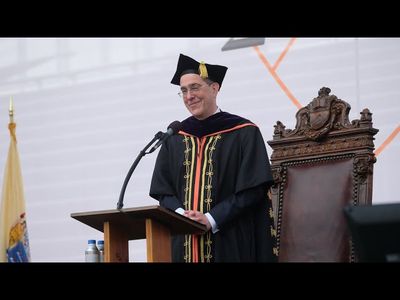
Tradition allows the Princeton president to share a few thoughts each year with our graduating students at Commencement. I regard that as a great privilege in any year, but especially so in this one, when all of you have persevered valiantly and brilliantly to overcome unprecedented challenges.
By completing your studies amidst this awful pandemic, you have distinguished yourselves even by the standards of this University's long and illustrious history. And in so doing, you have earned the right to participate in this unique and memorable Commencement ceremony, a ceremony that, I submit to you, provides a surprisingly apt metaphor for the past year.
We are together, gathered through creative planning, technological assistance, the tireless work of many people, and a fierce determination to mark with physical presence this important moment in your lives. And yet as we are together, we are also apart, masked, separated by carefully marked six-foot intervals, and denied the joyous embraces that we would ordinarily exchange on graduation day.
Such combinations of separation and sharing have permeated the last fifteen months. The separation is obvious. We have endured quarantines and lock-downs. We have learned the term "social distancing," which — hard though this is to believe — almost none of us had heard two years ago. We have had to give up communal dining, large events, small parties, and interpersonal contact of many kinds. We have met and learned through video conferencing rather than in person.
The sharing may be less obvious than the separation but it is equally real. It begins with the separation itself, and, more generally, with losses that people throughout the world have endured over the past year. The losses inflicted by COVID-19 have undoubtedly differed significantly from person to person. They have also differed across racial and economic groups, reminding us once again of the need to dedicate ourselves to achieving genuine social justice, not only in this country but around the world.
We should recognize these disparities while also recognizing that in real and meaningful ways we have shared the anxieties and burdens of this pandemic with people not only throughout this stadium, or this country, but across social divisions, international borders, and, indeed, vast continents. We fight a plague without boundaries, and our experience informs connections we feel with those suffering from the terrible outbreaks afflicting India, South America, and other parts of the globe.
To take another, smaller piece of this phenomenon: you now share with other graduating college students throughout the world this year a parallel experience of disruption, constraint, challenge, persistence, and achievement in response to this pandemic. Rarely, if ever, has humanity experienced such durable and unfamiliar forms of loss so widely and simultaneously.
The last year has also involved sharing in a second sense. Though we have been unable to interact in person, we have connected online in ways that most of us would not have thought possible, and indeed that would not have been possible even a few years ago. Most of us are thoroughly Zoomed-out and eager to return to physical forms of togetherness, but I doubt that any of us will abandon entirely our new virtual mechanisms of communication.
We may perhaps find some wisdom about these newest aspects of human community by considering very old ideas about the topic. Two millennia ago, Aristotle observed that people must cooperate with one another because they cannot otherwise satisfy their most basic physical needs. But, he noted, once people are forced together by their physical needs, they inevitably begin discussing and pursuing ideas about human flourishing. His insight was that because we must make and break bread together, we must form a common good together.
As this year's countless Zoom calls vividly illustrate, human technology has transformed, if not diminished or severed, this connection between the physical and intellectual realms of human activity. We can now interact politically, academically, artistically, and socially without ever being in the same room, the same state, or even the same country.
What technology made possible, the pandemic made compulsory. For most of this past year, we were present to one another in only two dimensions, as flattened figures on screens, while our three-dimensional bodies inhabited vastly different spaces. We shared an emaciated world.
It is not enough. The fractious, irritated, angry state of our national politics testifies to that fact.
So too, more poignantly, does our presence in this stadium today. We could have deployed technological machinery to produce a whiz-bang virtual Commencement, which you could have watched from the comfort of your homes. We concluded — with your vigorous encouragement — that it would be better to sit in this cavernous stadium, arrayed across a giant field and surrounding bleachers, together, six feet apart.
We lose an essential dimension of the human when we cannot be together physically. If indeed people must forge a common good because we need to make and break bread together, the pandemic suggests that something like the reverse is also true.
Simply put, our long, unwelcome separation teaches us this: to forge a common good together, we must break bread together. We must, in other words, relate to one another not just as disembodied intellects, interests, or ideologies, or as faces in Zoom boxes, but also as real, three-dimensional people who share basic needs and a common humanity.
I hope you will bear that idea in mind as you venture into this strange, uncertain world post-Princeton and post-pandemic. I also hope that you will find ways to break bread and reconnect not only with one another but also with people far outside your own social circles. As the political philosopher Danielle Allen '93 has urged in a passage that riffs on Aristotle, we must find ways to convey "the techniques and expertise of friendship" into "the rivalrous realm of politics."
We must all recover, renew, and reinvigorate the genuinely human forms of connection so missing from our world over the last year and all too absent, even before the pandemic, from our country's conversations about America's common good. As you venture forth beyond this campus, I hope that you will seize the opportunity to build the genuine community that we so urgently need.
The journey that commences today will take you into a new and changing world. I am confident that you are well prepared for the challenge. You have excelled here, and you have persisted through the pandemic with extraordinary determination, creativity, intelligence, compassion, and courage. We will need your leadership, your vision, and your dedication to the service of humanity.
On behalf of the University, its faculty, administration, trustees, and alumni, I offer you best wishes as you go forth. We hope you will always consider this campus one of your homes, and that you will return often, so that we can be together again in the future — together again, without also being six feet apart! I, and all of my colleagues, extend our sincerest congratulations on this happy day to all of Princeton's doctoral and master's degree recipients and to Princeton University's Great Class of 2021!
Congratulations!