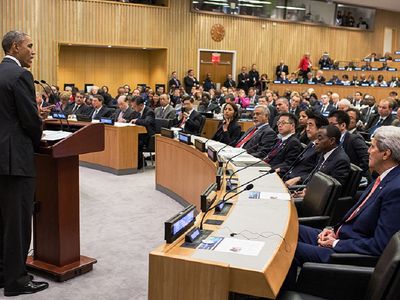
Mr. Secretary-General, thank you for bringing us together today to address an urgent threat to the people of West Africa, but also a potential threat to the world.
Dr. Chan, heads of state and government, especially our African partners, ladies and gentlemen: As we gather here today, the people of Liberia and Sierra Leone and Guinea are in crisis. As Secretary-General Ban and Dr. Chan have already indicated, the Ebola virus is spreading at alarming speed. Thousands of men, women and children have died. Thousands more are infected. If unchecked, this epidemic could kill hundreds of thousands of people in the coming months. Hundreds of thousands.
Ebola is a horrific disease. It's wiping out entire families. It has turned simple acts of love and comfort and kindness -- like holding a sick friend's hand, or embracing a dying child -- into potentially fatal acts. If ever there were a public health emergency deserving an urgent, strong and coordinated international response, this is it.
But this is also more than a health crisis. This is a growing threat to regional and global security. In Liberia, in Guinea, in Sierra Leone, public health systems have collapsed. Economic growth is slowing dramatically. If this epidemic is not stopped, this disease could cause a humanitarian catastrophe across the region. And in an era where regional crises can quickly become global threats, stopping Ebola is in the interest of all of us.
The courageous men and women fighting on the front lines of this disease have told us what they need. They need more beds, they need more supplies, they need more health workers, and they need all of this as fast as possible. Right now, patients are being left to die in the streets because there's nowhere to put them and there's nobody to help them. One health worker in Sierra Leone compared fighting this outbreak to "fighting a forest fire with spray bottles." But with our help, they can put out the blaze.
Last week, I visited the Centers for Disease Control and Prevention, which is mounting the largest international response in its history. I said that the world could count on America to lead, and that we will provide the capabilities that only we have, and mobilize the world the way we have done in the past in crises of similar magnitude. And I announced that, in addition to the civilian response, the United States would establish a military command in Liberia to support civilian efforts across the region.
Today, that command is up and it is running. Our commander is on the ground in Monrovia, and our teams are working as fast as they can to move in personnel, equipment and supplies. We're working with Senegal to stand up an air bridge to get health workers and medical supplies into West Africa faster. We're setting up a field hospital, which will be staffed by personnel from the U.S. Public Health Service, and a training facility, where we're getting ready to train thousands of health workers from around the world.
We're distributing supplies and information kits to hundreds of thousands of families so they can better protect themselves. And together with our partners, we'll quickly build new treatment units across Liberia, Guinea and Sierra Leone, where thousands will be able to receive care.
Meanwhile, in just the past week, more countries and organizations have stepped up their efforts -- and so has the United Nations. Mr. Secretary-General, the new UN Mission for Ebola Emergency Response that you announced last week will bring all of the U.N.'s resources to bear in fighting the epidemic. We thank you for your leadership.
So this is all progress, and it is encouraging. But I want us to be clear: We are not moving fast enough. We are not doing enough. Right now, everybody has the best of intentions, but people are not putting in the kinds of resources that are necessary to put a stop to this epidemic. There is still a significant gap between where we are and where we need to be.
We know from experience that the response to an outbreak of this magnitude has to be fast and it has to be sustained. It's a marathon, but you have to run it like a sprint. And that's only possible if everybody chips in, if every nation and every organization takes this seriously. Everybody here has to do more.
International organizations have to move faster, and cut through red tape and mobilize partners on the ground as only they can. More nations need to contribute critical assets and capabilities -- whether it is air transport, or medical evacuation, or health care workers, or equipment, or treatment. More foundations can tap into the networks of support that they have, to raise funds and awareness.
More businesses, especially those who already have a presence in the region, can quickly provide their own expertise and resources, from access to critical supply chains to telecommunications. And more citizens -- of all nations -- can educate themselves on this crisis, contribute to relief efforts, and call on their leaders to act. So everybody can do something. That's why we're here today.
And even as we meet the urgent threat of Ebola, it's clear that our nations have to do more to prevent, detect and respond to future biological threats -- before they erupt into full-blown crises. Tomorrow, in Washington, I'll host 44 nations to advance our Global Health Security Agenda, and we are interested in working with any country that shares this commitment.
Just to emphasize this issue of speed again. When I was down at the CDC -- and perhaps this has already been discussed, but I want to emphasize this -- the outbreak is such where at this point more people will die. But the slope of the curve, how fast we can arrest the spread of this disease, how quickly we can contain it is within our control. And if we move fast, even if imperfectly, then that could mean the difference between 10,000, 20,000, 30,000 deaths versus hundreds of thousands or even a million deaths.
So this is not one where there should be a lot of wrangling and people waiting to see who else is doing what. Everybody has got to move fast in order for us to make a difference. And if we do, we'll save hundreds of thousands of lives.
Stopping Ebola is a priority for the United States. I've said that this is as important a national security priority for my team as anything else that's out there. We'll do our part. We will continue to lead, but this has to be a priority for everybody else. We cannot do this alone. We don't have the capacity to do all of this by ourselves. We don't have enough health workers by ourselves. We can build the infrastructure and the architecture to get help in, but we're going to need others to contribute.
To my fellow leaders from Liberia, Sierra Leone and Guinea, to the people of West Africa, to the heroic health workers who are on the ground as we speak, in some cases, putting themselves at risk -- I want you to know that you are not alone. We're working urgently to get you the help you need. And we will not stop, we will not relent until we halt this epidemic once and for all.
So I want to thank all of you for the efforts that are made. But I hope that I'm properly communicating a sense of urgency here. Do not stand by, thinking that somehow, because of what we've done, that it's taken care of. It's not. And if we don't take care of this now we are going to see fallout effects and secondary effects from this that will have ramifications for a long time, above and beyond the lives that will have been lost.
I urge all of you, particularly those who have direct access to your heads of state, to make sure that they are making this a top priority in the next several weeks and months.
Thank you very much.