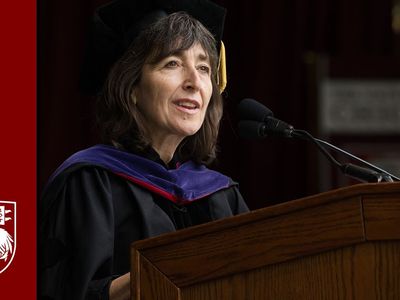
Good morning. After two years of COVID shutdown, it is with great pleasure that I find myself face to face with all of you on this convocation day. Congratulations to you and your families. You have persevered through unexpectedly difficult times, and we are here to celebrate your resilience, as well as your hours in the library and your academic achievements.
Let me step back to offer some perspective—an astronomical perspective, a view from 14 billion years ago. Carl Sagan, a University of Chicago alumnus, famously said, “If you wish to make an apple pie from scratch, you must first invent the universe.” Okay then, let's start with the universe.
About 14 billion years ago, our universe was born in a colossal expansion of space. Within minutes, nuclei of hydrogen emerged, some of which eventually found their way into the H2O—the water that comprises roughly 60 percent of each of our bodies. About half a billion years after the Big Bang, the first stars collapsed, igniting their nuclear furnaces, fusing carbon, nitrogen, oxygen and other elements that we depend on for life, before exploding and dispersing those elements into subsequent generations of stars, including our own Sun and its planets.
Contemplate the origin of these elements for a moment as you look at your hands, or the trees in the quad, or as you inhale a breath of air. We are literally the stuff of stars. As the naturalist John Muir noted, “When we try to pick out anything by itself, we find it hitched to everything else in the universe.”
Since the time of the initial expansion, the universe has continued its expansion. Today, the visible universe extends across 93 billion light-years. The structures that permeate the cosmos—the great walls, filaments and voids—extend to more than 100 million light-years. The galaxies within these structures, of which our Milky Way is but one, span roughly 100,000 light-years each.
Within these galaxies are nurseries where new stars continue to be born—for example, the beautiful Eagle Nebula in our Milky Way galaxy, so colorfully captured by the Hubble telescope, with pillars spanning 10 light-years, or, in everyday units, 60 trillion miles. Our own small star, the Sun, could contain more than a million Earths within it.
And so we come to our blue-and-white planet Earth as it is seen from afar, the planet that is our home. Things don't seem entirely promising on planet Earth right now.
Earth, where a tiny virus, SARS-CoV-2—and picture this: if we could capture all the COVID virus on this planet, we could contain it well within a single Coke can—has in its two and a half years of existence led to the estimated deaths of more than 15 million people worldwide, more than one million of them in the U.S. alone.
Where, in less than four months, tens of thousands of people—a tragic fraction of them civilians—are estimated to have been killed in the war in Ukraine, with no end in sight. Where our country finds itself bitterly divided and in anguish over escalating violence. And the world faces worsening energy, water, food, health, migration, political and extreme-weather crises, to name only a few.
We are living in a time of great uncertainty. And yet it is also a time of unprecedented cooperation, opportunity and progress. Martin Luther King once said, “But I know, somehow, that only when it is dark enough can you see the stars.”
Remarkably, in this dark time, as a result of unparalleled partnerships involving universities, industry and the private sector on a global scale, and in the midst of severe lockdowns, a messenger RNA vaccine was developed for COVID-19 by December 2020, only one year after the virus was first identified—more than ten times faster than almost all previous vaccines, with many others shortly following. It is estimated that a staggering two million lives in the U.S. were saved by COVID-19 vaccinations.
In my own field, this is a time of extraordinary promise. On Christmas Day 2021, the James Webb Space Telescope rocketed into space from French Guiana. The most ambitious telescope ever launched, with 18 mirrors protected by a giant sunshield with an equivalent sun protection factor, or SPF, of one million, Webb is now one million miles from Earth and is already sending back astonishing images filled with galaxies never seen before.
Many of you may not even know that the University of Chicago is a leader and partner in constructing the Giant Magellan Telescope on a peak in the Andes Mountains in Chile. This seven-mirror, 80-foot-diameter telescope will dwarf the Hubble Space Telescope, with ten times more resolving power and 100 times the sensitivity. First light for this behemoth new facility is on track for the 2030s, and we expect it to operate for at least half a century.
These amazing telescopes, James Webb and Giant Magellan, represent a quarter-century of cooperation among thousands of scientists and engineers across the U.S., Canada, Europe, Asia, Australia and South America, from universities, private institutions, national laboratories and independent companies—all working in concert.
These telescopes will expand our understanding of the universe and our place in it. For the first time, we will glimpse the formation of galaxies in the early universe; we will literally see the cosmic dawn. We will explore the birth of the universe's black holes and peer directly into stellar nurseries where stars are being born. We will have the opportunity to study other worlds—planets circling other stars.
Quite possibly—in fact, quite likely—someone in your generation, someone from among the roughly eight billion people living on Earth today, will be the first person to discover life on another planet.
Throughout history, we have taken many wrong turns, made many erroneous assumptions, encountered dead ends suggested by inadequate data, and often failed to question stale assumptions. Ultimately, many factors played a role in shaping our current understanding, not the least of which was a courageous willingness to challenge authority, sometimes quietly, sometimes boldly.
In 1543, Nicolaus Copernicus made the radical suggestion that the Earth orbits the Sun, contradicting the Earth-centered view of the universe that had persisted for two thousand years. Fearful of ridicule, he published his work only at the time of his death. Galileo Galilei, however, boldly defended the Copernican universe. Faced with the threat of torture before the Inquisition, he was forced to abjure and live the remainder of his life under house arrest. But he knew nevertheless: the Earth moves.
In the past century alone, our perspective has shifted from that of a static, fixed universe to one that is dynamic, expanding and now accelerating with time. This change has come about because of new and more accurate data, a growing and evolving understanding of the laws of nature, and the willingness to abandon old ideas in the face of better ones.
Early in my own career, I found myself embroiled in an unusual scientific altercation with one of the giants in astronomy, a man who was the heir to Edwin Hubble. As a junior scientist, I landed in a terrifically uncomfortable situation. My data not only conflicted with his, but also with conventional wisdom, which said—not unreasonably—that the universe cannot be younger than its oldest stars. Simply put, you can't be older than your own mother.
This prominent individual wrote to organizers of astronomy meetings, to the director of the institution where I had recently been hired, and to the head of science at NASA, aiming to get me disinvited from meetings and thwart my access to telescopes. I neither responded in kind nor backed down.
In the end, our team's data from the newly launched Hubble Space Telescope, combined with a new discovery—the discovery of the acceleration of the universe—allowed for an older universe that had no conflict with the ages of its oldest stars.
My advice to you today: resist the comfort of a static worldview. The universe, dynamic and evolving, continues to surprise us. We need to be prepared for and receptive to change. Continually and critically examine your own assumptions and preconceptions.
You leave the University of Chicago uniquely prepared to remain open as you seek answers to complex questions; to ask, and keep asking, whether you are even asking the right questions; to sift through contradictory ideas; to express your ideas respectfully; and to listen with respect as others express theirs.
Your education does not end with this degree that you will shortly hold—assuming that I stop talking. No worries, I've been asked to close out within two hours. Right, President Alivisatos? I probably shouldn't have started with the whole universe.
What I said to my own kids at this time in their lives was: with your degree in hand, you now begin the task of creating your own personal graduate school.
I have spoken about the vastness of the universe, our own small, imperiled planet, and the moment in time in which we live, with its distinct challenges that both threaten and inspire. Very shortly, you will undergo your own transformation from student to graduate—a University of Chicago graduate.
As we part, I wish each of you the courage to embrace the dynamics of your own evolving universe. My warmest congratulations to the Class of 2022.