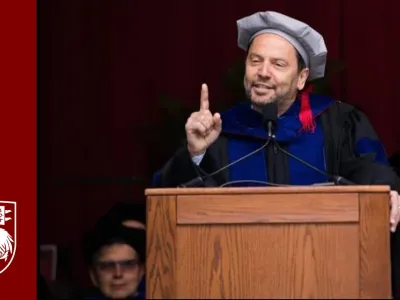
President Zimmer, Provost Diermeier, deans, trustees, colleagues, parents and friends of students, and other distinguished guests, good morning. And, of course, graduating students: congratulations.
I have participated in enough commencements to know that I am just a person between you and your well-deserved graduation party; to know that, of my speech, at best you will remember some jokes, at worst how tedious it was. At any other graduation, I would just crack some jokes—and believe me, I can crack jokes—and get you out of here as soon as possible.
But this is not a graduation at some random university, used to entertaining more than educating, where glamorous actors or failing politicians are invited to deliver the commencement speech. This is the graduation of the University of Chicago, where every moment is a learning opportunity.
So I will not try to entertain you. In true Chicago spirit, my goal is to deliver a speech that is provocative, research-based and relevant to you at this moment. After all, we know that Hyde Park is known as the place where fun comes to die. So I am asking you to die now, one last time, with me.
Graduation marks your entry into real life. While many of you are still struggling to find a job, and others are ducking this search by entering graduate school, sooner or later you cannot escape the responsibility of choosing where to work, how to spend the money you make, and how to invest the money you save. At that moment, your ideas will meet reality.
You want to save the planet, eradicate poverty, end racism. But you find yourself working ten hours a day for a company whose only proclaimed goal is to maximize profits. Many of you feel powerless. Your choice is constrained by a world we, the previous generation, built—a world you do not like, but feel you cannot change. Fortunately, this is not true. You have a great deal of power.
By choosing carefully whom you work for and what you work on, you can truly make an impact. For example, last year Google let a lucrative Pentagon project expire because its key engineers did not want to help develop technology that could be used to wage war. LGBT community rights were recognized first in the business world, not because of the open mentality of business leaders, but because of their desire to attract the greatest talent.
In a competitive labor market, companies are fast to adapt if adaptation is required to attract the most qualified workforce. That is you. This impact grows with the number of people who have the courage to behave according to their convictions—which is not always easy, since being without principles sometimes pays off.
Law firms have a tobacco career track for lawyers willing to defend tobacco companies. Tobacco lawyers earn more and make partner faster. While this difference may seem wrong, it is essential for the market system to work. Your reluctance to defend tobacco companies reduces the supply of talented tobacco lawyers, thereby increasing their wages. When it becomes too expensive to hire defense lawyers, tobacco companies are forced to settle.
It is precisely because it becomes too expensive to behave immorally that even businesses without a conscience end up behaving as if they have one. But your power to change the world is not limited to your work choices. You also have a great deal of power as consumers.
Even in the pre-internet world, coordinated consumer boycotts—like the one launched by Gandhi against British textile products, or by African Americans against segregated buses in Montgomery, Alabama—had major impact. Today, in the world of social media, this impact is only larger and more immediate.
Banks that financed the highly controversial Dakota Access Pipeline saw their deposits grow less than those of competitors. The Italian fashion house Dolce & Gabbana experienced a collapse in Chinese exports within days of airing a condescending and politically inappropriate ad. Consumer power is so great today that even the largest companies live in fear of boycott campaigns on social media.
Since any UChicago graduate is a superhero, let me remind you of what Uncle Ben says to Spider-Man: “With great power comes great responsibility.” It is your responsibility to ensure that this power is not wasted fighting minor corporate faux pas, but harnessed to resolve the greatest challenges of our time.
And what about your power as investors? I know the idea of investing may seem remote when you are mostly concerned about paying off your debt. But as soon as you get a regular job, you will have to start saving for retirement, ideally by investing in the stock market. At that moment, you will become shareholders of some corporation and discover how little power shareholders have to influence corporate policies in America.
After the Christchurch shooting in New Zealand, Hunting & Fishing, a local gun shop, voluntarily stopped selling assault rifles because its owners were willing to forgo profits in the name of a higher cause. In the United States, after the Sandy Hook Elementary School shooting, a Walmart shareholder proposed holding a vote on this very issue. The company's management refused, and that rejection was upheld by the U.S. Court of Appeals.
Eventually, Walmart stopped selling assault rifles, but out of fear of losing customers, not in response to shareholder pressure. Ironically, the strongest argument in favor of limiting shareholder influence comes from University of Chicago Nobel laureate Milton Friedman. Fifty years ago, he argued that society is better served when corporations focus only on maximizing profits.
This goal does not ignore workers' or consumers' concerns. If workers care about diversity and are therefore willing to work for less in a more diverse environment, a profit-maximizing firm will hire a diverse workforce. If consumers are willing to pay a premium for fair-trade coffee, a profit-maximizing coffee company will pay suppliers more to obtain that label.
Yet when it comes to shareholders, Friedman recommends ignoring their social concerns because, he claims, shareholders can address those concerns better by donating part of their profits to charity rather than changing the way corporations are run.
Friedman's logic has come to dominate not only the corporate world, but also the money-management industry. Managers feel they should simply maximize the financial returns of the assets they manage, regardless of their investors' social goals. For example, an anti-violence foundation should not try to stop Walmart's sales of assault weapons; it should just use the profits from those sales to fight violence.
As Oliver and I argue in our joint work, Friedman's theory relies on the assumption that by donating their dividends, shareholders can reverse any corporate wrongdoing at no extra cost. In most real-world situations, this condition does not hold. It is cheaper not to pollute than to pollute and clean up. It is cheaper not to sell assault weapons than to sell them and spend resources protecting all public places.
In these situations, it is more efficient for companies to adopt shareholders' social objectives, such as protecting the environment and reducing crime. In other words, corporate boards should maximize shareholder welfare, not just monetary returns.
Paradoxically, today the only way shareholders can express their social preferences is by selling stocks of companies they do not like. While politically appealing, this divestment may achieve the opposite outcome. If all environmentally conscious investors divest from oil stocks, oil companies will end up in the hands of investors who do not care about the environment—and they pollute more. The solution is not to divest, but to invest and engage.
You are in a unique position to shape how this new engagement will be implemented. So far, I have described a world where people have alternatives. If you do not want to be a tobacco lawyer, you can become an environmental lawyer. If you do not like McDonald's, you can eat at Chipotle. You might have to pay a price difference, but this difference is small. This is what we economists call a competitive market.
Most corporations operate in such environments. In this world, your power as workers, consumers and investors can make a difference. In this world, to rephrase President Kennedy, do not ask what companies should do to change. Ask what you can do to change them.
Yet there are some corporations, very small in number but very relevant in size, that do not face real competition. These are monopolies. It is easy to see what a monopoly is. How many people in this audience use Bing as their main search engine? Please do not be shy; it will not be held against you. And how many people use Google? This is what a monopoly is—a monopoly acquired through merit, since Google is by far the most efficient search engine, but nevertheless a monopoly.
Our antitrust laws cannot do anything against these kinds of monopolies. Historically, we have dealt with them in two ways: nationalization or regulation. The idea of having Google run with the efficiency of the U.S. Postal Service is not very appealing, and regulation does not seem a particularly attractive avenue either.
George Stigler, another of our Chicago Nobelists—and I promise I will not name them all, otherwise we will never get to the party—taught us that regulation tends to be shaped, or what we economists refer to as captured, by the very companies it is supposed to discipline. It increases their power rather than reducing it.
So what can we do? In joint work, Oliver Hart and I propose a third way to deal with monopolies: mandate a change in the objective of their corporate boards. Monopolies like Google would be required to maximize social welfare—the utility of society as a whole—not shareholder welfare.
What does that mean in practice? Consider Google's choice of how to rank news about political candidates. Experimental evidence shows that searches leading to a higher ranking of bad news about a political candidate result in fewer votes for that candidate. A board maximizing profits would tweak search results to disadvantage candidates who want to tax Google or break it up.
This is why we want the boards of monopolies to maximize social welfare, not just profits. You might argue that Google would never tweak political search results out of concern for its reputation. That might be true. If reputation is sufficient to make monopolies behave in the interests of society as a whole, then our proposal is redundant. Yet it could serve as an insurance policy to prevent bad behavior when concern for reputation falls short.
A more challenging question is whether we are convinced that a board elected by shareholders will maximize social welfare. The simple answer is that we impose on monopolies an additional fiduciary duty toward society, in addition to the existing one toward shareholders.
Finally, some may say our proposal is tantamount to socializing monopolies. In fact, it only forces social considerations into corporate decision-making when a company is deemed a monopoly. It is no different from Google's self-imposed motto, “Don't be evil.” We just add some bite to it.
We regard our proposal as a simple application of Uncle Ben's principle: with great power comes great responsibility. If Google or other monopolies find this social responsibility too burdensome, they can easily be relieved of it by voluntarily breaking themselves up.
To fight monopolies, your power as workers, consumers and investors is not sufficient. Your participation in the political process is critical. This is not a Republican or Democratic battle; it is an American battle. This country was born fighting monopolies.
The Boston Tea Party was not, as often repeated, a revolt against higher taxes, but a revolt against the unfair advantage enjoyed in America by Britain's East India Company, one of the worst monopolies history has ever seen, as many Chinese and Indians present here can testify.
The connection between American democracy and the fight against monopolies was not lost on Senator John Sherman, who in 1890 brought us the first antitrust law. “If we will not endure a king as a political power,” he wrote, “we should not endure a king over the production, transportation, and sale of any of the necessities of life.” If there is one sentence from my speech I hope you will remember, this is the one.
My conclusions may surprise people who identify Chicago faculty, especially economics and finance faculty, with a certain ideology. Chicago faculty, however, abide by a method, not an ideology. It is a method of intellectual inquiry without the blinders imposed by conventional wisdom; a method based on the courage to carry basic principles to their logical conclusions even when those conclusions are unpopular; a method based on constant attention to empirical evidence; a method designed to forge superheroes like you.
I hope you carry this method with you for the rest of your life. If you do, the expensive tuition you paid will not have been paid in vain. Congratulations again, superheroes. Now have fun. You deserve it.