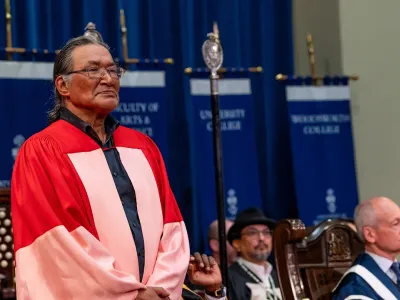
I am so honored to be here. Just this Monday, I flew down from the Arctic—from minus one degree to twenty-six. That is a little hard for me.
I grew up on the land, as my fathers had before me. I remember pulling on my caribou suit when I was six years old, walking out of our sod house, passing through the ice porch of our igloo, and going outside. I thought we were the only people on Earth. But by 1960, planes were already flying overhead.
When I was nine years old, I was sent to school so that I could learn to speak English. At that time, there were community movie screenings. Movies were so much like our own stories, our Inuit stories, that we tried to sneak into the show. We would look through a nail hole to watch, or I would try to finish my carving so I could go to a movie. From watching them, I went on to making them.
I had seen our original culture, but when I was growing up, my parents were so Anglican that they never sang traditional songs. When I became a filmmaker, I started learning about my culture. I went everywhere, asking questions and learning.
Then I realized that the years were going by. That is what happens: the years go by. I was already about to turn thirty and had not planned anything, so I began thinking about what I wanted to accomplish by thirty and then by forty. I was planning what I wanted to have as I grew older. I am already sixty-seven, and here I am.
I try to make my films authentic, because when a film is made by people from the culture it portrays, that is as close as it gets. I think about a hundred years from now, when I am six feet underground and people are studying these films. That is why we try to make them authentic.
Over the years, we have been losing our elders. Just last year, we lost an elder who had been my art director and helped me a great deal. Things are changing—really changing. We used to make our traditional tents from sealskins, but we can no longer do that. As a filmmaker, I buy canvas and paint it to look like sealskin. There it is, looking as it should. That is what we do as filmmakers: we make it look as it was.
Coming from the Arctic, I remember that in social studies I learned about Africa. There were elephants, giraffes, tigers, and monkeys—animals I would never hunt in my life. But that experience made me want to tell the story of my own culture.
As soon as I learned that anyone could own a motion-picture camera, I wanted one. I got one in 1980 and began recording my culture, doing more and more every year.
Making a film takes a long time, but I did not know what I was getting into. I thought you pointed the camera, filmed something, and then showed it. It is not like that. You need sound people, boom operators, camera operators—men and women working together.
Throughout my career, we learned by trial and error. That is what I did. I made many mistakes and learned from them, and I hope you graduates will learn from your mistakes, too.